

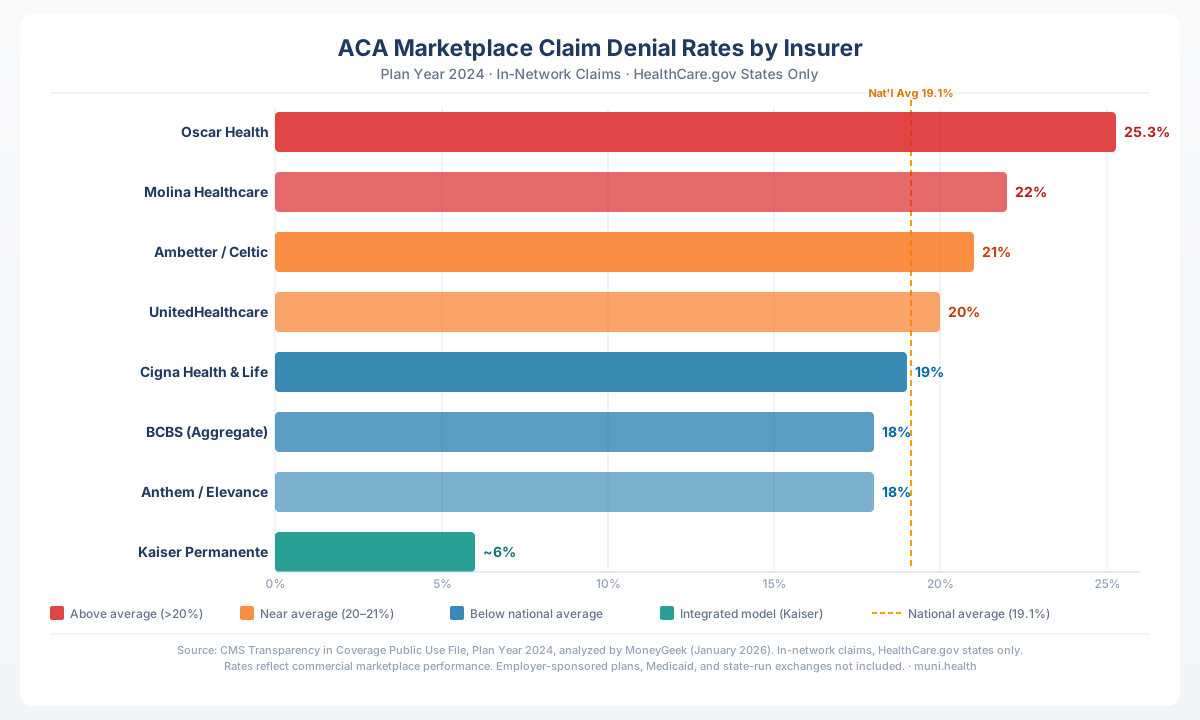
Oscar Health (25.3%) and Molina Healthcare (22%) had the highest health insurance claim denial rates among major ACA marketplace insurers in Plan Year 2024, per CMS Transparency in Coverage data. UnitedHealthcare dropped from 33% to 20% year-over-year. Kaiser Permanente has the lowest rate at roughly 6%. Fewer than 1% of denied medical claims are ever appealed — despite 44% of internal appeals succeeding.
How Insurance Denial Rates Are Measured
The most widely cited and legally mandated insurer-level denial benchmark is the CMS Transparency in Coverage Public Use File — HealthCare.gov insurers must report in-network claim denial statistics annually under the Affordable Care Act. This is the only apples-to-apples insurer comparison available nationally, though it covers ACA marketplace plans only and excludes employer-sponsored plans, state-run exchanges, and Medicaid fee-for-service programs.
Not all denial statistics measure the same thing. Data quality and coverage scope vary significantly across sources.
This article draws primarily from Plan Year 2024 data (reported in 2025) covering approximately 46 million in-network claims across HealthCare.gov states. The analysis excludes state-operated exchanges (California, New York, Massachusetts, and others), employer-sponsored plans, and Medicaid managed care — which means the figures below reflect commercial marketplace performance only.
Medicare Advantage prior authorization denial rates follow a separate reporting structure through CMS and are noted separately where relevant.
2024 National Baseline
ACA marketplace insurers denied 19.1% of in-network claims in Plan Year 2024 — approximately 8.8 million rejected claims out of 46 million submitted across HealthCare.gov states. That is a 3.4 percentage point drop from 22.5% in 2023, the largest single-year improvement on record.
Denial Rates by Insurance Company (2024 ACA Marketplace Data)
Oscar Health (25.3%) had the highest ACA marketplace denial rate among national insurers with broad multi-state coverage in Plan Year 2024; Kaiser Permanente (~6%) had the lowest. The national average dropped 3.4 percentage points to 19.1% — the largest single-year decline since CMS began collecting this data.
Prepare this appeal packet with your team.
Draft the appeal, coordinate missing documents, and approve the reviewed packet. Keep your clearinghouse; your practice checks deadlines and submits through the payer’s accepted channel.
First 3 appeals free, then $20 per appeal. Start with your denial letter or EOB and available records. No meeting or clearinghouse connection required.
The table below ranks major national insurers by their in-network ACA marketplace claim denial rate for Plan Year 2024, based on CMS Transparency in Coverage reporting analyzed by MoneyGeek (published January 2026).
| Insurer | ACA Denial Rate | Trend vs 2023 | Notes |
|---|---|---|---|
| Oscar Health | 25.3% | ↑ Highest nationally | Marketplace-focused insurer |
| Molina Healthcare | 22% | Consistent | Strong Medicaid presence |
| Ambetter (Celtic) | 21% | Consistent | ACA-marketplace-only insurer |
| UnitedHealthcare | 20% | ↓ Down from 33% | Largest U.S. insurer by membership |
| National Average | 19.1% | ↓ Down from 22.5% | HealthCare.gov states only |
| Cigna Health & Life | 19% | Consistent | EviCore manages specialty PA |
| BCBS (aggregate) | 18% | Consistent | Varies significantly by affiliate |
| Anthem / Elevance | 18% | Consistent | Parent of BCBS affiliates in 14 states |
| Kaiser Permanente | ~6% | Consistently low | Integrated model; limited ACA markets |
Source: CMS Transparency in Coverage Public Use File, Plan Year 2024, reported in 2025. Analyzed by MoneyGeek. Rates reflect in-network claims for HealthCare.gov states.
Ambetter's above-average denial rate reflects the same ACA-marketplace dynamics as Oscar and Molina — see our Ambetter appeal guide for the provider reconsideration/dispute deadlines, timely filing limit, and external review process specific to Ambetter denials.
Dealing with a high-denial insurer?
Muni Appeals prepares a review-ready draft from the denial and records you upload, with candidate payer-policy references and an evidence checklist for staff verification. Start 3 free appeals
Key takeaway: There is a nearly 20 percentage point gap between the highest-denying national insurer (Oscar at 25.3%) and Kaiser Permanente (approximately 6%). The range across all 175 reporting insurers was 2% to 49%, meaning plan selection matters significantly for practices managing denial volume.
Why Oscar and Molina Deny More Claims
Oscar and Molina deny above-average shares of claims because their risk pools and adjudication systems generate more prior authorization scrutiny and administrative rejections than integrated or large-employer carriers. Neither insurer publishes Clinical Policy Bulletins with the same depth as Aetna or UHC, making the specific denial criteria less predictable for billing teams constructing appeals. See the Oscar Health appeal letter templates and Molina Healthcare appeal letter template for insurer-specific letter language on both.
Oscar Health and Molina Healthcare operate primarily in the ACA marketplace and Medicaid, respectively. Marketplace-focused plans tend to have higher administrative denial rates because:
- They serve higher-risk enrollees who use more services and trigger more coverage scrutiny
- They rely heavily on prior authorization protocols to control costs
- Their claims adjudication systems generate more administrative and eligibility rejections
For Molina, Medicaid managed care enrollment also means stricter medical necessity criteria enforced at lower reimbursement rates — which correlates with higher denial rates in ACA marketplace filings.
UnitedHealthcare: A 13-Point Drop Worth Watching
UHC's ACA marketplace denial rate fell from 33% (2023) to 20% (2024) — the largest single-year decline among major national insurers and the most significant shift in any insurer's denial profile since CMS began ACA reporting. At 20%, UHC still denies one in five in-network marketplace claims, and its Medicare Advantage prior authorization denial rate (12.8%) remains the highest among major MA carriers nationally. The company processed 6.4 million ACA marketplace claims in 2024.
Several factors likely contributed:
- Increased regulatory scrutiny following publicized denial controversies in 2024
- Policy changes to prior authorization requirements for certain procedure categories
- Improved administrative processing to reduce technical denials
However, 20% still means UHC denies one in five in-network marketplace claims. For practices with significant UHC volume, that is a material revenue exposure. UHC's Medicare Advantage prior authorization denial rate (12.8%) is the highest among major MA insurers — a separate and often larger problem than the ACA rate. For the full breakdown of UHC denial rates by plan type, the nH Predict algorithm controversy, and denial-specific appeal strategies, see UnitedHealthcare Denial Rate Statistics 2026. For the correct appeal letter format, see the UHC appeal letter template 2026.
UHC Employer Plans Are Different
The ACA marketplace denial rate does not apply to UHC's employer-sponsored plans, which cover far more patients but report under different regulatory frameworks. Employer plan denial rates are generally lower and less consistently reported.
Aetna Denial Rates
Aetna denied approximately 22% of in-network ACA marketplace claims in Plan Year 2023 — above the 22.5% national average for that period, per KFF's analysis of CMS Transparency in Coverage data (KFF Health Insurance Coverage data brief, November 2024, n=approximately 44 million in-network claims across HealthCare.gov states). Aetna's Plan Year 2024 ACA marketplace rate will be included in the next CMS data release; the 2023 figure is the most recent published value for this insurer. Its Medicare Advantage prior authorization denial rate was 14.4% in Plan Year 2023 — the highest among major MA carriers nationally — based on CMS Part C Organization Determination Reporting.
Aetna's denial patterns, state-level variation, and appeal overturn data are covered in detail in Aetna Denial Rate Statistics 2026. For building a specific appeal, the Aetna appeal guide 2026 covers the step-by-step process.
BCBS Denial Rates: Affiliate Variation Is Extreme
BCBS's aggregate denial rate of 18% for Plan Year 2024 is slightly below the national average — but the aggregate is nearly meaningless in practice. The 36 independent BCBS licensees operate separate claims adjudication systems and apply different medical necessity criteria, producing affiliate-level denial rates in 2023 that ranged from below 10% to above 34%.
The 18% aggregate BCBS figure in the 2024 data obscures enormous variation across the 36 independent BCBS licensees. Analysis of 2023 state-level data found:
- Alabama BCBS: approximately 34% average denial rate — one of the highest state averages nationally
- Wisconsin BCBS: approximately 16%
- Other affiliates range from single digits to above 30%
If your practice works with a specific BCBS affiliate, the national aggregate is nearly meaningless. What matters is the performance of your state plan. For a full breakdown of denial rates by affiliate — including Anthem BCBS of Tennessee (57% in 2023), BCBS Alabama, HCSC, and affiliates without public data — see the BCBS denial rate by state guide 2026. When a claim is denied, see the BCBS denied claim guide 2026 for denial-type action paths and affiliate-specific submission routing.
Kaiser Permanente: Why the Integrated Model Produces Fewer Denials
Kaiser Permanente denies roughly 6% of in-network ACA marketplace claims — consistently the lowest rate among national insurers offering plans in seven or more states. The integrated payer-provider structure means Kaiser's authorization requirements are set and adjudicated within the same organization that delivered the care, eliminating most of the documentation friction that generates denials in fee-for-service arrangements. The integrated care model reduces several specific friction points:
- Authorization requirements are largely internal, eliminating third-party PA delays
- Claims are adjudicated within the same organization that delivered care
- Provider documentation practices align with plan criteria by design
The tradeoff is network access: Kaiser's closed network means most independent practices do not contract with Kaiser, limiting the relevance of their low denial rate for most billing teams. For emergency providers and those handling Kaiser Medicare Advantage disputes, see the Kaiser Permanente appeal guide 2026.
Medicare Advantage Prior Authorization Denial Rates
For Plan Year 2023 (the most recent complete MA prior authorization dataset published by CMS), Aetna reported the highest prior authorization denial rate among major carriers at 14.4%, and UnitedHealthcare reported 12.8% — both significantly higher than their ACA marketplace denial rates for the same period, indicating that Medicare Advantage enrollment generates substantially more prior authorization friction than commercial marketplace coverage. MA prior authorization denials are reported under a separate regulatory framework — CMS Part C Organization Determination reporting — and are not included in the ACA Transparency in Coverage filings used throughout this article.
The table below shows how UHC and Aetna's MA prior authorization denial rates compare to their ACA marketplace profiles:
| MA Insurer | PA Denial Rate (2023) | Key Context |
|---|---|---|
| UnitedHealthcare | 12.8% | Highest among major MA carriers; nH Predict algorithm controversy surfaced in 2024 congressional testimony |
| Aetna | 14.4% | Among the highest MA prior auth rates nationally; CVS Caremark clinical review adds a separate PA layer for pharmacy-adjacent services |
| Other MA carriers | Varies; not uniformly reported at national level | Humana, BCBS MA affiliates, and Cigna MA report at sub-plan or affiliate level only |
Source: CMS Organization Determination Reporting, Plan Year 2023.
Why this matters for appeal construction: MA prior authorization denials do not follow ACA marketplace appeal rules. The CMS Part C 5-level appeal ladder (organization determination → reconsideration → Administrative Law Judge → Medicare Appeals Council → federal court) governs MA denials — a procedurally distinct path from ACA internal/external review. Effective January 1, 2026, CMS-0057-F requires all MA plans to cite specific clinical criteria in prior authorization denial notices. Denials issued after that date that lack specific clinical criteria citation are themselves procedurally deficient and should be flagged explicitly in any reconsideration request.
State-Level Denial Rate Variation (2024)
State of residence is often a stronger predictor of denial frequency than insurer choice alone. Plan Year 2024 data shows a 21-percentage-point spread between the highest-state (Hawaii, 26.9%) and lowest-state (South Dakota, 5.4%) averages — larger than the gap between most individual insurers' national figures.
Even within the same insurer, denial rates vary substantially by state. Plan Year 2024 state-level data shows:
| State | Avg Denial Rate (2024) | Context |
|---|---|---|
| Hawaii | 26.9% | Highest state average nationally |
| Alaska | 25.5% | High-cost market, limited competition |
| Florida | 23.5% | Large marketplace; wide insurer variation (8%–49% by plan) |
| National Average | 19.1% | HealthCare.gov states only |
| South Dakota | 5.4% | Lowest state average nationally |
Source: CMS Transparency in Coverage Public Use File, Plan Year 2024, analyzed by MoneyGeek.
Florida's range — 8% to 49% across plans — illustrates how much insurer choice within a state matters. Two patients in the same city on different ACA plans can face dramatically different denial rates for identical services.
What Causes Most Denials?
Approximately 77% of ACA marketplace denials in Plan Year 2023 stemmed from administrative and coverage-design issues — not clinical medical necessity determinations, per KFF analysis of CMS Transparency in Coverage data (published November 2024, covering approximately 44 million in-network claims). The practical implication: most denials are reversible through documentation correction, not complex clinical arguments.
According to KFF analysis of 2023 ACA marketplace data, approximately 77% of denials stem from paperwork and plan design issues rather than clinical judgment:
- 34% — "Other" administrative reasons
- 18% — Administrative processing issues
- 16% — Excluded or non-covered services
- 9% — Lack of prior authorization or referral
- 6% — Medical necessity determination
This means the majority of denials are potentially reversible through an appeal that addresses the specific administrative or coverage issue — not through complex clinical arguments.
A growing portion of medical necessity denials are now generated by automated systems before a physician reviews the case. For practices seeing rapid-turnaround denials with generic language, our guide to fighting AI-driven insurance denials covers the documentation strategy and escalation path specific to algorithm-generated decisions.
Appeal Success Rates: The Opportunity Most Practices Miss
Fewer than 1% of denied ACA marketplace claims are ever appealed — yet 44% of those internal appeals successfully overturn the denial, per KFF's analysis of 2023 Transparency in Coverage data. That ratio means the appeal success rate is almost irrelevant: the primary revenue recovery gap is not the probability of winning, it is the near-universal failure to file.
For prior authorization denials specifically, the AMA's 2024 Prior Authorization Physician Survey (n=1,004 physicians) found that over 80% of prior authorization appeals ultimately succeed when pursued. The bottleneck is not success probability — it is the time and friction required to build and submit appeals. For a structured approach to deciding which denials are worth appealing versus writing off, see When to Appeal an Insurance Denial 2026.
Appeals Work — When Filed
Fewer than 1% of denied claims are ever appealed, yet 44% of internal appeals overturn the denial (KFF, 2023 ACA data). For prior authorization denials specifically, AMA research found over 80% of appeals succeed when pursued. The gap between denial volume and appeal volume is the primary revenue leakage point for most practices.
Which Insurer Is Hardest to Appeal?
No insurer publishes comparable insurer-level internal appeal overturn rates for ACA marketplace plans, and CMS does not require this disclosure. Appeal difficulty correlates most strongly with documentation predictability: insurers that publish detailed Clinical Policy Bulletins give billing teams a clear evidentiary target; those that do not require direct payer contact to identify what evidence will overturn the denial. The operational details below reflect what determines appeal success at each major payer.
The table below summarizes the two factors that most determine appeal difficulty — whether the payer publishes the clinical criteria it adjudicates against, and which entity actually issued the denial (filing to the wrong one forfeits the appeal). Internal-appeal deadlines are included because missing the window eliminates the appeal right regardless of evidence quality.
| Payer | Publishes Clinical Criteria? | Internal Appeal Deadline | Entity to Confirm Before Filing |
|---|---|---|---|
| Aetna | Yes — 600+ Clinical Policy Bulletins, indexed by procedure | 180 days | Aetna direct; cite the CPB in the denial's 'Basis for Decision' |
| UnitedHealthcare | Yes — Coverage Determination Guidelines | 65 days (commercial) — shortest of the majors | UHC standard claims vs. Optum (select MA reviews) |
| Cigna | Partial | 180 days | Cigna National Appeals Unit vs. EviCore (check letter header) |
| BCBS | Varies by affiliate | Typically 180 days (varies) | The specific BCBS affiliate; aggregate criteria don't apply |
| Humana | MA-concentrated | 60 days (Medicare Advantage) | Humana vs. EviCore (MSK, imaging, select behavioral) |
| Oscar Health | No published CPBs | 180 days (ACA marketplace) | Request criteria from UM team; PA reconsiderations route via Oscar Provider Portal, not Availity |
| Molina Healthcare | No published CPBs | Varies by Medicaid contract | Molina; Medicaid denials carry a State Fair Hearing escalation right |
Compiled by Muni Health from payer appeal-process documentation and denial-letter routing observed across submissions. Deadlines vary by plan and state — verify against the denial notice. See insurance appeal deadlines by company for the full filing-window breakdown.
What practices report, with specific process details:
- Aetna publishes over 600 Clinical Policy Bulletins (CPBs) indexed by procedure and diagnosis — each CPB specifies the exact clinical criteria Aetna applies. Appeals aligned to the specific CPB cited in the denial notice (or the CPB governing the denied service when no specific bulletin is cited) succeed at materially higher rates than appeals submitted without CPB citation. The CPB number appears in the denial letter's "Basis for Decision" section when applicable.
- UHC appeals require identifying whether the denial originated from UHC's standard claims adjudication or from Optum Health Networks (for select Medicare Advantage reviews) before choosing the appeal track. UHC's commercial appeal deadline is 65 days from the denial date — shorter than Aetna (180 days), BCBS (varies by affiliate, typically 180 days), and Cigna (180 days). Missing this deadline eliminates the internal appeal right entirely. See the step-by-step UHC appeal guide for the two-step reconsideration process and CDG citation strategy, or the UHC denied claim guide 2026 for EOB-based denial classification.
- Cigna appeals require identifying the adjudicating entity from the denial letter header before filing. Denial letters from "EviCore healthcare" (the header name used by EviCore) route to EviCore's P2P and appeal process — not Cigna's National Appeals Unit. Submitting a Cigna internal appeal for an EviCore-adjudicated denial routes to the wrong team and does not preserve EviCore appeal rights. See the step-by-step Cigna appeal guide for the EviCore routing decision tree, or the Cigna denied claim triage guide for EOB-based denial classification.
- BCBS affiliate processes vary significantly by state; the aggregate denial rate and appeal process described in national templates do not apply uniformly. Alabama BCBS and Anthem BCBS affiliates apply different clinical criteria systems than HCSC affiliates. See the BCBS denial rate by state guide for affiliate-level breakdowns.
- Humana denials are heavily concentrated in Medicare Advantage, where the appeal deadline is 60 days from the denial (shorter than ACA marketplace plans' 180 days) and EviCore specialty routing applies for musculoskeletal, imaging, and select behavioral health services. The Humana MA appeal ladder follows the CMS Part C 5-level process, not ACA internal/external review rules. See the step-by-step Humana appeal guide for the MCP citation walkthrough, or the Humana denied claim guide 2026 for denial classification.
- Oscar and Molina do not publish Clinical Policy Bulletins with the same depth as Aetna or UHC. For both payers, the operative clinical criteria must be requested directly from the plan's utilization management team before constructing the appeal — a step most billing teams skip. Oscar's appeal submissions route through the Oscar Provider Portal (not Availity) for PA reconsiderations. See the Oscar Health Appeal Guide 2026 and Molina Healthcare Appeal Guide 2026 for payer-specific workflows, including Molina's Medicaid State Fair Hearing escalation path.
Regardless of insurer, missing the appeal deadline eliminates the option entirely. Insurance appeal deadlines by company covers the specific filing windows for each major payer. For specialty-specific denial patterns, see the dermatology claim denials 2026 guide — dermatology practices face above-average denial rates due to cosmetic vs. medical reclassification, modifier audit flags, and biologic prior authorization volume — and the dental insurance claim denial appeal guide 2026 for ADA code-specific documentation requirements (D4341 SRP, D2750 crowns, D7310 alveoloplasty) across Delta Dental, MetLife, Cigna Dental, and Aetna Dental.
How Muni Appeals Addresses Denial Volume Systematically
For practices dealing with consistent denial rates across one or more of the insurers above, the core challenge is throughput: building insurer-specific, documentation-matched appeals fast enough to capture recoverable claims before deadlines pass.
Prepare this appeal packet with your team.
Draft the appeal, coordinate missing documents, and approve the reviewed packet. Keep your clearinghouse; your practice checks deadlines and submits through the payer’s accepted channel.
First 3 appeals free, then $20 per appeal. Start with your denial letter or EOB and available records. No meeting or clearinghouse connection required.
Muni Appeals prepares insurer-aware appeal drafts and evidence checklists for staff review:
- Insurer-specific appeal logic for Aetna, UHC, BCBS, Cigna, Humana, and Oscar
- Medical necessity documentation structured against each insurer's clinical criteria
- Deadline-risk guidance for staff-managed filing calendars
- Consistent formatting that matches each payer's internal requirements
At high denial volume, the staff-time cost of building each appeal manually adds up fast — see Muni Appeals Pricing Explained: $20 Per Appeal vs. the Real Cost of Manual Appeals for the sourced break-even math.
Frequently Asked Questions
Which insurance company denies the most claims?
Oscar Health denied 25.3% of ACA marketplace claims in Plan Year 2024, the highest rate among national insurers offering plans across seven or more states. Molina Healthcare (22%) and Ambetter/Celtic (21%) also denied claims at above-average rates. Kaiser Permanente had the lowest denial rate at approximately 6%.
What is the average health insurance denial rate?
The national average for in-network ACA marketplace claims was 19.1% in Plan Year 2024 — down from 22.5% in 2023. Out-of-network claims are denied at significantly higher rates (approximately 37%). Employer-sponsored plans generally have lower denial rates, though those are reported less transparently.
Did UnitedHealthcare's denial rate go down?
Yes. UHC's ACA marketplace denial rate dropped from approximately 33% in 2023 to 20% in 2024 — a 13 percentage point decline. This was the largest year-over-year improvement among major national insurers. UHC processed approximately 6.4 million in-network claims during the 2024 plan year.
What percentage of insurance appeals are successful?
According to KFF analysis of 2023 ACA marketplace data, 44% of internal appeals successfully overturned the denial. For prior authorization denials specifically, AMA research found over 80% of properly documented appeals succeed. The challenge is that fewer than 1% of denied claims are ever appealed.
Do BCBS plans deny more claims than average?
The aggregate BCBS denial rate was approximately 18% in 2024 — slightly below the national average of 19.1%. However, BCBS operates as 36 independent affiliates, and denial rates by state affiliate range from below 10% to above 30%. The national average does not predict your local plan's behavior.
Why does Kaiser Permanente have such a low denial rate?
Kaiser's integrated model — where the same organization provides insurance coverage and delivers care — eliminates the friction between payer and provider that generates most administrative denials. Claims are adjudicated within the system that treated the patient. Most independent practices do not contract with Kaiser, limiting the practical relevance of this comparison.
Does the insurer's denial rate affect my appeal strategy?
Not directly — the appeal strategy should be based on the specific denial reason code and insurer policy, regardless of that insurer's overall denial rate. High-denial insurers like Oscar may have more administrative denials (easier to fix) versus medical necessity denials (harder). Understanding the denial reason is more actionable than knowing the overall rate.
Are these denial rates the same for employer-sponsored plans?
No. The data in this article covers ACA marketplace plans sold through HealthCare.gov. Employer-sponsored plans are subject to different reporting requirements (ERISA for self-funded plans), and their denial rates are generally not reported with the same transparency. Most large employer plans are self-funded, meaning the employer — not the insurer — bears the risk and sets coverage criteria.
What is Cigna's ACA marketplace denial rate?
Cigna Health & Life denied approximately 19% of in-network ACA marketplace claims in Plan Year 2024 — right at the national average. Cigna routes many specialty and high-cost service prior authorizations through EviCore, a third-party management company, which adds a separate layer of review. Understanding whether a denial came from Cigna directly or from EviCore determines the correct appeal pathway. For KFF's parent-company figure, Cigna's own 2025 prior-authorization disclosure, and state-level appeal data, see our Cigna denial rate statistics.
How do I appeal a denied insurance claim?
Start by reviewing the denial letter for the specific reason code and the appeal deadline. Most ACA marketplace plans allow 180 days for an internal appeal. Gather the relevant medical records, clinical notes, and any applicable coverage criteria from the insurer's clinical policy bulletins. Submit a written appeal addressing the exact denial reason. If the internal appeal is denied, you have the right to request external review through an independent organization. See the insurance appeal deadlines guide for insurer-specific filing windows.
Does my state affect how often insurance claims are denied?
Yes — significantly. State-level denial rates ranged from 5.4% (South Dakota) to 26.9% (Hawaii) in Plan Year 2024. Florida showed the widest within-state range (8% to 49% across different plans). State insurance regulators also influence how aggressively insurers apply prior authorization requirements, and some states have enacted stronger external review protections than federal minimums require.
Which insurance company is easiest to appeal?
There is no publicly ranked insurer-by-insurer appeal ease metric. However, insurers with detailed, publicly available clinical policy bulletins — Aetna and UHC in particular — give practices a clearer framework for constructing medical necessity arguments. Appeals against Oscar and Molina often require more direct contact with the plan to understand what specific documentation is needed, since neither publishes CPBs with the same consistency as the larger carriers.
Ready to Reduce Denial Impact?
The denial rate data shows that your payer mix significantly shapes your administrative burden. High-denial insurers like Oscar, Molina, and UHC at 20%+ require consistent, structured appeals to recover the revenue that is routinely withheld.
Get Started with Muni Appeals:
- Insurer-specific appeal workflows for every major payer
- Medical necessity arguments built against each insurer's clinical policy criteria
- Deadline-risk guidance so staff can calendar each verified appeal window
- Consistent documentation quality across your billing team
This guide reflects Plan Year 2024 ACA marketplace denial data as reported by CMS Transparency in Coverage filings and analyzed by KFF and MoneyGeek. Data covers HealthCare.gov states only and does not include state-operated marketplaces, employer-sponsored plans, or Medicaid fee-for-service. Insurer-specific denial rates vary by state, plan type, and year. Verify current plan-specific data before making coverage or contracting decisions.