

Kaiser Permanente has the lowest in-network ACA marketplace claim denial rate of any national insurer — approximately 6% in Plan Year 2024, per CMS Transparency in Coverage data. Denials still happen, particularly for emergency care billing, prior authorization disputes, and Medicare Advantage coverage decisions. For independent providers, the appeal path depends on plan type: commercial Kaiser plans use Kaiser's internal grievance process then external review; Kaiser Medicare Advantage plans follow the CMS Part C process. For emergency claims, a copy-ready prudent-layperson dispute letter is below.
Why Kaiser Permanente Is Different from Other Payers
Kaiser Permanente is an integrated health system, not a standalone insurer. Kaiser combines the insurance plan and the care delivery network into one organization. Kaiser's physicians practice in the Permanente Medical Groups, which work exclusively with Kaiser, and most Kaiser members receive all care within Kaiser's facilities and medical groups.
That structure likely contributes to Kaiser's low denial rate. According to CMS Transparency in Coverage data for Plan Year 2024 (analyzed by MoneyGeek, January 2026), Kaiser denied approximately 6% of in-network ACA marketplace claims — compared to a 19.1% average across HealthCare.gov insurers and Oscar Health's 25.3% at the high end.
For the full insurer comparison, see the insurance denial rate by company guide.
Kaiser's 6% Denial Rate: What It Means
Kaiser's integrated model means most claims are adjudicated within the same organization that delivered the care. But a 6% denial rate is not zero — and for emergency providers treating Kaiser members, or for Kaiser Medicare Advantage disputes, the appeal process demands the same documentation rigor as any other major payer.
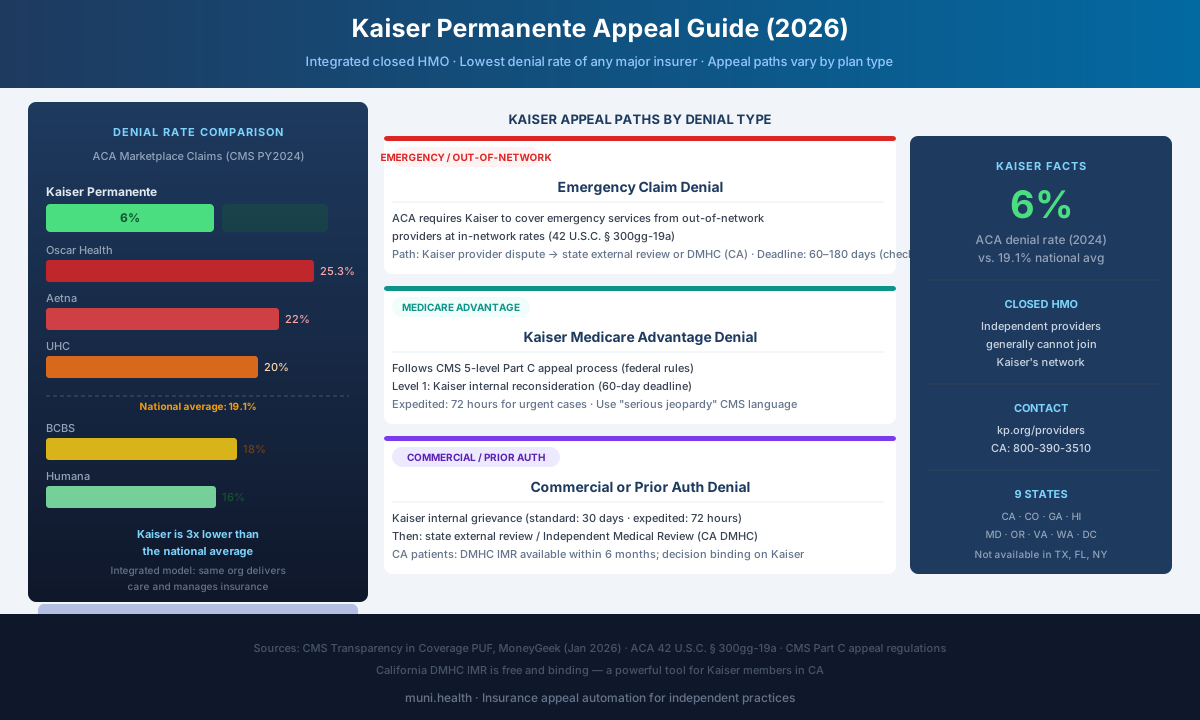
Kaiser operates in eight states plus Washington, D.C.: California (its largest market), Colorado, Georgia, Hawaii, Maryland, Virginia, Oregon, and Washington.
When Independent Providers Interact with Kaiser
Most independent practices cannot participate in Kaiser's network. Kaiser is a closed HMO — members see Kaiser-employed physicians or Kaiser-contracted facilities. But independent providers encounter Kaiser billing in three scenarios:
Emergency and urgent care. For commercial and marketplace plans that cover emergency services, federal law requires coverage without prior authorization and regardless of network status, with out-of-network emergency cost-sharing limited to the in-network level (42 U.S.C. § 300gg-111(a)). Emergency departments, trauma centers, and other providers that treat Kaiser members during genuine emergencies can bill Kaiser even without a network relationship.
Out-of-area urgent care. Kaiser members who travel outside Kaiser's service areas may have limited coverage for urgent (non-emergency) care from local providers. This coverage is plan-specific and varies by member's Kaiser plan.
Kaiser Point-of-Service (POS) plans. Some Kaiser plan designs allow members limited out-of-network access with higher cost-sharing. Providers treating these members can bill Kaiser subject to its out-of-network fee schedule.
Kaiser Permanente Denial Types and Appeal Paths
| Denial Type | Common Trigger | Appeal Path | Deadline |
|---|---|---|---|
| Emergency claim denial | Kaiser contests emergency status of out-of-network visit | Kaiser provider dispute → state external review or DMHC (CA) | Check the EOB or denial notice |
| Medical necessity denial | Post-service review determines service not medically necessary | Kaiser internal grievance → external review | Check denial letter for deadline |
| Prior authorization denial | PA requested for service Kaiser determines not meeting criteria | Kaiser appeal → state external review or DMHC (CA) | Pre-service; urgent: 72-hour expedited |
| Medicare Advantage denial | Kaiser MA prior auth or coverage denial | CMS Part C: Kaiser reconsideration → Independent Review Entity → ALJ → Medicare Appeals Council → Federal Court | Reconsideration: 60 days after receipt of the notice |
| Coding / billing dispute | Claim bundled, downcoded, or administratively rejected | Kaiser regional provider billing dispute process | Varies by regional entity and plan type |
Deadlines vary by plan type, regional Kaiser entity, and state law. Always verify the specific deadline on the denial notice or Explanation of Benefits (EOB).
If the denial came from a billing error rather than a coverage decision, a corrected claim may be the faster fix than an appeal. Kaiser's corrected-claim windows also vary by region; the Kaiser Permanente corrected claim timely filing guide lists them.
Step-by-Step: How to Appeal a Kaiser Denial
Step 1: Read the Denial Notice Carefully
Kaiser is required to provide a written denial notice that explains:
- The specific reason for the denial
- The clinical criteria or benefit provision applied
- Your right to appeal and the applicable deadline
- How to file a grievance or formal appeal
The denial type (emergency billing dispute vs. medical necessity vs. prior authorization) determines which appeal track to use and what documentation will be most persuasive.
Step 2: Compile Supporting Documentation
For medical necessity denials, gather:
- Clinical notes demonstrating medical necessity of the service
- Relevant diagnostic test results and imaging reports
- Treating physician's written statement of medical necessity
- Published clinical guidelines supporting the treatment (NCCN, AHA, ACS, ADA, or relevant specialty society)
- Any peer-reviewed literature supporting the clinical decision
Identify the criteria cited in the denial before writing the letter, and confirm their applicability to the plan, service, and region. Kaiser Permanente Washington publishes its own Clinical Review Criteria and references MCG or ASAM for some services. Its additional-network guidance says Aetna medical clinical policies apply when care is accessed through the Aetna Signature Administrators network; this is not a blanket rule for PPO or point-of-service claims. See the Kaiser Permanente medical necessity letter template for the copyable letter and the criteria-identification table.
For emergency claim disputes — where Kaiser contests whether the situation qualified as a genuine emergency — the documentation strategy is different (the letter template below is built for this case):
- Present the chief complaint and presenting symptoms at the time of arrival, not the final discharge diagnosis
- Apply the prudent layperson standard: coverage is required when a person with average medical knowledge would have believed the condition required emergency care
- Include EMTALA documentation if applicable
Emergency Claim Documentation Tip
Kaiser sometimes denies emergency claims when the final diagnosis turns out to be non-urgent. This is not the correct legal standard. Under federal law, coverage depends on the presenting symptoms — what a prudent layperson would have believed when the patient arrived, not what the diagnosis turned out to be. Document presenting symptoms explicitly and cite the prudent layperson standard in your appeal letter.
Step 3: Request a Peer-to-Peer Review First
For medical necessity denials, request a peer-to-peer review with Kaiser's regional medical director before filing a formal grievance. A physician-to-physician conversation can resolve a clinical disagreement before you invest in a formal grievance.
Request a peer-to-peer through Kaiser's regional Provider Services line — see our Kaiser Permanente provider phone numbers guide to find the right number for your region. This step is especially useful for complex specialty or surgical cases where clinical judgment is the central dispute.
Step 4: File a Kaiser Internal Grievance or Appeal
Kaiser's internal appeal process is called a "grievance and appeals" process. Kaiser operates as separate regional entities (Kaiser Foundation Health Plan of Southern California, Northern California, Colorado, Georgia, etc.), so specific contacts and portals vary by region. Providers also need to know which form applies — a claim payment dispute and a coverage/care grievance use different forms and go to different departments. See the Kaiser Permanente appeal form guide 2026 for the routing breakdown, and the Kaiser Permanente appeal letter template 2026 for the actual letter to send on each track, with regional mailing addresses.
General timelines for internal Kaiser appeals:
- Standard internal appeal: Submit in writing with supporting documentation. Turnaround: typically 30 days for post-service appeals. Always verify current timelines from the denial letter or your regional Kaiser Provider Relations contact.
- Expedited appeal: Available when standard timelines would seriously jeopardize the member's health or ability to regain maximum function. Turnaround: 72 hours.
Regional Variation in Kaiser Contacts
Kaiser operates as distinct regional entities, and appeal addresses, portal access, and representative contacts vary by region. Do not rely on a generic Kaiser mailing address or contact list. Always use the contact information provided on the denial notice or obtained directly from your regional Kaiser Provider Relations representative. For the current claims, authorization, and member services phone number in each of Kaiser's eight regions, see the Kaiser Permanente provider phone numbers guide.
Step 5: Request External Review
If Kaiser upholds the internal denial, request external review.
California Kaiser plans: Members and providers acting on members' behalf can request an Independent Medical Review (IMR) through the California Department of Managed Health Care (DMHC). California Health and Safety Code § 1374.30 establishes this right after one level of internal Kaiser grievance. IMR is free and handled by a medical reviewer with no affiliation to Kaiser. DMHC can also handle expedited IMR requests within 3 business days for urgent cases.
Other state Kaiser plans: State external review laws apply for non-ERISA plans. For ERISA-governed employer plans, federal external review rules under PPACA apply and an Independent Review Organization (IRO) handles the case. For more on IRO appeals, see the Independent Review Organization appeal guide 2026.
Kaiser Medicare Advantage: Follow the CMS 5-level Part C process described below.
Kaiser Emergency Claim Dispute Letter Template
Most independent providers meet Kaiser through emergency care, so this template is built for the most common dispute: Kaiser denies or downgrades an out-of-network emergency claim after the fact. Send it through the regional dispute route on the denial notice. For medical necessity denials on authorized care, use the Kaiser Permanente appeal letter template instead.
[Date]

[Kaiser Foundation Health Plan of (Region), e.g., Northern California / Colorado / Mid-Atlantic States]
[Provider dispute address or portal from the denial notice / EOB]

RE: Provider Dispute — Emergency Services Claim
Member Name: [Patient Full Name]
Kaiser Medical Record / Member Number: [Number]
Date of Birth: [MM/DD/YYYY]
Plan Type: [Commercial HMO / Medicare Advantage (Senior Advantage) / Marketplace]
Claim Number: [Claim # from EOB]
Date of Service: [MM/DD/YYYY] — Arrival Time: [HH:MM]
Denial / Adjustment Date: [MM/DD/YYYY]
Denial Reason as Stated: [Quote the reason from the EOB or notice]
Treating Facility / Provider / NPI / TIN: [Name / NPI / TIN]

To the Kaiser Provider Dispute Unit:

We dispute the [denial / reduced payment] of emergency services provided to the member above. The claim was adjudicated on the final diagnosis, [final diagnosis], rather than on the symptoms the member presented with — which is not the standard federal law applies to emergency services.

1. PRESENTING SYMPTOMS AT ARRIVAL
The member arrived at [time] reporting [chief complaint in the member's words, e.g., "sudden crushing chest pain radiating to the left arm"], with [vital signs / triage level / key findings]. These are documented in the attached triage and nursing notes.

2. PRUDENT LAYPERSON STANDARD
A prudent layperson with an average knowledge of health and medicine could reasonably expect the absence of immediate medical attention for these symptoms to place the member's health in serious jeopardy, cause serious impairment to bodily functions, or cause serious dysfunction of a bodily organ or part. Coverage of emergency services is determined by this standard, not by the final diagnosis:
- Commercial and marketplace plans that cover emergency services: 42 U.S.C. § 300gg-111(a) and 45 C.F.R. § 149.110, which require coverage without prior authorization and regardless of network status
- Medicare Advantage: 42 CFR § 422.113(b)

3. SERVICES PROVIDED
[Medical screening examination and stabilizing treatment: CPT/HCPCS codes, units]. [If applicable: Kaiser was notified of the member's presentation on [date/time] via [method]; post-stabilization care was [authorized by / requested from] [name] on [date/time].]

Requested action: Reprocess the claim as an emergency service and pay it [at the applicable out-of-network emergency rate / per our agreement], with member cost-sharing at the in-network level.

Enclosures:
1. EOB / denial notice
2. Triage record, nursing notes, and ED physician documentation
3. [EMTALA medical screening documentation / notification records, if applicable]

Please contact [Name] at [Phone] or [Email] with questions.

Sincerely,

[Name, Title]
[Facility / Practice Name] | NPI: [NPI]
Skip the blank template. Start with a review-ready draft.
Use the template as guidance, or let Muni prepare a payer-specific draft for your team to verify, sign, and submit.
First 3 appeals free, then $20 per appeal. Start with your denial letter or EOB and available records. No meeting or clearinghouse connection required.
Kaiser Medicare Advantage: CMS Part C Appeal Process
Kaiser offers Medicare Advantage plans in most of its service areas. When Kaiser MA denies a claim or prior authorization, the same CMS 5-level Part C appeal process applies as for all Medicare Advantage plans.
Prepare this appeal packet with your team.
Draft the appeal, coordinate missing documents, and approve the reviewed packet. Keep your clearinghouse; your practice checks deadlines and submits through the payer’s accepted channel.
First 3 appeals free, then $20 per appeal. Start with your denial letter or EOB and available records. No meeting or clearinghouse connection required.
Level 1 — Reconsideration by Kaiser: Request within 60 calendar days after receipt of the denial notice (receipt is presumed 5 days after the notice date — 42 CFR 422.582). Providers filing on behalf of members must be appointed as authorized representatives; a non-contracted provider that waives payment from the member can file for a payment denial (42 CFR 422.574).
Level 2 — Independent Review Entity: If Kaiser upholds the denial in whole or part, it must forward the case to the IRE automatically (42 CFR 422.590) — you do not file this level yourself.
Level 3 — ALJ Hearing: If the IRE upholds the denial and the disputed amount meets the threshold ($200 for 2026), request an Administrative Law Judge hearing within 60 days.
Level 4 — Medicare Appeals Council (MAC): If the ALJ rules against you, appeal to the MAC within 60 days.
Level 5 — Federal District Court: The final stage, available if the disputed amount meets the federal court threshold ($1,960 for 2026).
For Kaiser MA prior authorization denials specifically, CMS-0057-F (effective January 1, 2026) requires Kaiser to issue prior authorization decisions within 7 calendar days for standard requests and 72 hours for expedited cases. Kaiser must give a specific reason when it denies a prior authorization request.
For letter templates and detailed step-by-step guidance on Medicare Advantage appeals, see the Medicare Advantage appeal letter template 2026.
California DMHC: Kaiser's Primary Regulator
California is Kaiser's largest market and home to its most robust regulatory oversight. In California, Kaiser is regulated by the Department of Managed Health Care (DMHC) under the Knox-Keene Health Care Service Plan Act — not by the California Department of Insurance. This distinction matters because DMHC has direct authority to investigate Kaiser complaints and order coverage reversals.
Key California-specific rights:
- Independent Medical Review (IMR): Available after one level of internal grievance under California Health and Safety Code § 1374.30. The process is free, and DMHC assigns a qualified reviewer unaffiliated with Kaiser.
- DMHC Help Center: 1-888-466-2219. Handles Kaiser complaints and can escalate urgent cases.
- Expedited DMHC review: For urgent situations, DMHC can issue expedited IMR decisions within 3 business days.
DMHC publishes IMR decisions in a searchable database, so you can look up how reviewers have ruled on similar Kaiser disputes before you file.
How Muni Appeals Supports Kaiser Denial Disputes
Kaiser's low overall denial rate means the claims that do get denied are often the more complex, documentation-intensive disputes — emergency billing challenges, medical necessity disagreements for specialty procedures, and Medicare Advantage coverage disputes.
Muni Appeals helps billing teams organize documentation and prepare appeal drafts around Kaiser's cited denial reasons. Staff verifies the current policy and submission route and remains responsible for calendaring deadlines across internal and external review stages.
If you are weighing whether to keep writing these letters by hand, the appeal automation cost vs. manual comparison lays out staff time per appeal against software cost.
Frequently Asked Questions
Can independent practices appeal Kaiser denials?
Yes, in specific circumstances. Independent practices that treated Kaiser members for emergency or urgent care can file appeals for unpaid or underpaid claims through Kaiser's provider dispute resolution process, which varies by regional entity. For Kaiser Medicare Advantage denials, providers can participate in the CMS Part C appeal process with an authorized representative appointment from the member.
What is Kaiser's denial rate compared to other major insurers?
Kaiser denied approximately 6% of in-network ACA marketplace claims in Plan Year 2024 — the lowest among national insurers — according to CMS Transparency in Coverage data. Oscar Health denied 25.3% in the same period, UHC about 20%, and the HealthCare.gov average was 19.1%. The insurance denial rate by company 2026 guide has the full comparison.
How long do I have to appeal a Kaiser denial?
Deadlines vary by denial type and plan. Provider dispute windows depend on your Kaiser region and whether you are contracted, so use the deadline on the denial notice. For Kaiser Medicare Advantage denials, the reconsideration request is due within 60 calendar days after receipt of the notice; the IRE level is automatic, and later levels (ALJ, Council, federal court) each have their own 60-day filing windows. For a full breakdown by plan type and region, see the Kaiser Permanente timely filing limits guide 2026.
Does Kaiser use prior authorization for services?
Yes, Kaiser requires prior authorization for certain services — particularly specialty procedures, durable medical equipment, and high-cost medications. For Kaiser-employed physicians, this process is largely internal. For external providers, Kaiser's prior authorization requirements vary by regional entity and plan type. Contact Kaiser's regional Provider Services for current PA requirements.
Can I request a peer-to-peer review for a Kaiser denial?
Yes. For medical necessity denials, you can request a peer-to-peer discussion with Kaiser's regional medical director before filing a formal grievance. Contact Kaiser's regional Provider Services line to arrange a peer-to-peer call.
What is the DMHC Independent Medical Review for Kaiser?
In California, Kaiser members and providers acting on their behalf can request an Independent Medical Review (IMR) through the California Department of Managed Health Care after completing one level of Kaiser's internal grievance process. DMHC assigns a medical reviewer independent from Kaiser. The process is free, and DMHC can require Kaiser to reverse a denial if the reviewer finds the denial was not medically appropriate. Expedited DMHC review is available for urgent cases within 3 business days.
Does Kaiser Medicare Advantage follow the same appeal rules as other MA plans?
Yes. Kaiser Medicare Advantage plans are subject to the same CMS Part C regulations as all Medicare Advantage plans, including the CMS-0057-F rule effective January 1, 2026. The Part C appeal process — Kaiser reconsideration, Independent Review Entity, ALJ hearing, Medicare Appeals Council, federal district court — applies to all Kaiser MA coverage denials. See the Medicare Advantage appeal letter template 2026 for detailed guidance.
What if Kaiser doesn't respond within the required appeal timeframe?
For plans subject to federal claims-procedure rules, a plan that fails to follow those rules can be treated as having denied the claim, letting the claimant move to external review; California members can also go to DMHC after 30 days in Kaiser's grievance process. For Kaiser MA plans, a missed reconsideration deadline requires Kaiser to forward the case to the IRE (42 CFR 422.590). Document all submission dates and follow up in writing to create a record.
Ready to Challenge a Kaiser Denial?
Kaiser's 6% marketplace denial rate is the lowest among national insurers — but that number doesn't help when your emergency claim or Medicare Advantage dispute is one of the ones they got wrong. The appeal process still requires organized documentation, deadline tracking, and letters that address Kaiser's specific denial rationale.
Get Started:
- Identify the denial type and applicable appeal track (commercial, MA, or emergency billing)
- Gather clinical documentation aligned with Kaiser's cited criteria, or prudent layperson documentation for emergency disputes
- Request a peer-to-peer with Kaiser's regional medical director for medical necessity denials
- File within the deadline on your denial notice — verify the date before you start
- For California: use DMHC's IMR after Kaiser's internal process
- For Kaiser MA: follow the CMS Part C process
This guide reflects 2026 Kaiser Permanente appeal procedures. Kaiser operates as distinct regional entities with variation in processes and contacts — always verify current information from your denial notice or Kaiser's regional Provider Relations. Medicare Advantage appeal rules reflect CMS Part C regulations current as of January 2026. California DMHC oversight applies to Knox-Keene regulated plans only. Muni Health is not affiliated with Kaiser Permanente.