

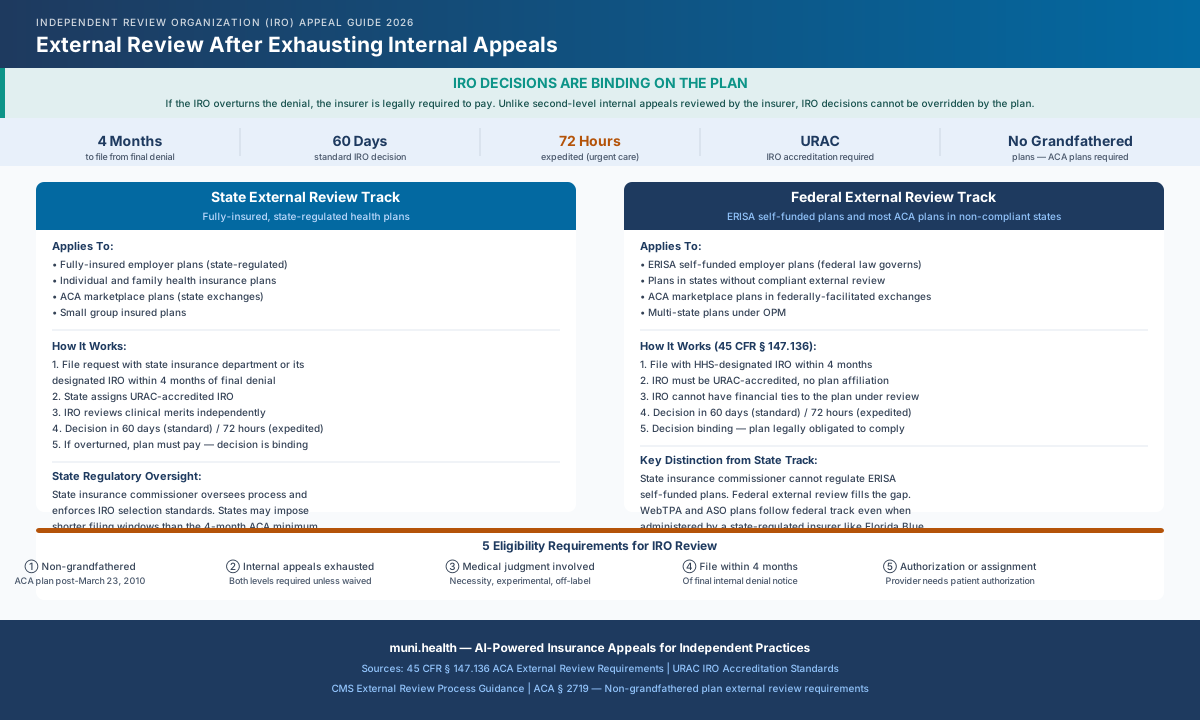
An Independent Review Organization (IRO) is a neutral, federally-accredited third party that reviews insurance denials after internal appeals are exhausted. Under ACA rules, you generally have 4 months from the final denial notice to file. Standard IRO decisions are due within 60 days; expedited reviews for urgent situations must be decided within 72 hours. IRO decisions are binding on the plan.
What Is an Independent Review Organization?
When a health insurer denies a claim or prior authorization and internal appeals fail, the case doesn't have to end there. Patients and, in most situations, authorized provider representatives can escalate to an Independent Review Organization — a certified neutral third party that evaluates whether the insurer's denial was clinically and contractually correct.
IROs exist because of a straightforward conflict of interest: insurers reviewing their own denials can't be fully objective. The ACA addressed this by requiring non-grandfathered health plans to offer external review through accredited IROs. Under 45 CFR § 147.136, an IRO must be accredited by the Utilization Review Accreditation Commission (URAC) or a comparable accrediting body and cannot have any financial or operational ties to the plan under review.
The practical consequence matters for independent practices: if the IRO overturns the denial, the insurer is legally required to pay — the decision is binding on the plan, not merely advisory.
IRO vs Second-Level Internal Appeal
A second-level internal appeal is still reviewed by the insurer. An IRO review is conducted by a completely independent organization with no financial relationship with the plan. If the IRO finds in your favor, the insurer cannot override it.
This ACA-driven IRO model doesn't cover every payer type. TRICARE runs an analogous but distinct escalation path — an independent hearing officer whose recommendation goes to the Defense Health Agency director rather than a URAC-accredited IRO — for disputes of $300 or more; see our TRICARE provider appeal guide for that structure.
Who Can Request External Review?
External review is formally a patient right, not a direct provider right. However, providers can file on behalf of a patient in two circumstances:
Prepare this appeal packet with your team.
Draft the appeal, coordinate missing documents, and approve the reviewed packet. Keep your clearinghouse; your practice checks deadlines and submits through the payer’s accepted channel.
First 3 appeals free, then $20 per appeal. Start with your denial letter or EOB and available records. No meeting or clearinghouse connection required.
- Assignment of benefits — when the patient has assigned their benefits to the practice, giving the provider the right to pursue payment directly.
- Authorized representative — the patient signs a written authorization designating the practice as their representative for the appeal. Most state external review regulations and the federal external review framework recognize this designation.
For practices handling denied claims where the patient assigned benefits, external review is a legitimate last step when internal appeals are denied. If the patient has not assigned benefits and has not signed an authorization, the patient must initiate the external review request.
Eligibility: When External Review Is Available
Not every denial qualifies for external review. General eligibility requirements under ACA rules:
- The plan must be a non-grandfathered health plan (most employer plans created after March 23, 2010, and all ACA marketplace plans qualify; grandfathered plans are exempt)
- Internal appeals must be exhausted — typically both a first-level and second-level internal appeal, unless the plan waives the requirement or the situation qualifies for simultaneous external review. An informal "reconsideration" step usually does not count toward exhaustion on its own — see Reconsideration vs. Appeal: What's the Difference for which payers treat the two as separate steps
- The denial must involve a medical judgment (medical necessity, experimental treatment, off-label drug use, or rescission of coverage) — pure coding and billing disputes may not qualify depending on state rules. An out-of-network payment-amount dispute on a covered emergency or surprise-billing service goes to the separate No Surprises Act open negotiation and IDR process, not an IRO
- The request must be filed within 4 months of the final internal denial notice (federal minimum; some states impose shorter windows)
Grandfathered Plan Exception
Plans grandfathered under the ACA — those that haven't made significant changes since March 23, 2010 — are not required to offer external review. Check the plan's Summary Plan Description (SPD) or ask the insurer directly whether the plan is grandfathered before filing.
State vs. Federal External Review: Which Track Applies?
The type of health plan determines which external review process applies. This is the most important distinction to understand before filing.
| Plan Type | Review Track | Who Governs | IRO Assignment | Request Deadline |
|---|---|---|---|---|
| Fully-insured, state-regulated plan | State external review | State insurance commissioner | State-assigned or state-approved IRO list | Varies by state (typically 4 months; CA = 180 days for IMR) |
| Self-funded ERISA plan (employer-sponsored) | Federal external review | Department of Labor / EBSA | HHS-designated IRO assigned randomly | 4 months from final denial notice |
| State without compliant external review law | Federal fallback process | HHS / CMS | HHS-designated IRO | 4 months from final denial notice |
| Grandfathered plan (any type) | No external review required | N/A | N/A | N/A — plan may offer voluntarily |
| Medicare Advantage plan | Medicare grievance and appeals process | CMS | Qualified Independent Contractor (QIC) | 60 days from Explanation of Benefits |
Medicaid managed care is not in the table above for a reason: Medicaid MCO plans — including Centene Corporation's Medicaid subsidiaries (Peach State, Sunshine Health, Buckeye) and WellCare's Medicare Advantage line — do not use IRO external review. Medicaid escalates to a State Fair Hearing through the state Medicaid agency, governed by 42 CFR Part 438, and WellCare Medicare Advantage escalates through the CMS Part C appeal ladder instead. Ambetter, Centene's ACA Marketplace brand, is the exception within that same corporate family — it follows the standard ACA IRO track described above, not the Medicaid or Medicare escalation paths. For the full appeal process across all of Centene's brands, see our Centene and WellCare provider appeal guide, and for Ambetter's specific provider deadlines and IRO filing mechanics, see our Ambetter appeal guide.
BCBS Federal Employee Program (FEP) plans are also absent for the same reason: FEP members carry an R-prefix subscriber ID and are covered under the Federal Employees Health Benefits Act (FEHBA), which preempts state insurance law under 5 U.S.C. §8902(m)(1). State departments of insurance and state IROs have no jurisdiction over FEP denial decisions. After an internal FEP reconsideration fails, the only external escalation path is OPM Disputed Claims — a federal administrative review by the U.S. Office of Personnel Management. For the complete FEP-specific appeal process and OPM deadlines, see our BCBS FEP claim denial appeal guide.
For a payer-specific breakdown of the state vs federal tracks, see the BCBS external review process guide which covers how the framework applies across BCBS affiliates. For a full comparison of state external review laws — including California's DMHC IMR, New York's DFS process, and the ERISA preemption rule — see the state-by-state insurance appeal laws guide.
How to identify the plan type: Check the Explanation of Benefits or Summary Plan Description. ERISA self-funded plans are usually employer-sponsored and will state "This plan is not an insurance policy" or "This plan is self-funded" in the SPD. State-regulated plans are issued by licensed insurance companies and backed by state insurance guaranty rules.
If you're unsure, contact the plan administrator. Sending an external review request through the wrong track adds weeks to the process. Self-funded ERISA plans also carry different rights well before external review is reached — a longer internal appeal deadline and a free copy of the complete claim file — covered in our ERISA self-funded plan appeal guide.
How to Request IRO External Review: Step-by-Step
Step 1: Confirm Internal Appeals Are Exhausted
Gather written denial notices from each internal appeal level. Most plans require a first-level reconsideration and a second-level appeal before external review is available. If the plan's denial notice states "you have the right to request external review," that's confirmation your internal appeals are complete.
Exception for simultaneous external review: If the situation involves urgent medical care, you may file for expedited external review at the same time as an internal appeal — you don't have to wait for the internal process to finish.
Step 2: Identify the Correct Filing Path
- State-regulated plan: Contact your state insurance commissioner's office. Most states have a dedicated external review request process, often through a state portal or a state-designated IRO.
- Self-funded ERISA plan: File through the plan's Summary Plan Description process, which must comply with DOL rules. If the plan doesn't offer a compliant process, file directly with EBSA or through the healthcare.gov external review portal.
Step 3: Prepare the Request Package
Standard external review requests typically require:
- Patient's full name, date of birth, member ID, and plan name
- Denial notice(s) from all internal appeal levels
- Claim or prior authorization number and date of service
- Written statement of what is being disputed and why the denial is incorrect
- Relevant medical records, clinical notes, and supporting documentation
- Physician's written justification (clinical rationale referencing applicable medical policy, clinical guidelines, or peer-reviewed literature)
- Proof of authorized representative status if the provider is filing on the patient's behalf
Step 4: File Within the Deadline
The ACA federal minimum is 4 months from the date on the final internal appeal denial notice. Some states have shorter deadlines — California's Independent Medical Review (IMR) process allows 180 days, but many states align with the 4-month minimum or go shorter. Missing the window closes the external review option permanently. See the insurance appeal deadlines guide for a full breakdown of internal appeal windows by insurer.
Step 5: Monitor the IRO Timeline
After the IRO accepts the request, the clock starts. The assigned IRO must notify the plan and claimant of its decision within the applicable timeline (see table below). Plans must implement IRO decisions immediately.
Standard vs. Expedited External Review
| Type | When to Use | IRO Decision Deadline | Request Requirements | Notes |
|---|---|---|---|---|
| Standard external review | Post-service denied claims; prospective denials when care is not yet urgent | 60 days from IRO accepting the request | Internal appeals exhausted; request within 4-month window | Most common track for denied claims and prior auth decisions |
| Expedited external review | Urgent or emergency care situations; ongoing treatment that would be seriously jeopardized by waiting 60 days; discharge disputes for inpatient care | 72 hours from IRO accepting the request | Can file simultaneously with internal appeal; physician must certify urgency | Insurer must also provide expedited decision on internal appeal within 72 hours |
Qualifying for expedited review: The treating physician must certify in writing that the standard timeline would seriously jeopardize the patient's life, health, or ability to regain maximum function. This is not a high bar for ongoing treatments like chemotherapy, dialysis, or post-acute care, but it must be documented.
What the IRO Actually Reviews
IROs evaluate medical necessity and clinical appropriateness based on:
- Clinical documentation submitted — the quality and completeness of the clinical record is the most important variable in external review outcomes
- Applicable coverage criteria — the insurer's own clinical policy bulletins, InterQual criteria, MCG criteria, or other criteria the plan uses for the service in question
- Peer-reviewed medical literature — the IRO's physician reviewers (who must be board-certified in a relevant specialty) assess whether the denial aligns with current clinical standards
- Contractual language — whether the service is excluded under the plan's benefit design or whether medical necessity criteria were misapplied
What IROs Don't Change
IROs cannot expand the plan's benefit design or override clear exclusions. If the plan explicitly excludes a service (e.g., cosmetic procedures), the IRO will not overturn on medical necessity grounds. External review is most effective for services that are covered in principle but denied as medically unnecessary or experimental.
The IRO's decision letter explains the clinical rationale. A reversal requires the IRO to find that the insurer's denial was inconsistent with the applicable standard of care, evidence-based guidelines, or the plan's own medical policies.
Behavioral health denials are among the most reversible at external review — research published in Health Affairs (2025) found external review overturn rates of 57–82% for behavioral health claim denials. MHPAEA parity violations provide an additional argument at the IRO level beyond standard medical necessity: if the insurer applied more restrictive criteria to behavioral health than to comparable medical/surgical services, cite that disparity directly in the external review submission. For behavioral health appeal routing and the payer-specific submission workflow, see the mental health insurance denial appeal guide. For the MHPAEA comparative analysis methodology — how to identify analogous medical/surgical benefits, request the NQTL document, and build the parity argument — see our behavioral health parity appeal guide.
How Muni Appeals Supports the External Review Process
The external review filing package is essentially a high-stakes version of the documentation work required at every internal appeal level. The difference is that the IRO's physician reviewers are specialists who will scrutinize the clinical record carefully.
Prepare this appeal packet with your team.
Draft the appeal, coordinate missing documents, and approve the reviewed packet. Keep your clearinghouse; your practice checks deadlines and submits through the payer’s accepted channel.
First 3 appeals free, then $20 per appeal. Start with your denial letter or EOB and available records. No meeting or clearinghouse connection required.
Practices that reach external review typically benefit from:
- Organized clinical documentation with clear reference to denial reason and applicable policy criteria
- Physician-authored letters that cite specific clinical guidelines and peer-reviewed sources, not generic medical necessity language
- Complete prior authorization and appeal history compiled without gaps
Muni Appeals helps billing teams organize that documentation workflow, compile the denial and appeal history, and generate structured appeal letters with insurer-specific policy citations — the same foundation needed for a strong external review submission.
Frequently Asked Questions
Does the provider or patient file for external review?
External review is formally a patient's right. However, providers with an assignment of benefits or a signed authorized representative form from the patient can file on the patient's behalf. For most independent practices billing with assignment, this means the billing team can initiate the process with the appropriate documentation in place.
What happens if the IRO upholds the denial?
If the IRO upholds the insurer's denial, the external review right is exhausted and the insurer does not have to pay. At that point, options include state insurance department complaints (for non-ERISA plans), negotiation with the insurer for a reduced payment, or ERISA lawsuit in federal court (for self-funded plans). See the insurance appeal statute of limitations guide for applicable legal deadlines if litigation is being considered.
Can I request external review if we're still in the internal appeal process?
Generally no — you must exhaust internal appeals first, with one exception: expedited external review for urgent medical situations can run simultaneously with an internal appeal. For non-urgent situations, the plan must be given the opportunity to resolve the denial internally before external review is available.
Does external review apply to prior authorization denials?
Yes. The ACA external review requirement covers both pre-service (prior authorization) and post-service (claim payment) denials where a medical judgment is involved. If a prior authorization denial results in a final internal appeal denial, external review is available. This is covered in more depth in the prior authorization denial guide.
How long does the whole external review process take?
Standard external review: up to 60 days from when the IRO accepts the request. In practice, many IROs complete reviews within 30–45 days for straightforward cases. Expedited reviews: 72 hours. Add 5–10 business days to account for request processing and acknowledgment at the front end.
Is there a cost to file for external review?
Under ACA rules, plans cannot charge patients or their authorized representatives a fee to request external review. The IRO is paid by the insurer. Some states go further and explicitly prohibit any cost-shifting to the claimant. Check your state insurance commissioner's guidance if you receive any fee notice — it may not be compliant.
Do IROs cover Medicare Advantage denials?
No. Medicare Advantage plans use a separate CMS-administered appeals process. After exhausting MA internal appeals (Level 1 reconsideration and Level 2 Qualified Independent Contractor review), escalation goes to an Office of Medicare Hearings and Appeals (OMHA) Administrative Law Judge — not a state or federal IRO. The BCBS external review and IRO framework described here applies to commercial and employer-sponsored plans. For the full MA 5-level appeal process with 2026 updates, see the Medicare Advantage appeal letter template 2026.
Ready to Build a Stronger External Review Package?
External review is worth pursuing for high-value denials where the clinical record is strong. The IRO process favors practices that submit complete, well-organized clinical documentation with specific policy citations — the same approach that improves outcomes at every internal appeal level.
Get Started:
- Organize your denial and appeal history in one place
- Generate physician-authored appeal letters with insurer-specific policy citations
- Track filing deadlines across internal and external appeal stages
- Reduce the manual work of compiling documentation for high-stakes reviews
This guide reflects 2026 external review procedures under federal ACA rules and state-regulated plan frameworks. State requirements vary — consult your state insurance commissioner's guidance for jurisdiction-specific external review processes. This information is for administrative and billing purposes and is not legal or medical advice.