

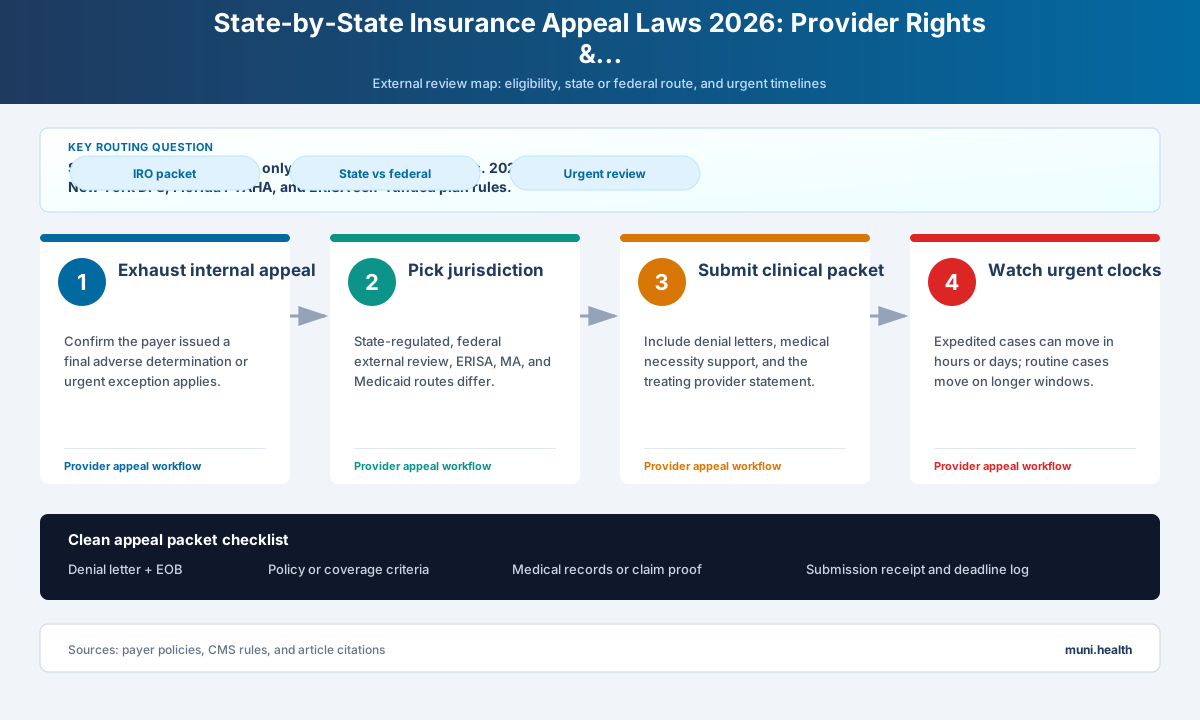
State insurance appeal laws vary significantly — but they only apply to fully insured health plans. If your patient's employer uses a self-funded ERISA plan (roughly 60% of large-employer workers, per KFF 2024 data), state external review protections don't apply; federal ERISA rules govern instead. For fully insured plans, states like California and New York now offer the strongest provider appeal rights in the country.
Why State Appeal Laws Matter for Independent Practices
Not all insurance appeals follow the same rules. The Affordable Care Act established a federal floor for internal and external appeals, but states have built substantially different systems on top of that foundation — some with far stronger protections than the minimum, others that effectively hand oversight back to the federal government.
For an independent practice billing across multiple states and payer types, understanding which rules apply to a given denial is not a compliance exercise. It is the difference between filing with the right body and having your appeal time-barred before you start.
The two critical variables are:
- Is the plan fully insured or self-funded? This determines whether state law applies at all.
- Which state governs the plan? This determines which external review process and deadlines apply.
A third category sits outside both frameworks entirely: federal government health programs. TRICARE, for example, is neither state-regulated nor ERISA-governed — it runs its own factual and medical necessity appeal tracks through the Defense Health Agency. See our TRICARE provider appeal guide for that separate system.
Source: KFF 2024 Employer Health Benefits Survey
According to the KFF 2024 Employer Health Benefits Survey, approximately 63% of covered workers at firms with 200 or more employees are enrolled in self-funded plans. At large firms (5,000+ employees), that figure exceeds 80%. Self-funded plans are not subject to state insurance laws.
The Federal Baseline: What ACA Guarantees in Every State
Under 45 CFR § 147.136, non-grandfathered health plans must provide both an internal claims and appeals process and access to external review. This applies nationwide, regardless of state law, for plans that fall under the ACA's scope.
Prepare this appeal packet with your team.
Draft the appeal, coordinate missing documents, and approve the reviewed packet. Keep your clearinghouse; your practice checks deadlines and submits through the payer’s accepted channel.
First 3 appeals free, then $20 per appeal. Start with your denial letter or EOB and available records. No meeting or clearinghouse connection required.
The federal baseline requires:
- Internal appeal: The plan must notify enrollees of the right to appeal any adverse benefit determination. Final internal decisions must be issued within 60 days (standard) or 72 hours (urgent care).
- External review: After exhausting internal appeals, enrollees — and authorized provider representatives — can request external review by an accredited Independent Review Organization (IRO). See the Independent Review Organization appeal guide for the full IRO filing process and eligibility criteria.
- Standard external review timeline: Decision due no later than 45 days from the IRO receiving a complete request (CMS external review FAQ, 2024).
- Expedited external review timeline: Decision due no later than 72 hours for urgent situations.
- Filing deadline: External review requests must generally be filed within 4 months of the final internal denial notice (this is the federal minimum; some states are shorter — see insurance appeal deadlines by payer and state for a payer-by-payer breakdown).
Grandfathered Plans Are Exempt
Health plans that were grandfathered under the ACA — those that haven't made significant changes to benefits or cost-sharing since March 23, 2010 — are not required to offer external review. Check the plan's Summary Plan Description or call the insurer to confirm grandfathered status before filing an external review request.
The ERISA Exception: When State Law Does Not Apply
This is the most important distinction for independent practices to understand before any external review filing.
The Employee Retirement Income Security Act of 1974 (ERISA) governs employer-sponsored benefits nationwide. Under ERISA's preemption clause, state insurance laws generally cannot apply to self-funded employer health plans. The Supreme Court has repeatedly upheld this preemption. The practical result: if an employer funds its own health benefits through a self-funded arrangement — rather than purchasing a fully insured policy from a carrier — the plan is governed by ERISA and federal rules, not by state insurance laws.
What this means for appeals:
- California's independent medical review rights, New York's clinical pre-denial review requirements, Florida's dispute resolution program — none of these apply to self-funded plans.
- Self-funded plans still must follow the ACA's internal and external review requirements (because ACA is federal law), but the external review process is administered through the federal track, not state agencies.
- The federal external review process is overseen by the U.S. Department of Labor (for ERISA plans) or the U.S. Department of Health and Human Services.
How to identify a self-funded plan: The plan's Summary Plan Description (SPD) should state whether it is self-funded or fully insured. The EOB may also identify the third-party administrator (TPA) separately from the insurance carrier — a common indicator of a self-funded arrangement. When in doubt, ask the payer directly before filing a state-level appeal.
Once you've confirmed a plan is self-funded, the appeal rules don't just skip state law — they run on a different federal timeline and disclosure standard entirely. See our ERISA self-funded plan appeal guide for the 180-day appeal floor, the right to a free copy of the complete claim file, and what happens when a self-funded plan doesn't follow its own claims procedures.
Self-Funded ERISA Plans: Use the Federal Track
Filing a state external review request against a self-funded ERISA plan is a common and costly mistake. The state agency will reject it, and you may lose time you needed to file with the federal process. Confirm plan funding type before choosing the appeal track.
State-by-State External Review: Where the Laws Are Strongest
For fully insured plans, states control their own external review processes. The landscape varies from comprehensive independent oversight (California, New York) to states that rely primarily on the federal track (Texas).
| State | Review Track | Governing Agency | Provider Filing Rights | Filing Deadline | Notable 2025–2026 Change |
|---|---|---|---|---|---|
| California | State — DMHC IMR | Dept. of Managed Health Care | Yes — authorized rep or assignee | 180 days from denial | SB 294: Plans must auto-submit upheld denials to IMR (effective Jan 1, 2026) |
| New York | State — DFS External Appeal | Dept. of Financial Services | Yes — concurrent & retrospective denials | 4 months from final internal denial | Healthcare Appeals Reform Act (Mar 2025): AI disclosure mandate, independent clinical review required before denial issuance |
| Florida | State + dispute resolution | FL Office of Ins. Regulation / AHCA Capitol Bridge | Yes — provider dispute resolution program | Varies by plan type | PTAHA (Oct 2024): 30-day max standard appeal resolution, expanded urgent definition |
| Texas | Federal track (DOL/HHS) | TDI coordinates; federal IRO assigned | Yes — as authorized rep | 4 months from final denial | No dedicated state process; federal baseline applies |
| Illinois | State — Dept. of Insurance | IL Dept. of Insurance | Yes — authorized rep | 4 months from final denial | State-run process in place; check IL DOI for current IRO list |
| Massachusetts | State — CHIA / DOI | MA Div. of Insurance | Yes — authorized rep | 4 months from final denial | MHEAR Act (Jan 2025): presumption of medical necessity for licensed provider's mental health recommendation |
| Michigan | State — DIFS | Dept. of Insurance and Financial Services | Yes — authorized rep | 60 days from final denial | Health Claims Transparency Act (Jan 2025): quarterly insurer denial/appeal statistics required |
| All other states | State or federal fallback | State insurance commissioner or HHS | Varies — check state DOI | Typically 4 months (federal minimum) | Refer to state DOI or HHS external review portal |
California: The Strongest State Protections
California runs the most provider-friendly external review system in the country through the Department of Managed Health Care (DMHC). The Independent Medical Review (IMR) process applies to HMO plans and delegated plans regulated by DMHC; the California Department of Insurance (CDI) oversees PPO and indemnity plans.
Key California IMR facts:
- The 180-day filing deadline is significantly longer than the federal 4-month window — critical for complex multi-level appeals.
- As of January 1, 2026, health plans that uphold a denial in response to a grievance must automatically submit the case to the IMR system within 24 hours — providers no longer need to separately initiate the request in many circumstances (California SB 294, codified at Cal. Health & Safety Code § 1374.30 effective 2025–2026).
- IMR decisions are typically issued within 45 days for standard reviews and sooner for expedited cases.
- Independent doctors conduct the IMR review — they have no financial ties to the plan.
- If the IMR overturns the denial, the plan is legally required to authorize or pay for the service.
For California practices, the IMR is often a stronger pathway than continued internal escalation. The automatic submission requirement (effective Jan 1, 2026) reduces the administrative burden of initiating the request.
New York: Strong Rights With New 2025 Protections
New York's external appeal process is administered by the Department of Financial Services (DFS). Providers have direct filing rights for concurrent and retrospective adverse determinations — not just patients.
Key New York facts:
- Providers can request an external appeal for concurrent adverse determinations (a denial while services are being provided) and retrospective adverse determinations (post-service denials).
- The 4-month filing deadline runs from the date of the final adverse determination from the first internal appeal — filing a second-level internal appeal does not extend this window.
- Cost allocation on appeals: If the provider files and loses entirely, the provider pays the external appeal fee. If the denial is partially overturned, cost is split. If the provider wins entirely, the health plan pays (New York Insurance Law § 4910).
New York's Comprehensive Healthcare Appeals Reform Act (effective March 2025) added two significant protections for providers:
- Insurers must disclose when AI or algorithmic tools were used in the denial decision.
- All denials based on medical necessity must be reviewed by an independent clinical specialist with expertise in the relevant field before the denial is finalized — this shifts the burden earlier in the process.
These provisions apply to fully insured plans regulated by New York; ERISA self-funded plans remain on the federal track.
Florida: Provider Dispute Resolution + PTAHA
Florida takes a dual approach: the standard external review process for consumer appeals and a dedicated Statewide Provider and Health Plan Claim Dispute Resolution Program administered through Capitol Bridge, the state's independent dispute resolution organization for provider-plan disputes.
Key Florida facts:
- The Patient Timely Access to Healthcare Act (PTAHA, effective October 2024) established a 30-day maximum resolution window for standard appeals and expanded the definition of "urgent" care to include any condition causing severe pain or significant potential for health deterioration.
- The provider dispute resolution program operates separately from patient external review — it is designed specifically for billing and clinical disputes between practices and plans.
- Florida's Office of Insurance Regulation and the Agency for Health Care Administration both have oversight roles depending on plan type.
Florida Provider Dispute Program
Florida's statewide dispute resolution program (Capitol Bridge) is distinct from the consumer external review process. Practices with billing disputes that don't meet the clinical criteria for external review may have a separate remedy here. Contact AHCA or the Florida OIR for eligibility criteria and current process details.
Texas: Federal Track by Default
Texas does not maintain a state-run external review program in the same way California and New York do. The Texas Department of Insurance (TDI) coordinates with the U.S. Department of Labor and HHS, which assign cases to accredited IROs under the federal external review process.
Prepare this appeal packet with your team.
Draft the appeal, coordinate missing documents, and approve the reviewed packet. Keep your clearinghouse; your practice checks deadlines and submits through the payer’s accepted channel.
First 3 appeals free, then $20 per appeal. Start with your denial letter or EOB and available records. No meeting or clearinghouse connection required.
For Texas practices, the practical implication is that the federal process governs — the 4-month filing deadline applies, the federal IRO assignment process applies, and the 45-day standard / 72-hour expedited decision timeline applies. The substantive protections are solid, but there is no state-specific enhancement layer.
How to Identify Which Track Applies Before Filing
Before filing any external review request, verify:
- Is the plan grandfathered? Check the SPD or ask the insurer. Grandfathered plans are exempt from external review requirements.
- Is the plan self-funded or fully insured? Check the SPD. A self-funded arrangement with a third-party administrator means ERISA rules apply — file through the federal process.
- Which state regulates the plan? For fully insured plans, the state where the insurance policy is issued (typically the employer's state for group plans) generally governs, not necessarily the state where the patient or practice is located.
- What type of denial is it? Medical necessity, experimental treatment, and rescission denials typically qualify for external review. Pure administrative or coding disputes may not — check state rules.
- Has the internal appeal been exhausted? Most external review processes require exhaustion of internal appeals first, unless the plan waives the requirement or a simultaneous review is appropriate.
How Muni Appeals Supports State-Specific Filing
Tracking which external review rules apply across a multi-state billing operation — while managing simultaneous internal appeals under different plan-type timelines — is one of the most common administrative gaps in independent practices.
Muni Appeals organizes the appeal workflow by payer and plan type, compiles the supporting documentation insurers and IROs request, and helps billing teams stay on top of filing deadlines across California DMHC, New York DFS, and federal track appeals simultaneously.
Frequently Asked Questions
Does state appeal law apply to my patient's employer-sponsored plan?
Only if the plan is fully insured. If the employer funds its own benefits (self-funded), ERISA preempts state insurance laws. The best way to confirm is to check the Summary Plan Description or ask the plan's third-party administrator directly. This distinction affects which external review process applies and which timelines govern.
What is the filing deadline for external review?
The federal baseline is 4 months from the final adverse determination of the internal appeal. Some states have different windows — California allows 180 days, Michigan imposes 60 days. Check the state-specific rules before assuming the federal 4-month window applies.
Can a provider file an external review, or is that only for patients?
Most state and federal external review processes allow authorized provider representatives to file on a patient's behalf. Typically, you need either an assignment of benefits from the patient or a signed written authorization designating the practice as the authorized representative. New York explicitly grants providers direct appeal rights for concurrent and retrospective denials without requiring patient authorization in those circumstances.
What happens if a plan denies using AI and the denial was based on faulty algorithm logic?
As of March 2025, New York requires insurers to disclose when AI or algorithmic tools were used in the denial decision. California's IMR process allows review of the clinical basis for any denial regardless of how it was generated. For multi-payer strategies, see How to Fight AI-Driven Insurance Denials 2026 for documentation and escalation approaches.
Is the IRO decision binding on the insurer?
Yes. Under federal ACA rules and most state external review frameworks, an IRO decision to overturn a denial is binding on the health plan. The insurer is legally required to pay for or authorize the denied service. For California's IMR, the statutory requirement is codified at Cal. Health & Safety Code § 1374.30.
Does the ACA's 72-hour expedited review apply across all states?
The 72-hour expedited external review timeline is a federal minimum under 45 CFR § 147.136. States may impose faster timelines. Florida's PTAHA (Oct 2024) expanded what qualifies as "urgent" for expedited review purposes, effectively broadening access to the faster track. California's DMHC IMR process also has an expedited pathway for cases involving imminent and serious threat to health.
Where do I send a federal external review request when my state doesn't have its own process?
For ERISA plans and states without their own external review programs (such as Texas), the federal external review process is administered through the HHS Center for Consumer Information and Insurance Oversight (CCIIO). CMS maintains a list of federally assigned IROs and provides a request portal. The TDI in Texas also provides guidance on the federal track for state residents.
Ready to Manage Appeals Across State Lines?
Multi-state billing means multi-state appeal rules. Missing a California 180-day IMR deadline or filing through a state agency when ERISA federal rules apply are the kinds of mistakes that close out viable recovery paths. The insurance appeal statute of limitations guide covers legal filing windows beyond the internal appeal process.
Get Started:
- Appeal workflow organized by payer, plan type, and state
- Documentation compilation for internal and external review filings
- Deadline-risk guidance across California DMHC, New York DFS, and federal IRO processes for staff verification
- Insurer-specific guidance for the plans you bill most
This guide reflects 2026 insurance appeal law and external review procedures. State laws, plan-specific rules, and regulatory guidance change frequently. ERISA preemption analysis is fact-specific — when in doubt, consult a benefits attorney before choosing an appeal track. This content is for administrative and billing informational purposes and is not legal advice.