

To appeal an AI insurance denial: (1) request the specific clinical criteria the algorithm applied — in writing within the first week; (2) build a documentation-heavy appeal addressing each criterion directly, citing specialty society guidelines; (3) request peer-to-peer review with the insurer's medical director before filing the written appeal if possible; (4) escalate to independent external review if the internal appeal fails. California, Texas, Arizona, and Maryland now ban AI-only adverse determinations without licensed physician review.
Seeing a Surge in AI Denials?
Most practices never appeal algorithmic denials — but peer-to-peer and external review can still be meaningful. Muni organizes uploaded denial materials against insurer-specific clinical criteria and surfaces deadline risk for staff verification. Start 3 free appeals.
Why AI Is Changing the Denial Landscape
Prior authorization and claims denials are not new for independent practices. What has changed is the speed and scale at which they now arrive.
Major insurers have deployed automated decision systems to review prior authorization requests and claims in bulk. These tools can screen hundreds of thousands of requests quickly, flagging mismatches between diagnosis codes and treatment plans without a physician ever reviewing the case.
According to the AMA's 2024 Prior Authorization Survey (n=1,000 practicing physicians, administered December 2024), three in five physicians (61%) are concerned that health plans' use of AI is increasing prior authorization denials. The same survey found that 75% of physicians reported that the number of prior authorization denials has increased over the past five years.
AMA 2024 Prior Auth Survey
The average physician spends 13 hours per week on prior authorization tasks. Two in five practices (40%) now employ staff members dedicated exclusively to prior authorization work.
A January 2026 study in Health Affairs by Stanford Law professor Michelle Mello, JD, PhD, and colleagues found that AI systems deployed in insurance decision-making lack robust governance processes to monitor accuracy and potential bias. The researchers noted that many wrongful denials may be occurring because of inadequate human review of AI recommendations.
The practical consequence for small practices: you may be receiving denials that were never reviewed by a physician—and the appeal path requires a different strategy than a standard medical necessity dispute. Before building the appeal, confirm the denial is worth the effort — the 2026 insurance denial triage framework covers which AI-generated denials have the strongest overturn potential and which to write off.
How to Identify an Algorithmic Denial
Not every denial is algorithm-driven, but there are clear signals to watch for.
Signs the denial was algorithmic:
- The denial arrived within minutes or hours of submission
- The denial language is generic and closely mirrors your ICD-10 or CPT code entry rather than addressing your clinical documentation
- The stated reason is "not medically necessary" with no citation of the specific clinical policy criteria applied
- The denial references coverage criteria by number (e.g., a clinical policy bulletin number) without explaining why your case failed to meet them
- The denial letter does not identify a reviewing clinician by name or credential
What to request immediately:
Under most state insurance regulations and ERISA, you have the right to request the specific clinical criteria used to evaluate the claim, as well as any clinical guidelines or coverage determination tools the insurer applied. Send this request in writing within the first week of receiving the denial. The response becomes the foundation of your appeal.
Request Criteria in Writing
Verbal explanations from a call center are not binding. Always request the full clinical review criteria used in the adverse determination in writing. Most insurers must provide this under applicable state or federal law.
Payer-Specific AI Systems to Know
Each major insurer uses different tools and frameworks. Understanding what system generated your denial shapes how you argue the appeal.
| Insurer | Known AI/Algorithm Tool | Primary Use | Key Concern |
|---|---|---|---|
| UnitedHealthcare / Optum | nH Predict (NaviHealth), Optum Real | Post-acute care decisions, PA review speed | nH Predict lawsuits alleged it was used to limit post-acute stays; UHC states it is a guide, not a coverage decision tool |
| Cigna | PxDx algorithm | Automated claims review | Lawsuits alleged PxDx auto-rejected claims in seconds without physician review; Cigna settled related actions |
| Aetna | Proprietary PA review automation | Medical necessity screening | Aetna CPBs (Clinical Policy Bulletins) drive criteria; algorithm flags cases not matching CPB thresholds |
| Humana | Proprietary MA utilization management tools | Medicare Advantage PA decisions | MA plan prior auth volumes under CMS scrutiny since 2022 OIG report; appeals succeed at high rates when documented |
Sources: UHC nH Predict litigation records; Cigna PxDx reporting (ProPublica / STAT News, 2023); Aetna CPB framework (Aetna.com); CMS OIG Medicare Advantage Report, April 2022; U.S. Senate PSI "Refusal of Recovery" Report (October 2024).
For UHC-specific denial statistics — including how the nH Predict deployment correlates with a documented ninefold increase in skilled nursing facility denials — see UnitedHealthcare Denial Rate Statistics 2026.
Note: Insurer tools change. The specific algorithm used in your denial may not be disclosed. The strategies below apply regardless of the underlying system.
Behavioral health algorithmic denials — particularly UBH level-of-care denials and Cigna/Evernorth concurrent review terminations — carry an additional argument: federal MHPAEA parity law prohibits applying more restrictive utilization management to behavioral health than to comparable medical/surgical services. If an algorithmic behavioral health denial fails the parity test, you have two independent grounds for appeal. See the mental health insurance denial appeal guide for behavioral health-specific routing, parity arguments, and the Wit v. UBH injunction that governs UBH algorithmic criteria through 2031.
Step-by-Step: How to Fight an AI Denial
Step 1: Confirm the Denial Category and Deadline
Before writing a word, confirm three things from the denial letter:
- Denial type: Is this a prior authorization denial, a concurrent review denial, or a post-service claim denial? Each has a different appeal process and deadline.
- Appeal deadline: Timely filing windows vary by insurer and plan type. Missing the window waives your right to appeal. See our guides on Cigna timely filing limits and UHC appeal timely filing deadlines for plan-specific deadlines.
- Denial code and clinical criteria: Note the exact denial reason code and any clinical policy bulletin or InterQual/MCG criteria number cited. This is what you will argue against.
Step 2: Build a Documentation-Heavy Appeal
Algorithmic denials are generated by systems that match codes against criteria. Your appeal needs to break that match—not by disputing the code, but by demonstrating that the clinical evidence overwhelms a narrow algorithmic interpretation.
What to include:
- Treating physician's narrative letter explaining why the requested service is medically necessary for this specific patient, citing the patient's clinical history, prior treatment failures, and current condition
- Relevant diagnostic results (labs, imaging, pathology) dated and labeled
- Citations to current clinical guidelines from specialty societies (ACS, AAN, ACR, etc.) or evidence-based databases that support the treatment
- The insurer's own clinical criteria (from your written request in Step 1)—and a point-by-point explanation of how the patient meets each criterion
- If step therapy was required: documentation of prior treatment attempts and outcomes
On CDG and InterQual citations:
Insurers like Aetna use Clinical Policy Bulletins (CPBs). UHC uses proprietary coverage determination policies. Cigna uses Coverage Policies. When your denial letter cites a specific policy document, pull that document from the insurer's public-facing provider portal and read the criteria. Your appeal should address each criterion by name and explain how your clinical documentation satisfies it.
Specialty Society Guidelines Are Powerful
Guidelines from the American Academy of Neurology, American College of Cardiology, American Cancer Society, and similar bodies carry significant weight in appeal decisions. A one-sentence denial from an algorithm does not override a published specialty guideline that supports your treatment recommendation.
Step 3: Request a Peer-to-Peer Review
Most insurers offer—and many require the option for—a peer-to-peer review: a direct call between the treating physician and the insurer's medical director.
This step is underused by independent practices and disproportionately effective. When a treating physician speaks directly to a reviewing physician, the conversation moves from code-matching to clinical reasoning. The insurer's medical director is reviewing the same case, but now with full clinical context.
How to request it:
Contact the insurer's provider relations or utilization management line immediately after the denial—before filing the formal written appeal if possible, as many insurers allow peer-to-peer review at the pre-appeal stage. Note the reviewer's name, date, and outcome of the call in writing.
If the peer-to-peer does not succeed, document that you attempted it. This record strengthens the formal appeal.
Step 4: File the Formal Internal Appeal
Submit your written appeal through the insurer's designated channel (fax, portal, or certified mail). Use the denial notice to confirm the correct address—it is required to be included. See insurer-specific appeal submission details for:
Include a cover page that states: the patient name, member ID, date of service, denial reference number, the clinical criteria you are addressing, and your contact information.
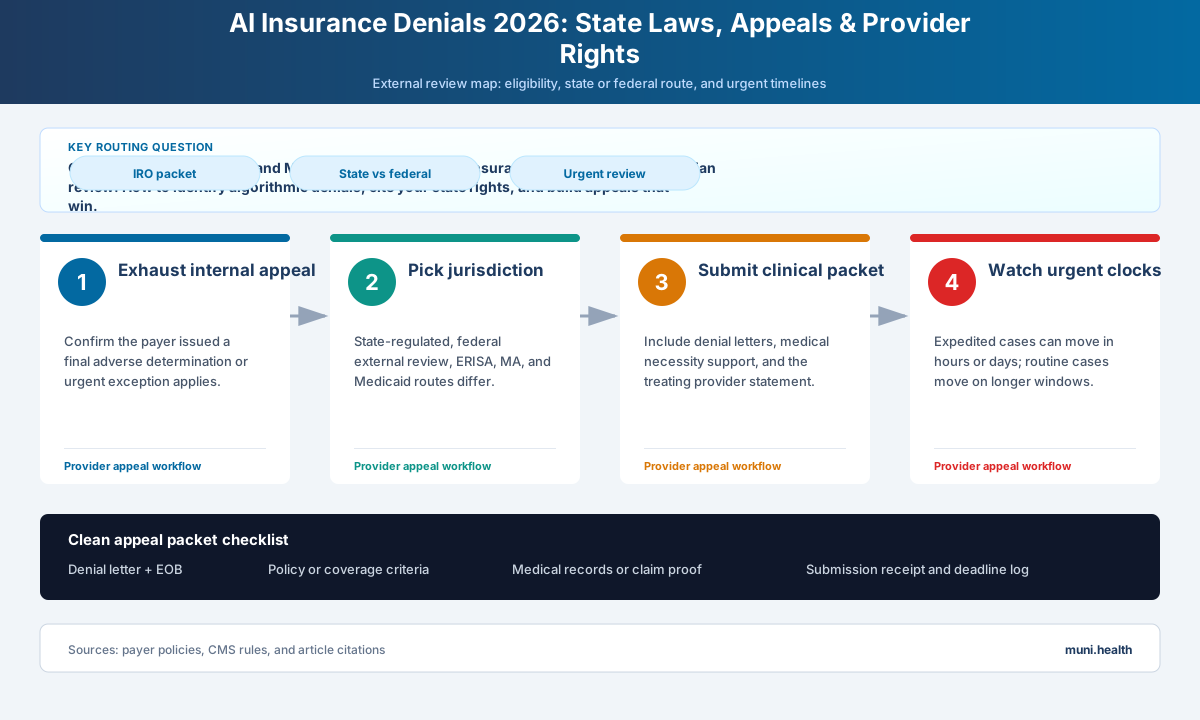
Step 5: Escalate to External Review
If the insurer upholds the denial after internal appeal, you have the right to request an independent external review in every state under the ACA. External reviewers are not affiliated with the insurer. Overturn rates at external review tend to be meaningful—and the insurer is bound by the decision.
How to request it:
The denial letter from the final internal appeal must include external review instructions. If it does not, contact your state's insurance commissioner office. Most states require the insurer to facilitate the external review process.
For Medicare Advantage denials, the external review path runs through the Medicare Appeals Council and, if needed, Administrative Law Judge (ALJ) hearings. See our Medicare Advantage appeal guide for the full MA appeal sequence.
State-Level Protections Against AI-Only Denials
Multiple states enacted laws in 2024 and 2025 requiring physician review of AI-generated adverse determinations. Knowing your state's status affects how you frame the appeal.
| State | Law / Statute | Effective Date | Key Requirement |
|---|---|---|---|
| California | SB 1120 (Physicians Make Decisions Act) | January 1, 2025 | Any denial based on medical necessity must be reviewed by a licensed physician or qualified clinician with expertise in the relevant clinical area |
| Texas | HB 1709 (2025) | September 1, 2025 | Utilization review agents cannot issue adverse determinations solely via automated decision system without physician oversight |
| Arizona | SB 1354 (2025) | July 1, 2025 | AI cannot be the sole basis for a medical necessity denial; human physician review required |
| Maryland | HB 1150 (2025) | October 1, 2025 | Prohibits insurers from using AI as the sole basis for denying, limiting, or conditioning coverage of health care services |
| Georgia | HB 396 (2026, pending as of March 2026) | TBD | Would prohibit insurance companies from issuing care denials based solely on AI output |
Sources: California SB 1120 (signed December 2024); Texas HB 1709 (2025 session); Arizona SB 1354 (2025 session); Maryland HB 1150 (2025 session); Georgia HB 396 tracking (Hoodline, March 2026).
If your state has enacted one of these laws and your denial was issued without documented physician review, state that explicitly in your appeal letter. Cite the statute. This is not a legal threat—it is a factual statement that the insurer's process may not comply with applicable law.
State law note: The table above reflects status as of March 2026. State AI-denial legislation is moving quickly — confirm your state's current status with your state insurance commissioner before citing a statute in an appeal letter.
Federal Update: CMS-0057-F and Medicare Advantage AI Denials (Effective January 1, 2026)
For Medicare Advantage plans specifically, federal regulation now adds a separate argument. Under CMS-0057-F, effective January 1, 2026, MA plans are required to provide PA denial notices that reference specific, current clinical criteria — not generic algorithmic output. If your MA denial letter does not cite the specific clinical policy basis for the adverse determination, the notice itself may be non-compliant with the new rule.
CMS-0057-F: A New Argument for MA AI Denials
If you receive a Medicare Advantage AI denial with a vague denial notice that doesn't cite specific clinical criteria, reference CMS-0057-F in your appeal. The rule requires MA plans to document the specific criteria applied — a requirement that algorithmic denials without physician review often fail to satisfy.
Federal Law Still Governs ERISA Plans
State AI-denial laws generally do not apply to self-funded employer plans governed by ERISA. If the patient's plan is self-funded (common in large employers), federal external review rules under the ACA apply instead of state protections. The denial letter should indicate whether the plan is subject to state or federal law.
A Sample Appeal Language Framework
You do not need to start from scratch. The following framework applies to most AI-driven medical necessity denials:
Re: Appeal of Adverse Determination — [Patient Name], Member ID [XXXXX]
Date of Service: [MM/DD/YYYY]
Procedure: [CPT Code] — [Procedure Name]
Denial Reference: [Denial Number from Letter]

This letter constitutes a formal first-level appeal of the adverse determination
issued on [denial date]. The denial states the requested service does not meet
medical necessity criteria under [insurer's policy/CPB number].

We respectfully disagree. The enclosed clinical documentation demonstrates that
[Patient Name] meets the criteria set forth in [policy document name] for the
following reasons:

1. [Criterion from policy] — Met. [Specific clinical evidence: e.g., "MRI dated
 XX/XX/XXXX confirms [finding]. This satisfies criterion X, which requires..."]

2. [Criterion from policy] — Met. [Clinical note dated XX/XX/XXXX documents
 [relevant finding or history].]

3. Alternative treatments have been attempted and failed: [List prior treatments,
 dates, and outcomes.]

Supporting guidelines: [e.g., "The American College of [Specialty]'s [guideline
name] (YYYY update) recommends [treatment] for patients presenting with [criteria
met by this patient]."]

We additionally request peer-to-peer review with the reviewing medical director
at the earliest available time. Please contact [physician name] at [phone number].

[Treating Physician Name, Credentials]
[Practice Name, NPI]
Skip the blank template. Start with a review-ready draft.
Use the template as guidance, or let Muni prepare a payer-specific draft for your team to verify, sign, and submit.
First 3 appeals free, then $20 per appeal. Start with your denial letter or EOB and available records. No meeting or clearinghouse connection required.
How Muni Appeals Helps With Algorithm-Driven Denials
The documentation burden in an AI-denial appeal is higher than a standard appeal. The insurer's system generated a coded decision—your appeal needs to systematically address the clinical criteria that triggered it.
Prepare this appeal packet with your team.
Draft the appeal, coordinate missing documents, and approve the reviewed packet. Keep your clearinghouse; your practice checks deadlines and submits through the payer’s accepted channel.
First 3 appeals free, then $20 per appeal. Start with your denial letter or EOB and available records. No meeting or clearinghouse connection required.
Muni Appeals organizes uploaded clinical documentation, surfaces candidate insurer-policy criteria, provides deadline-risk guidance, and generates appeal drafts structured around the stated medical-necessity rationale. Staff verifies the current policy and deadline, submits, and follows up with the payer.
For practices seeing a volume of AI-driven denials—especially for high-frequency CPT codes, prior auth for biologics, or post-acute care decisions—systematizing the response process reduces the time each appeal takes and improves consistency. Dermatology practices face particular pressure from AI-driven biologic prior authorization denials — the dermatology claim denials 2026 guide covers the documentation strategies for cosmetic vs. medical disputes and biologic PA appeals by payer.
Frequently Asked Questions
How do I know if my denial was generated by an algorithm?
Algorithmic denials typically arrive quickly after submission, use generic language that mirrors your ICD-10 codes rather than your clinical notes, and do not identify a reviewing clinician by name. You can also request in writing the name and credentials of the clinician who reviewed the denial—under most state and federal rules, the insurer must disclose this information.
What is the difference between an AI denial and a standard medical necessity denial?
A standard denial involves a human clinical reviewer who evaluated your documentation and determined it did not meet medical necessity. An AI denial may have bypassed clinical review entirely. The appeal strategy differs: with an AI denial, you are more likely to succeed by demanding physician-level review, citing the specific policy criteria that were algorithmically applied, and requesting peer-to-peer review.
Can I mention state AI laws in my appeal letter?
Yes, if your state has enacted a law requiring physician oversight of AI-generated adverse determinations (California, Texas, Arizona, Maryland as of early 2026), you can cite the applicable statute in your appeal. Note that ERISA self-funded plans are typically exempt from state insurance laws—check the denial letter or plan documents to determine whether your patient's plan is state-regulated or ERISA-governed.
What is a peer-to-peer review and how effective is it?
A peer-to-peer is a direct call between the treating physician and the insurer's reviewing medical director. It gives the treating physician an opportunity to explain the clinical rationale in detail. This approach is underused and often effective because it converts an algorithmic decision into a physician-to-physician clinical discussion. Many insurers allow peer-to-peer before the formal written appeal is filed.
What documentation matters most in an AI-denial appeal?
The most effective documentation: (1) a detailed physician narrative that addresses the insurer's specific clinical criteria, (2) diagnostic results supporting the clinical picture, (3) evidence of prior treatment failures if step therapy was required, and (4) citations to specialty society guidelines supporting the treatment. Generic cover letters that do not address the policy criteria are the most common reason appeals fail.
What is the external review process and when should I use it?
External review is an independent review by a third-party organization not affiliated with the insurer. Under the ACA, it is available for all non-grandfathered health plans after the internal appeal process is exhausted. Request it immediately after your final internal appeal is denied. External reviewers assess the denial against accepted clinical standards—not the insurer's internal criteria—and their decision is binding on the insurer.
Do AI-denial appeal strategies differ for Medicare Advantage plans?
Yes. Medicare Advantage has its own appeal pathway (redetermination, reconsideration by a Qualified Independent Contractor, ALJ hearing, Medicare Appeals Council). CMS oversight of MA AI utilization management is increasing following a 2022 OIG report that found MA organizations denied some medically necessary services. The documentation strategies above apply, but the submission channels and deadlines follow MA-specific rules rather than commercial plan rules.
Does Cigna's PxDx system still operate?
Cigna has faced litigation and significant public scrutiny over the PxDx algorithm (reported by ProPublica in March 2023). As of March 2026, Cigna has not publicly confirmed that PxDx has been decommissioned. Providers should treat any rapid Cigna denial with generic language as a potential automated decision and request the reviewing clinician's information in writing.
Ready to Systematize Your Appeal Process?
AI-generated denials are designed to be fast, generic, and easy to ignore. Appeals that cite clinical criteria directly, document the clinical picture in depth, and escalate to physician-level review succeed at meaningful rates—yet the majority of practices never file one.
Get Started:
- Organize documentation around insurer-specific clinical policy criteria
- Track appeal deadlines across multiple denials without manual follow-up
- Generate appeal letters structured to address medical necessity arguments directly
- Escalate to peer-to-peer and external review without losing track of the timeline
This guide reflects insurance appeal processes and regulatory developments as of March 2026. State AI-denial laws are evolving rapidly; confirm your state's current requirements before citing them in an appeal. ERISA self-funded plans are generally exempt from state insurance regulations. Muni Health is not a law firm and this content does not constitute legal advice. Consult a healthcare attorney for plan-specific legal questions.