

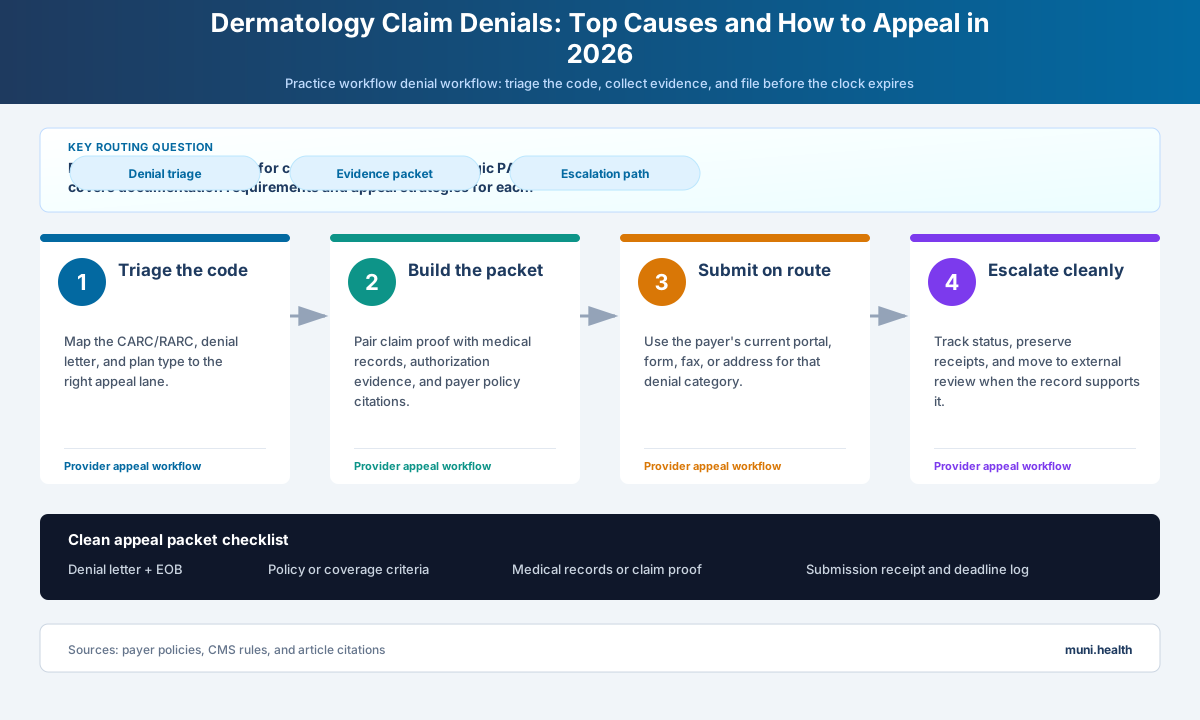
Dermatology claims are denied more than most specialties because procedures regularly fall near the line between cosmetic and medically necessary. The four most common denial types are cosmetic reclassification, Modifier 25 errors, incomplete biologic prior authorization, and excision size or location coding mistakes. Most dermatology denials are recoverable — the appeal has to cite the medical diagnosis, prove failed conservative treatment, and reference an AAD or specialty society guideline.
Why Dermatology Faces Elevated Denial Rates
Dermatology occupies a uniquely difficult position in insurance billing. A large share of dermatological procedures — excisions, injections, laser treatments — sit near the line between cosmetic and medically necessary, which gives payers repeated grounds to challenge claims.
The administrative burden is significant. According to the AMA's 2024 Prior Authorization Survey (n=1,004 physicians), 94% of respondents reported that PA requirements delay patient access to care, and 89% said the burden has grown substantially over the past five years. Biologics alone have driven prior authorization volume for dermatology to levels that strain billing workflows at most small practices.
Two trends in 2026 are making the environment harder:
AI-driven claim screening. UHC, Cigna, Aetna, and Humana use algorithmic tools to flag claims for review. Dermatology's cosmetic-vs-medical ambiguity generates more flags per claim than most specialties. See our guide on fighting AI-driven insurance denials in 2026 for documentation strategies that hold up against algorithm-based review.
CMS-0057-F (effective January 1, 2026). Medicare Advantage plans must now issue standard PA decisions within 7 calendar days and expedited decisions within 72 hours, and must provide specific clinical reasons for any denial. This creates documented appeal grounds for biologic PA denials that were previously returned with vague language.
The 5 Most Common Dermatology Denial Types
| Denial Type | Estimated Frequency | Root Cause | Primary Fix |
|---|---|---|---|
| Cosmetic vs. medical necessity | ~40% of derm denials | Payer reclassifies procedure as cosmetic despite medical diagnosis | ICD-10 code + functional impairment documentation + failed conservative treatment proof |
| Modifier errors (25, 59, X-series) | ~22% | Incomplete separate E/M documentation or wrong modifier selection | Separate procedure and E/M notes; use XS/XE instead of Modifier 59 when payer accepts X-modifiers |
| Biologic prior authorization denied | ~18% | Missing step therapy proof, severity scores, or incomplete lab work | Complete PA packet with BSA/PASI/DLQI scores, failed treatment dates, and all required labs |
| Excision size or location coding errors | ~12% | Measuring lesion only instead of lesion plus margins, or using wrong body region code | Document excised diameter pre-excision; verify 11400 vs. 11600 series and location group |
| Duplicate claims or patient data mismatch | ~8% | Double submission or name/DOB/ID errors at payer | Single submission channel; verify patient insurance ID at every visit |
Frequency ranges reflect reported denial pattern distributions in dermatology billing literature and are approximate. Actual percentages vary by practice type, payer mix, and documentation workflows.
Cosmetic vs. Medical Necessity: The Core Battle
The most common dermatology denial is a payer reclassifying a medically necessary procedure as cosmetic. This applies to Botox for hyperhidrosis, laser for actinic keratoses, mole removal for atypical nevi, and scar revision for hypertrophic scars causing functional limitations.
What a winning appeal must show:
- An ICD-10 diagnosis code that describes a medical condition — not a cosmetic concern
- Functional impairment documentation: pain level, restricted range of motion, recurrent infection, or occupational impact
- Failed conservative treatments with specific dates, doses, and outcomes
- A clinical guideline citation from the American Academy of Dermatology or an equivalent specialty society
| Procedure | Payer's Cosmetic Denial Claim | Medical Necessity Counter-Argument |
|---|---|---|
| Botox injection | Wrinkle reduction — not covered | Hyperhidrosis (R61.1), chronic migraine (G43.909), or blepharospasm (G24.5) — covered when medically indicated and documented |
| Laser treatment | Skin rejuvenation — not covered | Actinic keratosis (L57.0), rosacea (L71.9), or vascular lesions with documented functional impact — covered |
| Mole removal | Appearance improvement — not covered | Atypical nevus (D22 series) with melanoma risk, chronic irritation, or bleeding on contact — covered |
| Chemical peel | Cosmetic enhancement — not covered | Actinic keratoses (L57.0) are precancerous lesions — medical indication; document lesion count and clinical appearance |
| Scar revision | Aesthetic improvement — not covered | Hypertrophic scar (L91.0) causing pain, restricted range of motion, or recurrent breakdown — covered when functional impact is documented |
Appeal template for cosmetic denial:
I am appealing the denial of [procedure / CPT code] for [patient name] on [date of service].

The denial states this procedure is "cosmetic." This determination is incorrect.

Diagnosis: [ICD-10 code] — [description]
Functional impact: [Pain level 0-10, restricted motion in degrees, infection history,
work or daily activity limitation]

Failed conservative treatments:
— [Treatment 1]: [dates, dose/strength, duration, outcome]
— [Treatment 2]: [dates, dose/strength, duration, outcome]

Per [AAD Clinical Practice Guideline / National Psoriasis Foundation treatment
algorithm], [procedure] is the standard of care for [diagnosis] after failure of
[prior treatments]. Supporting documentation is attached.

I request reconsideration and approval.
Skip the blank template. Start with a review-ready draft.
Use the template as guidance, or let Muni prepare a payer-specific draft for your team to verify, sign, and submit.
First 3 appeals free, then $20 per appeal. Start with your denial letter or EOB and available records. No meeting or clearinghouse connection required.
Documentation Timing
Do not create clinical documentation retroactively for appeal purposes. Document functional impairment, failed treatments, and medical necessity language in the office note at the time of the visit. Appeals built on chart notes created after denial are flagged by payer audit teams.
Biologic Prior Authorization in 2026
Biologic therapy for psoriasis, atopic dermatitis, and hidradenitis suppurativa requires prior authorization from every major payer. Denials typically involve three deficiencies: step therapy not completed, severity not documented to the payer's threshold, or lab work missing.
2026 MA Plan PA Timelines (CMS-0057-F)
Effective January 1, 2026, Medicare Advantage plans must decide standard PA requests within 7 calendar days and expedited requests within 72 hours. They must also provide specific clinical denial reasons. This rule creates documented, challengeable grounds for biologic PA denials that were previously returned with non-specific language.
Required documentation for biologic PA across major payers:
- Severity scores: BSA (body surface area) greater than 10% for most psoriasis biologics; PASI score greater than 12; DLQI score greater than 10; for atopic dermatitis, EASI and IGA scores
- Failed step therapy: Topical corticosteroids, phototherapy (UVB or PUVA), and conventional systemics (methotrexate, cyclosporine) — each documented with start date, dose, duration, and specific reason for discontinuation
- Lab results: CBC with differential, comprehensive metabolic panel, hepatitis B surface antigen and antibody, hepatitis C antibody, TB QuantiFERON or PPD
- Photographic documentation: Timestamped clinical photos showing extent of involvement with a scale reference
BSA documentation formula:
Patient's entire palm (including fingers) = 1% BSA

Count the number of palm-sized areas covered by psoriatic plaques.

Documentation example:
"Psoriatic plaques cover approximately 18% BSA — trunk 8% (8 palm areas),
upper extremities 6% (6 areas), lower extremities 4% (4 areas)."

Include timestamped clinical photographs.
Biologic denial appeal — step therapy:
I am appealing the denial of [biologic name] for [patient name] with [diagnosis, ICD-10].
The denial cites incomplete step therapy. Our patient has tried and failed the following:

1. [Drug 1] [dose] — [start date] to [end date]: [outcome / reason discontinued]
2. [Drug 2] [dose] — [start date] to [end date]: [outcome / reason discontinued]
3. [Drug 3 if applicable] — contraindicated because: [specific clinical reason]

Disease severity at current evaluation:
— BSA: [X]% (payer threshold: >10%)
— PASI: [X] (payer threshold: >12)
— DLQI: [X] (payer threshold: >10)

Per the National Psoriasis Foundation treatment algorithm (2025 edition), biologic therapy
is appropriate for patients meeting these severity criteria who have failed conventional
systemic therapy. Our patient meets all three thresholds and has failed [X] prior
treatments. Supporting documentation, photographs, and lab results are attached.
State Step Therapy Override Laws
As of 2026, 29 states have enacted step therapy override laws that let practices request an exemption when step therapy is contraindicated or a patient previously failed the required drugs outside the current plan. If your state has a step therapy override law, cite it by name in the appeal and document the specific contraindication or prior failure.
For a broader look at prior authorization denial strategy across all payers, see the prior authorization denial complete guide 2026.
Excision and Biopsy Coding: Where Errors Happen
Excision Codes (11400–11646)
Excision codes are determined by the excised diameter — the lesion size plus the narrowest margin on each side — and the anatomic location. The most common coding error is measuring only the lesion.
Excision diameter formula:
Excised Diameter = Lesion Diameter + (2 × Narrowest Margin)

Example:
0.8 cm melanoma with 0.5 cm margins all around
= 0.8 + (2 × 0.5) = 1.8 cm → Code 11602 (trunk/arms/legs, 1.1–2.0 cm)

Document this measurement in the procedure note before excision.
Pathology report measurements are not acceptable — specimens shrink in formalin.
| Excised Diameter | Trunk / Arms / Legs | Scalp / Neck / Hands / Feet | Face / Ears / Lips |
|---|---|---|---|
| ≤0.5 cm | 11400 | 11420 | 11440 |
| 0.6–1.0 cm | 11401 | 11421 | 11441 |
| 1.1–2.0 cm | 11402 | 11422 | 11442 |
| 2.1–3.0 cm | 11403 | 11423 | 11443 |
| 3.1–4.0 cm | 11404 | 11424 | 11444 |
| >4.0 cm | 11406 | 11426 | 11446 |
These are benign lesion excision codes (11400 series). Malignant lesion excisions use the 11600–11646 series with the same size and location structure. If lesion type is uncertain at time of service, billing teams should confirm with the physician whether to bill benign or malignant — or wait for pathology to determine the correct series.
Biopsy Codes (11102–11107)
Skin biopsy codes were updated January 2019. The current codes are based on technique, not lesion size. Claims submitted with the deleted 11100/11101 codes are automatically denied.
| Technique | Primary Code | Add-on Code | When to Use |
|---|---|---|---|
| Tangential (shave) | 11102 | +11103 | Raised or superficial lesions — BCC, SCC screening, seborrheic keratosis |
| Punch | 11104 | +11105 | Deep dermal sampling — suspected melanoma, inflammatory conditions |
| Incisional | 11106 | +11107 | Large lesions requiring partial sampling for diagnosis |
Key rule: Only one primary biopsy code per session. If multiple techniques are used, bill one primary code and add-on codes for additional biopsies. Do not bill two primary codes (e.g., 11102 + 11104) in the same session — this is a common coding error that triggers automatic denial.
Modifiers That Make or Break Dermatology Claims
Dermatology depends on modifiers more than almost any specialty, and modifier errors are one of the most common denial drivers after cosmetic reclassification. Payers audit modifier patterns aggressively, so correct usage — and documentation that supports it — is the difference between payment and a denial.
Modifier 25 — a significant, separately identifiable E/M service on the same day as a procedure. Use it when the E/M involves distinct medical decision-making beyond the procedure itself. The classic correct case: a patient presents for an annual skin check (E/M), a suspicious lesion is found and biopsied during the visit. The classic incorrect case: a patient scheduled specifically for a mole removal, where the only exam is of that mole. A Modifier 25 rate above ~40% of E/M visits is a well-known audit trigger — the typical dermatology range is 15–20% of visits. The documentation has to make the two services independently legible:
CHIEF COMPLAINT: Annual full-body skin cancer screening (E/M)

E/M NOTE (documented before the procedure note):
Complete skin exam performed. Atypical 6 mm pigmented lesion identified
on the right forearm with asymmetry and color variation, concerning for
melanoma. Risks/benefits of biopsy discussed with the patient.

PROCEDURE NOTE (separate):
Shave biopsy, right forearm lesion (11102).

Why Modifier 25 applies: the screening E/M has its own history, exam, and
medical decision-making beyond the biopsy that it triggered.
Modifier 59 and the X-modifiers (XE, XS, XP, XU) — a distinct procedural service. Use these to show that procedures usually bundled together were genuinely separate. In dermatology the most common is XS (separate structure) — two lesions excised from different anatomic sites. Medicare and most commercial payers prefer the specific X-modifiers over the older Modifier 59: XE (separate encounter), XS (separate structure), XP (separate practitioner), XU (unusual, non-overlapping). Use Modifier 59 only when a payer does not recognize X-modifiers, and never stack multiple X-modifiers on one line.
Modifier 76 — repeat procedure by the same physician. Correct for a second biopsy after an inconclusive first pathology result; incorrect for multiple biopsies performed at the initial visit, which use add-on codes instead.
Modifiers LT/RT — laterality. Required on procedures that are inherently lateral or bilateral; do not append them to codes that carry no laterality distinction.
Appeal a Modifier Denial by Proving the Split
When a claim is denied for modifier misuse, the appeal succeeds or fails on documentation, not argument. Attach the E/M note and the procedure note as separate records, and point to the distinct medical decision-making in the E/M. If the two services truly were separate and the chart shows it, the denial reverses.
Preventing Dermatology Denials Before Submission
Most dermatology denials are cheaper to prevent than to appeal. A short pre-submission scrub on the highest-dollar claims catches the errors payers reject most often. Run each claim against this checklist before it goes out:
Prepare this appeal packet with your team.
Draft the appeal, coordinate missing documents, and approve the reviewed packet. Keep your clearinghouse; your practice checks deadlines and submits through the payer’s accepted channel.
First 3 appeals free, then $20 per appeal. Start with your denial letter or EOB and available records. No meeting or clearinghouse connection required.
- Medical vs. cosmetic: Does the ICD-10 code establish a medical indication, and does the chart avoid aesthetic language a payer could use to reclassify the service?
- Modifier support: If Modifier 25 is on the claim, is the E/M note complete and separate from the procedure note? If Modifier 59 is used, would a specific X-modifier be more accurate?
- Prior authorization: Does the CPT code — especially for biologics — require PA, and is the approval on file before the date of service?
- Code-to-diagnosis pairing: Does the diagnosis actually support the procedure billed?
- Excision size and site: Does the excision code match the documented diameter (lesion plus twice the margin) and the body region?
- Current biopsy codes: Are you using the 11102–11107 technique-based codes, not the deleted 11100/11101?
Building this scrub into intake — and reserving a manual review for claims above a set dollar threshold — keeps the recurring, predictable errors out of your denial queue entirely.
How Muni Appeals Handles Dermatology Denials
Dermatology appeals require specialty-specific documentation that generic billing workflows miss — the medical framing for cosmetic-adjacent procedures, the precise severity scores for biologic PA appeals, and the excision diameter calculations that have to match the CPT codes billed.
Muni Appeals reviews the documentation structure for each denial type and builds appeals against the specific clinical policy the payer cited:
- Identifies cosmetic vs. medical documentation gaps before the appeal is submitted
- Generates biologic PA appeal drafts around candidate payer-policy criteria that staff verifies against the current source
- Reviews Modifier 25 documentation to confirm the E/M note is complete and separate
- Surfaces payer and plan-type deadline risk from the uploaded denial for staff verification and calendaring
For a broader view of how denial rates compare across insurers, see the insurance denial rate by company 2026 guide. For dental specialty billing teams facing ADA code-specific denials — D4341 SRP documentation, D2750 crown coverage disputes, D7310 alveoloplasty bundling — the dental insurance claim denial appeal guide 2026 covers documentation requirements and payer-specific appeal processes for Delta Dental, MetLife, Cigna Dental, and Aetna Dental. The same failed-conservative-treatment documentation standard drives medical necessity denials in gynecologic surgery — see the OB/GYN claim denials guide for how payers apply it to hysterectomy and endometrial ablation.
Start 3 Free Dermatology Appeals
Frequently Asked Questions
Why do dermatology claims get denied more often than other specialties?
Dermatology has a higher denial rate than most specialties because many procedures fall near the line between cosmetic and medically necessary — and payers have broad discretion to reclassify them. Dermatology also relies heavily on Modifier 25, which is a consistent audit flag when documentation is incomplete. Biologic prior authorization for psoriasis, atopic dermatitis, and hidradenitis suppurativa adds a third category of systematic denials with high documentation requirements.
What documentation makes a cosmetic denial appeal succeed?
A strong cosmetic denial appeal needs four things: (1) an ICD-10 code describing a medical condition — not a cosmetic concern; (2) functional impairment documentation such as pain scale, restricted range of motion, recurrent infection, or occupational impact; (3) a list of failed conservative treatments with specific dates, doses, and outcomes; and (4) a citation from an AAD or specialty society clinical guideline supporting the procedure as standard of care for the documented condition. Avoid aesthetic language in chart notes — phrases like "patient unhappy with appearance" are used by payers to support cosmetic classification.
How is the excised diameter calculated for dermatology excision coding?
The excised diameter equals the lesion diameter plus twice the narrowest margin. For example, a 0.8 cm lesion with 0.5 cm margins on each side has an excised diameter of 1.8 cm (0.8 + 0.5 + 0.5). Document this measurement in the procedure note before the excision — pathology measurements are not acceptable for CPT code selection because specimens shrink in formalin. The body region (trunk/arms/legs vs. scalp/neck/hands/feet vs. face/ears/lips) determines which code series applies.
What does CMS-0057-F change for dermatology biologic prior authorization in 2026?
CMS-0057-F, effective January 1, 2026, requires Medicare Advantage plans to issue standard PA decisions within 7 calendar days and expedited decisions within 72 hours. It also requires specific clinical denial reasons — MA plans can no longer return vague blanket denials. For dermatology, this means biologic PA denials from MA plans must cite the specific criteria the request failed to meet, which gives you a direct target for the appeal. Commercial plan timelines are set by individual plan documents and are unaffected by CMS-0057-F.
When should I use Modifier 25 for a dermatology visit?
Use Modifier 25 when a significant, separately identifiable E/M service is performed on the same day as a procedure, and when that E/M involves distinct medical decision-making beyond the procedure itself. The E/M note must be documented completely separate from the procedure note. Do not use Modifier 25 when the only activity was performing the scheduled procedure. A Modifier 25 rate above 40% of E/M visits is a common payer audit trigger — the typical range for dermatology is 15–20% of visits.
What is the difference between Modifier 59 and the X-modifiers?
The X-modifiers (XE, XS, XP, XU) are more specific versions of Modifier 59. XS (Separate Structure) is the most common in dermatology — use it when billing procedures on different anatomic sites in the same session. XE (Separate Encounter) applies when the same procedures occur at different times on the same day. Medicare and most commercial payers prefer X-modifiers over Modifier 59. Use Modifier 59 only when the payer does not accept X-modifiers. The same modifier hierarchy applies in orthopedic billing, where NCCI bundling edits are especially common; see the orthopedic surgery claim denials guide for CPT-specific unbundling examples and NCCI edit documentation requirements.
What documentation is required for Dupixent prior authorization in 2026?
For Dupixent (dupilumab) in atopic dermatitis, payers typically require: disease severity scores (EASI and IGA — most payers require IGA ≥3 or EASI ≥16); documented failure of high-potency topical corticosteroids (two to three different agents, 4+ weeks each); failure of phototherapy if the payer requires it; baseline labs including CBC, CMP, and hepatitis panel; and timestamped clinical photographs. The specific step therapy requirements vary by payer — check the current Clinical Policy Bulletin before submitting. Under CMS-0057-F, MA plan denials must now state the specific criterion the request failed to meet, which tells you exactly what to address in the appeal.
Can I bill both an E/M visit and a procedure on the same day?
Yes — using Modifier 25 — but only when the E/M service is significant and separately identifiable from the procedure. Three requirements: the E/M note is documented completely separately from the procedure note; the E/M involves distinct medical decision-making beyond the procedure itself; and the E/M addresses a different condition or goes meaningfully beyond a routine pre-procedure assessment. A patient who comes in for a full skin check where a lesion is found and biopsied supports both charges. A patient scheduled specifically to remove one mole, where you examine and remove only that mole, does not — bill the procedure alone.
How do I calculate Body Surface Area (BSA) for a psoriasis biologic approval?
Use the palm method: the patient's entire palm including fingers equals roughly 1% BSA. Count the palm-sized areas covered by psoriatic plaques and sum them — for example, trunk 8 palms + upper extremities 6 + lower extremities 4 = approximately 18% BSA. Most biologic prior authorizations require BSA above 10%, a PASI score above 12, or a DLQI above 10. Document the calculation explicitly in the note and include timestamped clinical photographs with a ruler or known-size reference for scale. Calculate conservatively but completely — understating involvement is a common cause of "insufficient severity" denials.
Ready to Recover Your Dermatology Denials?
Dermatology denial patterns are predictable. Cosmetic reclassification, Modifier 25 documentation gaps, and biologic PA deficiencies follow consistent patterns across Aetna, BCBS, UHC, Cigna, and Humana. With specialty-specific documentation and appeals structured around each payer's clinical policy, most dermatology denials are recoverable.
Get started with Muni Appeals:
- Appeal drafting for cosmetic vs. medical denials, structured around AAD guidelines
- Biologic PA appeal letters tailored to each payer's Clinical Policy Bulletin
- Modifier 25 documentation review before claims are submitted
- Deadline-risk guidance across payer and plan contexts for staff verification
This guide reflects 2026 dermatology billing and coding procedures, including CPT skin biopsy codes updated January 2019 and Medicare Advantage prior authorization timeline requirements under CMS-0057-F effective January 1, 2026. State-specific step therapy override laws and individual payer Clinical Policy Bulletins vary. Always verify current payer requirements before submitting claims or appeals.