

If your prior authorization was denied, you can appeal within 15–180 days depending on the insurer and urgency. Start by reading the denial reason carefully, then pull the insurer's clinical criteria and build a documentation package that addresses each criterion directly. For Medicare Advantage, Medicaid, and ACA marketplace plans, CMS-0057-F (effective January 1, 2026) now requires specific written denial reasons and faster appeal decisions — use those requirements when filing.
Skip the Paperwork — Muni Handles PA Appeals
Muni Appeals prepares review-ready prior-authorization appeal documentation with policy citations, an evidence checklist, and deadline-risk guidance. Staff coordinates peer-to-peer review, verifies deadlines, and submits. Start 3 free appeals.
What Changed for Prior Authorization in 2026
The two most significant 2026 changes are CMS-0057-F (effective January 1, 2026), which mandates 7-day standard PA decisions and specific written denial reasons for Medicare Advantage, Medicaid, and ACA marketplace plans, and the CMS WISeR Model, which introduced prior authorization requirements for Traditional Medicare Part B for the first time in six states.
Two regulatory shifts reshaped the prior authorization landscape starting January 2026.
This guide covers denials on services where prior authorization was actually required and binding. If you're not sure whether a service needed prior authorization at all, or you're weighing that against a payer's optional predetermination estimate, see Predetermination vs. Prior Authorization vs. Precertification first.
CMS Interoperability and Prior Authorization Final Rule (CMS-0057-F), finalized February 2024 and effective January 1, 2026, requires Medicare Advantage organizations, Medicaid managed care plans, CHIP, and ACA marketplace plans to:
- Decide standard PA requests within 7 calendar days
- Decide urgent/expedited PA requests within 72 hours
- Provide specific clinical reasons for every denial — denial codes alone no longer satisfy the requirement
- Publish PA requirements via FHIR-based APIs so practices can look up coverage criteria programmatically
This rule does not apply to commercial employer-sponsored plans not sold on the ACA marketplace. For those plans, ERISA and state law still govern timelines.
CMS WISeR Model, live since January 5, 2026, introduced prior authorization requirements for Traditional Medicare Part B in six states — NJ, OH, OK, TX, AZ, and WA — for select high-cost, high-variation services including epidural steroid injections, cervical fusion, and skin substitutes. This is the first time fee-for-service Medicare has required PA for outpatient services at scale.
For a full state-by-state and CPT code breakdown of WISeR, see the CMS WISeR model prior authorization guide.
Traditional Medicare also runs a separate prior authorization program for certain durable medical equipment, prosthetics, orthotics, and supplies, and that list expands again on October 28, 2026. For DME-specific documentation requirements and appeal routes, see the DME denial and prior authorization guide.
PA Burden in 2026
According to the AMA's 2023 Prior Authorization Physician Survey (n=1,000 physicians), 94% of physicians report PA delays care and 89% report it negatively impacts patient outcomes. The average practice spends roughly 13 hours per week managing prior authorization requirements. The new CMS rule addresses federal plan timelines — commercial timelines remain unchanged.
Why Prior Authorization Requests Get Denied in 2026
The most common stated reason for prior authorization denial is "not medically necessary," accounting for approximately 45–50% of denials across major commercial insurers — followed by incomplete step therapy documentation (~20–25%) and "experimental or investigational" classifications (~10–12%). Understanding the exact stated reason on the denial letter determines your entire appeal strategy.
Prepare this appeal without starting from scratch.
Muni drafts the letter, surfaces payer-policy citations, and builds the evidence checklist. Your staff stays responsible for review and submission.
First 3 appeals free, then $20 per appeal. Start with your denial letter or EOB and available records. No meeting or clearinghouse connection required.
Most PA denials fall into a small number of categories.
| Denial Reason | Est. Frequency | Appeal Strategy | Key Documentation |
|---|---|---|---|
| Not medically necessary | ~45–50% of denials | Cite the insurer's clinical criteria directly; document why the patient meets them or qualifies for an exception | Clinical notes, CPB/CDG reference, peer-reviewed guidelines, physician narrative |
| Conservative treatment not completed (step therapy) | ~20–25% of denials | Document all prior treatments with dates, doses, duration, and clinical outcomes | Treatment history, prescribing records, chart notes showing treatment failure |
| Experimental or investigational | ~10–12% of denials | Cite FDA approval, peer-reviewed studies, and applicable clinical society guidelines | Published research, medical society guidelines (AMA, AAOS, AAD, etc.), FDA labeling |
| Insufficient clinical information | ~8–10% of denials | Resubmit with complete records; request peer-to-peer review to walk through clinical details | Progress notes, imaging reports, lab results, functional assessments |
| Out-of-network provider | ~5–8% of denials | Document lack of comparable in-network expertise or geographic access | Letter of necessity, network adequacy documentation |
| Service not covered under plan | <5% of denials | Review Summary of Benefits carefully; check for applicable state mandates or ACA essential benefits protections | Benefit documents, state insurance department guidance |
Frequency estimates reflect general commercial insurer patterns based on CMS and insurer public data; individual payer and plan-type rates vary. For step therapy denials specifically — the ~20–25% category — the exception request process, five recognized grounds, and payer-specific routing differ significantly from standard medical necessity appeals. For a full breakdown focused on Aetna, see the Aetna step therapy denial appeal guide.
Prior Authorization Denial Rate Trends: 2019–2026
Prior authorization denial rates and PA administrative burden have increased substantially from 2019 through 2026, driven by rising PA volume, AI-automated review, and expanding plan requirements — with the most recent federal regulatory response (CMS-0057-F) taking effect January 1, 2026.
The following data points are drawn from named primary sources covering the 2019–2026 period:
- HHS Office of Inspector General, April 2022 (reviewing Medicare Advantage prior authorization practices): OIG found that MA organizations denied a substantial percentage of prior authorization requests that met Medicare coverage standards — services that were later approved upon appeal or auditor review. OIG concluded that MA organization review processes led to some care access issues for beneficiaries with legitimate medical needs. (Source: HHS OIG, "Some Medicare Advantage Organization Denials of Prior Authorization Requests Raise Concerns About Beneficiary Access to Medically Necessary Care," 2022)
- KFF, November 2023 (analyzing 2021 ACA marketplace data from 38 insurers): Insurer-level denial rates for in-network claims varied substantially across payers, with denial rates differing dramatically between the lowest- and highest-denying insurers. The data showed no single "industry standard" rate — access to coverage varied significantly based on which plan a patient enrolled in. (Source: KFF Issue Brief, "Claims Denials and Appeals in ACA Marketplace Plans, 2021")
- AMA Prior Authorization Physician Survey 2023 (n=1,000 physicians): 62% of physicians reported PA requirements increased over the prior five years. 94% reported PA causes care delays. 89% reported PA negatively affects patient outcomes. Practices spend an average of 13 hours per physician per week managing PA requirements — equivalent to roughly two full staff members per practice. (Source: AMA, "2023 AMA Prior Authorization Physician Survey")
- AMA Prior Authorization Physician Survey 2024: 61% of physicians now report that AI-based PA review systems at major insurers result in more denials than human review. (Source: AMA, "2024 AMA Prior Authorization Physician Survey")
- CMS-0057-F regulatory response, effective January 1, 2026: The rule's preamble cited OIG findings and rising MA denial volumes as justification for the 7-day decision mandate and specific written denial reason requirement. CMS estimated that Medicare Advantage plans receive approximately 46 million prior authorization requests annually. (Source: CMS Interoperability and Prior Authorization Final Rule, effective January 1, 2026)
| Year | PA Denial Signal | Source |
|---|---|---|
| 2019 | OIG audit found MA organizations denied a substantial share of PA requests for services that met Medicare coverage standards and were later approved on appeal | HHS OIG, 2022 (reviewing 2019 MA data) |
| 2021 | ACA marketplace denial rates varied dramatically across 38 major insurers — from low single digits to nearly 50% — with no single industry standard | KFF Issue Brief, November 2023 |
| 2023 | 62% of physicians report PA burden increased vs. 5 years prior; 94% cite care delays; 13 hrs/physician/week average | AMA 2023 Prior Authorization Physician Survey |
| 2024 | 61% of physicians report AI-based PA systems produce more denials than human review | AMA 2024 Prior Authorization Physician Survey |
| 2026 | CMS-0057-F requires specific written denial reasons and 7-day standard / 72-hour expedited decisions for MA, Medicaid managed care, and marketplace plans; ~46M MA PA requests/year estimated | CMS-0057-F Final Rule, effective Jan 1, 2026 |
The 2019–2026 trend reflects both rising denial volumes and the emergence of AI-driven review as the dominant systemic pressure on PA appeals. CMS-0057-F addresses transparency and speed for federal plan denials but does not cap commercial insurer denial rates, which remain governed by state law and plan-specific policy.
Behavioral health prior authorization denials carry additional appeal grounds under federal parity law: if the insurer applies more restrictive medical necessity criteria to the behavioral health PA than to a comparable medical/surgical authorization, that is an MHPAEA violation — a separate and often stronger argument than a standard medical necessity appeal. See the mental health insurance denial appeal guide for MHPAEA-based arguments and payer-specific behavioral health routing.
For orthopedic and musculoskeletal procedures, Cigna, Humana, and select BCBS affiliates delegate MSK prior authorization to EviCore — which means appeals for those denials must go to EviCore, not the health plan. See the orthopedic surgery claim denials guide for EviCore routing details, modifier 59 and NCCI bundling fixes, and CMS-0057-F timeline guidance specific to orthopedic cases.
Gastroenterology denials carry a coding trap most other specialties don't: a screening colonoscopy that converts to diagnostic mid-procedure requires the correct payer-specific modifier (PT for Medicare, 33 for commercial), and using the wrong one causes an automatic denial regardless of PA status. See the gastroenterology claim denials guide for the modifier rule, capsule endoscopy PA requirements, and NCCI bundling fixes for biopsy-and-polypectomy claims.
Neurology denials frequently trace to a coding rule rather than a coverage dispute: billing a standalone EMG code on the same date as a nerve conduction study, instead of the correct combined code, causes an automatic denial under Medicare's own billing guidance. See the neurology claim denials guide for the EMG/NCS coding fix, brain and spine MRI PA routing through EviCore and Carelon, and Botox-for-chronic-migraine step-therapy documentation.
How to Appeal a Prior Authorization Denial in 2026: Step by Step
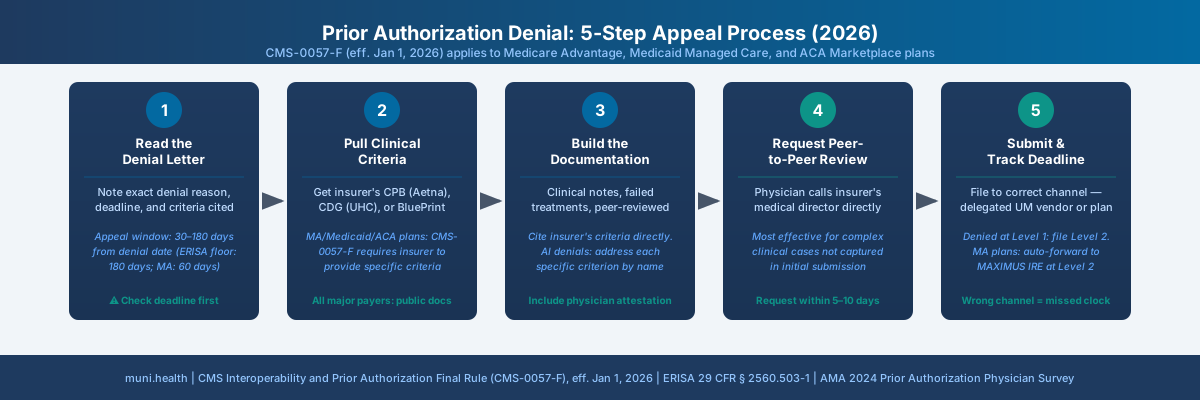
Appealing a prior authorization denial requires five steps: read the denial letter for the exact stated reason and filing deadline, pull the insurer's published clinical criteria, compile a documentation package that addresses each criterion directly, request a peer-to-peer review, and submit through the insurer's correct channel before the deadline.
Step 1: Read the Denial Letter Carefully
Every denial letter must include:
- The specific reason for denial (required under CMS-0057-F for MA, Medicaid, and marketplace plans)
- The clinical criteria used to evaluate the request
- Your appeal rights and deadline
- Contact information for the appeals department
If the denial letter for a federal plan provides only a denial code without clinical rationale, you have grounds to request the specific reasoning in writing before filing the appeal. Document that you made this request.
This is also where a documented original request pays off. If the prior authorization was requested or followed up by phone, pull the call log — reference number, rep name, and stated decision date — it shows exactly what was submitted and when, which strengthens the appeal if the denial contradicts what was discussed on the call.
Deadline Is the First Thing to Check
Most commercial insurers require PA appeals within 30–180 days of the denial date. Medicare Advantage plans must accept standard appeals within 60 calendar days under CMS rules. Missing the deadline usually forfeits appeal rights entirely.
Step 2: Pull the Insurer's Clinical Coverage Criteria
Each major insurer publishes the clinical guidelines used to evaluate PA requests — these documents define what counts as medically necessary and list specific exceptions. Using the insurer's own criteria language in your appeal is the single most effective tactic because reviewers evaluate appeals against that same document.
| Payer | Clinical Criteria Document | Where to Find It | What to Cite in Your Appeal |
|---|---|---|---|
| Aetna | Clinical Policy Bulletins (CPBs) | Aetna provider portal → Clinical Policies → CPBs by service type | CPB number, version date, and specific criterion the patient meets or exception that applies |
| UnitedHealthcare | Coverage Determination Guidelines (CDGs) + Clinical Coverage Policies | UnitedHealthcareOnline → Policies & Protocols → Coverage Determination Guidelines | CDG title and the specific inclusion/exclusion criterion; confirm MA vs. commercial version — they differ |
| Cigna | Medical Coverage Policies + CoverageEdge Guidelines | cigna.com/providers → Coverage Policies → Medical Coverage Policies | Policy number, effective date, and the clinical criterion at issue; CoverageEdge applies to select commercial plans |
| BCBS | BluePrint Medical Guidelines + affiliate-specific policies | Varies by affiliate; Carelon (formerly AIM) governs imaging and MSK PA criteria for most affiliates | For Carelon-delegated services, cite Carelon MCG criteria — not BCBS plan guidelines. See the BCBS prior authorization template for full Carelon routing. |
| Humana | Medical Coverage Policies | humana.com → For Providers → Coverage Policies | Confirm whether service is delegated to eviCore or Evolent — their criteria govern, not Humana Medical Coverage Policies; denial letter will name the reviewing entity |
| Medicare Advantage (all plans) | CMS Medicare Coverage Determinations + plan-specific coverage rules | CMS Local and National Coverage Determinations (LCD/NCD) available at cms.gov; plan-specific coverage at plan's provider portal | Cite the applicable LCD/NCD; for MA plan-specific denials, the plan must disclose the specific criterion under CMS-0057-F |
The appeal should address the insurer's criteria directly. If the denial cited a specific guideline or coverage policy section, quote that section in your response. If the patient's situation is an exception the guideline contemplates, name the exception explicitly.
Step 3: Compile the Documentation Package
A complete documentation package addresses the denial reason on its own terms.
At minimum, include:
- Complete clinical notes from the relevant treatment period
- Objective findings — imaging reports, lab values, functional assessments
- Failed conservative treatments — documented with dates, doses, and clinical outcomes
- Physician attestation — the ordering provider's narrative connecting the clinical picture to the requested service
- Peer-reviewed support — published guidelines from applicable medical societies
- CPB/CDG citation — the insurer's own clinical criteria, including any exceptions the patient qualifies under
For AI-driven denials — where the PA was rejected algorithmically before physician review — detailed structured documentation is especially important. If you're dealing with a denial that shows signs of automated review, see the guide to fighting AI insurance denials in 2026 for documentation language and escalation steps by payer.
Step 4: Request a Peer-to-Peer Review
A peer-to-peer review (P2P) connects the ordering or treating physician directly with the insurer's medical reviewer by phone. Most insurers offer this either before the formal written appeal or alongside it.
P2P is most effective when:
- The denial is medical necessity-based and clinical complexity was not captured in the initial submission
- The chart tells a more complete story than the records that were submitted
- The denial cites "incomplete information" rather than a hard clinical exclusion
P2P requests typically must be made within 5–10 business days of the denial. Confirm the window with the insurer's provider line and document the request date. For payer-specific scheduling steps, documentation checklists, and what to say on the call, see the peer-to-peer review provider guide 2026.
Step 5: Submit the Appeal Through the Right Channel
Use the insurer's preferred submission method. For insurer-specific fax numbers, portal URLs, and mailing addresses, see:
- Aetna prior authorization appeal guide
- UHC prior authorization template and submission guide
- How to appeal a UHC prior authorization denial
- Cigna prior authorization appeal guide
- Humana prior authorization guide 2026
- Humana prior authorization denial appeal guide — EviCore routing, P2P, and MA appeal ladder
- Anthem prior authorization template 2026 — AIM, EviCore, and IngenioRx routing
- Oscar Health prior authorization denial guide 2026 — EviCore delegation, P2P routing, and portal submission (not Availity)
Your cover letter should:
- Identify the patient, claim, denial date, and specific denial reason being addressed
- List every document included by title and date
- State the exact clinical criteria you are meeting or the exception you are invoking
- Request a second-level review if the first-level appeal is denied
2026 PA Decision Timelines by Plan Type
Medicare Advantage, Medicaid managed care, and ACA marketplace plans are now subject to CMS-0057-F's 7-day standard decision requirement and 72-hour expedited requirement (effective January 1, 2026). Commercial and ERISA employer plans operate on insurer-specific timelines — typically 14–15 days for initial PA decisions and 30–60 days for standard appeals.
The timeline an insurer has to decide a PA request or appeal depends on whether the plan falls under the CMS-0057-F rule. For appeal filing deadlines — how long you have to submit after a denial — see the insurance appeal deadlines guide for 2026.
| Plan Type | Initial PA Decision | Standard Appeal Window | Expedited Appeal | Governing Rule |
|---|---|---|---|---|
| Medicare Advantage | 7 calendar days | 60 calendar days | 72 hours | CMS-0057-F (effective Jan 1, 2026) |
| Medicaid Managed Care (CMS-regulated) | 7 calendar days | Varies by state | 72 hours | CMS-0057-F (effective Jan 1, 2026) |
| ACA Marketplace (federal plan) | 7 calendar days | 60 calendar days | 72 hours | CMS-0057-F (effective Jan 1, 2026) |
| Traditional Medicare — WISeR states | 7 business days (pre-service) | Expedited review available for urgent cases | 72 hours for urgent/emergent | CMS WISeR Model (effective Jan 5, 2026) |
| Commercial (non-marketplace) | Typically 14–15 calendar days | Typically 30–60 days (insurer-specific) | 72 hours (most states) | State law + insurer policy |
| ERISA employer plan (self-funded) | 15 calendar days (pre-service) | 60 calendar days (pre-service) | 72 hours (urgent) | ERISA 29 CFR § 2560.503-1 |
For commercial plans outside the ACA marketplace, timelines are set by state insurance law and the insurer's own procedures. If the deadline is unclear, call the provider line and ask for the deadline in writing.
PA Appeal Filing Deadlines by Payer: How Long You Have to File
The deadline to submit a PA appeal runs from the date of the denial notice — not the date of service. Missing the window typically forfeits appeal rights entirely. The table below reflects provider administrative guide standards for the 2026 plan year; confirm the exact deadline in the denial letter because plan-specific contracts sometimes extend the minimum window, and California, New York, and Texas each impose separate state-level appeal timeline requirements.
| Payer / Plan Type | Standard PA Appeal Filing Window | Expedited (Urgent) Window | Primary Authority |
|---|---|---|---|
| Medicare Advantage (all plans) | 60 calendar days from denial notice | 72 hours (urgent/expedited) | CMS-0057-F; 42 CFR § 422.568 |
| Medicaid Managed Care (CMS-regulated) | Varies by state; typically 60–90 calendar days | 72 hours | CMS-0057-F; state Medicaid plan contract |
| ACA Marketplace (federal/state exchange) | 60 calendar days from denial notice | 72 hours | CMS-0057-F; 45 CFR § 147.136 |
| Aetna Commercial | 180 calendar days from denial notice | 72 hours | Aetna Commercial Provider Administrative Guide, 2026 |
| UnitedHealthcare Commercial | 60 calendar days from denial notice | 72 hours | UHC Provider Administrative Guide, 2026 |
| Cigna Commercial | 180 calendar days from denial notice | 72 hours | Cigna Provider Toolkit and Administrative Guide, 2026 |
| BCBS (varies by affiliate) | 30–180 calendar days (affiliate-specific); BlueCross BlueShield FEP: 6 months | 72 hours | Verify with the specific BCBS affiliate's provider manual |
| Humana Commercial | 60 calendar days from denial notice | 72 hours | Humana Provider Administrative Manual, 2026 |
| ERISA self-funded employer plan | Minimum 60 calendar days (pre-service) | 72 hours (urgent care) | 29 CFR § 2560.503-1 (minimum); plan SPD may set a longer window |
| Traditional Medicare — WISeR states (NJ, OH, OK, TX, AZ, WA) | Pre-service: file before procedure; post-payment: 120 calendar days from remittance | 72 hours for urgent/emergent services | CMS WISeR Model rules, effective January 5, 2026 |
If the denial letter shows a shorter window than the table above, confirm with the insurer's provider line — in most cases the plan must honor the federal or ERISA floor even if the letter was incorrectly shorter. For a full breakdown of appeal filing deadlines across insurer types and states, see the insurance appeal deadlines guide 2026.
Where to File Your PA Appeal: Delegated UM Routing by Payer
Filing a PA denial appeal to the health plan when the denial came from a delegated UM vendor is the single most common reason provider appeals fail before clinical review begins. When a major insurer delegates prior authorization review to a specialty vendor such as eviCore or Evolent, the appeal must go to that vendor — not the health plan — using the vendor's portal or fax. The denial letter identifies which entity conducted the review; that entity is the correct appeal destination.
Prepare this appeal without starting from scratch.
Muni drafts the letter, surfaces payer-policy citations, and builds the evidence checklist. Your staff stays responsible for review and submission.
First 3 appeals free, then $20 per appeal. Start with your denial letter or EOB and available records. No meeting or clearinghouse connection required.
| Payer | Delegated Service Categories | UM Vendor | File Appeal To |
|---|---|---|---|
| UnitedHealthcare | Imaging, oncology, musculoskeletal | eviCore | eviCore provider portal (evicore.com/provider) — not UHC Authorization Manager |
| UnitedHealthcare | Behavioral health | Optum Behavioral Health | Optum Behavioral Health appeals portal — separate from commercial UHC |
| Aetna | Imaging, musculoskeletal, cardiac, oncology | eviCore | eviCore provider portal — not Aetna commercial portal or Availity |
| Aetna | Behavioral health | Aetna Behavioral Health | Aetna BH appeals pathway — separate from commercial medical claims |
| Cigna | Imaging, musculoskeletal (select codes) | eviCore | eviCore provider portal; confirm routing on denial letter (CignaPromptPA for select codes) |
| Humana | Cardiology, imaging, MSK, oncology, neurology | eviCore | eviCore provider portal — per Humana eviCore delegated UM agreement |
| Humana | Radiation oncology, surgical oncology | Evolent | Evolent provider portal — per November 2024 Humana-Evolent partnership expansion |
| Anthem | Imaging, musculoskeletal | Carelon (formerly AIM) | Carelon provider portal — Anthem transitioned from AIM branding; same portal and process |
| Medicare Advantage (all plans) | All services | Plan's internal UM | Plan's MA appeals department; Level 2 auto-forwards to the IRE — C2C Innovative Solutions as of May 1, 2026 (previously Maximus) — under CMS rules |
For payer-specific submission portal URLs, fax numbers, and mailing addresses, see the payer-specific guides linked in Step 5 above. If the denial letter does not identify the reviewing entity, call the provider line and confirm before filing — redirects cost deadline days.
Handling AI-Generated Denials in 2026
An AI-generated prior authorization denial can be identified by three patterns: a decision returned in under 24 hours on a clinically complex case, templated denial language that does not engage the patient's specific chart, or a generic "not medically necessary" reason despite detailed clinical submission. If you suspect algorithmic review, explicitly invoke peer-to-peer review rights and request the name of the reviewing physician.
An increasing share of PA denials at major insurers — particularly UnitedHealthcare, Cigna, and Humana — are generated by automated review systems before a physician reviews the case. According to the AMA's 2024 Prior Authorization Physician Survey, 61% of physicians reported that AI-based PA processes result in more denials than human review.
AI denials look identical to human denials on paper. They cite standard denial reasons and reference clinical criteria. But they are structurally different in how clinical data is evaluated.
Signs of an algorithmic denial:
- Decision returned in under 24 hours on a clinically complex case
- Denial language is templated without engaging the specific chart
- The stated reason is generic ("not medically necessary") despite detailed clinical submission
How to escalate:
- Request the name of the reviewing physician and a copy of the clinical rationale used
- If no physician review occurred, explicitly invoke the right to peer-to-peer review
- If a P2P is offered but the reviewer is not a peer specialist, note that in the appeal — some states require peer specialty matching
- Use the insurer's CDG language to identify the specific criteria the algorithm would have flagged, then address each criterion in your written response
For full documentation language and escalation paths by payer, see the AI insurance denial appeal guide.
How Muni Appeals Handles Prior Authorization Appeals
Muni Appeals organizes the uploaded denial and records, surfaces candidate clinical-policy references, and generates a structured appeal draft. Staff must verify the controlling policy, exact language, clinical facts, deadline, and submission route before filing.
PA appeals require matching clinical documentation to the insurer's specific review criteria — and doing this consistently across hundreds of cases without missing deadlines.
Muni Appeals prepares these materials for staff review:
- Surfaces candidate Clinical Policy Bulletin, CDG, or coverage-policy references for staff to verify against the current payer source
- Organizes clinical documentation by denial reason and coverage criteria
- Generates a structured appeal draft with candidate criteria and exception language for staff verification
- Surfaces deadline risk and follow-up fields per case; staff verifies the deadline and monitors appeal status
The insurer-specific guidance is current — not a generic template that misses the payer's actual evaluation framework.
For what this costs versus handling PA appeals manually, see Muni Appeals Pricing Explained: $20 Per Appeal vs. the Real Cost of Manual Appeals.
Frequently Asked Questions
What is the most common reason for prior authorization denials?
The most common stated reason is "not medically necessary," accounting for an estimated 45–50% of PA denials across commercial insurers. This typically means the submitted documentation did not meet the insurer's clinical criteria — not that the treatment is clinically inappropriate. A well-documented appeal that addresses the specific coverage criteria directly has strong overturn potential.
How long do I have to appeal a prior authorization denial?
It depends on plan type. For Medicare Advantage, Medicaid, and ACA marketplace plans, federal rules now require a minimum 60-day appeal window for standard reviews. For commercial plans, appeal windows range from 30 to 180 days depending on the insurer and state. The deadline is printed on the denial letter — confirm it before drafting the appeal. For a complete Medicare Advantage-specific appeal guide with 2026 regulatory updates, see the Medicare Advantage appeal letter template 2026.
Does the new CMS 2026 PA rule apply to commercial patients?
No. The CMS Interoperability and Prior Authorization Final Rule (CMS-0057-F), effective January 1, 2026, applies to Medicare Advantage organizations, Medicaid managed care plans, CHIP, and ACA marketplace plans only. Commercial employer-sponsored plans not sold on the ACA marketplace are governed by ERISA or state law and are not subject to the 7-day decision requirement.
What is a peer-to-peer review and does it help?
A peer-to-peer (P2P) review is a direct phone call between the ordering physician and the insurer's medical director. It gives the treating physician an opportunity to explain clinical nuance that wasn't captured in the initial submission. P2P tends to be most effective for medical necessity denials involving complex clinical situations — less effective for hard coverage exclusions. Most insurers allow P2P requests within 5–10 business days of the denial.
Can I appeal a PA denial after the treatment already occurred?
Retrospective appeals are possible but harder. Most insurers have specific retrospective review processes, and success rates are generally lower than pre-service appeals. If the treatment was urgent and the PA delay would have harmed the patient, document the clinical urgency carefully. Under the new CMS rule, federal plans must process urgent PA requests within 72 hours — if that timeline was missed, note it in the appeal.
What happens if my first-level PA appeal is denied?
Most insurers offer a second-level internal appeal. For Medicare Advantage, Medicaid, and marketplace plans, you have the right to request external independent review by an Independent Review Organization (IRO) after exhausting internal appeals. For commercial plans, external review rights vary by state. See the independent review organization guide for how external review works and when to use it.
What should a PA appeal letter include?
An effective PA appeal letter should: (1) identify the patient, claim, and denial date; (2) state the specific denial reason being addressed; (3) cite the insurer's clinical criteria directly and explain how the patient meets them or qualifies for an exception; (4) list all supporting documentation attached; and (5) request a specific written response timeline. Avoid generic "this treatment is medically necessary" language — the letter should engage the insurer's specific coverage policy. For standard and expedited letter templates with payer-specific criteria citations, see the medical necessity justification letter guide 2026.
What if my Medicare Advantage, Medicaid, or marketplace plan gives a denial code but no clinical explanation?
Under CMS-0057-F (effective January 1, 2026), Medicare Advantage organizations, Medicaid managed care plans, CHIP, and ACA marketplace plans must provide specific clinical reasons for every prior authorization denial — a denial code alone no longer satisfies the requirement. If your denial letter provides only a code, submit a written request to the plan's appeals department stating: "Please provide the specific clinical criteria and evidence standard used to evaluate this prior authorization request, as required under the CMS Interoperability and Prior Authorization Final Rule (CMS-0057-F), 42 CFR § 422.568 (Medicare Advantage) and 42 CFR § 438.210(c) (Medicaid managed care)." Document the date of this request. The plan's failure to respond with specific criteria strengthens your appeal on the merits and may constitute a reportable violation. Note that CMS-0057-F applies only to MA, Medicaid managed care, CHIP, and ACA marketplace plans — commercial employer-sponsored plans not sold on the marketplace are governed by ERISA or state law and are not subject to this requirement.
How does the WISeR model affect PA appeals for Traditional Medicare?
For practices in NJ, OH, OK, TX, AZ, or WA performing WISeR-affected services, prior authorization is now required before the procedure for Traditional Medicare Part B. WISeR denials can follow a post-payment review path for some services rather than a standard pre-service PA denial path, which changes the appeal route. See the CMS WISeR model guide for the specific appeal path for WISeR procedures.
Ready to Stop Losing Prior Auth Appeals?
Prior authorization denials require matching clinical documentation to insurer-specific coverage criteria — not just asserting medical necessity. The 2026 regulatory environment has shifted timelines and transparency requirements for federal plans, but the underlying documentation strategy is the same: cite the insurer's criteria directly, document the clinical picture completely, and file before the deadline.
What a strong PA appeal looks like:
- Cites the insurer's specific CPB, CDG, or coverage policy
- Documents failed conservative treatment with dates and clinical response
- Requests P2P review before or alongside the written appeal
- Files within the plan-specific deadline
- Responds to AI denial patterns with structured, criteria-matched documentation
Muni Appeals surfaces candidate insurer-specific criteria from available sources, compiles an evidence checklist, and generates a structured draft. Staff verifies every current policy and citation against the payer's authoritative source.
This guide reflects 2026 prior authorization procedures and regulations. The CMS Interoperability and Prior Authorization Final Rule (CMS-0057-F) applies to Medicare Advantage, Medicaid managed care, CHIP, and ACA marketplace plans. Commercial and ERISA plan timelines are governed by individual insurer policies and state law. State requirements and specific plan details may vary. This information is for administrative and billing purposes and is not medical advice.