

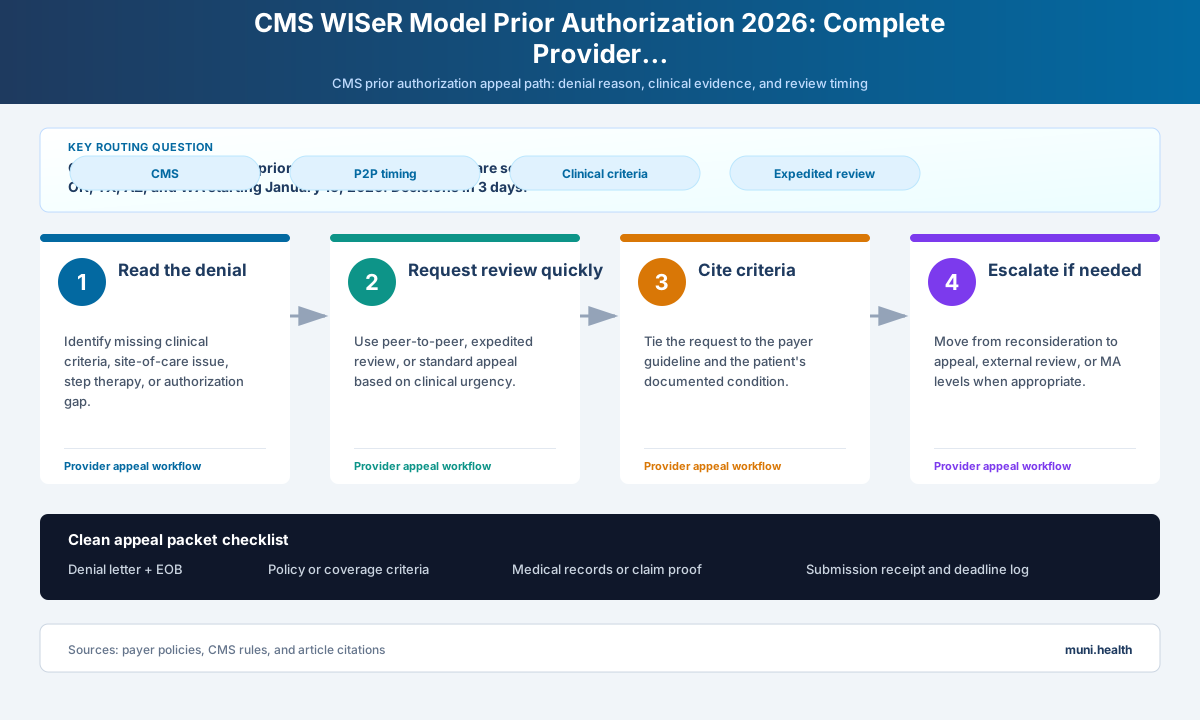
The CMS WISeR (Wasteful and Inappropriate Service Reduction) model launched January 15, 2026, requiring prior authorization or pre-payment review for 13 service categories — including epidural steroid injections, cervical fusion, and skin substitutes — for Traditional Medicare patients in New Jersey, Ohio, Oklahoma, Texas, Arizona, and Washington. Standard decisions take 3 business days.
What Is the CMS WISeR Model?
The Wasteful and Inappropriate Service Reduction (WISeR) model is a CMS Innovation Center payment model that runs from January 1, 2026 through December 31, 2031. It introduces prior authorization requirements for Traditional Medicare (Original Medicare Part B) in six states, targeting service categories identified as high-risk for overutilization and fraud.
WISeR is not a Medicare Advantage program. It applies to fee-for-service Medicare — the program covering approximately 35 million Americans who have not enrolled in a Medicare Advantage plan.
Services Date Effective January 15, 2026
WISeR participants and Medicare Administrative Contractors (MACs) began accepting prior authorization requests on January 5, 2026. The prior authorization or pre-payment review requirement applies to services rendered on or after January 15, 2026. Services provided before that date are not affected.
CMS uses AI and machine learning tools — alongside human clinical review — to make coverage determinations. The model does not change Medicare coverage policy; covered services remain covered. It adds an authorization step before (or immediately after) the service is delivered.
Which States Are Affected?
WISeR currently operates in six states. One technology vendor (called a "model participant") operates in each state and handles prior authorization review:
Turn this denial into a review-ready draft.
Muni prepares a payer-specific appeal, policy citations, and an evidence checklist. Your team reviews and submits it.
| State | Model Participant | MAC Jurisdiction |
|---|---|---|
| Texas | Cohere Health, Inc. | JH — Novitas Solutions |
| New Jersey | Genzeon Corporation | JL — Novitas Solutions |
| Oklahoma | Humata Health, Inc. | JH — Novitas Solutions |
| Ohio | Innovaccer Inc. | J15 — CGS Administrators |
| Washington | Virtix Health LLC | JF — Noridian Healthcare Solutions |
| Arizona | Zyter Inc. | JF — Noridian Healthcare Solutions |
Providers in all other states are not affected by WISeR during the 2026 performance year.
Which Services Require Prior Authorization?
WISeR covers 13 service categories. Each has specific CPT codes that trigger the prior authorization or pre-payment review requirement. The table below lists each category and its primary CPT codes, sourced from the American Society of Anesthesiologists' WISeR CPT code reference (accessed March 2026).
| Service Category | Primary CPT Codes |
|---|---|
| Epidural Steroid Injections (excluding facet joint injections) | 62321, 62323, 64479, 64480, 64483, 64484 |
| Percutaneous Vertebral Augmentation (vertebral compression fracture) | 22510–22515 |
| Cervical Fusion | 22554 |
| Knee Osteoarthritis Procedures (arthroscopic lavage/debridement) | 29877, 29880, 29881, 64447 |
| Skin and Tissue Substitutes (chronic wounds) | 15271–15278 |
| Electrical Nerve Stimulators | 63655 |
| Sacral Nerve Stimulation (urinary incontinence) | 64561, 64581 |
| Phrenic Nerve Stimulator | 33276, 33277 |
| Vagus Nerve Stimulation | 64568 |
| Induced Lesions of Nerve Tracts | 64605, 64610 |
| Hypoglossal Nerve Stimulation (sleep apnea) | 64582, 42975 |
| Incontinence Control Devices | 53440, 53445, 53451, 53452, 57288 |
| Impotence Treatment | 54400, 54401, 54405 |
Note: Deep brain stimulation implementation has been delayed by CMS and is not currently active. Always verify the current CPT code list directly from your MAC's WISeR resources or the CMS WISeR provider operational guide before submitting.
Provider Options: Prior Authorization vs. Post-Payment Review
Providers have a choice when furnishing WISeR-covered services to Traditional Medicare patients in the six affected states:
Option 1 — Prior Authorization (Recommended)
Submit a prior authorization request before rendering the service. If affirmed, the authorization is valid for 120 calendar days from the approval date. Payment for a compliant claim is not subject to further medical review for the approved service.
Option 2 — Post-Service Pre-Payment Review
Skip the prior authorization step and allow the claim to go through pre-payment medical review after the service is rendered. The MAC requests documentation; providers have 45 days to respond. A determination is issued within 3 days of a complete documentation submission.
Post-service review carries payment risk: if the claim is not affirmed, payment is withheld. For high-cost procedures like cervical fusion or vertebral augmentation, this risk is significant.
Gold Card Exemption
Providers who achieve a provisional affirmation rate of 90% or higher during a designated CMS performance review period may qualify for an exemption from prior authorization requirements — a "gold card" status. Consistently strong documentation practices are the fastest path to gold card eligibility.
How to Submit a WISeR Prior Authorization Request
Prior authorization requests can be submitted through two pathways:
Direct to the Model Participant
Contact the model participant for your state (see table above) and submit the request directly. Each participant operates a portal or accepts submissions by fax or mail. Check your MAC's WISeR resource page for participant contact details and preferred submission method.
Through Your MAC
Submit the request to your Medicare Administrative Contractor. The MAC will forward it to the appropriate model participant for review. This pathway is useful if your practice already has established workflows with the MAC.
If your practice submits or follows up on WISeR requests by phone rather than portal, use a consistent prior authorization phone call script — anchoring every call to a reference number, rep name, and stated decision date is what makes a phone-submitted request defensible later.
Documentation to Include
Strong prior authorization submissions include:
- Patient demographics and Medicare beneficiary ID
- Diagnosis codes (ICD-10) supporting medical necessity
- Procedure code(s) (CPT) being requested
- Clinical notes documenting the indication and relevant history
- Conservative treatment history (especially for spine and knee procedures)
- Ordering physician attestation and NPI
- Any relevant imaging reports, lab results, or specialist notes
Documentation Tip for Spine Procedures
Epidural steroid injections and cervical fusion are among the highest-denial-risk categories. Include documentation of prior conservative treatments (physical therapy, medications, non-surgical management) and imaging findings that correlate with the patient's clinical presentation. A peer-to-peer review is available if the initial request is not affirmed.
Decision Timelines
| Request Type | Decision Timeline | Notes |
|---|---|---|
| Standard prior authorization | 3 business days | From receipt of complete request |
| Urgent/expedited prior authorization | 2 business days | Use when clinical urgency exists |
| Post-service pre-payment review | 3 business days after complete docs | 45-day window to submit documentation |
| Approval validity period | 120 calendar days | From date of affirmation |
If Your Prior Authorization Is Not Affirmed
A "non-affirmation" decision from the model participant means the request was not approved in its current form. Non-affirmation decisions are not directly appealable through the standard Medicare appeals process — but they are not final.
Providers have two options:
1. Resubmit with Additional Documentation
Unlimited resubmissions are permitted. Add clinical documentation that addresses the reviewer's concern — additional imaging, a specialist letter, documentation of failed conservative care, or updated clinical notes.
2. Request Peer-to-Peer Review
Contact the model participant to schedule a clinical review with a physician reviewer. Peer-to-peer calls are one of the most effective tools for overturning a non-affirmation. Prepare a concise clinical rationale before the call.
If You Performed the Service and the Claim Is Denied
If you skipped prior authorization and the post-service pre-payment review results in a claim denial, you retain full Medicare appeal rights under the standard five-level Medicare appeals process. See prior authorization denial appeals: complete guide and what happens if prior authorization is denied for the full appeals workflow.
What WISeR Does Not Change
CMS has been explicit about the model's scope:
- Medicare coverage does not change. All 13 service categories remain covered by Traditional Medicare when medically necessary.
- Patient cost-sharing does not change. Beneficiaries in WISeR states pay the same copays and deductibles.
- Patients can still choose their provider. WISeR does not restrict access to specific networks.
- Non-WISeR states are unaffected. Providers outside NJ, OH, OK, TX, AZ, and WA continue to bill without WISeR prior authorization requirements.
Preparing Your Practice for WISeR
Step 1: Confirm Affected Services
Review your billing history for the 13 CPT code categories above. Identify which services — and how many claims per month — are now subject to WISeR review in your state.
Step 2: Identify Your Model Participant and MAC
Know who your model participant is (see the state table above) and confirm contact information and submission preferences. Your MAC's website will have WISeR-specific resources and portal links.
Step 3: Build Documentation Templates
Create service-specific checklists aligned with WISeR's medical necessity criteria. For high-frequency services like epidural steroid injections, a standardized documentation template can dramatically reduce non-affirmation rates.
Step 4: Train Billing and Clinical Staff
Both clinical staff (documentation) and billing staff (prior auth submission, tracking, follow-up) need to understand the new workflow. Map out who submits the request, who tracks it, and who escalates non-affirmations.
Step 5: Track Affirmation Rates
Monitor your prior authorization affirmation rate by service category. A rate consistently above 90% puts you on the path to gold card status. Below 80% signals a documentation or clinical indication gap that needs investigation.
How Muni Appeals Helps With WISeR Compliance
The WISeR model adds a meaningful administrative layer to Traditional Medicare billing in six states. For practices performing high volumes of covered services, the prior authorization and documentation burden compounds quickly.
Turn this denial into a review-ready draft.
Muni prepares a payer-specific appeal, policy citations, and an evidence checklist. Your team reviews and submits it.
Muni Appeals helps practices:
- Prepare service-specific prior authorization drafts and evidence checklists for staff verification and submission
- Prepare status, expiration, and resubmission fields for staff to verify and manage in the approved workflow
- Standardize clinical documentation across billing and clinical teams
- Prepare peer-to-peer scripts when non-affirmations need escalation
- Build toward gold card affirmation rates through consistent documentation quality
Frequently Asked Questions
Does WISeR apply to Medicare Advantage patients?
No. WISeR applies only to Traditional Medicare (Original Medicare Part B). Medicare Advantage plans have separate prior authorization requirements managed by each plan. If your patient has a Medicare Advantage plan, their prior authorization process is determined by that plan — not WISeR.
What if I'm in a WISeR state but don't perform any of the 13 service categories?
No action is required. WISeR only applies to providers who furnish one or more of the 13 covered service categories. If none of those CPT codes appear in your billing, the model does not affect your practice.
Can I still get paid if I perform a service without prior authorization?
Yes, but with risk. You can opt for post-service pre-payment review instead of prior authorization. If the review affirms the claim, you're paid. If not, payment is withheld — and you'll need to either appeal the denial or write off the service. Prior authorization eliminates this payment uncertainty.
How long is a WISeR prior authorization approval valid?
An affirmation is valid for 120 calendar days from the date of approval. If the service is not rendered within that window, you need a new prior authorization.
What is the gold card exemption and how do I qualify?
Providers who maintain a provisional affirmation rate of 90% or higher during a designated performance review period may be exempted from prior authorization requirements for WISeR services. Gold card status is earned through consistently strong documentation practices and high approval rates over time.
Is there a peer-to-peer review available for WISeR denials?
Yes. If a prior authorization request is not affirmed, you can request a peer-to-peer review with a physician reviewer at the model participant. This is your strongest tool for overturning a non-affirmation before resubmitting. Schedule the call promptly and prepare a concise clinical summary of why the service is medically necessary.
What does WISeR mean for practices in non-affected states?
Nothing changes for providers outside the six WISeR states. If CMS expands the model in future performance years, CMS will announce changes through official channels. Monitor CMS Innovation Center updates and your MAC's communications for any expansion announcements.
Where can I get current WISeR CPT codes and submission instructions?
The most current source is the CMS WISeR Provider and Supplier Operational Guide (version 4.0), available at cms.gov/priorities/innovation/innovation-models/wiser. Your MAC's WISeR resource page also contains state-specific submission portals and contact information for your model participant.
Ready to Streamline WISeR Prior Authorizations?
The WISeR model runs through 2031 — this is a long-term workflow change, not a temporary disruption. Practices that build strong prior authorization documentation and tracking processes now will reach gold card exemption faster and face fewer payment delays.
Get Started:
- Service-specific prior authorization documentation aligned with WISeR criteria
- Prior auth tracking with 120-day expiration alerts
- Peer-to-peer preparation support for non-affirmation follow-ups
- Consistent documentation quality toward gold card eligibility
This guide reflects CMS WISeR model procedures and state assignments as of March 2026. CMS may update service categories, model participants, or state assignments during the six-year model period. Verify current requirements at cms.gov/priorities/innovation/innovation-models/wiser and with your Medicare Administrative Contractor.