

Orthopedic claims are denied at higher rates than most specialties—particularly for prior authorization gaps, modifier 59 bundling errors, and NCCI edit conflicts. For Cigna, Humana, and select BCBS plans, MSK prior authorization denials must be appealed through EviCore, not the insurer. As of January 1, 2026, CMS-0057-F requires urgent PA decisions within 72 hours and standard decisions within 7 calendar days, and mandates specific clinical criteria in every denial notice.
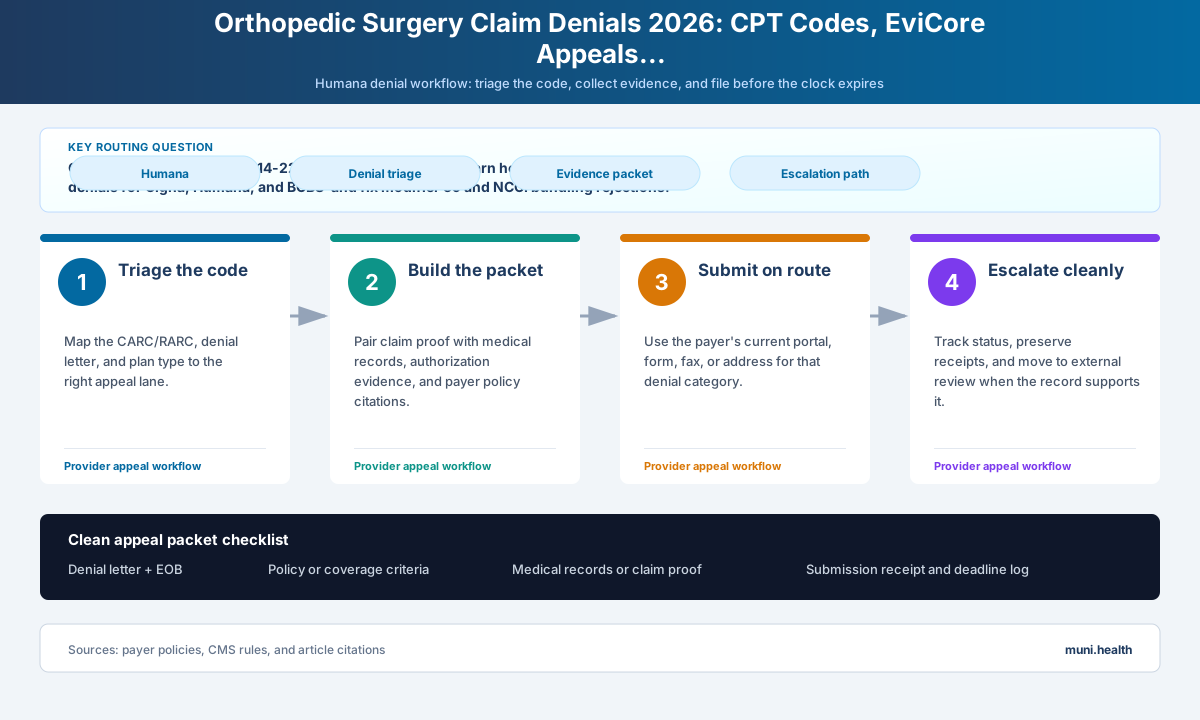
Why Orthopedic Claims Face Above-Average Denial Rates
Orthopedic procedures sit at the intersection of several high-risk billing categories: mandatory prior authorization, strict medical necessity criteria, complex CPT bundling rules, and insurer delegation to third-party review organizations like EviCore. The result is a denial rate well above the national average.
A 2024 Experian Health survey found that 41% of practices now report denial rates of 10% or higher. For orthopedic ambulatory surgery center (ASC) cases, industry data suggests denial rates commonly reach 14–22%, driven by prior authorization complexity, implant bundling rules, and global period violations.
92% of Orthopedic ASC Cases Require Pre-Authorization
Industry estimates indicate 92% of orthopedic ASC claims now require prior authorization—up sharply over three years as Medicare Advantage plans and commercial payers expanded PA programs into outpatient joint procedures and advanced imaging.
The three most common denial categories for orthopedic practices are:
- Medical necessity denials — insufficient documentation that conservative treatment was attempted before surgery
- Coding and bundling denials — modifier 59 misuse, NCCI edit conflicts, or incorrect arthroscopy vs. open code selection
- Prior authorization denials — expired authorizations, wrong procedure code at auth time, or appealing to the wrong entity (EviCore vs. the health plan)
Understanding which denial type you're facing—and where to send the appeal—is the first step to recovering the claim.
If your practice dispenses braces or other orthoses, those claims follow Medicare's separate DMEPOS documentation rules. CMS adds knee, thoracic-lumbar-sacral, and upper limb orthoses to its prior authorization list starting October 28, 2026. See the DME denial and prior authorization guide.
EviCore MSK Delegation: Where Orthopedic Appeals Actually Go
The most common routing mistake in orthopedic billing is sending a prior authorization appeal to the health plan when the plan has delegated MSK review to EviCore. When EviCore manages a procedure's authorization, the appeal must go to EviCore—not to Cigna, Humana, or the BCBS affiliate.
Plans that delegate MSK prior authorization to EviCore (as of 2026):
| Health Plan | EviCore MSK Scope | Appeal Route |
|---|---|---|
| Cigna (commercial) | Interventional pain management, major joint surgery (hip/knee/shoulder), spine surgery | evicore.com/provider or 888-444-6182 |
| Humana (commercial & MA) | Radiology, musculoskeletal, oncology, genetics, sleep medicine, select cardiology | evicore.com/provider or 888-444-6182 |
| BCBS Montana | Select MSK procedures — EviCore is the utilization review entity | evicore.com/provider |
| BCBS Arizona (AZ Blue) | Medical drug management + select MSK via EviCore clinical guidelines | evicore.com/provider |
| HealthSpring / Cigna MA | All MSK, radiology, cardiovascular — plan name changed Jan 1, 2026 from Cigna MA | evicore.com/provider (HealthSpring) |
Check the denial notice carefully. If EviCore issued the denial letter, the appeal goes to EviCore regardless of the plan name on the patient's ID card. For plans not on this list—including Aetna, most UHC plans, and Anthem—appeals go directly to the health plan. For cardiovascular procedures through EviCore-contracted plans, the same routing rules apply — see the cardiology claim denials guide for cath-lab and cardiac imaging PA routing details. Interventional pain management sits inside the same EviCore MSK scope shown above, but runs on its own frequency-limit and conservative-care rules rather than orthopedic surgery's medical-necessity criteria — see the pain management claim denials guide for the ESI, facet/MBB, and RFA session caps.
EviCore Appeal Process and Timelines
EviCore offers two post-denial pathways before a formal internal appeal:
Reconsideration: Must be requested within 7 business days of the initial denial. Reconsiderations allow you to submit additional clinical documentation without entering the formal appeal process.
Formal appeal: If reconsideration is unavailable or denied, a formal appeal follows. EviCore issues decisions within 30 days for standard cases, or earlier per state or federal requirements. Contact: 888-444-6182 (7 a.m.–7 p.m. ET, Mon–Fri); portal: evicore.com/provider.
Don't Miss the 7-Business-Day Reconsideration Window
For EviCore-managed Cigna or Humana orthopedic cases, you have 7 business days from the denial date to request a reconsideration with additional clinical documentation. Missing this window means going straight to a formal 30-day appeal—which delays surgery scheduling significantly.
EviCore also publishes its MSK clinical guidelines publicly at evicore.com/provider/clinical-guidelines. Review the applicable guideline before submitting additional documentation—it shows exactly what criteria the reviewer is evaluating against.
CMS-0057-F: What Changed for Orthopedic Prior Authorization in 2026
Effective January 1, 2026, the CMS Interoperability and Prior Authorization Final Rule (CMS-0057-F) took effect for Medicare Advantage plans, Medicaid managed care entities, and Qualified Health Plans. Two changes directly affect orthopedic PA workflows:
Faster mandatory decision timelines:
- Urgent/expedited PA: Decision within 72 hours (previously up to 3 business days or more under many plan policies)
- Standard non-urgent PA: Decision within 7 calendar days (previously up to 14 days under most plan policies)
Specific denial reasoning required: Plans must now include specific clinical criteria in PA denial notices. A vague "not medically necessary" response no longer satisfies the rule. This creates a direct appeal argument: if the denial notice lacks specific clinical criteria, cite CMS-0057-F in your appeal letter and state that the denial does not meet the rule's transparency requirements.
CMS-0057-F Applies to MA, Medicaid MCOs, and QHPs — Not Traditional Medicare FFS
CMS-0057-F applies to Medicare Advantage, Medicaid managed care, and ACA Marketplace plans. It does not change traditional Medicare fee-for-service procedures. For commercial plans not subject to CMS rules, check your state's prior authorization reform laws for equivalent requirements.
CMS has specifically identified orthopedic fusions, neurostimulators, and advanced imaging as high-authorization-burden procedure types targeted by the rule—a direct acknowledgment that orthopedic PA delays have real clinical consequences.
For a broader overview of the full CMS-0057-F regulatory framework, see our complete prior authorization denial guide.
Modifier 59 and X-Modifiers: Orthopedic Unbundling Rules
Modifier bundling denials are one of the most correctable—and most mishandled—error categories in orthopedic billing. The core issue: NCCI (National Correct Coding Initiative) Procedure-to-Procedure (PTP) edits bundle pairs of CPT codes that are presumed to overlap unless a modifier documents that they are legitimately distinct services.
Modifier 59 (Distinct Procedural Service) is the baseline unbundling tool. It signals that two procedures occurred at different anatomical sites, involved separate incisions, or were performed at different sessions.
CMS X-modifiers are the preferred alternative when specificity allows:
| Modifier | Meaning | When to Use in Orthopedics |
|---|---|---|
| XS | Separate Structure | Procedure on different joint or body segment—e.g., ipsilateral knee and hip on same day |
| XE | Separate Encounter | Procedure performed at a separate patient encounter on the same calendar day |
| XP | Separate Practitioner | A different physician performed the second procedure |
| XU | Unusual Non-Overlapping Service | Service does not overlap the primary procedure's normal component services |
| -59 | Distinct Procedural Service | Use only when no X-modifier more precisely describes the distinction |
Per CMS MLN Fact Sheet 1783722 (revised April 2026) on proper use of modifiers 59, XE, XP, XS, and XU, payers increasingly require X-modifiers where specificity is possible. Submitting modifier -59 when XS applies can trigger an NCCI compliance review.
Modifier 59 Overuse Is a Targeted Probe and Educate Trigger
CMS's Targeted Probe and Educate (TPE) program specifically targets modifier 59 overuse. If your claims show frequent -59 use without X-modifier specificity, expect prepayment review. Procedure notes must explicitly document why each billed procedure is distinct from the other.
Arthroscopy vs. Open Procedure Code Selection
A frequent bundling trap: selecting an arthroscopy CPT code (e.g., 29827 for rotator cuff repair) when the procedure converted intraoperatively to an open approach—or the reverse. Payers bundle arthroscopy and open codes on the same joint as a default NCCI edit. Using the wrong code family creates a bundling denial that requires documentation to unbundle.
The operative note must explicitly state the surgical approach. If a procedure starts arthroscopically and converts to open, document the conversion in the operative narrative before modifiers can support unbundling on appeal.
Step-by-Step: Appealing an Orthopedic Claim Denial
Step 1: Identify the Denial Category
Pull the denial EOB and identify the denial reason code. The appeal strategy differs by type:
- CO-4 (no prior authorization on file): Retroactive authorization request or medical necessity appeal
- CO-B7 (provider not credentialed at date of service): Provider enrollment or timely credentialing exception appeal — see the provider credentialing denial appeal guide
- CO-97 (bundling): Modifier correction or NCCI edit appeal with operative documentation
- CO-50 / N-390 (not medically necessary): Medical necessity appeal with clinical records and conservative treatment history
- CO-15 (incorrect authorization number): Resubmit with the correct authorization number from the auth notification
Step 2: Confirm Who Receives the Appeal
Check the denial letter sender. If EviCore issued the denial for a Cigna, Humana, or EviCore-delegated BCBS case, the appeal goes to EviCore—not the health plan. If the health plan issued the denial directly, use the health plan's standard internal appeal process.
Step 3: Gather Clinical Documentation
For medical necessity appeals, compile:
- Operative notes and pre-op clinical examination records
- Conservative treatment history (physical therapy attempts, injections, medication trials with dates and duration)
- Imaging reports (X-ray, MRI, CT arthrogram) with radiologist interpretation
- Relevant specialty society guidelines supporting the procedure (AAOS, ACOEM)
- The specific clinical criteria cited in the denial notice—CMS-0057-F requires payers to include these starting January 1, 2026
Step 4: Draft the Appeal Letter
Address each clinical criterion cited in the denial notice point by point. If the denial lacks specific criteria, state in the letter that the denial does not meet CMS-0057-F's specificity requirements and request the clinical standard applied before the determination stands.
For EviCore-managed cases, download the applicable MSK clinical guideline from evicore.com/provider/clinical-guidelines and structure your documentation to address each listed criterion directly.
Step 5: Submit Before the Deadline
| Plan / Reviewer | Internal Appeal Deadline | Expedited Option |
|---|---|---|
| EviCore (Cigna / Humana / BCBS) | 30 days formal appeal; 7 business days reconsideration | Urgent: 72 hours per CMS-0057-F (MA/Medicaid plans) |
| Aetna (commercial) | 180 days from denial date | 72 hours expedited for urgent cases |
| UHC (commercial) | 180 days from denial date | 72 hours expedited per UHC policy |
| Medicare Advantage (most plans) | 60 days from denial notice | 72 hours under CMS-0057-F |
Missing the internal appeal window eliminates the right to external review in most states. Set calendar reminders at the halfway point for every open orthopedic denial.
Orthopedic denials taking too long to resolve?
Muni Appeals organizes the uploaded denial, candidate clinical evidence, likely EviCore context, and deadline risk. Your billing team verifies the route, calendars the deadline, submits, and follows up.
First 3 appeals free, then $20 per appeal. Start with your denial letter or EOB and available records. No meeting or clearinghouse connection required.
How Muni Appeals Handles Orthopedic Denials
Orthopedic billing teams manage a disproportionate share of documentation-heavy appeals: PA denials from EviCore, modifier audits, global period disputes, and implant bundling rejections. The administrative burden compounds when a single ASC case requires appeal routing to separate entities—EviCore for the PA denial and the health plan for a bundling dispute on the facility claim.
Muni Appeals helps billing teams:
- Provide likely EviCore versus health-plan routing guidance for staff to verify against the denial source
- Organize clinical documentation requirements by insurer and denial type
- Surface deadline risk from uploaded Cigna, Humana, BCBS, Aetna, and UHC notices for staff verification and calendaring
- Compile policy bulletin references and modifier justifications for recurring denial patterns
For practices seeing repeat orthopedic denials on the same procedure types, Muni surfaces the pattern—so the fix addresses the root cause rather than one-off resubmissions.
Frequently Asked Questions
Does an EviCore denial for a Cigna MSK case go to Cigna or EviCore?
The appeal goes to EviCore, not Cigna. When Cigna delegates MSK prior authorization to EviCore, EviCore issues the denial and manages the appeal process. The denial letter will identify EviCore as the reviewer. Submit the appeal at evicore.com/provider or call 888-444-6182. If you send it to Cigna directly, it will be redirected—losing time from your appeal window.
What does CMS-0057-F require for orthopedic prior authorization in 2026?
Effective January 1, 2026, CMS-0057-F requires MA plans, Medicaid MCOs, and QHP plans to issue urgent PA decisions within 72 hours and standard PA decisions within 7 calendar days. Plans must also include specific clinical criteria in denial notices. If your denial cites only vague policy language, reference CMS-0057-F in the appeal letter and request that the plan identify the specific clinical standard applied.
When should I use modifier 59 vs. XS on an orthopedic claim?
Use XS when two procedures involve separate anatomical structures—for example, a procedure on the knee and a procedure on the hip billed on the same date. Use modifier -59 only when no X-modifier more precisely describes the distinction. CMS's April 2026 MLN guidance emphasizes X-modifier specificity and flags frequent -59 use (without X-modifier alternatives) as a Targeted Probe & Educate program trigger.
What orthopedic CPT codes are most frequently denied?
High-denial codes include arthroscopic codes (29827, 29828, 29881, 29882) when NCCI edits bundle them with open-approach codes on the same joint; spinal fusion codes (22633, 22612) when conservative therapy documentation is insufficient; and shoulder and knee replacement codes (27447, 23472) when the authorized CPT doesn't match the billed CPT. Confirm the authorized procedure code matches exactly before submitting the claim.
How does NCCI bundling affect orthopedic billing?
NCCI Procedure-to-Procedure (PTP) edits bundle CPT code pairs that CMS considers overlapping by definition. For orthopedic cases, common bundled pairs include arthroscopy codes with open procedure codes on the same joint, and add-on codes billed without their required primary codes. A bundling denial means the code pair is bundled by default—to unbundle, attach the correct modifier and operative documentation proving the procedures were genuinely distinct.
Can I request a peer-to-peer review for an EviCore orthopedic denial?
Yes. EviCore offers a peer-to-peer option where the treating physician speaks directly with an EviCore medical reviewer. This is typically available within the reconsideration window (7 business days of the initial denial). P2P reviews can reverse denials before the formal appeal process begins. Contact EviCore at 888-444-6182 to schedule. Missing the reconsideration window forfeits the P2P option for most plans.
What documentation does Aetna require for orthopedic medical necessity appeals?
Aetna's orthopedic medical necessity reviews are governed by its Clinical Policy Bulletins (CPBs). The denial notice should cite the specific CPB number. Pull the applicable CPB from Aetna's provider portal and address each listed criterion in your appeal letter. Include imaging reports, documented conservative treatment failure with dates, functional limitation documentation, and the treating physician's clinical rationale tied directly to the CPB criteria.
How do AI-based prior authorization reviews affect orthopedic practices?
Several Medicare Advantage plans use AI-driven pre-payment review for orthopedic authorizations, particularly for joint replacement and advanced imaging. CMS-0057-F requires that even AI-generated denials cite specific clinical criteria. If your denial is vague or cites only general policy language, use the rule's specificity requirement as an appeal argument. For a broader guide to appealing AI-driven denials, see our guide to fighting AI insurance denials.
Ready to Recover Your Orthopedic Denials?
Orthopedic practices lose significant revenue to correctable denials—wrong appeal routing, missing modifier documentation, and expired appeal windows on otherwise valid claims. Knowing that EviCore handles Cigna and Humana MSK appeals, and that CMS-0057-F now mandates faster decisions and specific denial reasoning, puts your billing team in a stronger position on every open case.
Get Started:
- Route EviCore vs. health plan appeals correctly from day one
- Track open appeal deadlines across all active orthopedic cases
- Compile modifier documentation and clinical policy citations for recurring denial patterns
- Identify root-cause denial triggers before they compound across a billing cycle
This guide reflects 2026 orthopedic claims, prior authorization, and appeal procedures. EviCore delegation arrangements, plan-specific appeal windows, and CMS-0057-F applicability vary by plan type, state, and contract. Verify current procedures with the specific health plan and consult qualified billing counsel for complex disputes.