

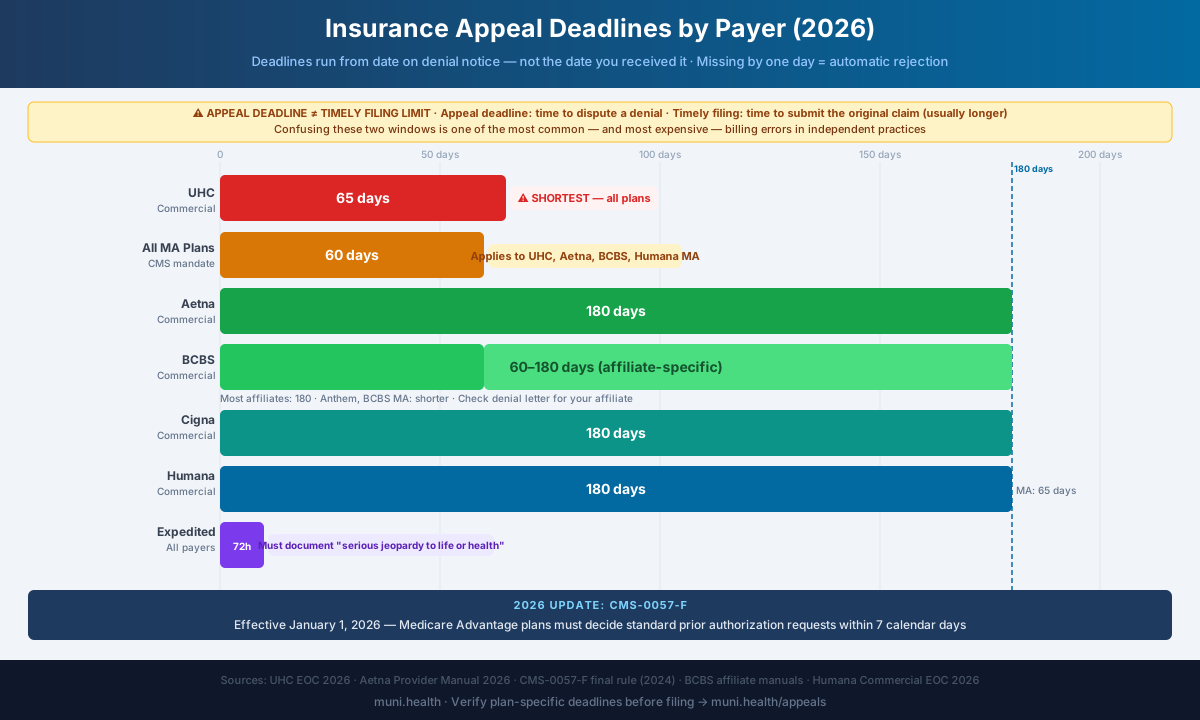
Insurance appeal deadlines for 2026: UnitedHealthcare's commercial appeal deadline is commonly cited at 65 days — the shortest among major commercial insurers — though UHC's own guidance says the exact figure varies by Participation Agreement, so verify it against your contract. Aetna, Blue Cross Blue Shield, Cigna, and Humana commonly use 180-day commercial windows, but the stage matters: Aetna lists 180 days for reconsideration, 60 days after a reconsideration decision, and up to 65 days only for a Medicare non-contracted provider's direct appeal. Medicare Advantage appeals have a CMS-mandated minimum of 60 days for non-contracted providers. These are appeal deadlines; claim-submission windows are separate.
Looking for claim timely filing limits instead?
This page covers appeal deadlines — how long you have to contest a denial after you receive it. If you're trying to find how long you have to submit the original claim (timely filing), that's a separate, usually longer clock. See Timely Filing Limits by Insurance Company: 2026 Master Guide for the full cross-payer claim-TFL comparison.
Why the Right Deadline Is Everything
Missing an appeal deadline — even by one day — results in automatic rejection. The insurance company doesn't review the merits. The claim closes permanently.
This isn't a procedural inconvenience. For practices managing dozens of open appeals across multiple payers, a single missed UHC commercial deadline (commonly cited at 65 days — confirm your contract) looks identical on the calendar to an Aetna deadline (180 days) unless you're tracking them separately by payer.
The two deadlines billing teams confuse most:
- Timely filing limit (TFL): How long you have to submit the original claim after the date of service — typically 90–365 days. For the full cross-payer TFL comparison, see Timely Filing Limits by Insurance Company: 2026 Master Guide.
- Appeal filing deadline: How long you have to appeal a denial after receiving the denial notice — typically 60–180 days. If the patient's plan is self-funded (ERISA-governed rather than state-regulated), federal law sets a 180-day floor regardless of what a given payer's standard commercial deadline looks like — see our ERISA self-funded plan appeal guide for the full breakdown. TRICARE runs on its own federal timeline outside this table entirely — a flat 90-day window for both factual and medical necessity appeals — covered in our TRICARE provider appeal guide. VA Community Care Network is also outside this table and splits further still — a 90-day claim reconsideration with Optum or TriWest, a separate 90-day referral reconsideration with the VA itself, and an unrelated 1-year track for a veteran's own emergency-care reimbursement claim — see the VA Community Care appeal guide.
Getting these wrong in either direction costs money. Filing a TFL denial as an appeal delays the corrected claim and may forfeit both paths. For the full decision matrix by denial code, see the corrected claim vs. insurance appeal guide.
Deadline Starts on the Denial Date — Not the Date You Read It
Appeal deadlines are calculated from the date printed on the denial notice, not the date your billing team opened it. A letter dated October 1 with a UHC commercial deadline commonly cited at 65 days expires around December 5 — even if it sat in the mail pile until October 15. Confirm the exact figure against your Participation Agreement before calendaring it.
2026 Insurance Appeal Deadlines: Complete Table by Payer
Most commercial plans give you 180 calendar days to appeal a denial. The major exception is UnitedHealthcare's commercial deadline, commonly cited at 65 days — though UHC's own appeals guidance defers the exact figure to your Participation Agreement, so confirm it in your contract rather than assuming the commonly-cited number. Medicare Advantage plans from any insurer have a CMS-mandated minimum of 60 days for non-contracted providers, including UnitedHealthcare's own MA plans. Expedited (urgent) appeals must be decided within 72 hours by all plans — but only when submitted with the correct CMS "serious jeopardy" language; see the urgent and expedited insurance appeal guide 2026 for verbatim language and payer-specific submission paths.
Prepare this appeal packet with your team.
Draft the appeal, coordinate missing documents, and approve the reviewed packet. Keep your clearinghouse; your practice checks deadlines and submits through the payer’s accepted channel.
First 3 appeals free, then $20 per appeal. Start with your denial letter or EOB and available records. No meeting or clearinghouse connection required.
| Payer | Plan Type | Appeal Deadline | Claim TFL Window | Expedited Decision |
|---|---|---|---|---|
| Aetna | Commercial | Reconsideration: 180 days; appeal after reconsideration: 60 days | 90 days (varies by contract) | 72 hours |
| Aetna | Medicare Advantage | Notice/contract controls; up to 65 days for a non-contracted direct appeal | 365 days (CMS federal rule) | 72 hours |
| Aetna | Medicaid | State-specific | State-specific | 72 hours |
| Blue Cross Blue Shield | Commercial (most affiliates) | 180 days | 90–365 days (plan-specific) | 72 hours |
| Blue Cross Blue Shield | Medicare Advantage | 60 days | 365 days (CMS federal rule) | 72 hours |
| Blue Cross Blue Shield | Medicaid | 60–180 days (state-specific) | State-specific | 72 hours |
| UnitedHealthcare | Commercial | 65 days (commonly cited — verify against your Participation Agreement) | 90–365 days (plan-specific) | 72 hours |
| UnitedHealthcare | Medicare Advantage | 60 days (non-contracted providers; contracted providers follow the participation agreement) | 365 days (CMS federal rule) | 72 hours |
| UnitedHealthcare | Medicaid | State-specific | State-specific | 72 hours |
| Cigna | Commercial | 180 days | 90–180 days | 72 hours |
| Cigna | Medicare Advantage (HealthSpring) | 60 days | 365 days (CMS federal rule) | 72 hours |
| Cigna | Medicaid | State-specific | State-specific | 72 hours |
| Humana | Commercial | 180 days | 90–180 days | 72 hours |
| Humana | Medicare Advantage | 65 days | 365 days (CMS federal rule) | 72 hours |
| Humana | Medicaid | 60 days | State-specific | 72 hours |
| Premera Blue Cross | Commercial / Standard | 180 days | 365 days from service date | 72 hours |
| Premera Blue Cross | Heritage Plans | 365 days | 365 days | 72 hours |
| Premera Blue Cross | Medicare Advantage | 60 days | 365 days (CMS federal rule) | 72 hours |
Key takeaway: Most commercial plans give you 180 days; UHC's commercial appeal window is commonly cited at 65 days but UHC's own guidance ties the exact figure to your Participation Agreement, so confirm it before calendaring. Medicare Advantage plans follow CMS minimums: 60 days for appeals (non-contracted providers), 365 days for claim submission. Plan-specific contracts may vary — always verify against your denial notice.
What Changed in 2026: CMS-0057-F and CMS-4208-F
Two federal rules took effect January 1, 2026 with direct implications for how practices manage Medicare Advantage appeals.
CMS-0057-F: Prior Authorization Decision Timelines
The CMS Interoperability and Prior Authorization Final Rule (CMS-0057-F) now requires Medicare Advantage organizations and affected Medicaid and CHIP programs and managed care plans to:
- Decide standard prior authorization requests within 7 calendar days (previously 14 days)
- Decide expedited (urgent) PA requests within 72 hours
- Provide a specific reason for every PA denial — vague "not medically necessary" language no longer meets compliance requirements
This applies to medical and behavioral health services — it does not cover drug PA decisions.
CMS expressly excludes Qualified Health Plan issuers on the Federally Facilitated Exchanges from these new decision timeframes. Their standard non-urgent window remains no later than 15 days under the applicable federal claims rule, while expedited requests remain subject to a 72-hour limit.
For practices appealing PA denials from MA plans in 2026: if the plan exceeded the 7-day standard or failed to give a specific denial reason, document it in your appeal. Both are grounds for challenging the process, not just the clinical decision.
CMS-4208-F: Retroactive Denial Ban for Inpatient MA Admissions
Effective January 1, 2026, Medicare Advantage plans generally cannot retroactively deny inpatient hospital admissions that were previously approved — either before admission or during the stay. The only exceptions are fraud or obvious error.
If you're dealing with a retroactive MA inpatient denial for a stay that was approved at admission, cite CMS-4208-F directly in your appeal. This is a new compliance requirement, not a gray area.
2026 Regulatory Summary for MA Appeals
As of January 1, 2026: (1) MA plans must respond to standard PA requests within 7 days, not 14; (2) All PA denials require a specific stated reason; (3) Previously approved inpatient admissions generally cannot be retroactively denied. These changes apply to MA appeals filed on or after January 1, 2026.
Payer-by-Payer Appeal Deadline Details
Aetna: 180-Day Reconsideration, Then a 60-Day Appeal Window
How Aetna counts the deadline: Reconsideration is generally due within 180 calendar days of the initial claim decision. A formal appeal after reconsideration is due within 60 days of the reconsideration decision. For direct appeals that do not qualify for reconsideration, Aetna lists up to 180 days generally and up to 65 days for Medicare non-contracted providers. Verify the applicable route against the notice and contract.
State exceptions apply for fully insured commercial plans — California, New York, and Texas have specific state-level requirements. Provider contracts may grant additional time.
Where to file:
- Online: Aetna.com provider portal via Availity (fastest)
- Mail: Aetna Appeals Department, P.O. Box 14463, Lexington, KY 40512-4463
- Fax: 1-859-425-3379 (standard), 1-859-425-3380 (expedited)
Decision timeline: Standard 30 days; expedited 72 hours. Missing an applicable internal-appeal decision deadline does not automatically approve the appeal. Federal claims rules generally treat internal remedies as exhausted, which may allow external review or the next available escalation; confirm the plan, state, and notice-specific process.
→ Full Aetna Appeal Guide 2026 | Aetna Timely Filing Limits
Blue Cross Blue Shield: 180 Days — But 34 Companies, Not One
The BCBS appeal timely filing limit is 180 days for standard commercial plans across all affiliates. The critical variable is which BCBS company issued the denial — BCBS is 34 independent companies with separate policies, and filing with the wrong one results in automatic denial.
BCBS is 34 independent companies. Your deadline depends on which affiliate issued the denial, not "BCBS" as a category.
| BCBS Company | Appeal Deadline | State(s) |
|---|---|---|
| Anthem BCBS | 180 days | 14 states incl. CA, NY, OH, IN, VA |
| Blue Cross NC | 180 days | North Carolina |
| CareFirst BCBS | 180 days | MD, DC, Northern VA |
| BCBS Michigan | 180 days | Michigan |
| BCBS Texas (commercial) | 180 days | Texas |
| BCBS Texas (STAR Medicaid) | 60 days | Texas |
| Premera Blue Cross (standard) | 180 days | Washington, Alaska |
| Premera Blue Cross (Heritage) | 365 days | Washington, Alaska |
| Florida Blue | 180 days | Florida |
The most common billing error with BCBS: filing the appeal with the wrong company. The plan ID on the member's card identifies the home plan. Appeals go to the home plan, even when the patient received care in a different state.
For out-of-state BCBS patients (BlueCard), the home plan's clinical criteria govern, not the host state's — appeal goes to the home plan identified by the alpha prefix on the member's ID card.
→ BCBS Timely Filing Limits 2026 | Full BCBS Appeal Guide
UnitedHealthcare: Commercial Commonly Cited at 65 Days, Medicare Advantage 60 Days
This is one of the most commonly missed deadlines in commercial insurance. Practices that manage Aetna and BCBS denials on a 180-day cadence often find UHC appeals sitting unworked well past the actual deadline.
UHC's commercial appeal deadline is commonly cited at 65 calendar days, but UHC's own appeals guidance says the exact figure varies by Participation Agreement — confirm it in your contract rather than assuming the commonly cited number. For Medicare Advantage, non-contracted providers have a CMS-mandated 60-day window; contracted providers follow the participation agreement instead of a fixed number.
UHC may grant extensions if you request one before the deadline expires, citing good cause (serious illness, hospitalization, administrative error by UHC). "Busy practice" does not qualify.
Where to file:
- Portal: UHCprovider.com (required for most network providers as of January 2025)
- Phone: 1-866-480-1086
- Fax or mail: See your denial notice for plan-specific address
Decision timeline: Standard 7 calendar days — the fastest among major insurers. Expedited: 72 hours.
→ UHC Appeal & Timely Filing Deadlines 2026 | UHC Appeal Letter Template
Cigna: 180 Days Commercial, 60 Days Medicare Advantage
Cigna's appeal timely filing limit is 180 calendar days from the initial denial or payment date for commercial plans. Second-level appeals have a separate 60-day window measured from the date of the first-level denial letter — not from the original denial date. HealthSpring (Medicare Advantage — owned by Health Care Service Corporation since a deal closed March 19, 2025, not Cigna): 60 days from denial notice, consistent with CMS minimums.
Where you file depends on whether Cigna delegated the service to eviCore, or whether it's a HealthSpring case that isn't Cigna's at all:
- Cigna-direct (non-delegated) cases: Submit through Availity or MyCigna.com/provider — navigate to Claims > Appeal Submission. Most medical and surgical appeals go here.
- eviCore-delegated cases (musculoskeletal, radiology, cardiology, oncology, and behavioral health in most Cigna commercial plans): File through the eviCore provider portal at evicore.com. Appeals for delegated services go to eviCore, not directly to Cigna. The 180-day appeal timely filing limit still applies, calculated from the eviCore denial notice date.
- HealthSpring / Medicare Advantage cases: Use the applicable HealthSpring appeal form and the fax or mailing destination on the denial notice. Availity payer ID 52192 is used for electronic claims and supported PA workflows, not as a universal appeal route. The 60-day CMS minimum applies.
Second-level appeal window: 60 days from the date of the first-level denial letter — not the original claim denial date. If you missed the first-level Cigna appeal, the second-level clock is separate.
Cigna reconsideration vs. formal appeal: Cigna allows an informal reconsideration (clinical review request) within 30 days of denial, typically resolved within 2 business days by phone. Reconsideration does not consume your formal appeal rights — if it fails, you retain the full 180-day formal appeal timely filing limit from the original denial date.
Cigna-specific workflow note: Peer-to-peer (P2P) review resolves many Cigna denials same-day and does not count as a formal appeal. Request P2P within 14 days of denial for fastest scheduling. If P2P fails, you still have the full 180-day appeal timely filing limit remaining from the original denial date.
→ Cigna Timely Filing Limits 2026 | Cigna Appeal Guide
Humana: 180 Days Commercial, 65 Days Medicare Advantage
Commercial plans: 180 days. Medicare Advantage plans: 65 days (Humana-specific — CMS sets a 60-day minimum for all MA plans). Medicaid plans: 60 days.
→ Humana Medicare Advantage Timely Filing 2026
Medicare Advantage (All Plans): 60 Days
Regardless of which insurer administers the plan, all Medicare Advantage plans must accept appeals within a minimum of 60 calendar days from the denial notice. This is a CMS federal requirement — individual plans may set longer windows, but not shorter.
New in 2026 (CMS-0057-F): Standard PA decisions must be issued within 7 days; expedited PA decisions within 72 hours. If a plan misses these timelines, the request auto-escalates to external review.
For a full walkthrough of the 5-level MA appeal ladder (plan → QIC → OMHA → MAC → federal court) and AIC thresholds, see our Medicare Advantage appeal guide.
How to Calculate Your Exact Deadline
Count calendar days from the date printed on the denial notice — not the date your team opened it, not the date of service. Weekends and holidays count. If the deadline lands on a weekend or federal holiday, most insurers extend to the next business day, but don't rely on it.
Step 1 — Find the denial notice date. Look for "Date of Determination," "Date of Decision," or "Notice Date." This is Day 0.
Step 2 — Apply your payer's window:
- Aetna, BCBS (most), Cigna, Premera (standard): 180 calendar days
- UHC commercial: commonly cited at 65 calendar days — verify against your Participation Agreement
- Aetna: 180 days for reconsideration; 60 days after reconsideration; up to 65 days for a Medicare non-contracted direct appeal
- Humana MA: 65 calendar days under Humana's applicable provider guidance
- Medicare Advantage (all, non-contracted providers, including UHC): 60 calendar days minimum
- Humana Medicaid: 60 calendar days
Step 3 — Count calendar days, not business days. Weekends and holidays count. If the deadline falls on a weekend or federal holiday, most insurers extend to the next business day — but don't rely on it.
Step 4 — File before the deadline. If the deadline is March 30, file by March 28. For mail, use certified mail — postmark date counts, not arrival date. For online submissions, the timestamp must be before midnight on the deadline day.
Decision Timelines: How Long the Insurer Has to Respond
Once you file your appeal, insurers have 7–30 days to issue a decision — UHC is fastest at 7 days standard; most others are 30 days. Expedited appeals require a decision within 72 hours from all plans. Under federal law, if the insurer misses their own deadline, the appeal is either automatically approved or deemed exhausted — giving you immediate access to external independent review.
Prepare this appeal packet with your team.
Draft the appeal, coordinate missing documents, and approve the reviewed packet. Keep your clearinghouse; your practice checks deadlines and submits through the payer’s accepted channel.
First 3 appeals free, then $20 per appeal. Start with your denial letter or EOB and available records. No meeting or clearinghouse connection required.
| Insurance Company | Standard Decision | Expedited Decision | If They Miss the Deadline |
|---|---|---|---|
| Aetna | 30 days | 72 hours | Automatic approval (federal law) |
| BCBS (most affiliates) | 30 days | 72 hours | Automatic approval |
| UnitedHealthcare | 7 days | 72 hours | Move to external review immediately |
| Cigna | 30 days (pre-service) / 60 days (post-service) | 72 hours | Automatic approval |
| Humana | 30 days | 72 hours | Automatic approval |
| Premera Blue Cross | 30 days | 72 hours | Automatic approval |
| MA Plans (CMS-0057-F, eff. Jan 1 2026) | 7 days (PA requests) | 72 hours (PA requests) | Auto-escalates to external IRE |
Under 29 CFR 2560.503-1, if an insurer fails to respond within the required timeframe, the appeal is either automatically approved or deemed exhausted — allowing you to proceed directly to external independent review without completing internal appeals.
Expedited Appeals: The 72-Hour Standard
All major commercial payers and Medicare Advantage plans must decide expedited appeals within 72 hours. You qualify when the standard 7–30 day review would seriously jeopardize the patient's health, disrupt ongoing treatment, or cause severe pain that cannot be managed without the requested service.
Any denial qualifies for expedited review (72-hour decision) if the standard timeline would:
- Seriously jeopardize the patient's life or ability to regain maximum function
- Cause severe pain that cannot be managed without the treatment
- Disrupt ongoing treatment (hospital stay, infusion series, etc.)
Many states have expanded this definition beyond immediately life-threatening situations to include severe pain affecting daily function, risk of disability, or mental health crises.
How to request it: Include this in your appeal cover letter:
I am requesting EXPEDITED review under [Insurance Company]'s urgent
appeal procedures per [State] regulations and 29 CFR 2560.503-1.
Delay in receiving [treatment] will [specific medical harm with timeline].
Physician documentation of urgent medical need is attached.
For prior authorization denials specifically — and the new CMS-0057-F timelines that apply in 2026 — see our prior authorization denial appeal guide.
What to Do If You Missed Your Appeal Deadline
Most insurers will reject a late appeal without reviewing the merits — but "good cause" exceptions exist for well-documented circumstances. No insurer or regulator publishes a success-rate figure for these exceptions; approval depends heavily on the documentation and how quickly you act. Act immediately: the further past the deadline you are when you request an exception, the lower the odds.
Good Cause Exceptions
Most insurers and Medicare will consider late appeals if you document "good cause" for missing the deadline.
Accepted reasons:
- Serious illness or hospitalization that physically prevented filing
- Death or critical illness of an immediate family member
- Natural disaster that destroyed records or prevented access
- Insurance company gave you incorrect deadline information (documented)
- Denial notice never received (proof of non-delivery required)
- Administrative error by the insurer caused the delay
Not accepted: Being busy, forgetting, not understanding the process, or waiting to gather documentation.
How to file a late appeal with good cause: Act immediately — the further past the deadline, the lower the odds. Your cover letter should state the specific circumstance with dates, explain why you couldn't file on time, and note when you discovered the missed deadline and took immediate action. Attach documentation (hospital records, insurer correspondence, certified mail receipts).
Timely Filing Denial vs. Missed Appeal Deadline
If you received a CO-29 denial (timely filing), that's different from missing an appeal deadline. CO-29 denials are claim submission issues — appealed with proof of timely filing (submission confirmation, clearinghouse logs, EOB showing prior processing). For decision logic by denial code — CO-4, CO-16, CO-29, CO-97 — the key question is whether the denial reflects a billing error (corrected claim) or a clinical dispute (formal appeal).
For external review timelines and ERISA lawsuit windows, see our insurance appeal statute of limitations guide.
How Muni Surfaces Appeal Deadline Risk
Manual tracking breaks at scale. A practice running active appeals across UHC, Aetna, and Medicare Advantage plans needs a reliable calendar and staff verification process rather than a shared spreadsheet alone.
Muni Appeals reads the uploaded denial materials, surfaces the payer and a deadline-risk bucket, and prepares a review-ready packet. It does not maintain the practice's filing calendar or send payer-deadline alerts; staff must verify the exact plan and state rule, calendar it, submit the appeal, and record the submission. Once an appeal is filed, our appeal status call script covers how to check on it by phone and document the call if its timeliness is ever disputed.
Frequently Asked Questions
What is the shortest insurance appeal deadline among major payers?
UnitedHealthcare's commercial appeal deadline is commonly cited at 65 days — UHC's own guidance ties the exact figure to your Participation Agreement, so confirm it against your contract. This is one of the most commonly missed deadlines because billing teams often assume the standard 180-day commercial window applies. UHC's own Medicare Advantage appeals follow the 60-day CMS minimum for non-contracted providers, not the commercial figure.
Do Medicare Advantage plans all have the same appeal deadline?
CMS sets a minimum of 60 calendar days for non-contracted-provider MA appeals. Payer processes and contracts can differ. Aetna lists 180 days for reconsideration, 60 days after reconsideration, and up to 65 days for a Medicare non-contracted provider's direct appeal; do not apply the 65-day exception to every Aetna Medicare workflow.
What's the difference between a timely filing deadline and an appeal deadline?
Timely filing (TFL) is how long you have to submit the original claim after the date of service — typically 90–365 days depending on the payer and plan type. An appeal deadline is how long you have to contest a denial after receiving the denial notice — 60–180 days. A CO-29 TFL denial requires different handling than a standard clinical denial appeal. Never file a corrected claim using the appeal process, or vice versa.
Did the 2026 CMS rules change any appeal deadlines?
The appeal deadlines themselves did not change. What changed under CMS-0057-F (effective January 1, 2026) is the timeline for prior authorization decisions in Medicare Advantage plans — 7 calendar days standard, 72 hours expedited. And CMS-4208-F (also effective January 1, 2026) limits MA plans from retroactively denying previously approved inpatient admissions. These affect the grounds and context for appeals, not the 60-day filing window.
My denial letter doesn't list an appeal deadline. What do I do?
Federal law (29 CFR 2560.503-1) requires all denial notices to include the reason for denial, the appeal deadline, and instructions for filing. If this information is missing, the insurer violated procedural requirements. File your appeal immediately and note in your cover letter that the denial notice failed to include required appeal rights information per 29 CFR 2560.503-1. You may also file a complaint with your state insurance commissioner's office.
Can I file a partial appeal by the deadline and supplement later?
Yes. File the appeal with whatever documentation you have by the deadline. Include a cover letter stating: "Initial appeal filed to meet [payer] deadline. Supplemental clinical documentation to follow by [date, typically 10–14 days]." Most insurers allow supplemental submissions during active review. The deadline governs when you initiate the appeal, not when all documentation must be received.
What happens if the insurance company misses their own decision deadline?
Under federal law (29 CFR 2560.503-1), if the insurer fails to issue a decision within the required timeframe (typically 30 days standard, 72 hours expedited), the internal appeal process is generally deemed exhausted — allowing you to move directly to external independent review. A missed deadline does not approve the appeal; it removes the requirement to keep waiting on the plan before escalating. For ERISA plans, this is a significant procedural protection. Document the submission date and track the decision deadline to the day.
What is the deadline for external review after an internal appeal is denied?
External review deadlines vary by state, ranging from 4–6 months after internal appeal denial. Federal minimum is 4 months. California (IMR) gives 6 months; New York gives 4 months. Your internal denial letter must state your external review rights and deadline. For a full breakdown, see our insurance appeal statute of limitations guide and our independent review organization guide.
This guide reflects the 2026 sources reviewed for publication, including CMS-0057-F and CMS-4208-F changes effective January 1, 2026. Appeal deadlines vary by insurance company, plan type, and state. Your specific plan or provider contract may have different requirements. Always verify the exact deadline from the denial notice and confirm it with the payer.