

To appeal an Aetna denial in 2026, you have 180 days from the denial date for commercial plans. Submit via Availity or mail to P.O. Box 14463, Lexington, KY 40512-4463. Include the denial letter, clinical records, and a physician statement citing the relevant Aetna Clinical Policy Bulletin. Expedited appeals receive decisions within 72 hours.
What Changed with Aetna in 2026
Before diving into the appeal process, independent practices billing Aetna in 2026 need to understand one significant policy shift that went into effect January 1, 2026.
Aetna's Level of Severity Inpatient Payment Policy — originally announced for November 2025, then delayed — is now active for Medicare Advantage (MA) and Special Needs Plan patients. The policy applies Aetna's own severity criteria to all urgent or emergent admissions lasting at least one midnight.
The critical issue: if a hospital stay doesn't meet Aetna's level-of-severity criteria, Aetna pays the observation rate instead of the inpatient rate. This isn't coded as a denial — it shows up as a payment, just a lower one. Billing teams may not catch it without specific monitoring.
2026 Silent Denial Alert
Aetna's Level of Severity policy doesn't generate a standard denial code. It downgrades inpatient stays to observation-level payment without a denial notice. Peer-to-peer review is not available for these determinations. To dispute, you must fax a request within 7 business days of the decision notification and before the claim is submitted, or request a "severity discussion" by phone within 14 calendar days of the decision.
For stays spanning 5 or more midnights, Aetna pays the inpatient rate automatically. For shorter stays, you need to proactively document and defend the level-of-severity criteria — before billing, not after.
Aside from this policy change, the standard commercial appeal process in 2026 is largely the same as prior years but with some process updates covered below. For a broader evaluation of Aetna as a payer — covering reimbursement rates, network stability, and appeal success data — see the Aetna provider reviews guide. If you're specifically handling Aetna Medicare Advantage denials — which follow a different 65-day deadline, a 5-level CMS appeal ladder, and the CVS Caremark dual-track for pharmacy PAs — see the dedicated Aetna Medicare Advantage denial appeal guide.
Understanding Aetna Denial Types
Aetna denies approximately 22% of claims overall, with HMO denial rates climbing to 39.4% in some states, according to state-level reporting data. The most common denial categories:
- Prior authorization not obtained — the leading denial reason (denial code 197)
- Medical necessity not established — frequently cited, code B7
- Out-of-network services — limited appeal success without emergency documentation
- Experimental or investigational procedures — code 96; appeals require published guideline support
- Coding and documentation inconsistencies — code 146; often resolved at reconsideration stage
The first two categories — prior auth and medical necessity — account for the majority of denials and are the most commonly overturned on appeal when properly documented. Step therapy denials — where Aetna requires prior failure on a preferred drug before approving the requested one — are a distinct category that routes through CVS Caremark for pharmacy benefit drugs and requires its own exception process; see the Aetna step therapy denial appeal guide for that workflow.
For a complete breakdown of each denial type — including the specific codes, corrected-claim vs. formal-appeal routing, and deadlines for commercial vs. Medicare Advantage plans — see the Aetna denied claim action guide.
Step-by-Step: How to Appeal Aetna Denials in 2026
Step 1: Read the Denial Letter on the Day It Arrives
Your denial letter contains everything you need to build a strong appeal:
- Denial code — the specific reason Aetna denied the claim
- Clinical Policy Bulletin reference — the CPB Aetna used to make the determination
- Appeal deadline — typically 180 days from denial date (some states have longer windows)
- Claim and member identifiers — required on every appeal document
- Requested documentation — what Aetna says is missing or insufficient
Don't file anything until you understand exactly why Aetna denied the claim. Addressing the wrong issue is the most common appeal mistake.
Step 2: Gather the Right Documentation
Documentation Is Everything
Aetna's medical directors review the documentation you submit, not the clinical reality of the patient's situation. Appeals that fail typically do so because the documentation doesn't explicitly demonstrate compliance with the relevant CPB — not because the treatment wasn't appropriate.
For medical necessity denials (code B7):
- Office visit notes documenting the patient's condition and progression
- Diagnostic results — labs, imaging, functional assessments
- Records showing failed conservative treatments with dates
- Physician letter of medical necessity
- Relevant pages from Aetna's Clinical Policy Bulletin showing the coverage criteria your patient meets
- Supporting guidelines from AMA, specialty societies, or peer-reviewed publications
For prior authorization denials (code 197):
- Documentation showing why authorization wasn't obtained (emergency, administrative error)
- Evidence that the service is covered under the patient's plan
- Clinical urgency documentation if requesting retroactive authorization
For experimental/investigational denials (code 96):
- FDA approval documentation for the drug or device
- Evidence-based guidelines recommending the treatment
- Peer-reviewed studies demonstrating clinical acceptance
Step 3: Determine Your Appeal Type
The type of appeal you file affects both the required form and the processing timeline.
| Appeal Type | When to Use | Your Filing Deadline | Aetna's Response Time |
|---|---|---|---|
| Standard Commercial Appeal | Most claim denials, medical necessity disputes | 180 days from denial date | 30-60 days (30 if pre-authorized service) |
| Expedited Appeal | Urgent/emergent situations where standard timeline risks patient health | As soon as possible | 72 hours |
| Pre-Service (Prior Auth) Appeal | Prior authorization denied before service is rendered | 180 days from denial date | 15 business days |
| Medicare Advantage Appeal | MA/SNP plan denials — different rules apply | 65 days from denial | 7 days expedited, 30 days standard |
| External Independent Review | After internal appeals are exhausted | 4 months after internal denial | 60 days |
For expedited appeals, your physician must document that the standard review timeline would jeopardize the patient's health or result in severe pain that cannot be adequately managed.
Step 4: Write the Appeal Letter
The appeal letter is what Aetna's medical director reads first. A well-structured letter addresses Aetna's specific denial reason, cites the relevant Clinical Policy Bulletin, and presents the clinical evidence clearly.
Effective structure:
Opening paragraph: State the patient name, member ID, claim number, date of service, and specific procedure. Immediately identify the denial code and Aetna's stated reason.
Medical necessity section: Document the clinical presentation, prior treatments that failed (with dates), and why the denied service is medically necessary. Quote the specific CPB criteria and show exactly how the patient meets each requirement.
Evidence section: Cite clinical guidelines by name, version, and year. Reference peer-reviewed studies when applicable. Include any specialist consultation notes that support the treatment.
Closing: Request the specific action you want — claim payment or authorization approval — and include your preferred contact method.
[Practice Letterhead]
[Date]

Re: Appeal of Denial — [Patient Name] | Member ID: [XXXXXXXX]
Claim #: [XXXXXXXXXX] | Date of Service: [MM/DD/YYYY]
Procedure: CPT [XXXXX] | Denial Code: [B7/197/96/etc.]

Dear Aetna Appeals Department,

I am writing to formally appeal Aetna's denial of [procedure] for [Patient Name],
denied on [Date] under denial code [Code].

[Clinical narrative: patient presentation, diagnosis, prior treatment failures,
medical necessity with specific CPB criteria cited]

Per Aetna Clinical Policy Bulletin #[XXXX] (updated [Month Year]),
[procedure] is considered medically necessary when [criteria].
[Patient] meets this criteria as documented in the attached records:
[List each criterion and corresponding documentation]

Supporting clinical evidence:
- [Guidelines/studies cited with year and section references]

I request that Aetna reconsider this denial and approve [payment/authorization]
for the above-referenced service.

Sincerely,
[Physician Name], [Credentials]
[NPI], [Phone], [Fax]
Skip the blank template. Start with a review-ready draft.
Use the template as guidance, or let Muni prepare a payer-specific draft for your team to verify, sign, and submit.
First 3 appeals free, then $20 per appeal. Start with your denial letter or EOB and available records. No meeting or clearinghouse connection required.
Step 5: Request Peer-to-Peer Review (For Clinical Denials)
For medical necessity and prior authorization denials, request peer-to-peer review in addition to filing the written appeal. This puts your physician in direct conversation with Aetna's medical director.
Request peer-to-peer within 5 business days of receiving the denial notice. On the call:
- Reference the specific CPB number and criteria
- Present outcome data for similar patients, not theoretical benefits
- Ask what additional documentation would change the determination
- Offer to submit supplemental records immediately
Note: Peer-to-peer is not available for Aetna's Level of Severity inpatient payment determinations under the 2026 policy.
Step 6: Submit the Appeal
Availity Portal (Recommended):
- Log in at Availity.com
- Navigate to Payer Spaces → Aetna → Claims & Disputes → Submit Appeal
- Upload the appeal letter and supporting documentation (PDF format)
- Save the confirmation number
Mail:
Aetna Appeals Department
P.O. Box 14463
Lexington, KY 40512-4463
Use certified mail with return receipt requested so you have proof of submission and date.
Fax:
- Standard appeals: 1-859-425-3379
- Expedited appeals: 1-859-425-3380
Provider Services (for questions):
- Non-Medicare plans (commercial, individual/family): 1-888-632-3862
- Medicare medical/dental plans: 1-800-624-0756
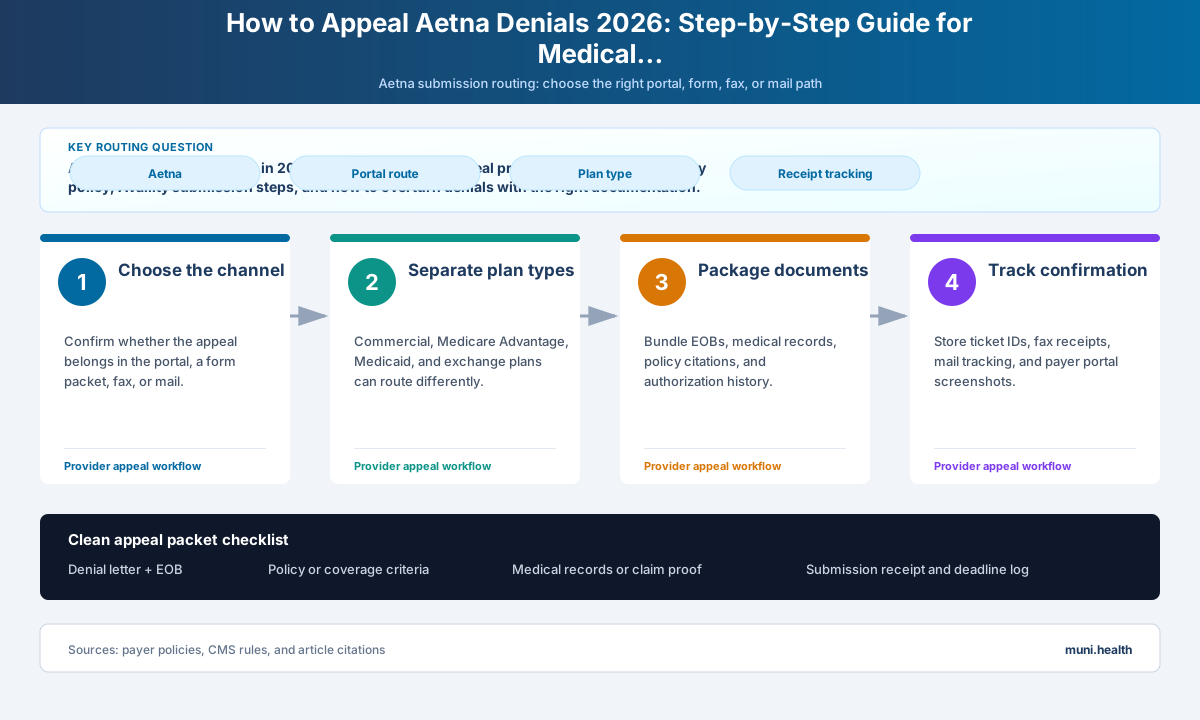
For a detailed breakdown of each submission channel by plan type — including plan-type specific fax addresses and the Availity step-by-step workflow — see the Aetna appeal submission methods guide. For form download locations, regional mailing addresses, and portal navigation steps, see the Aetna appeal form guide.
- Hours: 8 AM – 5 PM local time
Aetna Denial Codes and Resolution Strategies
| Denial Code | What It Means | Resolution Approach |
|---|---|---|
| B7 | Medical necessity not established | Cite the relevant Aetna CPB criteria. Document how the patient meets each requirement. Include failed conservative treatment history and supporting guidelines. |
| 197 | Precertification/authorization absent | Submit retroactive authorization request with clinical urgency documentation or evidence of administrative error. Act within 180 days. |
| 96 | Experimental or investigational procedure | Provide FDA approval status, evidence-based clinical guidelines recommending the treatment, and peer-reviewed studies demonstrating standard-of-care status. |
| 146 | Diagnosis/procedure inconsistency | Verify ICD-10 and CPT code pairing. Provide clinical documentation linking diagnosis to treatment. Often resolved at reconsideration without formal appeal. |
| 50 | Non-covered service under the plan | Review the patient's benefit document. If the service should be covered, cite the specific benefit language and request a formal reconsideration. |
| W3 | Additional patient information required | Respond within 30 days with the requested documentation. Failure to respond converts this to an automatic denial. |
Prepare this appeal packet with your team.
Draft the appeal, coordinate missing documents, and approve the reviewed packet. Keep your clearinghouse; your practice checks deadlines and submits through the payer’s accepted channel.
First 3 appeals free, then $20 per appeal. Start with your denial letter or EOB and available records. No meeting or clearinghouse connection required.
External Review: When Internal Appeals Fail
If Aetna upholds the denial after your internal appeal, you have the right to independent external review at no cost.
Eligibility requirements:
- The denial must be based on medical necessity, experimental/investigational status, or clinical judgment
- Your financial responsibility must exceed $500
- Internal appeals must be exhausted
The external review is conducted by an Independent Review Organization (IRO) — physicians with no financial relationship to Aetna. The IRO's decision is binding on Aetna.
You have up to 4 months from your final internal denial to request external review. Approximately 40% of external reviews result in overturn, according to publicly available state insurance department data.
Aetna Medicare Advantage: Different Appeal Rules
If you're dealing with an Aetna Medicare Advantage or Special Needs Plan denial, the rules differ significantly from commercial coverage:
Key differences for MA appeals:
- Filing deadline: 65 days from the denial (vs. 180 days for commercial)
- Expedited review: 7 days (vs. 72 hours for commercial — note the MA timeline is longer in some cases)
- Oversight: CMS (Centers for Medicare & Medicaid Services), not the state insurance commissioner
- Additional appeal levels: Medicare Reconsideration → ALJ Hearing → Medicare Appeals Council → Federal Court
January 2026 Level of Severity policy reminder: This policy applies specifically to Aetna Medicare Advantage and SNP patients. Track inpatient payment rates for short-stay MA patients — downgrades will appear as lower payments, not denials.
For detailed MA appeal guidance, see our Insurance Appeal Deadlines Guide for a comparison of deadlines across plan types.
How Muni Appeals Helps with Aetna Denials
The manual appeal process — pulling records, finding the right CPB, structuring the letter, tracking deadlines — takes billing staff significant time per claim. The more complex the denial, the longer it takes.
Muni Appeals organizes the full workflow for Aetna denials:
- Suggests a likely denial type and candidate Clinical Policy Bulletin for staff verification
- Compiles required documentation into a structured package
- Drafts appeal letters addressing Aetna's specific denial reason with CPB-cited language
- Provides deadline-risk and follow-up fields for staff to verify, calendar, and manage
- Supports both standard and expedited appeal workflows
Frequently Asked Questions
How long do I have to appeal an Aetna denial in 2026?
You have 180 days from the date you receive the denial notice for commercial Aetna plans. For Medicare Advantage plans, the deadline is 65 days. These deadlines are strictly enforced — appeals received after the deadline are rejected without review. File as soon as you've gathered documentation rather than waiting.
What is Aetna's Level of Severity policy and how does it affect appeals?
Aetna's Level of Severity Inpatient Payment Policy, effective January 1, 2026, applies to Medicare Advantage and SNP patients. It evaluates inpatient stays shorter than five midnights against Aetna's severity criteria. Stays that don't meet criteria are paid at the observation rate instead of the inpatient rate. This doesn't appear as a denial. To dispute, fax additional clinical information within 7 business days of the decision (before submitting the claim), or request a severity discussion with a medical director by phone within 14 calendar days.
What documentation do I need to appeal an Aetna medical necessity denial?
For medical necessity (code B7) denials, you need: the denial letter, complete clinical records (minimum 6 months of relevant history), a physician letter of medical necessity, diagnostic results, documentation of failed conservative treatments with dates, and the relevant section of Aetna's Clinical Policy Bulletin showing the coverage criteria your patient meets. Supporting guidelines from major medical societies significantly strengthen the appeal.
How does Aetna's Availity portal work for submitting appeals?
Log in to Availity.com, navigate to Payer Spaces → Aetna → Claims & Disputes → Submit Appeal. Upload your appeal letter and supporting documentation in PDF format. The portal generates an appeal submission confirmation automatically — no separate appeal form is required when submitting via Availity. Keep the confirmation number for follow-up tracking.
When should I request an expedited Aetna appeal?
Request expedited review when the standard 30-60 day timeline would seriously jeopardize the patient's health, result in unmanageable pain, or when an ongoing course of treatment requires an immediate decision. Your physician must document the clinical urgency. Aetna processes expedited appeals within 72 hours. Note: expedited review is not available for the Level of Severity inpatient payment determinations.
What happens after I submit an Aetna appeal?
Aetna sends an acknowledgment within 5 business days. During review (15-30 days for standard appeals), a medical director reviews your documentation and may request additional information — you typically have 10 days to respond. Aetna may also offer peer-to-peer review during this period. Once decided, you'll receive written notice. If denied, the decision letter explains your external review rights.
Can I get peer-to-peer review for any Aetna denial?
Peer-to-peer review is available for medical necessity and prior authorization denials — request within 5 business days of the denial. However, peer-to-peer is not available for Aetna's Level of Severity inpatient payment determinations under the 2026 policy. For that policy, the dispute process is severity discussion by phone or fax-based clinical review, both of which must occur before the claim is submitted.
What is external review and when does it apply?
External review is independent physician review conducted by an organization with no affiliation to Aetna. It's available after internal appeals are exhausted, when the denial involves medical necessity or experimental/investigational status, and when your financial responsibility exceeds $500. The review must be requested within 4 months of your final internal denial. The external reviewer's decision is binding on Aetna. Approximately 40% of external reviews result in overturn.
Ready to Streamline Your Aetna Appeals?
Manual Aetna appeals require navigating CPBs, building documentation packages, and tracking multiple deadlines across plan types. For practices managing volume, that adds up.
Muni Appeals handles the workflow:
- Aetna-specific appeal letter drafting with CPB citations
- Documentation checklist generation based on denial code
- Deadline-risk guidance for commercial and Medicare Advantage plans, verified and calendared by staff
- Availity or mail/fax submission guidance for staff to verify and use directly
Related Aetna Resources:
- Aetna Appeal Letter Template 2026 — Complete templates for each denial type
- Aetna Medical Necessity Letter 2026 — CPB-cited medical necessity letter templates
- Aetna Prior Authorization Template 2026 — Prior auth denial and retroactive auth templates
- Aetna Prior Authorization Denial Appeal Guide 2026 — EviCore and NIA vendor routing, 7-day P2P windows, submission paths by entity
- Aetna Denial Rate Statistics 2026 — Denial rate breakdown by plan type and state
This guide reflects Aetna's 2026 appeal procedures including the January 2026 Level of Severity Inpatient Payment Policy. State-specific requirements, plan-type variations, and individual contract terms may affect your appeal rights. Consult your provider contract and Aetna's current Clinical Policy Bulletins for the most current guidance.