

What is Aetna's denial rate? It depends on the market and decision being measured. In KFF's parent-company analysis of 2023 HealthCare.gov data, CVS Health — Aetna's parent company — denied 21.6% of in-network ACA Marketplace claims. In a separate Medicare Advantage dataset, CVS Health denied 11.6% of prior-authorization requests in 2024. Neither figure represents every Aetna claim or plan.
Aetna Denial Rate: The Most Comparable Public Data
CVS Health reported 26.005 million medical members as of March 31, 2026. That parent-company membership total spans multiple products; it is not the denominator for either denial-rate dataset below.
For a consistent insurer comparison, the chart uses one source and one cohort: KFF's parent-company table of 2023 in-network claims submitted to HealthCare.gov issuers. That is the most recent year with a verified parent-company breakdown. KFF's 2024 update reports a 19% in-network denial rate, with large parent companies ranging from 8% (Elevance Health) to 25% (Oscar Health). The table embedded in that update repeats the 2023 values, so no verified 2024 figure for CVS Health is available.
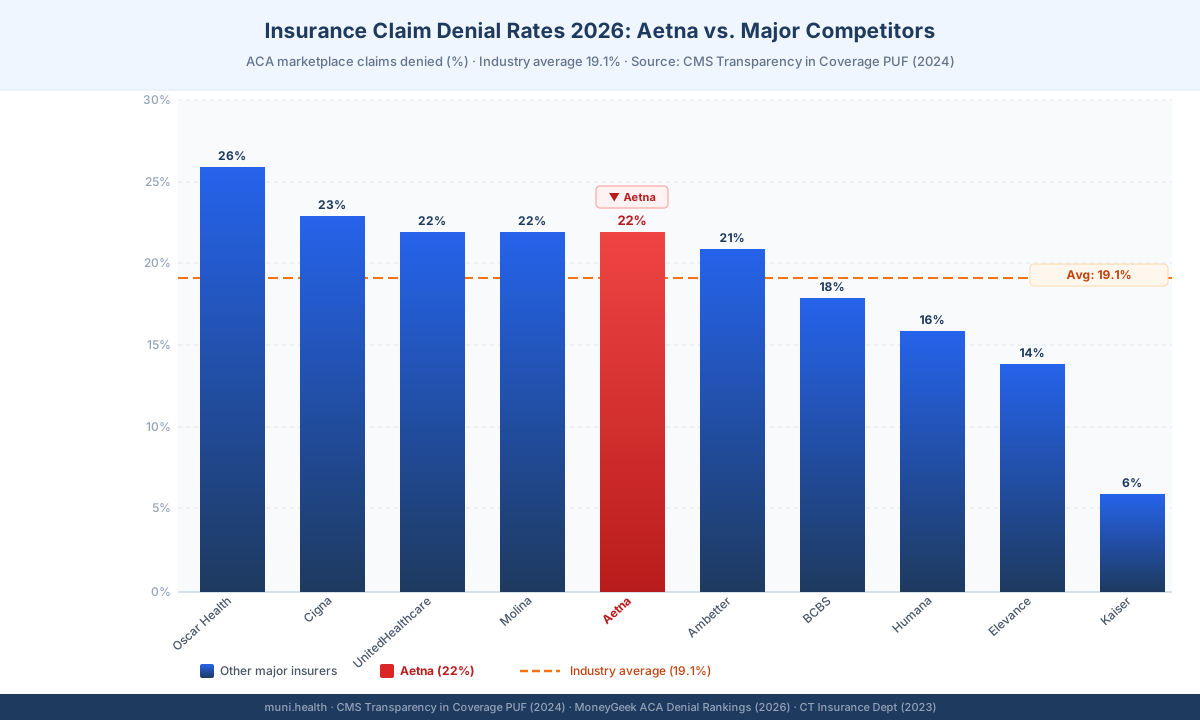
| 2023 HealthCare.gov Cohort | In-Network Claim Denial Rate | Scope |
|---|---|---|
| UnitedHealth Group | 33.3% | Parent-company plans in KFF's table |
| CVS Health (Aetna parent) | 21.6% | Parent-company plans in KFF's table |
| All HealthCare.gov issuers | 20% | National in-network average |
| Oscar Health | 17.1% | Parent-company plans in KFF's table |
Key takeaway: In this specific 2023 ACA cohort, CVS Health's 21.6% rate was about 1.6 percentage points above the 20% HealthCare.gov average, below UnitedHealth Group's 33.3%, and above Oscar Health's 17.1%. These figures do not create a universal ranking across employer, Medicaid, Medicare Advantage, or state-regulated plans.
For a broader provider-side evaluation of Aetna, see our Aetna provider reviews guide.
Do Not Mix Denial-Rate Denominators
An ACA claim denial rate measures submitted claims. A Medicare Advantage prior-authorization denial rate measures requests for approval before care. State reports may use still other definitions. Compare insurers only when the market, year, claim status, and denominator match.
Why Published Aetna Denial Rates Differ
Public reports can all be accurate while describing different questions:
Prepare this appeal packet with your team.
Draft the appeal, coordinate missing documents, and approve the reviewed packet. Keep your clearinghouse; your practice checks deadlines and submits through the payer’s accepted channel.
First 3 appeals free, then $20 per appeal. Start with your denial letter or EOB and available records. No meeting or clearinghouse connection required.
- Claims versus prior authorization: A denied claim and a denied request to authorize care are different events.
- Parent company versus plan: KFF groups Aetna under CVS Health, while a denial notice identifies the legal plan and benefit contract that govern an appeal.
- In-network versus all claims: Some datasets exclude out-of-network claims or report them separately.
- National versus state reporting: State insurance departments may cover only state-regulated products, excluding many self-funded employer plans.
- Initial decisions versus appeals: An overturn rate applies only to the subset of denials that were appealed; it is not the share of all denials ultimately paid.
This is why a single "Aetna denial rate" should always be paired with its market and year.
Common Aetna Denial Reasons and What to Verify
No public dataset provides a reliable Aetna-specific percentage breakdown by denial reason or a category-level probability of winning. Use the denial notice to identify the stated reason before choosing a response.
| Denial Reason | What to Verify Before Filing |
|---|---|
| Prior authorization not obtained | Whether the service required authorization and whether emergency, continuity-of-care, or retrospective-review rules apply |
| Medical necessity disputed | The exact Clinical Policy Bulletin or coverage criterion cited, its effective date, and the clinical record supporting each criterion |
| Out-of-network provider | Network-adequacy, emergency-care, referral, and plan-specific exception rules |
| Experimental or investigational | The cited policy, FDA status, recognized compendia, peer-reviewed evidence, and plan exclusions |
| Coding or documentation issue | Whether the correct path is a corrected claim, reconsideration, or formal appeal |
For a step-by-step provider guide covering denial types and submission choices, see the Aetna denied claim provider guide.
Aetna Medicare Advantage Prior-Authorization Data
KFF's analysis of CMS data reports 52.8 million Medicare Advantage prior-authorization determinations in 2024. KFF publishes both market-wide figures and selected parent-company figures, including CVS Health.
| 2024 Metric | CVS Health (Aetna parent) | All MA Insurers | Interpretation |
|---|---|---|---|
| Prior-authorization denial rate | 11.6% | 7.7% | Share of determinations denied |
| Requests per enrollee | Not separately stated here | 1.7 | Average request volume, not a denial rate |
| Appealed denials overturned | 92.6% | 80.7% | Among denials that were appealed |
| Total determinations | Not separately stated here | 52.8 million | All Medicare Advantage insurers |
The payer-specific percentages are parent-company aggregates, not guarantees for every Aetna Medicare Advantage contract. The 92.6% overturn figure also does not mean 92.6% of all denials were reversed: it applies only to denied requests that reached an appeal.
Beginning in 2026, CMS-0057-F requires affected payers to send expedited prior-authorization decisions within 72 hours and standard decisions within seven calendar days. Those are initial prior-authorization decision timelines, not universal appeal deadlines.
For the Aetna Medicare Advantage appeal ladder, see the Aetna Medicare Advantage denial appeal guide.
→ Prepare an Aetna Medicare Advantage Appeal
How to Respond to an Aetna Denial
1. Identify the Exact Workflow
Confirm whether the notice concerns a member appeal, provider payment dispute, corrected claim, prior-authorization appeal, or external review. Each lane can have a different deadline and filing destination.
2. Match the Evidence to the Stated Reason
For medical-necessity disputes, map the clinical record to the exact policy language cited in the notice. For coding or administrative denials, first determine whether Aetna requires a corrected claim or reconsideration instead of an appeal.
3. Use Peer-to-Peer Review Only When Offered
A peer-to-peer discussion may be available for some pre-service clinical decisions, but it does not automatically replace a written appeal or preserve a deadline. Confirm the effect in the denial notice before relying on it.
4. Escalate Only Through an Available Review Right
External review eligibility depends on the plan, issue, state, and whether internal review has been exhausted. Follow the notice and the applicable regulator's instructions; do not assume every payment or contract dispute qualifies.
5. Track the Record Without Exposing Patient Information
Record the plan, denial code, date received, deadline, submission channel, confirmation number, and next review level. Keep clinical details inside approved systems rather than general analytics or logs.
Muni Appeals can prepare a draft and evidence checklist from the materials you upload; it does not guarantee an outcome or replace verification of the current plan and denial notice.
→ See How Muni Appeals Prepares Aetna Appeal Drafts
Aetna Appeal Deadlines and Filing Paths
The denial notice is the controlling source for a specific case. The rows below summarize distinct Aetna workflows; they are not interchangeable. For Medicare Advantage, CMS's current Part C reconsideration guidance says a reconsideration request must be filed within 65 calendar days from the date of the organization-determination notice.
Prepare this appeal packet with your team.
Draft the appeal, coordinate missing documents, and approve the reviewed packet. Keep your clearinghouse; your practice checks deadlines and submits through the payer’s accepted channel.
First 3 appeals free, then $20 per appeal. Start with your denial letter or EOB and available records. No meeting or clearinghouse connection required.
| Workflow | When to File | Decision Timing | Where to File |
|---|---|---|---|
| Commercial member claim appeal | Within 180 days after receiving the denial | Plan and notice specific | Destination printed on the member's denial notice |
| Commercial provider claim dispute | Common sequence: reconsideration within 180 days of the initial claim decision; appeal within 60 days after reconsideration | Up to 60 business days under Aetna's national provider process | Current provider dispute page or portal; contract exceptions may apply |
| Medicare Advantage authorization appeal | 65 calendar days from the organization-determination notice; the denial notice controls | 30 calendar days standard; 72 hours only when the expedited health-risk standard is met | Instructions in the organization-determination notice; verify against Aetna's current Medicare appeals page |
| Medicare Advantage payment or claim appeal | 65 calendar days from the organization-determination notice; the denial notice controls | 60 calendar days; expedited review is not available for a payment request | Instructions in the organization-determination notice; verify against Aetna's current Medicare appeals page |
| Medicaid appeal | State and plan specific | State and plan specific | Medicaid plan notice and state fair-hearing instructions |
Check the official page that matches the filer and product before submission:
- Aetna member claim-denial and appeal guidance
- Aetna provider disputes and appeals overview
- Aetna Medicare appeals guidance
Request expedited review only when the appeal concerns authorization for care and waiting could seriously jeopardize the member's life, health, or ability to regain maximum function. Payment-only claim appeals are not expedited. Always use the current phone number, fax number, address, or portal printed on the denial notice or official product page.
For broader filing guidance, see Insurance Appeal Deadlines by Company and How to Appeal Aetna Denials 2026.
Frequently Asked Questions
Does Aetna deny a lot of claims?
In KFF's 2023 HealthCare.gov parent-company analysis, CVS Health plans denied 21.6% of in-network ACA Marketplace claims, compared with a 20% national average. KFF's 2024 update puts the national rate at 19% but does not publish a verified 2024 CVS figure. That is a specific ACA cohort, not an all-products Aetna rate.
What is Aetna's denial rate compared with other insurers?
Within the same 2023 HealthCare.gov parent-company table, UnitedHealth Group was 33.3%, CVS Health was 21.6%, and Oscar Health was 17.1%. The ordering changes when the market, plan, or denominator changes, so there is no defensible universal rank for Aetna across all insurance products. In the same table, Cigna Health's rate was 20.8%; see Cigna denial rate statistics. For a broader comparison, see the insurance denial rate comparison by company.
How often does Aetna deny prior-authorization requests?
For Medicare Advantage, KFF reports that CVS Health denied 11.6% of prior-authorization determinations in 2024, compared with 7.7% across all MA insurers. No equivalent nationwide public figure covers every Aetna commercial plan.
What percentage of Aetna appeals are successful?
KFF reports that CVS Health overturned 92.6% of appealed Medicare Advantage prior-authorization denials in 2024; the industry-wide figure was 80.7%. Those figures apply only to the subset appealed and do not establish a commercial-claim, denial-reason, or documentation-specific success rate.
Is Aetna the worst insurance company for denials?
No single public dataset supports that conclusion across all products. In the cited 2024 ACA cohort, CVS Health's rate fell between UnitedHealth Group and Oscar Health. Medicare Advantage prior-authorization data use a different denominator and should be compared separately.
Why did Aetna deny my claim for medical necessity?
The denial notice should identify the clinical policy or benefit criterion Aetna applied. Verify the exact policy version, match the record to each stated criterion, and follow the review route printed on the notice. Do not assume a medical-necessity denial automatically qualifies for expedited or external review.
The Bottom Line
The most useful public Aetna statistics are specific, not universal:
- CVS Health's 2023 in-network ACA Marketplace claim denial rate was 21.6%, versus 20% across HealthCare.gov issuers (KFF; the 2024 national rate was 19%).
- CVS Health's 2024 Medicare Advantage prior-authorization denial rate was 11.6%, versus 7.7% industry-wide.
- Among Medicare Advantage prior-authorization denials that were appealed, CVS Health overturned 92.6% and the industry overturned 80.7% in 2024.
- In the separate ACA Marketplace cohort, fewer than 1% of denied in-network claims were appealed in 2024.
Review every denial promptly, but file only through the correct plan-specific route with the evidence and deadline stated in the notice.
→ Start Preparing an Aetna Appeal
Sources: KFF Claims Denials and Appeals in ACA Marketplace Plans (2024), KFF Medicare Advantage Prior Authorization Analysis (2024), CVS Health Q1 2026 results filed with the SEC, CMS Part C reconsideration guidance, CMS Interoperability and Prior Authorization Final Rule, Aetna member claim-denial guidance, Aetna provider disputes and appeals overview, Aetna Medicare appeals guidance