

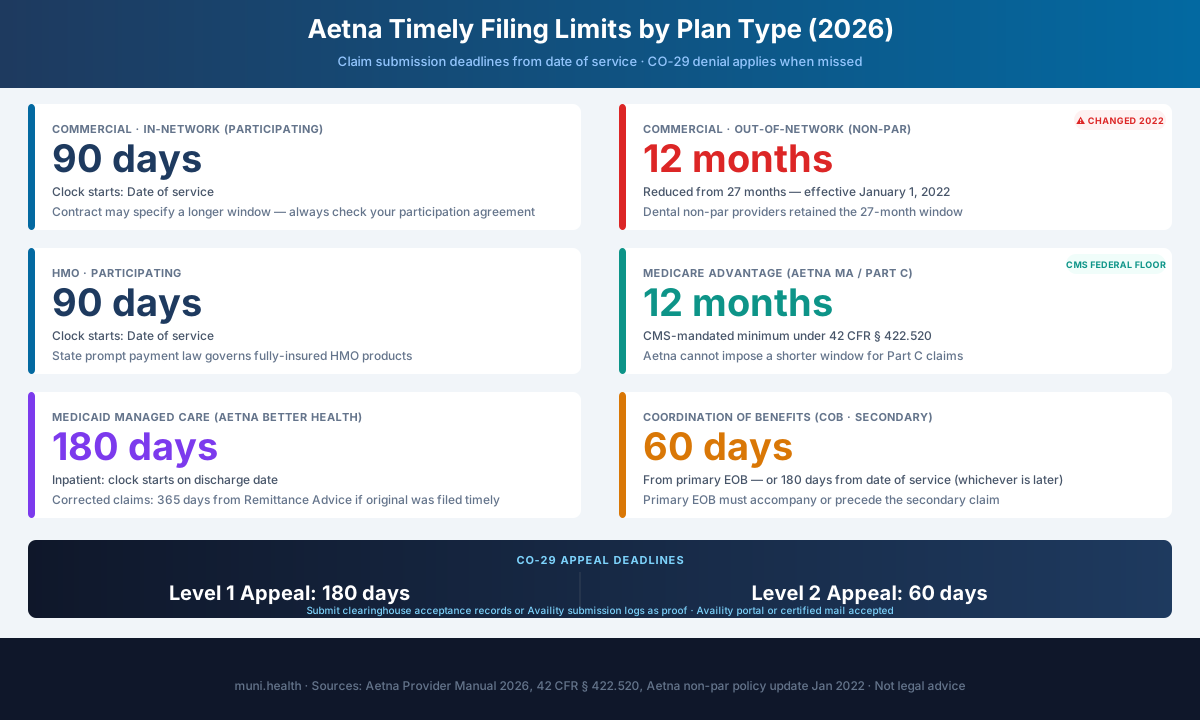
Aetna's timely filing limit (TFL) for in-network commercial providers is 90 days from the date of service. Out-of-network (non-participating) providers have 12 months, effective January 1, 2022. Medicare Advantage claims follow a CMS-mandated 12-month floor. Medicaid Managed Care: 180 days. Appeal deadlines: 180 days for Level 1, 60 days for Level 2. CO-29 timely filing denials can be appealed with clearinghouse acceptance records or Availity submission logs as proof.
Don’t guess the next step for this denial.
Choose the denial stage and available documentation to find a relevant synthetic example. Try preparation without an account, or start your real case now. No files are sent to a payer.
First 3 appeals free, then $20 per appeal. Start with your denial letter or EOB and available records. No meeting or clearinghouse connection required.
Key statistic
Fewer than 1% of denied claims are ever appealed, yet insurers overturn roughly 44% of the internal appeals that providers and patients do file (KFF analysis of 2023 ACA marketplace data, 2024). Timely-filing (CO-29) denials are among the most recoverable of all — but only when you appeal with submission proof before the window closes.
Why Aetna's Timely Filing Rules Are More Complex Than Most Payers
Aetna operates one of the more complicated timely filing structures in commercial insurance — not because its standard limits are unusual, but because they vary by network status, plan type, state law, and a major policy change that took effect in 2022 that many billing teams still haven't fully absorbed.
The most consequential shift: effective January 1, 2022, Aetna reduced its non-participating provider filing window from 27 months to 12 months (365 days). Practices that historically relied on the extended non-par window now face denials they weren't expecting. Aetna began enforcing the new limit aggressively in 2023 as claims from early 2022 started reaching the deadline, and CO-29 denials for non-par claims spiked accordingly.
For independent practices, the risk is concentrated in a few specific scenarios: billing a mix of in-network and out-of-network plans without tracking deadlines separately, handling Medicare Advantage claims under the wrong assumption that the commercial 90-day rule applies, and missing COB secondary claim windows because the clock starts from the primary EOB rather than the date of service.
This guide covers every Aetna timely filing limit by plan type, explains the appeal deadlines for CO-29 denials, and tells you exactly what documentation Aetna requires to overturn a late-filing denial.
Aetna Claim Submission Timely Filing Limits by Plan Type
Aetna's TFL is 90 days for in-network commercial claims, 12 months for non-par and Medicare Advantage claims, and 180 days for Medicaid Managed Care — measured from the date of service unless noted otherwise below.
| Plan Type | Timely Filing Limit | Clock Starts | Notes |
|---|---|---|---|
| Commercial — In-Network (Participating) | 90 days | Date of service | Your individual provider contract may specify a longer window — always check your contract language |
| Commercial — Out-of-Network (Non-Participating) | 12 months (365 days) | Date of service | Reduced from 27 months effective January 1, 2022. Dental non-par providers retained the 27-month window |
| HMO — Participating | 90 days | Date of service | Same standard as commercial PPO in-network; state prompt payment law governs fully insured HMO products |
| Medicare Advantage (Aetna MA / Part C) | 12 months (365 days) | Date of service | CMS-mandated minimum floor under 42 CFR § 422.520 — Aetna cannot impose a shorter window |
| Medicaid Managed Care (Aetna Better Health) | 180 days | Date of service (inpatient: discharge date) | Corrected/resubmitted claims: 365 days from Provider Remittance Advice date, if original filed timely |
| FEHB (AetnaFeds) | ~12 months | Date of service | Consistent with OPM program norms; verify at aetnafeds.com or call 888-238-6240 for plan-specific deadline |
| Coordination of Benefits (COB — Secondary) | 60 days from primary EOB or 180 days from DOS | Whichever is later governs | Primary payer's EOB must accompany or precede secondary claim — Aetna pends if missing |
Don’t guess the next step for this denial.
Choose the denial stage and available documentation to find a relevant synthetic example. Try preparation without an account, or start your real case now. No files are sent to a payer.
First 3 appeals free, then $20 per appeal. Start with your denial letter or EOB and available records. No meeting or clearinghouse connection required.
Non-Par Window Changed in 2022 — Many Practices Don't Know
Aetna's non-participating provider filing window dropped from 27 months to 12 months on January 1, 2022. This is not a rumor — it was announced via billing alerts published by XiFin, WCH Service Bureau, and multiple RCM sources in late 2021. If your billing team is still operating as though non-par Aetna claims have a two-year runway, you are likely losing revenue on enforceable CO-29 denials.
Your Provider Contract Governs Over the Manual
Aetna's published timely filing limits in the Provider Manual are the default baseline. Your individual Aetna participation agreement can — and sometimes does — specify a different window. Common negotiated variations include:
- 120-day windows for in-network commercial practices with high Aetna volume
- Extended windows for specific service lines (e.g., behavioral health, complex specialty practices)
- Plan-specific addenda that extend the standard for certain employer group plans
When in doubt, pull your contract language. The Aetna manual is a floor, not a ceiling.
Aetna Appeal Timely Filing Limits
Getting a CO-29 denial doesn't always mean the revenue is gone — but you have to act within Aetna's appeal window or the denial becomes final. Aetna's appeal deadlines are separate from its claim submission deadlines and run from the date of the denial notice, not the date of service.
| Plan Type | Level 1 Appeal Deadline | Level 2 Appeal Deadline | External Review / IRO |
|---|---|---|---|
| Commercial — All Plans | 180 days from denial date | 60 days from Level 1 decision | 180 days from final internal denial; amount in controversy must exceed $500 |
| Medicare Advantage (Part C) — Level 1 Redetermination | 65 days from denial notice | N/A (auto-forwards to IRE if applicable) | IRE (C2C Innovative Solutions, as of May 1, 2026) review available after Level 1 |
| Medicare Advantage (Part C) — Level 2 IRE | 60 days from Level 1 decision | 60 days from Level 2 for ALJ hearing | Amount in controversy ≥ $200 (2026 threshold) for ALJ; ≥ $1,960 for Federal District Court |
| Medicaid Managed Care (Aetna Better Health) | 60–180 days from denial (state-specific) | Varies by state contract | State external review process; timelines defined by state |
| State — Exceptions Apply | 180 days (default) — but state law may be longer | Verify state supplement | State external review deadlines vary; CA, TX, NY have specific rules |
Appeal Decision Timelines — What Aetna Owes You
Once you submit an appeal, Aetna has defined response windows. Knowing these protects you from appeal limbo — if Aetna misses its own deadline, that becomes an additional point of leverage:
- Commercial standard appeals: 75 business days from receipt of appeal
- Medicare Advantage Level 1: 60 days (post-service); 30 days (pre-service organization determinations)
- Medicare Advantage Level 2 (IRE): 60 days
- Expedited appeals (urgent clinical need): 72-hour decision required
State Law May Extend Your Window
Aetna explicitly acknowledges that state insurance regulations supersede its standard 180-day appeal filing window for fully insured plans and self-funded non-ERISA plans. The Aetna Provider Manual — State Supplement PDF lists state-by-state exceptions. California, New York, and Texas all have notable overrides. Self-funded ERISA plans are generally not subject to state mandates. For a cross-payer comparison of appeal deadlines and state overrides, see the insurance appeal deadlines guide.
How to Appeal an Aetna CO-29 Timely Filing Denial
A CO-29 denial (CARC code 29 — "The time limit for filing has expired") is Aetna's standard code for timely filing denials. Because it carries a CO (Contractual Obligation) group code, the balance cannot be billed to the patient — which makes the appeal the only path to recovery.
CO-29 denials are among the most commonly upheld denial types, but they are winnable when you have the right documentation. Aetna's appeals process is looking for one thing: evidence that you submitted the claim within the applicable window, regardless of when Aetna's system logged it. For a broader look at all Aetna denial types and their action paths, see the Aetna denied claim guide.
Step 1: Confirm Which Filing Window Applied
Before building your appeal, verify which timely filing limit actually governed this specific claim:
- In-network commercial: Was your 90-day window calculated correctly from the date of service?
- COB secondary claim: Did you measure 60 days from the primary carrier's EOB date — not from the date of service?
- Non-par claim: Was the date of service after January 1, 2022? If so, the 12-month window applies, not 27 months.
- Medicare Advantage: Does the CMS-mandated 12-month floor apply, even if Aetna's EOB references a shorter window?
- State override: Are you in California, New York, Texas, or another state with a longer statutory window that supersedes Aetna's standard?
Aetna issues CO-29 errors on COB claims fairly often — when billing teams use the service date instead of the primary EOB date as the clock start. Confirming the correct window first may resolve the denial without a full appeal.
Step 2: Gather Timely Submission Proof
Aetna's appeals process requires you to prove the claim was transmitted within the applicable window. Required documentation:
- 277CA transaction / clearinghouse acceptance report — the payer-side acceptance confirmation showing the date your clearinghouse submitted the claim to Aetna's EDI gateway and Aetna accepted it. This is the strongest evidence.
- Availity submission log — timestamp of accepted electronic submission if filed directly through Availity.
- Practice management system transmission report — batch confirmation showing submission date.
- For paper claims: certified mail receipt, delivery confirmation, or Aetna mailroom receipt confirmation.
- For resubmissions of previously rejected claims: proof of the original timely submission attempt, even if that claim was rejected, plus the corrected resubmission.
Aetna Does Not Accept 'We Missed It' as an Exception
Aetna strictly enforces timely filing limits and does not accept general staff turnover, software transitions, billing discovery delays, or administrative error as exceptions. The exceptions that Aetna does recognize are narrow and specific — see Step 3 below.
Step 3: Document a Filing Exception (If Applicable)
If you genuinely missed the timely filing window — not an error in your records — Aetna will only waive a CO-29 denial if the delay was caused by a specific, documentable external circumstance:
- FEMA-declared natural disaster affecting the provider's facility or operations during the filing window
- Verified Availity or EDI portal outage — documented system downtime from Aetna or your clearinghouse during the filing period
- Retroactive member eligibility — the claim could not be filed because eligibility was not confirmed until after the window closed (requires documentation from the member or employer group)
- COB delays — you were waiting for the primary payer's EOB before filing secondary, and the delay was due to the primary payer's processing time
- Aetna administrative error — Aetna provided an incorrect address or claim routing that caused the delay
Step 4: Submit Your Appeal
Aetna accepts CO-29 appeals via:
- Availity portal — fastest; allows attachment of documentation
- Mail: Address listed on the EOB/remittance advice, or see our Aetna claims and appeals mailing address directory for the correct PO box by state and plan type
- Fax: Aetna provider services fax number per your state
- Phone-initiated reconsideration: Aetna provider services (1-888-MD-AETNA) — typically followed by written appeal
For the full breakdown of which Aetna number to call for a claim, appeal, or peer-to-peer request, see our Aetna provider phone numbers guide.
Your appeal letter should:
- Reference CO-29 and Aetna's timely filing policy explicitly
- State the date of service and the date of original submission
- Attach all supporting documentation in a single organized packet
- Reference the applicable filing window (and why it wasn't violated, or what exception applies)
For a ready-to-use template for Aetna appeal letters, see the Aetna appeal letter template. For the full step-by-step Aetna appeals workflow — including peer-to-peer review, expedited appeals, and post-appeal escalation — see How to Appeal Aetna Denials 2026.
| Appeal Method | Best For | Attachment Support | Turnaround |
|---|---|---|---|
| Availity portal | Electronic submissions with attachment | Yes — PDF, image, X12 | Fastest; 75 business days for Aetna review |
| Complex appeals with extensive documentation | Yes — paper records | Add 5-7 business days for transit | |
| Fax | Urgent appeals near deadline | Yes — fax-legible records | Confirm receipt with Aetna provider services |
| Phone (informal reconsideration) | Simple cases with obvious documentation | No — requires follow-up in writing | May resolve faster but less documentation protection |
Aetna Medicare Advantage Timely Filing — Five-Level Appeal Process
Medicare Advantage claims and appeals follow a CMS-mandated structure that is distinct from Aetna's commercial process. The CMS framework provides five escalation levels, each with its own deadline and deciding authority:
- Level 1 — Redetermination (Aetna): Provider has 65 days from denial notice. Aetna has 60 days to decide (post-service) or 30 days (pre-service)
- Level 2 — Independent Review Entity (C2C Innovative Solutions, as of May 1, 2026): 60 days from Level 1 decision. Aetna must auto-forward if the appeal is for urgent clinical care
- Level 3 — ALJ Hearing (OMHA): 60 days from Level 2 decision. Amount in controversy ≥ $200 (2026 threshold)
- Level 4 — Medicare Appeals Council (DAB/MAC): 60 days from ALJ decision
- Level 5 — Federal District Court: 60 days from Level 4 decision. Amount in controversy ≥ $1,960 (2026 threshold)
For most billing teams, Levels 1 and 2 cover the majority of recoverable MA timely filing denials. Level 3 and above are reserved for high-value denials or systemic disputes.
For a complete breakdown of Aetna MA timely filing by plan type — HMO, PPO, PFFS, D-SNP, I-SNP, corrected claims, and the D-SNP dual-clock billing requirement — see the Aetna Medicare Advantage timely filing guide. For how Aetna's corrected claim window compares to UHC, Cigna, Anthem BCBS, and Humana, see the Corrected Claim Timely Filing Limits 2026 guide.
How Muni Appeals Handles Aetna Timely Filing Denials
Timely filing denials are administrative denials — they don't require clinical judgment, just accurate records and organized documentation. They're also highly time-sensitive: missing the Level 1 appeal deadline permanently forecloses recovery.
Muni Appeals prepares the CO-29 appeal draft and evidence checklist for staff review:
- Deadline-risk guidance by plan type, with staff verification against the denial notice and provider agreement
- Automated documentation pulls from clearinghouse acceptance reports and Availity logs
- Appeal letter generation with Aetna-specific CO-29 language and filing window references
- Escalation routing for claims that need exception documentation
Frequently Asked Questions
What is Aetna's timely filing limit for in-network providers?
Aetna's standard timely filing limit for in-network (participating) commercial and PPO providers is 90 days from the date of service. Your individual provider contract may specify a longer window — always check your contract before assuming the manual standard applies.
What is Aetna's timely filing limit for out-of-network providers?
Effective January 1, 2022, Aetna reduced its non-participating (out-of-network) provider filing window from 27 months to 12 months (365 days) from the date of service. This change was announced in late 2021 and took effect for claims with dates of service on or after January 1, 2022. Dental non-par providers retained the 27-month window.
What is the timely filing limit for Aetna Medicare Advantage?
Aetna Medicare Advantage plans must follow the CMS-mandated minimum floor of 12 months from the date of service under 42 CFR § 422.520. Aetna cannot impose a shorter window than CMS permits for Medicare Advantage claims.
How long do I have to appeal a CO-29 timely filing denial from Aetna?
You have 180 days from the date of Aetna's denial notice to file a Level 1 appeal on commercial plans. For Medicare Advantage, the Level 1 redetermination deadline is 65 days from the denial notice. Missing either window makes the denial final.
What documentation does Aetna require to appeal a timely filing denial?
The strongest evidence is a 277CA clearinghouse acceptance report showing Aetna's EDI gateway accepted your claim within the applicable filing window. Availity submission timestamps and practice management system transmission reports are also accepted. For paper claims, certified mail receipts or delivery confirmations serve the same function.
Will Aetna waive a timely filing denial if we just didn't know about the claim?
No. Aetna does not accept general oversight, staff turnover, software transitions, or late claim discovery as exceptions. The only accepted exceptions are FEMA-declared disasters, verified Aetna/Availity portal outages, retroactive eligibility situations where coverage was unknown, and specific Aetna administrative errors. Document these carefully if they apply.
How does the COB (secondary claim) timely filing window work?
For claims where Aetna is the secondary payer, the timely filing clock starts from the date of the primary payer's EOB — not the date of service. The window is 60 days from the primary EOB or 180 days from the date of service, whichever is later. Billing from the service date on COB claims is one of the most common triggers for erroneous CO-29 denials.
Does state law affect Aetna's timely filing limits?
Yes, for fully insured plans and self-funded non-ERISA plans. Aetna acknowledges that state insurance regulations supersede its standard timely filing windows in states with longer statutory requirements. California, New York, and Texas are notable examples. The Aetna Provider Manual — State Supplement PDF (available at aetna.com) is the canonical source. Self-funded ERISA plans are generally exempt from state insurance mandates.
Ready to Stop Losing Revenue to Aetna CO-29 Denials?
Timely filing denials are the most preventable revenue loss in medical billing. Every CO-29 that sticks represents a claim that was legitimately payable — just submitted at the wrong time, or appealed without the right proof.
Get Started:
- Deadline-risk guidance by Aetna plan type (in-network, non-par, MA, Medicaid)
- A checklist for uploading the clearinghouse documentation needed for CO-29 appeals
- Aetna-specific appeal letter generation with correct window references
- Escalation routing before Level 1 appeal deadlines expire
This guide reflects 2026 Aetna timely filing procedures based on the Aetna Provider Manual, Aetna Provider Manual State Supplement, and Aetna Better Health plan documents. Individual provider contracts, state-specific regulations, and plan-type variations may differ from the defaults described here. Verify your specific contract terms and consult the Aetna State Supplement for state-level overrides. Aetna Medicare Advantage timely filing limits are governed by CMS regulations under 42 CFR § 422.520. For corrected claim timely filing windows by Aetna plan type — commercial, Medicare Advantage, and Medicaid — see Aetna Corrected Claim Timely Filing Limits 2026.