

UnitedHealthcare appeal letters require 7 essential components: patient information with UHC member ID, clear denial identification with claim number, medical necessity justification citing UHC Coverage Determination Guidelines (CDGs), supporting clinical documentation, timeline compliance (65-day filing deadline for commercial plans; 60 days for Medicare Advantage and Part D), specific relief requested, and physician signature with credentials. UHC requires digital submission through UHCProvider.com for most network providers. Response times are 30 days for pre-service appeals and 60 days for post-service appeals, with expedited decisions within 72 hours when health is at risk.
Understanding UnitedHealthcare's Complex Appeal Structure
UnitedHealthcare operates the largest private health insurance network in the United States, covering over 70 million Americans through commercial plans, Medicare Advantage, Medicaid managed care, and Federal Employee programs. This scale creates complexity—different plan types follow different appeal procedures, timelines, and submission requirements.
Key UHC Plan Variations:
- Commercial Plans: 65-day filing deadline, 30/60-day response times
- Medicare Advantage: 65-day filing deadline, 7-30-day response times depending on urgency
- Medicaid Managed Care (Community Plan): State-specific timelines (often 60 days)
- Medicare Part D (OptumRx): 60-day filing deadline for prescription drug appeals
- Federal Employee Program: Follows OPM regulations with distinct procedures
Additionally, UHC uses OptumHealth for utilization management and prior authorization reviews, adding another layer of complexity when citing coverage policies. For the full step-by-step appeal workflow — including the two-step reconsideration process, peer-to-peer review scheduling, and Optum MA routing — see the how to appeal UHC denials guide.
Critical: Digital Submission Required
As of January 2025, UnitedHealthcare requires most network providers to submit appeals digitally through UHCProvider.com or via secure fax. Paper mail submission times out in many cases. Always check your contract status and use the digital portal when available for faster processing and confirmation of receipt.
Industry Denial & Success Rates
UnitedHealthcare denied 20% of in-network ACA marketplace claims in Plan Year 2024 (down from 33% in 2023), and its Medicare Advantage prior authorization denial rate runs around 12.8% — one of the highest among major insurers. See the UHC denial rate statistics guide for the full breakdown by plan type. When physicians do appeal a prior authorization denial, the outcome is favorable more often than not — appealing is generally worth the effort when the clinical documentation supports medical necessity.
UHC Appeal Success Data
According to the AMA's 2024 Prior Authorization Physician Survey, 81.7% of appealed prior authorization denials were fully or partially overturned. The same survey found only 18% of physicians say they always appeal a denial, and just 16% feel the health plan's peer-to-peer reviewer typically has the appropriate qualifications — appealing works more often than physicians act on it.
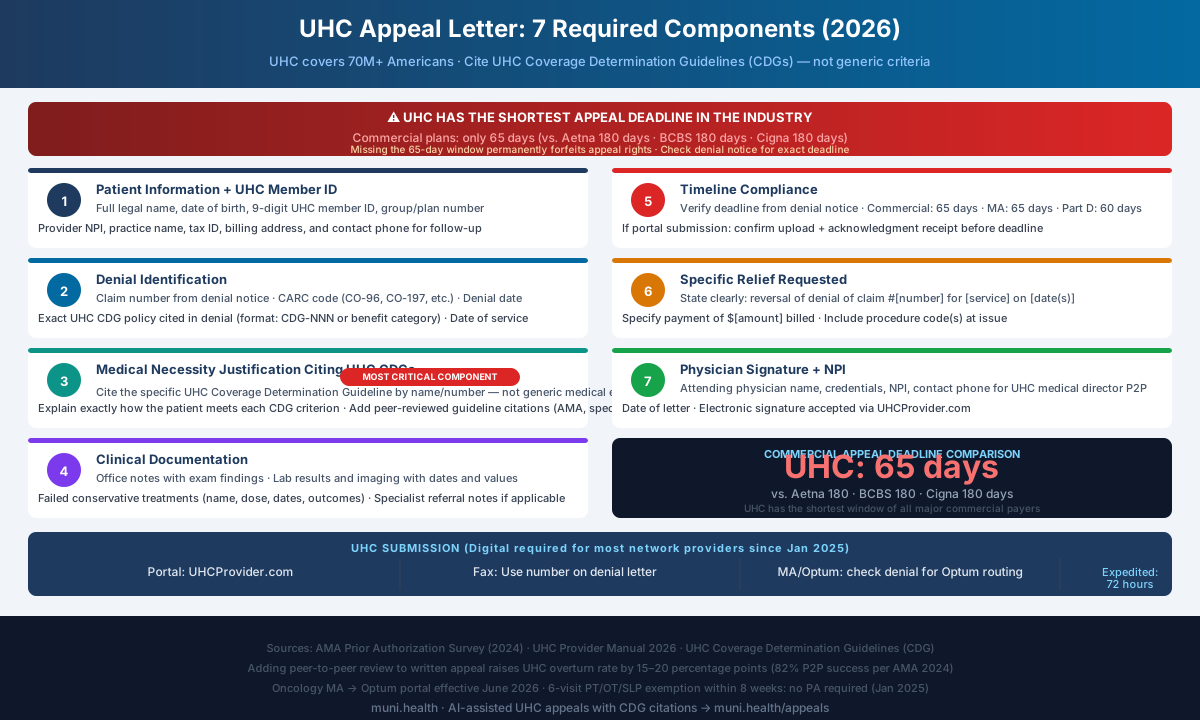
UHC Appeal Timely Filing Limit 2026: 65-Day Deadline for Commercial Plans
UnitedHealthcare has one of the shortest appeal timely filing limits in the industry: only 65 calendar days for commercial plans. This is significantly shorter than Aetna, BCBS, and Cigna, which allow 180 days for commercial plan appeals. Missing UHC's 65-day timely filing limit permanently forfeits your appeal rights. For a full breakdown by plan type including Medicare Advantage and Medicaid deadlines, see our UHC timely filing deadlines guide.
| Plan Type | UHC Filing Deadline | Industry Comparison |
|---|---|---|
| Commercial Plans (PPO, HMO, EPO) | 65 days | Aetna/BCBS/Cigna: 180 days |
| Medicare Advantage | 65 days | Most MA plans: 60 days |
| Medicare Part D (OptumRx) | 60 days | CMS standard: 60 days |
| Medicaid Community Plan | 60 days (state-specific) | Varies by state |
| Federal Employee Program | 60–90 days | Follows OPM regulations |
UHC's 65-Day Deadline is Shorter Than Most Insurers
Don't assume you have 180 days like other insurers! UnitedHealthcare strictly enforces the 65-day timely filing limit for commercial plans. Set a calendar reminder for 45 days after denial to allow 20-day buffer for preparation. Missing this deadline means automatic rejection without clinical review.
How UHC's Timely Filing Limit is Calculated:
- The clock starts on the date printed on your EOB or denial letter (not the date you received it)
- Count calendar days, not business days
- If day 65 falls on a weekend/holiday, some states extend to the next business day (verify with UHC)
- Appeals received after the timely filing limit are automatically denied—no exceptions
Why UHC's Shorter Deadline Matters: Many practices lose appeal rights because they expect the industry-standard 180 days. With UHC:
- You have less than half the time compared to Aetna, BCBS, and Cigna
- Track denial dates immediately upon receipt
- Prioritize UHC appeals over other insurers when managing multiple denials
When to File a UHC Appeal: Denial Types & Deadlines
Filing Deadlines by Plan Type
Commercial Plans:
- 65 days from date on Explanation of Benefits (EOB) or denial letter
- Applies to employer-sponsored plans, individual market plans
Medicare Advantage:
- 60 days from organization determination (coverage decision denial)
- Automatic elevation to Level 2 if UHC doesn't respond within 7 days (standard appeals)
Medicare Part D (Prescription Drugs):
- 60 days from date of denial letter
- Appeals handled by OptumRx, separate submission address
Medicaid Managed Care (Community Plan):
- 60 days from Notice of Action (most states)
- State-specific variations exist (check your denial letter)
Federal Employee Program (FEP):
- Follows OPM regulations (typically 60-90 days)
Don't Miss UHC's Shorter Deadline
Unlike Aetna and BCBS (which allow 180 days for commercial plans), UnitedHealthcare strictly enforces a 65-day appeal filing deadline for commercial plans and 60 days for Medicare plans. Missing this deadline permanently forfeits your appeal rights. Track denial dates immediately and set calendar reminders for 45 days (giving a 20-day buffer for preparation).
Common UHC Denial Reasons Worth Appealing
These denial reasons tend to have the strongest grounds for appeal:
Medical Necessity Denials:
- "Does not meet UHC Coverage Determination Guidelines"
- "Not medically necessary per OptumHealth clinical criteria"
- "Insufficient clinical documentation to support medical necessity"
- "Service considered investigational or unproven"
Prior Authorization Denials:
- "Prior authorization required but not obtained"
- "Does not meet Optum prior authorization criteria"
- "Alternative treatment should be attempted first" (step therapy)
- "Service should be provided in different setting" (inpatient vs outpatient)
Administrative/Coding Denials:
- Incorrect coding or code/diagnosis mismatch
- Timely filing disputes (when submission was actually timely)
- Out-of-network denial when network adequacy insufficient
- Duplicate claim denials (when services were actually separate)
Low-Success Denial Types (Skip These):
- Services explicitly excluded in SPD (Summary Plan Description)
- Cosmetic procedures without functional medical component
- Services after policy cancellation/termination
- Experimental procedures without FDA approval or substantial evidence base
Essential Components of a Winning UHC Appeal Letter
After analyzing successful UHC appeals across plan types, these 7 components consistently separate approved appeals from denied ones:
1. Complete Patient & Provider Identification
Patient Demographics:
- Full legal name (as appears on insurance card)
- Date of birth
- UHC Member ID (format varies by plan: often 9 digits or alpha-numeric)
- Group number (employer-sponsored plans)
- Plan type (PPO, HMO, POS, EPO, Medicare Advantage, Community Plan)
Provider Information:
- Provider name with credentials (MD, DO, etc.)
- Medical license number and state
- National Provider Identifier (NPI)
- Tax ID (TIN) for claim matching
- Practice name and address
- Phone, fax, email for peer-to-peer contact
2. Clear Denial Identification
Reference exact denial details from your EOB or determination letter:
- Denial date (date on letter)
- Claim number (12-16 digit number on EOB)
- Service/procedure denied with CPT/HCPCS codes
- Date of service
- Denial reason (exact language from EOB or determination letter)
- Remark code (if provided: CO-50, N56, etc.)
- Billed amount and allowed amount (if post-service claim)
3. UHC Coverage Determination Guidelines (CDG) Citation
This is critical. UnitedHealthcare uses Coverage Determination Guidelines (formerly called "Clinical Coverage Policies") that define when services are medically necessary. OptumHealth manages utilization review and prior authorizations using these CDGs.
Finding UHC CDGs:
- Visit UHCProvider.com → Clinical Resources → Coverage Determination Guidelines
- Search by procedure name or CPT code
- Note the CDG number and effective date
CDG Structure:
- Each guideline has a number and title
- Lists "Coverage Criteria" (when service is covered)
- Lists "Not Covered" scenarios
- References clinical evidence and guidelines
In Your Appeal Letter:
According to UnitedHealthcare Coverage Determination Guideline #[NUMBER] - [TITLE] (effective [DATE]), [service] is considered medically necessary when:

"[Quote exact CDG coverage criterion #1]"

[Patient Name] meets this criterion because:
- [Specific clinical evidence]
- [Objective measurement/finding]
- [Documentation reference]

"[Quote exact CDG criterion #2]"

[Patient Name] meets this criterion as evidenced by:
- [Clinical finding]
- [Test result]
- [How this satisfies the criterion]

[Continue for ALL CDG criteria]
Skip the blank template. Start with a review-ready draft.
Use the template as guidance, or let Muni prepare a payer-specific draft for your team to verify, sign, and submit.
First 3 appeals free, then $20 per appeal. Start with your denial letter or EOB and available records. No meeting or clearinghouse connection required.
4. Medical Necessity Justification
Structure your clinical argument comprehensively:
A. Patient Clinical History
- Diagnosis with ICD-10 codes
- Symptoms, exam findings, functional limitations (objective data)
- Previous treatments attempted with dates, duration, outcomes
- Why this specific treatment is necessary now
B. Evidence-Based Support
- Medical society guidelines (with year and version)
- Peer-reviewed research supporting treatment
- FDA approval status (medications/devices)
- Standard of care documentation
C. Expected Outcomes & Consequences
- Measurable treatment goals with timeline
- Consequences of denial (disease progression, disability, cost of delayed care)
5. Supporting Clinical Documentation
Attach comprehensive evidence:
Clinical Records:
- Office visit notes documenting medical necessity
- Diagnostic test results (labs, imaging, pathology)
- Previous treatment records showing progression
- Specialist consultation notes
- Letter of medical necessity from treating physician
Policy & Evidence:
- Copy of denial letter/EOB
- UHC Coverage Determination Guideline excerpts showing coverage criteria
- Medical society guideline excerpts
- Peer-reviewed journal abstracts (1-2 key studies)
Administrative:
- Prior authorization denial (if applicable)
- Prescription/treatment order
- Any correspondence with UHC/OptumHealth regarding this case
6. Timeline Compliance Statement
Explicitly document timely filing:
"This appeal is submitted within the 65-day filing deadline for commercial plans, [X] days after receiving the denial notice dated [Date]."
7. Specific Relief Requested & Peer-to-Peer Offer
Be direct:
"I respectfully request that UnitedHealthcare overturn this denial and approve payment for [specific service, CPT codes] in the amount of $[billed amount] as medically necessary per UHC Coverage Determination Guideline #[number]."
Always include: "I am available for peer-to-peer review with a UnitedHealthcare or OptumHealth medical director at your earliest convenience. Please contact me at [phone] or [email]."
Requesting peer-to-peer review meaningfully improves overturn odds — per the AMA's 2024 Prior Authorization Physician Survey cited above, most physicians who pursue an appeal see it succeed.
Template 1: Commercial Plan Appeal Letter (Medical Necessity Denial)
[Date]

UnitedHealthcare Appeals Department
[Submit via UHCProvider.com portal OR fax to number on denial letter]

RE: Appeal - Medical Necessity Denial
Member: [Patient Full Name]
Member ID: [UHC ID Number]
Date of Birth: [MM/DD/YYYY]
Group #: [Group Number]
Plan: [PPO/HMO/POS/EPO]
Claim #: [Claim Number from EOB]
Date of Service: [MM/DD/YYYY]
Provider: [Your Practice Name]
Provider NPI: [Your NPI Number]
Provider TIN: [Tax ID]

Dear UnitedHealthcare Medical Director:

I am writing to appeal the denial of coverage for [SPECIFIC SERVICE/PROCEDURE] provided to the above-referenced patient on [DATE]. This appeal is submitted [X] days after the denial dated [DENIAL DATE], within the required 65-day filing deadline for commercial plans.

DENIAL IDENTIFICATION:
UnitedHealthcare denied this claim stating: "[exact denial language from EOB]" (Remark Code: [code if provided]). This denial is medically inappropriate and should be overturned based on the patient's clinical presentation, medical necessity of this treatment, and compliance with UHC Coverage Determination Guideline #[NUMBER].

PATIENT CLINICAL PRESENTATION:
[Patient Name] is a [age]-year-old [gender] diagnosed with [CONDITION] (ICD-10: [CODE]) who presented on [date] with [SYMPTOMS/CLINICAL FINDINGS].

Current Clinical Status:
- [Objective finding #1 with measurement]
- [Objective finding #2]
- [Functional limitations with specific impact]
- [Relevant exam findings with data]
- [Diagnostic test results confirming diagnosis and severity]

Previous Conservative Management:
Prior to this treatment, the following conservative therapies were attempted:

1. **[Treatment #1]:** [Duration, dates]
 - Outcome: [Objective result with measurements, why insufficient]

2. **[Treatment #2]:** [Duration, dates]
 - Outcome: [Objective result, why inadequate]

3. **[Treatment #3]:** [Duration, dates]
 - Outcome: [Objective result, continued symptoms/limitations]

Despite adequate trials of conservative management, [Patient Name] continues to experience [disabling symptoms/functional impairment], necessitating the treatment that was denied.

UHC COVERAGE DETERMINATION GUIDELINE COMPLIANCE:
According to UnitedHealthcare Coverage Determination Guideline #[NUMBER] - [CDG TITLE] (effective [DATE], last reviewed [DATE]), [service/procedure] is considered medically necessary when:

**CDG Criterion 1:** "[Quote exact language from UHC Coverage Determination Guideline]"

[Patient Name] meets this criterion as evidenced by:
- [Specific clinical finding satisfying this criterion]
- [Objective measurement or test result]
- [Documentation reference: office note date, test date]

**CDG Criterion 2:** "[Quote exact CDG language]"

[Patient Name] meets this criterion because:
- [Specific clinical evidence]
- [Documented finding from medical record]
- [Explanation of how this satisfies the requirement]

**CDG Criterion 3:** "[Quote exact CDG language]"

[Patient Name] meets this criterion as demonstrated by:
- [Clinical evidence]
- [Supporting documentation]
- [Compliance explanation]

[Continue for ALL criteria listed in the UHC CDG for this service]

CLINICAL GUIDELINE SUPPORT:
The requested treatment aligns with evidence-based clinical guidelines:

**[Medical Society Name] Clinical Practice Guidelines ([Year]):**
"[Quote specific recommendation supporting this treatment]"

[Explain how patient's condition matches guideline recommendation]

**Peer-Reviewed Evidence:**
[Author et al.], [Journal], [Year] (n=[sample size]): Demonstrated [key finding supporting medical necessity]. [Brief explanation of clinical relevance to this patient]

**FDA Approval Status [if medication/device]:**
[Drug/device name] received FDA approval on [date] for [indication]. The requested use is on-label for [Patient Name]'s diagnosis.

MEDICAL NECESSITY RATIONALE:
[2-3 paragraphs explaining:]

[Paragraph 1: Why this specific treatment is necessary given patient's condition, why alternatives are inadequate or contraindicated, clinical urgency if applicable]

[Paragraph 2: Expected clinical outcomes with measurable goals and timeline for improvement]

[Paragraph 3: Consequences of denial—disease progression, permanent disability, quality of life impact, increased healthcare costs from complications or hospitalizations]

SUPPORTING DOCUMENTATION:
I have attached the following documentation:
- Office visit notes from [dates] documenting medical necessity
- [Diagnostic test] results from [date] showing [findings]
- Treatment records from previous interventions ([dates])
- UHC Coverage Determination Guideline #[number] excerpts
- [Medical Society] Clinical Practice Guideline excerpts
- Peer-reviewed research abstracts
- Letter of medical necessity from treating physician

RELIEF REQUESTED:
I respectfully request that UnitedHealthcare overturn this denial and approve payment for [specific service/procedure, CPT code(s)] in the amount of $[billed amount] as medically necessary per UHC CDG #[number] and evidence-based clinical practice.

PEER-TO-PEER REVIEW REQUESTED:
I am available for peer-to-peer review with a UnitedHealthcare or OptumHealth medical director at your earliest convenience:
- Direct Phone: [phone number]
- Cell: [cell if willing to provide]
- Email: [email address]
- Best times to reach: [specify or state "any time"]

TIMELINE:
This appeal is submitted [X] days after the denial notice dated [DATE], within the 65-day filing deadline for commercial plans. Per UnitedHealthcare appeal procedures, I request a written response within 30 days [for pre-service] or 60 days [for post-service claims].

Sincerely,

[Physician Signature]
[Physician Name, MD/DO with Credentials]
Medical License #: [Number] ([State])
NPI: [Number]
TIN: [Tax ID]
[Practice Name]
[Complete Address]
[Phone] | [Fax] | [Email]

Enclosures:
[List all attachments - typically 8-12 documents]
Template 2: Medicare Advantage Appeal Letter
[Date]

UnitedHealthcare Medicare Advantage
Medicare Appeals Department
P.O. Box 30770
Salt Lake City, UT 84130-0770

[OR submit digitally via UHCProvider.com portal]

RE: Medicare Advantage Organization Determination Appeal
Member: [Patient Name]
Medicare Advantage Plan: [Specific UHC MA plan name]
Member ID: [Medicare ID]
Claim #: [Claim Number]
Date of Service: [MM/DD/YYYY]

Dear UnitedHealthcare Medicare Medical Director:

I am filing an organization determination appeal under Medicare Advantage regulations for the denial of [service/item] for the above Medicare beneficiary. This appeal is filed [X] days after the denial notice dated [DATE], within the required 60-day deadline.

DENIAL REASON:
UnitedHealthcare Medicare denied coverage stating: "[exact denial language]." This determination contradicts Medicare coverage policy and medical necessity standards.

MEDICARE COVERAGE CRITERIA:
[Service/item] is covered by Medicare under the following provisions:

**CMS National Coverage Determination (NCD) [if applicable]:**
NCD #[number] - [title] establishes coverage for [service] when [quote relevant Medicare coverage language].

**Local Coverage Determination (LCD) [if applicable]:**
LCD [number] for [MAC name] states: "[Quote relevant LCD coverage criteria]"

**UHC Medicare Advantage Coverage Policy:**
UnitedHealthcare Medicare Advantage Coverage Determination Guideline #[NUMBER] (consistent with CMS coverage guidelines) states:
"[Quote UHC MA CDG language]"

PATIENT MEETS MEDICARE CRITERIA:
[Patient Name], a Medicare beneficiary age [XX], meets all Medicare and UHC MA coverage requirements:

1. **[First Medicare/MA criterion]:**
 [How patient meets it with clinical evidence]

2. **[Second criterion]:**
 [How patient meets it with objective findings]

3. **[Continue for all applicable criteria]**

CLINICAL JUSTIFICATION:
[Patient Name] has [condition, ICD-10 code] requiring [treatment]. Clinical presentation:
- [Objective findings]
- [Functional limitations]
- [Previous treatments attempted with dates and outcomes]

Per Medicare medical necessity standards and accepted medical practice, [service] is medically reasonable and necessary for [Patient Name]'s condition.

SUPPORTING CLINICAL EVIDENCE:
**[Medical Society] Clinical Guidelines ([Year]):**
"[Quote guideline recommendation]"

**Peer-Reviewed Research:**
[Author et al.], [Journal], [Year]: [Key finding supporting medical necessity]

MEDICARE APPEAL RIGHTS:
As a Medicare Advantage enrollee, [Patient Name] has the right to:
- Organization determination review (current appeal)
- Reconsideration by Independent Review Entity (IRE) if denied
- ALJ hearing if claim exceeds Medicare threshold

If UnitedHealthcare does not make a decision within 30 days (or 7 days if expedited), this appeal will automatically advance to IRE review per CMS regulations.

RELIEF REQUESTED:
Overturn the denial and authorize coverage for [service, CPT codes] under Medicare Advantage provisions and Medicare coverage policy.

PEER-TO-PEER REVIEW:
I am available for peer-to-peer review at [phone] or [email].

I request a decision within 30 calendar days [or 7 days if expedited review appropriate] per Medicare Advantage appeal timelines.

Sincerely,

[Signature and Credentials]

Enclosures:
- Denial notice
- Clinical documentation
- Medicare NCD/LCD excerpts [if applicable]
- UHC MA CDG documentation
- Evidence-based clinical support
Template 3: Expedited/Urgent Appeal Letter
[Date]

**EXPEDITED APPEAL REQUEST - URGENT**

UnitedHealthcare Expedited Appeals
Fax: [Urgent fax number from denial letter]
Phone: 1-866-604-3267 (UHC Expedited Review Line)

RE: EXPEDITED Appeal - Urgent Medical Necessity
Member: [Patient Name]
Member ID: [UHC ID]
Claim/PA #: [Number]
Date of Service / Requested Service: [DATE]

Dear UnitedHealthcare Urgent Review Medical Director:

I am requesting EXPEDITED appeal review for [service/procedure] due to urgent medical necessity. Standard appeal timelines (30-60 days) pose unacceptable risk to this patient's health.

URGENT CLINICAL SITUATION:
[Patient Name] requires immediate [treatment] due to [urgent medical condition]. Delay in care will result in [specific, measurable clinical consequences].

Current Urgent Status:
- **[Urgent finding #1]:** [Objective clinical data showing urgency]
- **[Urgent finding #2]:** [Time-sensitive clinical parameter]
- **Risk of Delay:** [Specific harm: disease progression timeline, permanent injury risk, severe quality of life deterioration]
- **Clinical Timeline:** Without treatment within [timeframe], patient will likely experience [specific adverse outcome]

MEDICAL NECESSITY JUSTIFICATION:
**Diagnosis:** [Diagnosis with ICD-10]

**Why Immediate Treatment is Necessary:**
[2-3 paragraphs focusing on urgency:]
- Current critical clinical status
- Why immediate intervention required
- Expected deterioration without prompt treatment
- Why standard appeal timeline is medically unacceptable

**UHC CDG Compliance:**
Per UnitedHealthcare Coverage Determination Guideline #[NUMBER], [service] is medically necessary when [quote key criterion]. [Patient Name] meets this criterion urgently based on [clinical evidence].

**Clinical Guideline Support:**
[Medical Society] guidelines ([Year]) recommend [quote guideline regarding timing/urgency].

PREVIOUS DENIAL BASIS:
UHC denied [prior authorization / claim] on [date] stating "[denial reason]." This denial is inappropriate given:
- [Why denial reason is incorrect clinically]
- [Clinical evidence supporting medical necessity]
- [Urgency factors requiring immediate approval]

PEER-TO-PEER IMMEDIATE AVAILABILITY:
I am available for IMMEDIATE peer-to-peer review 24/7:
- Direct Phone: [number]
- Cell Phone: [number]
- Email: [email]
- Available: Any time

TIME-SENSITIVE REQUEST:
Per UnitedHealthcare expedited review procedures, I request a decision within **72 hours** to prevent irreversible harm to [Patient Name].

RELIEF REQUESTED:
Immediate authorization for [service, CPT codes] to begin [treatment timeline: today, within 24-48 hours, etc.].

Sincerely,

[Signature]
[Physician Name with Credentials]
Medical License #: [Number]
NPI: [Number]
[Phone] | [Cell] | [Email]

**SUBMITTED VIA FAX FOR IMMEDIATE REVIEW: [Date/Time]**
**Follow-up phone call to confirm receipt and expedited processing**

Enclosures:
- Clinical documentation demonstrating urgency
- Diagnostic test results
- UHC CDG excerpts
- Clinical guidelines supporting urgent intervention
Template 4: Medicare Part D (Prescription Drug) Appeal Letter
[Date]

OptumRx Medicare Part D Appeals
P.O. Box 6103
MS CA120-0368
Cypress, CA 90630-0023

Fax: 1-844-403-1028

RE: Medicare Part D Redetermination Appeal
Member: [Patient Name]
Member ID: [UHC Medicare Part D ID]
Date of Birth: [MM/DD/YYYY]
Prescription: [Drug Name, Strength, Quantity]
Denial Date: [DATE]

Dear OptumRx Medical Director:

I am writing to appeal the denial of coverage for [DRUG NAME] for the above Medicare Part D enrollee. This redetermination request is submitted [X] days after the coverage determination denial dated [DENIAL DATE], within the required 60-day filing deadline.

DENIAL REASON:
OptumRx/UnitedHealthcare denied coverage stating: "[exact denial language from coverage determination letter]." This denial is medically inappropriate and should be overturned.

PATIENT CLINICAL PRESENTATION:
[Patient Name] is a [age]-year-old Medicare beneficiary with [DIAGNOSIS, ICD-10: CODE] requiring [drug name] for [therapeutic purpose].

Clinical Status:
- [Disease severity with objective measures]
- [Current symptoms and functional impact]
- [Comorbid conditions affecting treatment options]
- [Why this specific medication is necessary]

MEDICARE PART D COVERAGE CRITERIA:
According to Medicare Part D regulations and OptumRx coverage policies, [drug name] should be covered when:

1. **FDA-Approved for Indication:**
 [Drug name] is FDA-approved for [indication], specifically for [patient's diagnosis]. FDA approval date: [date].

2. **Medically Accepted Indication [if off-label]:**
 Use of [drug name] for [condition] is supported by [compendia: AHFS-DI, Micromedex, NCCN] and is a medically accepted indication per CMS guidelines.

3. **Medical Necessity:**
 [Patient Name] requires this medication because [clinical rationale with evidence].

PREVIOUS MEDICATION TRIALS (Step Therapy):
[Patient Name] has systematically attempted formulary-preferred alternatives without adequate response:

1. **[Alternative drug #1]:** [Duration, dates]
 - Outcome: [Objective result - inadequate efficacy OR adverse effects]
 - [Clinical data: lab values, symptom scores, functional measures]

2. **[Alternative drug #2]:** [Duration, dates]
 - Outcome: [Why insufficient]
 - [Supporting documentation]

3. **[Alternative drug #3 if applicable]:** [Duration, dates]
 - Outcome: [Failure reason]

[OR if contraindications exist:]

**Contraindications to Formulary Alternatives:**
[Patient Name] cannot use formulary-preferred medications due to:
- [Specific contraindication #1 with clinical evidence]
- [Contraindication #2]
- [Medical reason why requested drug is only appropriate option]

CLINICAL GUIDELINE SUPPORT:
**[Medical Society] Treatment Guidelines ([Year]):**
"[Quote guideline recommendation supporting this medication for this indication]"

**Peer-Reviewed Evidence:**
[Author et al.], [Journal], [Year]: Demonstrated [efficacy/safety data supporting use of this drug for this condition].

EXPECTED OUTCOMES:
With [drug name], expected clinical outcomes include:
- [Measurable goal #1 with timeline]
- [Measurable goal #2]
- [Improvement in quality of life, function, or disease control]

CONSEQUENCES OF DENIAL:
Without this medication, [Patient Name] will experience:
- [Disease progression or symptom worsening]
- [Functional decline]
- [Quality of life impact]
- [Potential complications or increased healthcare costs]

RELIEF REQUESTED:
I respectfully request that OptumRx/UnitedHealthcare overturn this coverage determination denial and approve [drug name, strength, quantity, refills] as medically necessary for [Patient Name]'s Medicare Part D covered condition.

PEER-TO-PEER REVIEW:
I am available for peer-to-peer discussion with an OptumRx pharmacist or medical director:
- Phone: [phone]
- Email: [email]

Per Medicare Part D appeal regulations, I request a redetermination decision within 7 calendar days. If UnitedHealthcare does not make a decision within 7 days, this appeal will automatically advance to the Independent Review Entity (IRE) per CMS requirements.

Sincerely,

[Signature]
[Physician/Prescriber Name with Credentials]
DEA #: [if controlled substance]
Medical License #: [Number]
NPI: [Number]
[Phone] | [Fax]

Enclosures:
- Coverage determination denial letter
- Clinical notes documenting diagnosis and severity
- Previous medication trial documentation
- Lab results / diagnostic tests
- [Compendia] support for off-label use [if applicable]
- Clinical guideline excerpts
UHC Appeal Submission: Addresses, Digital Portal & Fax Options
UnitedHealthcare requires digital submission for most network providers as of 2025. Always verify your submission method based on your contract status.
Prepare this appeal packet with your team.
Draft the appeal, coordinate missing documents, and approve the reviewed packet. Keep your clearinghouse; your practice checks deadlines and submits through the payer’s accepted channel.
First 3 appeals free, then $20 per appeal. Start with your denial letter or EOB and available records. No meeting or clearinghouse connection required.
Digital Submission (Preferred Method)
UHCProvider.com Portal:
- Log in to UHCProvider.com
- Navigate to "Claims & Payments" → "Appeals"
- Select "Submit Appeal"
- Upload appeal letter and supporting documentation (PDF format)
- Save confirmation number
Advantages:
- Immediate confirmation of receipt with tracking number
- Faster processing than mail, with no transit or handling delay
- Digital status tracking
- No mail delays or lost documents
Fax Submission
Commercial Plans: Fax number varies—use the number on your denial letter
Medicare Advantage: Fax: Check denial letter for plan-specific fax number
Medicare Part D (OptumRx): Fax: 1-844-403-1028
Mailing Addresses (When Digital Not Available)
Commercial Plan Appeals: UnitedHealthcare Appeals P.O. Box 30432 Salt Lake City, UT 84130-0432
Medicare Advantage Appeals: UnitedHealthcare Medicare Appeals P.O. Box 30770 Salt Lake City, UT 84130-0770
Medicare Part D Appeals (OptumRx): OptumRx Medicare Part D Appeals P.O. Box 6103, MS CA120-0368 Cypress, CA 90630-0023
Medicaid Community Plan Appeals (State-Specific): Check your state's Community Plan website at UHC.com/CommunityPlan/[State]
Always Verify Current Address
UHC periodically updates submission addresses and processes. Always use the appeal address printed on your denial letter when provided. If no address is specified, call UnitedHealthcare Provider Services at 1-866-604-3267 to obtain the correct current appeal submission method and address for your plan type.
Confirmation & Tracking
After Submission:
- Save confirmation number (digital) or certified mail receipt (if mailing)
- For fax: Keep fax confirmation showing successful transmission
- If no confirmation received within 7 business days, call Provider Services to verify receipt
- Document submission date for 60-day deadline tracking
UHC Coverage Determination Guidelines: How to Find & Cite Them
UnitedHealthcare uses Coverage Determination Guidelines (CDGs) managed by OptumHealth. These define when services are medically necessary.
Finding UHC Coverage Determination Guidelines
Step 1: Access CDG Database Visit: UHCProvider.com → Clinical Resources → Coverage Determination Guidelines
Step 2: Search for Your Service
- Search by procedure name, CPT code, or clinical category
- CDGs organized by specialty (e.g., "Orthopedic Procedures," "Imaging," "DME")
- Note the CDG number and effective date
Step 3: Download the Full Guideline
- Click on the CDG title to view full document
- Save PDF for reference when writing appeal
- Extract coverage criteria (usually 3-6 specific requirements)
CDG Structure
Typical Components:
- CDG Number & Title (e.g., "CDG-MS-0123: Physical Therapy Services")
- Effective Date and Last Review Date
- Coverage Rationale (overview)
- Coverage Criteria (specific requirements for medical necessity—THIS IS CRITICAL)
- Limitations/Exclusions (what's not covered)
- References (clinical guidelines, peer-reviewed evidence)
Citing CDGs in Your Appeal
Effective Citation Format:
According to UnitedHealthcare Coverage Determination Guideline #[NUMBER] - [TITLE] (effective [DATE], last reviewed [DATE]), [service] is considered medically necessary when:

"[Quote exact CDG language for coverage criterion #1]"

[Patient Name] meets this criterion because:
- [Specific clinical evidence]
- [Objective measurement/finding]
- [Documentation reference]

"[Quote exact CDG language for criterion #2]"

[Patient Name] meets this criterion as evidenced by:
- [Clinical finding]
- [Test result]
- [How this satisfies criterion]

[Continue for ALL CDG coverage criteria]
Why This Works:
- Quotes UHC's own policy verbatim
- Provides criterion-by-criterion response
- Uses objective clinical evidence
- Demonstrates compliance with insurer's guidelines
Why CDG Citation Matters
Appeals that quote UHC's own Coverage Determination Guidelines verbatim and respond to each coverage criterion individually give the medical director a direct basis to overturn the denial, rather than requiring them to interpret a generic medical necessity statement against unstated criteria.
Common UHC Denial Reasons & Counter-Arguments
Denial: "Does not meet UHC Coverage Determination Guidelines"
Counter-Argument Structure:
- Cite the specific CDG number and quote all coverage criteria
- Demonstrate criterion-by-criterion compliance with objective clinical data
- Reference clinical guidelines from medical societies
- Document previous treatments (if step therapy applies)
- Explain clinical consequences of continued denial
Example Language: "UHC's denial stating 'does not meet Coverage Determination Guidelines' is contradicted by the clinical documentation. CDG #[number] states [service] is medically necessary when [quote criteria]. The attached records document [specific findings meeting criteria], including [objective measurements]. This aligns with [Medical Society] Guidelines ([year]) recommending [quote guideline]."
Denial: "Prior authorization required but not obtained"
Counter-Arguments:
If Emergent: "Service was medically urgent, meeting emergency care standards. [Patient Name] presented with [emergency condition] requiring immediate intervention. Per UHC policy and state/federal regulations, emergency services do not require prior authorization."
If PA Was Obtained: "Prior authorization was obtained on [date], authorization number [PA number]. Attached is PA approval documentation. This claim should process as an authorized service."
If Administrative Oversight: "While prior authorization was inadvertently not obtained, the service was medically necessary per UHC CDG #[number] as demonstrated by [clinical evidence]. I request retroactive authorization based on clear medical necessity and compliance with UHC coverage criteria."
Denial: "Service deemed investigational or unproven"
Counter-Arguments:
-
FDA Approval: "[Drug/device/procedure] received FDA approval on [date] for [indication]. This is FDA-approved, not investigational. Attached is FDA approval documentation."
-
Standard of Care: "[Medical Society] Clinical Guidelines ([year]) endorse this treatment as [standard/first-line/recommended] for [condition]. See attached guideline excerpts. This is evidence-based standard care, not experimental."
-
Peer-Reviewed Evidence: "[Number] peer-reviewed studies in [journals] demonstrate efficacy and safety. See attached bibliography with abstracts. This treatment has substantial evidence base."
-
UHC Coverage Elsewhere: "UHC covers this same service for [similar indication] per CDG #[number]. The evidence supporting use for [patient's condition] is equally robust. Inconsistent coverage decisions contradict UHC's own policies."
Denial: "Alternative treatment should be tried first"
Counter-Arguments:
-
Prior Failures: "Patient systematically trialed [list alternatives] from [dates] without adequate response. See attached records documenting [objective outcomes]. Further failed therapy delays definitive treatment and risks disease progression."
-
Contraindication: "Suggested alternative is contraindicated due to [specific reason: allergy documented [date], previous adverse reaction, comorbid condition]. See attached clinical documentation. Requiring contraindicated therapy as prerequisite for coverage is medically inappropriate."
-
Guideline-Supported First-Line: "[Medical Society] Guidelines ([year]) recommend requested treatment as first-line for [patient's presentation], not second-line. Patient meets guideline criteria for this as initial therapy."
-
Clinical Urgency: "Patient's condition requires immediate definitive treatment. Delay for trial of [less-effective alternative] poses unacceptable risk of [clinical consequence]. Evidence supports requested treatment in urgent scenarios."
UHC Appeal Response Times & What to Expect
Standard Appeal Response Times
Commercial Plans:
- Pre-service appeals: 30 calendar days
- Post-service appeals: 60 calendar days
Medicare Advantage:
- Standard appeals: 30 calendar days
- Expedited appeals: 72 hours (when health at risk)
- Auto-escalation: If UHC doesn't respond within timeframe, appeal automatically advances to IRE
Medicare Part D (OptumRx):
- Redetermination: 7 calendar days
- Auto-escalation to IRE: If no decision in 7 days
Medicaid Community Plan:
- Standard: 30 calendar days
- Expedited: 72 hours
What Happens During Review
Days 1-5:
- Appeal logged into UHC system
- Assigned to medical director or utilization review nurse
- Verification of timely filing
Days 5-20:
- Medical director reviews clinical documentation
- May request additional records
- OptumHealth clinical specialist consultation (for complex cases)
- Peer-to-peer review scheduled (if requested)
Days 20-30 (or 60):
- Final determination made
- Decision letter drafted and sent
If No Decision Received:
- Day 31 (or 61): Call UHC Provider Services: 1-866-604-3267
- Request appeal status, medical director name, expected decision date
- Request expedited decision if past deadline
- Document all calls (date, time, representative name)
Peer-to-Peer Accelerates Decisions
Peer-to-peer reviews with UHC medical directors typically occur within 5-7 business days of request. Decisions often follow within 24-48 hours after the call. Always provide direct phone contact and availability in your appeal letter.
How Muni Prepares UHC Appeal Drafts with CDG Context
UnitedHealthcare's digital submission requirements, complex CDG structure, and OptumHealth utilization management create significant administrative burden. Muni prepares a review-ready draft and supporting checklist; staff verifies the current route and completes the payer workflow.
CDG Auto-Citation
Manual Process (50-70 minutes):
- Log into UHCProvider.com
- Navigate to CDG database
- Search for relevant guideline
- Download and read 12-20 page CDG document
- Identify coverage criteria
- Draft criterion-by-criterion response
- Format appeal letter
- Upload to digital portal
Muni-supported process:
- Upload the UHC denial and supporting records
- Muni surfaces candidate UHC CDG references
- Muni prepares a criterion-by-criterion response draft
- Staff verifies the current CDG and patient clinical details
- Staff verifies the deadline and route, then submits through UHC's accepted channel
Digital Submission Guidance
Muni provides:
- Likely commercial, MA, or Part D context from the uploaded denial
- Submission guidance for staff to verify against current UHC instructions
- Document upload in required PDF format
- Confirmation number capture and tracking
- Status monitoring with automated follow-up alerts
What Muni Saves You
Manually finding the relevant UHC Coverage Determination Guideline, extracting its coverage criteria, and drafting a criterion-by-criterion response takes significant staff time. Muni can surface candidate CDG references and prepare a response draft so staff can focus on verifying the policy and patient-specific clinical detail.
Generate Your First UHC Appeal Free →
Try 3 free UHC appeals with candidate CDG references and submission guidance for staff verification. Your team submits through UHC's accepted channel. No credit card required.
2026 UHC Policy Updates
Three regulatory and operational changes directly affect UHC appeals in 2026:
CMS-0057-F — UHC Medicare Advantage Prior Authorization (Effective Jan 1, 2026): All UHC Medicare Advantage plans (including AARP MedicareComplete and other UHC MA products) must now decide standard prior authorization requests within 7 calendar days and expedited requests within 72 hours. If UHC MA doesn't respond within 7 days, the request defaults to approved under federal regulations — escalate immediately to CMS if this occurs. Cite CMS-0057-F directly in your appeal if UHC misses the statutory timeline.
CMS-4208-F — Retroactive Reversal Ban for Inpatient Admissions (Effective Jan 1, 2026): UHC Medicare Advantage plans can no longer retroactively reverse an approved inpatient admission while the patient is still hospitalized. This eliminates the mid-stay coverage reversal that previously created significant revenue exposure for providers. If UHC approved an inpatient admission, they must maintain that coverage through discharge — any mid-stay reversal is a federal violation and grounds for appeal.
UHC Oncology PA Transition to Optum Portal (Effective June 2026): UHC is consolidating oncology and specialty drug prior authorization through a new Optum-integrated portal. Providers submitting oncology PAs for UHC commercial and Medicare Advantage plans should verify current submission routing through UHCProvider.com — submission channels may change as the June 2026 transition completes. If an oncology PA denial cites submission channel issues, reference the transition timeline in your appeal and resubmit through the newly required channel.
UHC-Specific Templates and Resources
For specific UnitedHealthcare appeal scenarios, we've created detailed templates and guides:
- UHC Denied Claim Guide 2026 - Denial type triage for UHC (medical necessity, timely filing, coding, prior auth) with action paths and deadlines
- UHC Prior Authorization Template - Complete prior auth templates including Gold Card Program guidance
- UHC Medical Necessity Letter - Medical necessity templates with CDG citations
- UHC 90834 Appeal Guide - Specialty guide for mental health therapy denials
- Insurance Appeal Deadlines 2025 - Complete deadline comparison for UHC, Aetna, BCBS, Cigna, and Humana
- UHC Denial Rate Statistics 2026 - Full breakdown of UHC denial rates by plan type, the nH Predict controversy, and the Gold Card program
- Insurance Denial Rate by Company 2026 - UHC denial rate vs. all major insurers, with appeal success data
- UMR Appeal Letter Template 2026 - The fully-insured template above doesn't apply to UMR-administered self-funded plans; this version builds in the ERISA 180-day floor and document-access rights instead of CDG citations
Frequently Asked Questions
How long do I have to file a UHC appeal?
65 days for commercial plans (employer-sponsored, individual market), from the date on your Explanation of Benefits (EOB) or denial letter. 60 days for Medicare Advantage, Medicare Part D, and Medicaid Community Plans. This commercial deadline is significantly shorter than Aetna and BCBS, which allow 180 days. Missing UHC's deadline permanently forfeits your appeal rights. Set a calendar reminder for 45 days after denial to allow a 20-day buffer for preparation.
Do I have to submit UHC appeals digitally or can I mail them?
As of January 2025, UnitedHealthcare requires digital submission through UHCProvider.com portal for most network providers. Paper mail is accepted but processes slower and may time out. Fax is also accepted for urgent/expedited appeals. Check your provider contract status and the submission instructions on your denial letter. Digital submission provides immediate confirmation, faster processing, and status tracking. If you don't have portal access, call UHC Provider Services at 1-866-604-3267 to set up your account.
Where do I find UHC Coverage Determination Guidelines?
Visit UHCProvider.com → Clinical Resources → Coverage Determination Guidelines. Search by procedure name or CPT code. Note the CDG number and effective date. Download the full PDF to extract coverage criteria. If you can't access the CDG online, call OptumHealth Provider Services at 1-866-604-3267 and request the specific Coverage Determination Guideline by service name or CPT code. Citing the specific CDG and its coverage criteria gives the medical director a direct, criterion-by-criterion basis to overturn the denial — far stronger than a generic medical necessity statement.
What is the difference between UHC and OptumHealth for appeals?
UnitedHealthcare is the insurance company that makes final coverage decisions and processes appeals. OptumHealth is UHC's utilization management division that performs prior authorization reviews and makes initial coverage determinations. Most denials come from OptumHealth, but appeals are submitted to UnitedHealthcare Appeals Department. Coverage Determination Guidelines (CDGs) are managed by OptumHealth but applied by both. In your appeal, cite UHC CDGs and request peer-to-peer with "UnitedHealthcare or OptumHealth medical director."
How long does UHC take to respond to appeals?
Commercial plans: 30 days (pre-service) or 60 days (post-service). Medicare Advantage: 30 days standard, 72 hours expedited. Medicare Part D: 7 days for redetermination (auto-escalates to IRE if no decision). Medicaid: 30 days standard, 72 hours expedited. If you don't receive a decision within these timeframes, call UHC Provider Services at 1-866-604-3267 to request status and expedited resolution. Peer-to-peer reviews typically occur within 5-7 days and accelerate final decisions to 24-48 hours post-call.
Should I request peer-to-peer review in my UHC appeal?
Yes. According to the AMA's 2024 Prior Authorization Physician Survey, 81.7% of appealed prior authorization denials were fully or partially overturned — peer-to-peer review is a standard part of building that case. Always include in your appeal: "I am available for peer-to-peer review with a UnitedHealthcare or OptumHealth medical director. Please contact me at [phone] or [email]." Provide direct number and best times to reach you. UHC typically schedules peer-to-peer within 5-7 business days, with decisions following within 48 hours.
What happens if my UHC appeal is denied?
For commercial plans, check your denial letter for Level 2 internal appeal options (some plans offer, others don't). If Level 2 denied or unavailable, you may pursue external review through your state's independent review process if the denial is based on medical necessity. For Medicare Advantage, denied organization determinations can be appealed to an Independent Review Entity (IRE), then potentially to an Administrative Law Judge (ALJ) if amount exceeds Medicare threshold. For Medicare Part D, IRE review follows redetermination denial.
How do I submit an expedited UHC appeal?
For urgent situations where delay poses health risk: (1) Call UHC Expedited Review Line: 1-866-604-3267 and state "expedited appeal request," (2) Submit your appeal via fax (number on denial letter) or UHCProvider.com portal marked "EXPEDITED - URGENT," (3) In your letter, document urgent clinical situation, specific harm from delay, why immediate treatment necessary, (4) Provide 24/7 contact info for immediate peer-to-peer, (5) Request 72-hour decision. Follow up 4-6 hours after submission to confirm expedited processing.
Can I appeal UHC Medicare Part D denials differently than medical claims?
Yes. Medicare Part D prescription drug appeals (called "redeterminations") go to OptumRx at a separate address: P.O. Box 6103, MS CA120-0368, Cypress, CA 90630-0023 (Fax: 1-844-403-1028). Timeline is 7 calendar days for redetermination decision (faster than medical claims). If OptumRx doesn't respond in 7 days, appeal automatically advances to Independent Review Entity (IRE). Part D appeals focus on: (1) FDA approval/medically accepted indication, (2) Previous drug trial failures (step therapy), (3) Contraindications to formulary alternatives, (4) Clinical guideline support for requested medication.
What should I do if UHC doesn't respond within the required timeline?
Immediately call UHC Provider Services: 1-866-604-3267. Request: (1) Appeal status and tracking number, (2) Medical director assigned to case, (3) Expected decision date, (4) Expedited decision due to missed deadline. Document your call with date, time, representative name. For Medicare Advantage/Part D: If response deadline passes, your appeal automatically escalates to Independent Review Entity (IRE) per CMS regulations—confirm this escalation occurred. Consider filing complaint with state insurance commissioner if UHC repeatedly misses deadlines.
Do UHC Medicaid Community Plan appeals have different procedures?
Yes. UHC Community Plan (Medicaid managed care) follows state Medicaid regulations, which differ from commercial UHC. Common differences: (1) State-specific appeal forms may be required, (2) Shorter timelines in some states (30 days standard, 72 hours expedited), (3) Different appeal addresses by state, (4) State Medicaid policies may supersede UHC CDGs. Check your Medicaid denial letter for state-specific procedures, or visit UHC.com/CommunityPlan/[YourState] for your state's appeal requirements and submission address.
Does UHC have a 90-day timely filing limit for appeals?
No. UnitedHealthcare does not have a 90-day appeal filing deadline. The correct limits are: 65 days for commercial plans (employer-sponsored and individual market) and 60 days for Medicare Advantage, Part D, and Medicaid Community Plans. Some older guides or provider manuals may reference 90 days—this applied to claim submission timely filing for some plan types, not to the appeal deadline. Always use the deadline printed on your specific denial letter. For a complete comparison of appeal deadlines across all major insurers, see our insurance appeal deadlines guide.
What is the UHC timely filing limit in 2025 versus 2026?
The deadline did not change between 2025 and 2026. UnitedHealthcare commercial plan appeal timely filing remains 65 calendar days from the denial date on your EOB or denial letter. Medicare Advantage and Part D remain 60 days. The confusion often stems from Google search results mixing 2025 and 2026 content—the rules are the same. What changed for 2026: UHC now requires digital submission through UHCProvider.com for most network providers (instead of paper mail) and updated several Coverage Determination Guidelines for oncology and musculoskeletal services.
How do I cite clinical guidelines to strengthen my UHC appeal?
Use this format: [Medical Society Name] [Guideline Title] ([Year]): "[Direct quote of specific recommendation]." Example: "American College of Cardiology Clinical Practice Guideline for Stable Ischemic Heart Disease (2023): 'Cardiac stress testing is recommended for patients with intermediate pretest probability of coronary artery disease (Class I, Level of Evidence A).' [Patient name] has intermediate pretest probability based on [clinical factors], meeting guideline criteria for stress testing." Include: society name spelled out, guideline title, year, direct quote, immediate connection to your patient. Cite 2-3 guidelines plus UHC CDG for strongest appeals.
Ready to Simplify UHC Appeals with CDG Automation?
You know your treatment is medically necessary. You know the evidence supports it. But navigating UHC's digital portal, finding the right Coverage Determination Guideline, extracting coverage criteria, and formatting criterion-by-criterion responses wastes clinical time.
Muni prepares UHC appeal drafts so your team can focus its clinical and policy review.
What You Get:
- ⚡ Faster appeal drafting — Muni finds the CDG and drafts the criterion-by-criterion response, so you add patient-specific clinical detail instead of researching guidelines from scratch
- 📋 Candidate UHC CDG citations for staff verification
- 🖥️ Portal submission guidance; staff verifies the current channel and submits through UHCProvider.com
- 💰 3 free appeal credits to try it risk-free (no credit card required)
How It Works:
- Upload the UHC denial and supporting records
- Muni surfaces candidate UHC Coverage Determination Guideline references
- Muni prepares a draft addressing the stated denial criteria
- Staff verifies the current CDG and patient clinical details
- Staff verifies the deadline and submits through UHC's accepted channel
Generate Your First UHC Appeal Free →
Reduce blank-page Coverage Determination Guideline research. Let Muni surface candidate CDG references and prepare the first draft for staff verification.
This guide reflects the UHC sources reviewed in January 2026. Coverage guidelines and submission processes change regularly; verify the current policy, deadline, and submission instructions before filing.