

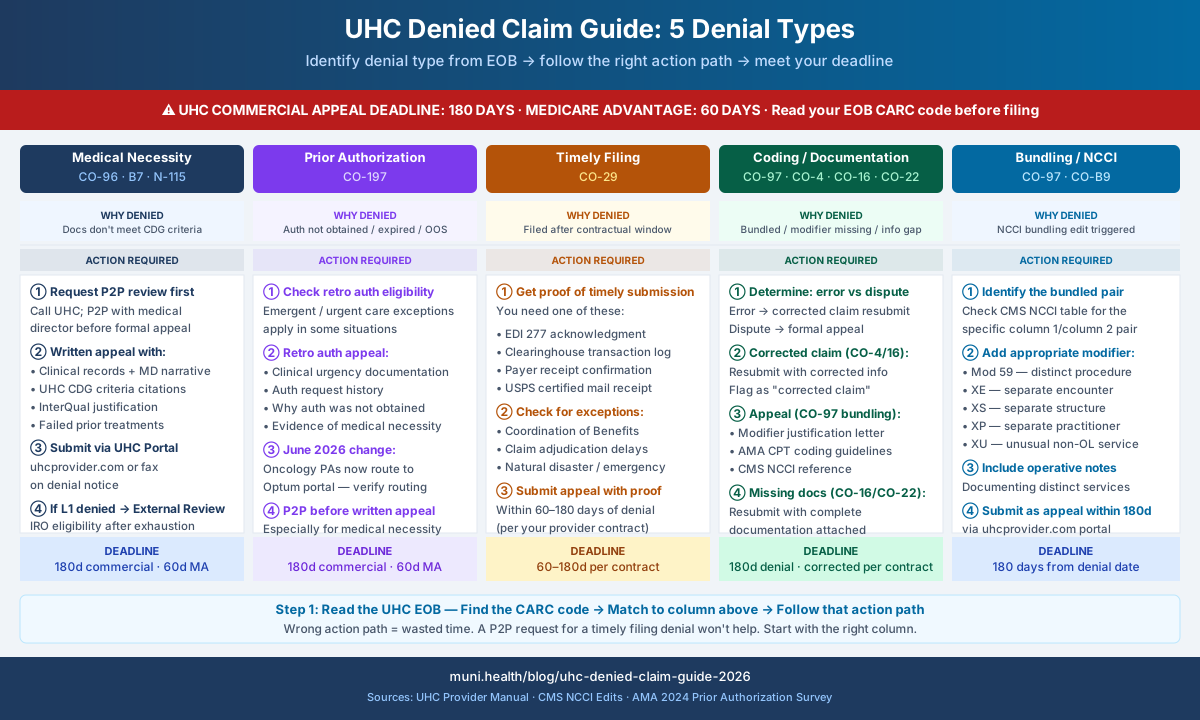
When UnitedHealthcare denies a claim, your first step is to identify the denial type from the Explanation of Benefits: medical necessity (CO-50), prior authorization (CO-197), timely filing (CO-29), or a coding issue (CO-97, CO-4). Each has a different action path and deadline. For commercial plans, UHC gives providers 12 months to complete both a claim reconsideration and a follow-up appeal, but your Participation Agreement sets the controlling timeline. For Medicare Advantage, the reconsideration window is 60 days. Most UHC network providers must submit reconsiderations and appeals digitally through the UnitedHealthcare Provider Portal or API — and when medical necessity is in dispute, request a peer-to-peer review before filing a written appeal.
Why UHC Denials Require a Type-Specific Response
UnitedHealthcare is the largest private health insurer in the United States, so most independent practices see its denials every month. For sourced figures on how often UHC denies claims, see the UHC denial rate statistics guide.
For billing teams managing UHC accounts, that volume makes a systematic response workflow essential. The most common mistake is applying the same appeal approach to every denial. Filing a medical necessity appeal on a timely filing denial — or sending a peer-to-peer request for a coding error — wastes time and produces poor results.
Each UHC denial type has a specific cause, a specific fix, and a specific submission channel. This guide walks through all five major categories. For the full step-by-step appeal workflow — including peer-to-peer review, CDG citation strategy, and Optum MA routing — see the how to appeal UHC denials guide.
For context on how UHC's denial patterns compare to other major payers, see the full insurance denial rate comparison by company.
The Five UHC Denial Categories (and What Each Requires)
| Denial Category | Common Codes | Primary Cause | Appeal Path | Deadline |
|---|---|---|---|---|
| Medical Necessity | CO-50 | Documentation doesn't meet UHC Coverage Determination Guidelines | Written appeal with clinical records + physician narrative citing CDG criteria; peer-to-peer review recommended before filing | Commercial: per Participation Agreement (12-month reconsideration + appeal window); MA: 60 days |
| Prior Authorization | CO-197 | Auth not obtained, expired, or service exceeded scope of approved auth | Retro auth request if eligible; formal appeal with clinical urgency documentation and auth history | Commercial: per Participation Agreement; MA: 60 days |
| Timely Filing | CO-29 | Claim submitted after the contractual filing window | Appeal with proof of timely submission: EDI confirmation, clearinghouse transaction log, payer acknowledgment receipt | Per Participation Agreement; check the denial notice |
| Coding / Documentation | CO-97, CO-4, CO-16, CO-22 | Service bundled, modifier missing, diagnosis invalid, or claim info incomplete | Corrected claim resubmission for technical errors; formal appeal with modifier justification or missing documentation supplied | Appeal: per Participation Agreement; corrected claims: per contract |
| Bundling / NCCI | CO-97 | Claim includes a code pair subject to NCCI bundling edits | Appeal with modifier 59, XE, XS, XP, or XU to establish distinct service; include operative or procedural notes | Per Participation Agreement |
Step 1: Read the EOB Before Doing Anything Else
Every UnitedHealthcare Explanation of Benefits (EOB) contains the information you need to route the denial correctly:
- Claim Adjustment Reason Code (CARC) — the primary code explaining why the claim was denied
- Remittance Advice Remark Code (RARC) — additional context, often pointing to the specific Coverage Determination Guideline (CDG) applied or the documentation gap
- Group code — who is financially responsible: CO (contractual obligation, write-off) vs. PR (patient responsibility) vs. OA (other)
- Appeal deadline — check the EOB or denial notice and your Participation Agreement; do not rely on a generic deadline from another payer
- Contact instructions — the portal route or any alternate submission instructions for that claim
Group Code Matters Before You Bill the Patient
If the group code is CO (Contractual Obligation), you cannot bill the patient for that amount — it must be written off under your network agreement. If it is PR (Patient Responsibility), you can bill the patient. Misapplying these codes can result in balance-billing violations. Always verify the group code before any patient communication about the denied amount.
Step 2: Match the Denial to Its Action Path
Medical Necessity Denials (CO-50)
A medical necessity denial means UHC's review process — which may be automated, algorithmic, or physician-reviewed — determined that the clinical documentation did not meet the criteria in the applicable Coverage Determination Guideline (CDG). UHC CDGs are published at uhcprovider.com.
Immediate actions:
- Identify the specific CDG or clinical criteria document cited in the denial letter or EOB remark code. CDG titles follow a standard format (e.g., "Blepharoplasty and Brow Ptosis Repair," "Spinal Cord Stimulation").
- Compare your clinical documentation against the CDG criteria line by line. Identify which criteria are unmet or absent from the record.
- Request a peer-to-peer review before filing the written appeal. Use the phone number on the denial letter, or call UHC Provider Services at 1-877-842-3210, and ask to speak with the reviewing medical director. The treating physician — not billing staff — should make this call.
- If peer-to-peer does not result in reversal, file a reconsideration or appeal through the UnitedHealthcare Provider Portal. Attach clinical records, a physician narrative, and direct CDG citations — the letter template after Step 2 gives you the structure.
For a complete UHC medical necessity appeal letter template and CDG citation strategy, see the UHC medical necessity letter template guide.
Prior Authorization Denials (CO-197)
CO-197 means either: (a) no prior authorization was obtained before the service, (b) authorization was obtained but expired before the service date, or (c) the service delivered differed from what was authorized (different CPT code, site of service, or dates of service).
Immediate actions:
- Check whether UHC allows retroactive authorization for the service and situation. True emergencies and certain urgent situations may qualify — submit a retro auth request through the UHC Provider Portal with documentation of clinical urgency.
- Verify the authorization number and CPT code match. A frequent CO-197 trigger is a code mismatch between what was authorized and what was billed, even when authorization existed.
- If retro auth is not available, file an appeal with documentation of why authorization could not be obtained prior to service, or why the service billed was within the scope of what was authorized.
Prior Auth Denials Are Increasingly Automated
UHC uses Optum clinical decision-support tools in its prior authorization process. In the AMA's 2024 Prior Authorization Physician Survey, 61% of physicians said they are concerned that health plans' use of AI is increasing prior authorization denials. For strategies specific to algorithm-generated denials, see the guide to fighting AI-driven insurance denials.
For the full UHC prior authorization appeal workflow and documentation templates, see the UHC prior authorization template guide.
Timely Filing Denials (CO-29)
CO-29 denials mean UHC received the claim after the contractual filing deadline. The standard UHC commercial filing window for in-network providers is 90 days from the date of service, though some UHC network contracts provide 180 days. Non-participating providers should confirm the filing limit that applies to the member's plan and state.
Your Contract Controls — Not the General Rule
UHC contracts vary by market, product line, and negotiated terms. Never assume 90 days or 180 days without confirming your specific contract language. Your Provider Operations Agreement (POA) or the participating provider section of your network contract specifies the filing window. If you cannot locate it, call UHC Provider Services at 1-877-842-3210 and ask for your contract terms.
If you receive a CO-29 denial:
- Pull the clearinghouse transaction log or EDI acknowledgment report showing when the claim was submitted. The date on your end does not equal the date UHC received the claim if there was a clearinghouse lag.
- If you submitted within the deadline, appeal with the transmission confirmation as proof. UHC's timely filing policy allows appeals when you can demonstrate timely submission even if the claim was not received in time.
- If the deadline was genuinely missed, check whether any exception applies: the payer was incorrect at time of service, the patient's eligibility was retroactively terminated, or the claim was submitted timely to a different payer under coordination of benefits rules.
For a detailed breakdown of UHC timely filing deadlines by plan type — including Medicare Advantage, Medicaid, and appeal windows — see the UHC appeal timely filing deadlines guide.
Coding and Documentation Denials (CO-4, CO-16, CO-97, CO-22)
These denials cover a range of billing and documentation issues:
- CO-4: Procedure code inconsistent with the modifier used; modifier required
- CO-16: Claim or service lacks required information or was submitted with invalid information
- CO-22: This care may be covered by another payer per coordination of benefits
- CO-97: Benefit for this service is included in the payment for another service or procedure already adjudicated
Approach by code:
- CO-4: Review the modifier usage against CMS guidelines and the CPT descriptor. Common causes include a missing modifier, a modifier that does not fit the code, or modifier 25 applied to a same-day E/M without separately documented work.
- CO-16: Identify the specific missing element from the RARC on the EOB. Resubmit as a corrected claim (claim frequency code 7, replacement) with the missing information added.
- CO-22: Request updated COB information from the patient, then resubmit with the correct primary/secondary payer order.
- CO-97: See the bundling section below.
Bundling Denials (CO-97, NCCI Edits)
Bundling denials occur when UHC applies National Correct Coding Initiative (NCCI) edits — CMS-defined code pairs where one code is considered included in the payment for another. These are among the most complex denials to appeal because the NCCI structure is policy-driven, not clinical.
When to appeal a bundling denial:
Append a modifier to establish that the services were separately distinct:
- Modifier 59: Distinct procedural service (catch-all; appropriate when a more specific X-modifier is not available)
- XE: Separate encounter
- XS: Separate structure (different organ or body part)
- XP: Separate practitioner
- XU: Unusual non-overlapping service
Include operative or procedural notes demonstrating that the services were performed separately, on separate anatomical structures, or during a distinct encounter.
Check NCCI Edits Before Filing
CMS publishes the NCCI Procedure-to-Procedure (PTP) edit tables quarterly. Before appealing a CO-97 denial, verify whether a modifier-indicator of "1" exists for the code pair — meaning a modifier can override the bundle. A modifier-indicator of "0" means the code pair cannot be unbundled regardless of modifier, and the appeal will fail. CMS NCCI edit tables are available at cms.gov.
UHC Denied-Claim Appeal Letter Template
Use this letter for any of the five denial categories above. Fill in the section that matches the denial code on the EOB and delete the other four. Attach it to your reconsideration or appeal in the UnitedHealthcare Provider Portal along with the supporting documents listed at the bottom.
[Date]

UnitedHealthcare
[Submitted via UnitedHealthcare Provider Portal — or the address/route on the denial notice]

RE: [Claim Reconsideration / Appeal] — Denied Claim
Member Name: [Patient Full Name]
Member ID: [UHC Member ID]
Date of Birth: [MM/DD/YYYY]
Plan Type: [Commercial / Medicare Advantage / Community Plan]
Claim Number: [Claim # from EOB]
Date(s) of Service: [MM/DD/YYYY]
Denial Date: [MM/DD/YYYY]
Denial Code(s): [CARC / RARC from EOB, e.g., CO-197, N-xxx]
Billing Provider / NPI / TIN: [Practice Name / NPI / TIN]
Rendering Provider: [Name, Credentials]

To the UnitedHealthcare Appeals Reviewer:

We are requesting [reconsideration / appeal] of the denial of the claim above. The denial was issued under code [CARC] and is incorrect for the reasons below.

--- USE THE ONE SECTION THAT MATCHES YOUR DENIAL ---

[A] MEDICAL NECESSITY (CO-50)
UHC applied Coverage Determination Guideline "[CDG title]" (effective [date]). The patient meets each criterion:
- Criterion: "[quote CDG language]" — Met by: [clinical finding, date, record page]
- Criterion: "[quote CDG language]" — Met by: [clinical finding, date, record page]
[Peer-to-peer requested on [date] with [reviewer name]; outcome: [result / not granted].]

[B] PRIOR AUTHORIZATION (CO-197)
[Authorization [#] was approved for CPT [code], [units], [dates], and the billed service falls within that scope. / Authorization could not be obtained before service because [clinical urgency / emergency], documented in the attached records.]

[C] TIMELY FILING (CO-29)
The claim was originally submitted on [date], within the filing limit in our Participation Agreement. The attached clearinghouse acceptance report shows transaction [ID] accepted on [date].

[D] CODING / DOCUMENTATION (CO-4 / CO-16 / CO-22)
[Describe the correction or the missing information now supplied, e.g., "Modifier [xx] is supported by the attached note" or "The attached COB information confirms UHC is primary."]

[E] BUNDLING / NCCI (CO-97)
CPT [code 1] and CPT [code 2] were distinct services: [separate encounter / separate anatomic site / separate practitioner]. The NCCI modifier indicator for this pair is "1," and modifier [59 / XE / XS / XP / XU] is supported by the attached [operative / procedure] notes.

--- END SECTION ---

Requested action: Reprocess and pay the claim for [CPT codes / billed amount] in accordance with the member's benefits and our Participation Agreement.

Enclosures:
1. Copy of EOB / denial notice
2. [Clinical records / progress notes, dates]
3. [Authorization record / clearinghouse report / COB information — as applicable]
4. [Physician letter of medical necessity — medical necessity denials]

Please contact [Name] at [Phone] or [Email] with questions.

Sincerely,

[Name, Credentials]
[Practice Name] | NPI: [NPI]
Don’t guess the next step for this denial.
Choose the denial stage and available documentation to find a relevant synthetic example. Try preparation without an account, or start your real case now. No files are sent to a payer.
First 3 appeals free, then $20 per appeal. Start with your denial letter or EOB and available records. No meeting or clearinghouse connection required.
For a letter built entirely around UHC's CDG criteria, use the UHC medical necessity letter template instead.
Step 3: Submit Through the Correct UHC Channel
Per UnitedHealthcare's appeals page, most network health care professionals and facilities are required to submit reconsiderations and pre- and post-service appeals digitally. UHC gives providers 12 months to complete both steps — a claim reconsideration, then an appeal if you disagree with the reconsideration outcome — but timelines vary, so confirm them in your Participation Agreement.
Don’t guess the next step for this denial.
Choose the denial stage and available documentation to find a relevant synthetic example. Try preparation without an account, or start your real case now. No files are sent to a payer.
First 3 appeals free, then $20 per appeal. Start with your denial letter or EOB and available records. No meeting or clearinghouse connection required.
| Submission Method | How to Access | Best For | Notes |
|---|---|---|---|
| UnitedHealthcare Provider Portal | Portal login; claim reconsideration and appeal tools | Reconsiderations and appeals for most network providers | Required digital channel for most network providers; allows attachment upload and status tracking |
| API | UHC provider API integration | Practices or vendors submitting at volume | UHC's alternative digital channel to the portal |
| Route on the denial notice | Address or instructions printed on the denial letter | Members, non-network providers, or plans that give different instructions | Follow the notice for that claim; keep proof of submission |
| Peer-to-peer review | Number on the denial letter, or UHC Provider Services at 1-877-842-3210 | Medical necessity only; the treating physician should make the call | Should precede the formal written appeal |
| Optum portal (for PA-related denials) | provider.optum.com | Prior auth decisions managed by Optum | Confirm on your denial letter whether Optum handled the decision |
For a step-by-step walkthrough of the UHCProvider.com portal, including how to select the correct appeal type by denial code and how to cite CDGs in your narrative, see the UHC provider appeal form guide.
How Muni Appeals Helps With UHC Denials
UHC denial management is time-intensive because each denial type requires a different workflow. Medical necessity denials need CDG citation lookups and peer-to-peer coordination. Prior auth denials require authorization history research and retro auth eligibility checks. Timely filing denials require clearinghouse transaction logs pulled before the appeals window closes.
Muni Appeals organizes uploaded denial materials by type, compiles a review-ready packet, and surfaces deadline risk. Billing teams verify the current UHC deadline and channel, then submit and monitor the appeal directly.
- Insurer-specific guidance for UHC commercial, Medicare Advantage, and Medicaid plan types
- Deadline-risk guidance for staff-managed appeal calendars
- Documentation compilation and appeal letter drafting
- Denial pattern visibility across your UHC account panel
For UHC Community Plan Medicaid denials specifically, the two-step internal appeal process, state fair hearing rights, and 29-state program routing are covered in the UHC Community Plan Medicaid appeal guide 2026.
If you are weighing whether to keep writing these letters by hand, the appeal automation cost vs. manual comparison lays out staff time per appeal against software cost.
Frequently Asked Questions
How long do I have to appeal a UHC denied claim?
For commercial plans, UHC's appeals page gives providers 12 months to complete both a claim reconsideration and an appeal, but it also states that timelines vary and directs providers to their Participation Agreement — so the contract controls. For Medicare Advantage, a reconsideration request must be filed within 60 calendar days after receipt of the denial notice (42 CFR 422.582). See the UHC appeal timely filing deadlines guide for the full breakdown by plan type.
Can I request a peer-to-peer review after UHC denies a claim for medical necessity?
Yes. Peer-to-peer reviews are available for medical necessity denials. Use the number on the denial letter, or call UHC Provider Services at 1-877-842-3210, and request to speak with the reviewing medical director. The treating physician should make the call. A peer-to-peer conversation can resolve a denial before you invest time in the formal written appeal.
What is the difference between a reconsideration and an appeal for UHC claims?
For UHC commercial claims, a claim reconsideration is the first step: a request to review a claim you believe was processed incorrectly. If you disagree with the reconsideration outcome, you file an appeal — both steps within UHC's 12-month window, subject to your Participation Agreement. For Medicare Advantage, the terms follow the CMS structure: organization determination (UHC's original decision) → reconsideration (by UHC) → Independent Review Entity → ALJ hearing → Medicare Appeals Council → federal court. Each level has its own deadline.
What if UHC denies my claim with CO-197 but I had a prior authorization?
A CO-197 denial despite an existing authorization usually signals a mismatch: the CPT code billed differs from the code authorized, the service date is outside the authorization window, or the unit count exceeds what was approved. Pull the original authorization document and compare it line-by-line against the claim. If the service genuinely fell within the scope of the authorization, appeal with both documents attached and highlight the discrepancy.
How do I prove timely filing to UHC when my claim was submitted but not received?
Clearinghouse transaction logs and EDI acknowledgment receipts are the strongest evidence. The acknowledgment from your clearinghouse (e.g., Change Healthcare, Availity, Waystar) includes a timestamp showing when the claim was transmitted and a payer-assigned transaction control number (TCN) confirming receipt. Attach this to your appeal. If your clearinghouse can provide a "payer accepted" status report, that is even stronger than a transmission-only confirmation.
Does UHC use AI to review prior authorizations and claims?
UHC uses Optum clinical decision-support tools in its prior authorization process. If you believe a denial did not reflect a clinician's review of your patient's records, ask in your appeal for a physician-level review of the documentation. For Medicare Advantage, CMS's February 6, 2024 FAQ memo on the CMS-4201-F final rule says an algorithm may assist coverage decisions, but the plan must base medical necessity determinations on the individual patient's circumstances — an algorithm that decides coverage from a larger data set instead of the patient's history, physician recommendations, or clinical notes is not compliant.
Can I file a UHC appeal on behalf of the patient?
Yes. For commercial plans, practices can file provider appeals on behalf of the patient as the authorized representative, typically by including a signed authorization form. For Medicare Advantage, a non-contracted provider that formally waives any right to payment from the member becomes a party to the determination and can request reconsideration (42 CFR 422.574); contracted providers follow the dispute process in their UHC agreement. Check your UHC contract and plan type before choosing the appeal channel.
What happens if UHC denies my first-level appeal?
If UHC upholds the denial at first level, you have the option to file a second-level internal appeal. If the second-level is also denied, you can request external review through an Independent Review Organization (IRO) for commercial plans, or continue through the CMS Medicare Advantage appeal chain for MA claims. For ERISA-governed self-funded plans, you may also pursue legal remedies under ERISA Section 502(a)(1)(B) after exhausting internal remedies. See the insurance appeal statute of limitations guide for deadlines on external and legal remedies.
Ready to Recover Your Denied UHC Claims?
UHC denial management takes time that most independent practices do not have to spare. The difference between a recovered claim and a write-off often comes down to whether the right documentation was compiled and submitted before the appeal window closed.
Get Started:
- Denial-type-specific workflows for UHC commercial, Medicare Advantage, and Medicaid
- Appeal letter drafting with CDG citations and documentation checklists
- Deadline-risk guidance across the UHC claims panel for staff verification
- Organized submission through the correct UHC channel for each denial type
This guide reflects 2026 UnitedHealthcare appeal procedures and UHC Provider Portal processes. Contract terms, filing windows, and plan-specific requirements vary. Always verify deadlines and submission requirements against your specific UHC participating provider agreement and the denial letter for each claim.