

UnitedHealthcare denied 20% of ACA marketplace claims in Plan Year 2024 — down sharply from 33% in 2023, the largest year-over-year improvement among major insurers. For Medicare Advantage prior authorizations, UHC denies approximately 12.8% of requests — one of the highest MA rates nationally. UHC's commercial appeal deadline is 65 days, the shortest in the industry. Most properly documented appeals succeed when filed on time.
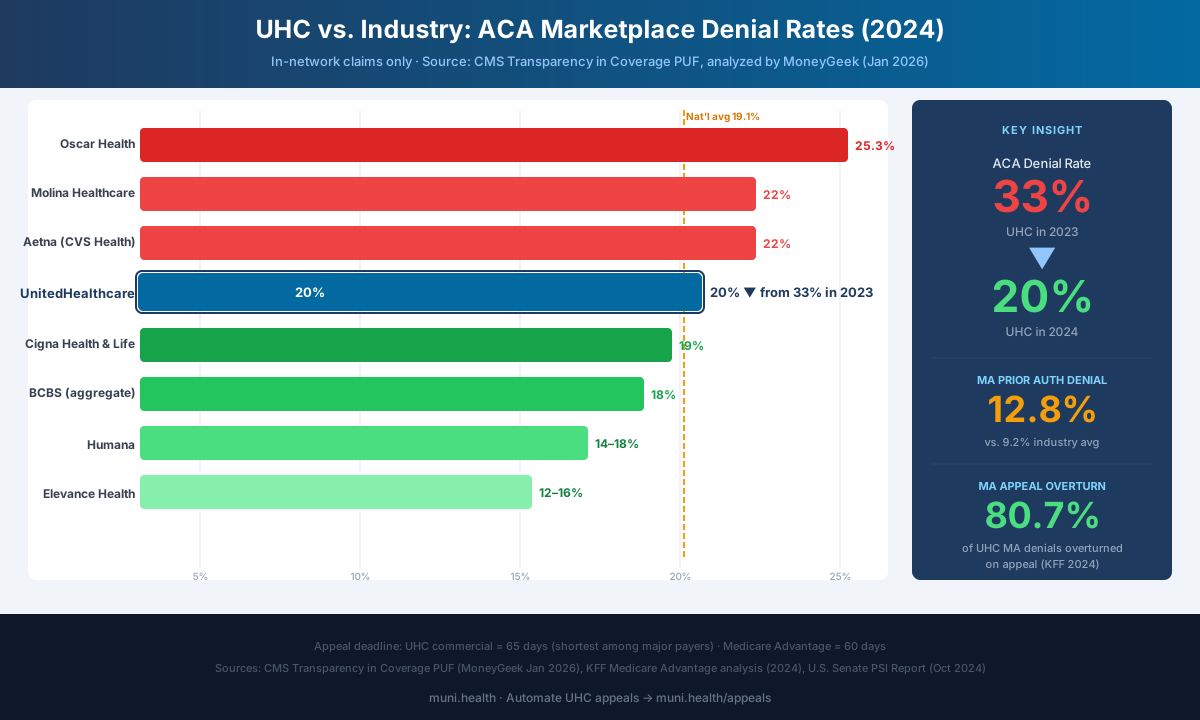
UHC Denial Rates: The Current Picture
UnitedHealthcare is the largest private health insurer in the United States, covering more than 70 million members across commercial, Medicare Advantage, Medicaid managed care, and Federal Employee programs. It processed approximately 6.4 million in-network ACA marketplace claims in Plan Year 2024 — more than any other reporting insurer.
After years of carrying some of the highest denial rates in the industry, UHC's overall ACA denial rate dropped dramatically in 2024:
| Plan Type / Metric | UHC Rate | Industry Average | Data Source |
|---|---|---|---|
| ACA Marketplace (in-network, 2024) | 20% | 19.1% | CMS Transparency in Coverage PUF, analyzed by MoneyGeek (Jan 2026) |
| ACA Marketplace (in-network, 2023) | 33% | 22.5% | CMS Transparency in Coverage PUF / KFF (2024) |
| Medicare Advantage (prior auth, 2024) | 12.8% | ~9.2% | KFF analysis of CMS MA data (2024) |
| Post-Acute Care PA (2022, pre-reform) | 22.7% | N/A | U.S. Senate PSI Report (October 2024) |
| Skilled Nursing Facility (2022, pre-reform) | 12.6% | N/A | U.S. Senate PSI Report (October 2024) |
| MA Prior Auth Overturn on Appeal | ~80.7% | ~83.2% | KFF analysis of CMS MA data (2024) |
Key takeaway: UHC's 20% ACA marketplace rate in 2024 sits just above the 19.1% national average — a significant change from 2023, when UHC was among the top deniers nationally at 33%. However, its Medicare Advantage prior authorization denial rate of 12.8% remains elevated compared to the industry average of approximately 9.2%.
Largest Single-Year Drop Among Major Insurers
UHC's 13-point decline — from 33% in 2023 to 20% in 2024 — is the largest year-over-year improvement recorded among major national insurers in the ACA marketplace. Multiple factors contributed, including regulatory pressure following high-profile denial controversies in late 2024, PA reduction commitments, and the Gold Card program expansion.
How UHC Compares to Other Insurers
Even after the 2024 improvement, UHC's volume means the absolute number of denied claims is substantial. At 20% of 6.4 million claims, that is roughly 1.28 million denied ACA marketplace claims in 2024 alone.
Prepare this appeal packet with your team.
Draft the appeal, coordinate missing documents, and approve the reviewed packet. Keep your clearinghouse; your practice checks deadlines and submits through the payer’s accepted channel.
First 3 appeals free, then $20 per appeal. Start with your denial letter or EOB and available records. No meeting or clearinghouse connection required.
| Insurer | ACA Denial Rate (2024) | MA Prior Auth Denial Rate | Notes |
|---|---|---|---|
| Oscar Health | 25.3% | N/A (limited MA presence) | Highest nationally among major ACA insurers |
| Molina Healthcare | 22% | 7.2% | Medicaid-heavy; above-average ACA rate |
| Aetna (CVS Health) | 22% | 11.9% | Above average; exiting ACA markets in 2026 |
| UnitedHealthcare | 20% | 12.8% | Improved from 33%; highest MA PA denial rate |
| National Average | 19.1% | ~9.2% | HealthCare.gov states, CMS PUF 2024 |
| Cigna Health & Life | 19% | 8.1% | At national average; EviCore manages specialty PA |
| BCBS (aggregate) | 18% | Varies by affiliate | Wide variation across 36 affiliates |
| Humana | 14–18% | 5.8% | Below average; lower MA PA denial rate |
| Elevance Health | 12–16% | 4.2% | Lowest MA PA denial rate among large insurers |
| Kaiser Permanente | ~6% | 10.1% | Lowest ACA denial rate; closed network |
Sources: CMS Transparency in Coverage Public Use File, Plan Year 2024, analyzed by MoneyGeek (January 2026). MA prior auth data: KFF analysis of CMS Medicare Advantage data (2024). ACA rates cover HealthCare.gov states only.
The MA prior authorization column tells a different story than the ACA rates: UHC has the highest Medicare Advantage prior auth denial rate among major insurers at 12.8% — higher than Aetna (11.9%) and Humana (5.8%). For practices with significant Medicare Advantage volume, this is the more operationally relevant number.
For context on the full insurer landscape, see the insurance denial rate comparison by company 2026.
Why UHC Has Above-Average Medicare Advantage Denial Rates
The nH Predict Algorithm and Post-Acute Denials
The U.S. Senate Permanent Subcommittee on Investigations released a report in October 2024 examining how UnitedHealthcare, Humana, and CVS Health used automated technology to manage Medicare Advantage prior authorization decisions, with a focus on post-acute care services.
The report documented that UHC deployed NaviHealth's nH Predict algorithm to estimate the number of days of skilled nursing facility care a Medicare Advantage beneficiary would need — using historical data from similar patients rather than the actual clinical assessment of the treating provider.
Key findings from the Senate report:
- UHC's post-acute services prior auth denial rate increased from 8.7% in 2019 to 22.7% in 2022, coinciding with wider NaviHealth deployment
- UHC's skilled nursing facility denial rate increased ninefold from 1.4% (2019) to 12.6% (2022, the first full year NaviHealth managed these claims)
- The algorithm predicted discharge timelines that often conflicted with treating physicians' assessments
UHC disputed the characterization, stating it does not use algorithmic tools to make adverse coverage determinations. Regardless of mechanism, the documented denial rate increases in post-acute care are a matter of public record from the Senate investigation.
Post-Acute Care Providers: Document Against Discharge Criteria
If you are seeing rapid UHC MA prior authorization denials for skilled nursing facility, inpatient rehabilitation, or home health services — particularly denials citing expected discharge dates — your appeal should include explicit clinical justification for continued stay that goes beyond the nH Predict prediction framework. Reference the treating physician's assessment, functional status documentation, and progress notes directly.
The Gold Card Program: Partial Offset
On the other side of the ledger, UHC has been expanding its National Gold Card Program, which automatically approves prior authorization requests for approximately 500 procedure codes from qualifying provider groups that demonstrate consistent adherence to evidence-based care guidelines.
Key Gold Card developments:
- More than 40% increase in qualifying provider groups in 2025
- Additional provider groups became eligible starting October 1, 2025
- Applies to commercial, Individual Exchange, Medicare Advantage, and Community Plan members
- Eligible provider groups bypass PA requirements for covered codes — directly reducing denial exposure
UHC also committed to eliminating approximately 10% of its prior authorization requirements in 2025 and removed PA requirements for home health services managed by Optum Home & Community effective April 1, 2025, covering Medicare Advantage and dual special needs plan members in more than 30 states.
Why UHC Denies Claims: The Main Denial Categories
UHC's denial patterns align broadly with industry trends. According to KFF analysis of 2023 ACA marketplace data, approximately 77% of denials industry-wide stem from administrative or coverage design reasons rather than clinical judgment. For UHC specifically:
| Denial Category | Examples | Typical Overturn Path |
|---|---|---|
| Prior authorization not obtained | Service performed without PA; PA expired; wrong service authorized | Submit corrected claim with retroactive PA request where allowed, or peer-to-peer review |
| Medical necessity disputed | UHC CDG criteria not clearly met in documentation | Written appeal citing Coverage Determination Guidelines and supporting clinical evidence |
| Administrative / coding errors | Missing modifier, incorrect NPI, eligibility mismatch | Corrected claim resubmission; usually resolved without formal appeal |
| Out-of-network / coverage exclusion | Non-covered service; non-contracted provider | Coverage determination appeal; usually harder to overturn without plan exception |
| Timely filing exceeded | Claim or appeal submitted after deadline | Hardship or exception request; limited appeal rights once deadline passes |
Coverage Determination Guidelines (CDGs) are UHC's primary medical necessity framework — the equivalent of Aetna's Clinical Policy Bulletins (CPBs). UHC publishes these at UHCProvider.com. If your denial cites medical necessity, your appeal must engage the specific CDG that applies to the denied service, not just cite clinical literature in general.
For post-authorization denials in Medicare Advantage, Optum manages utilization review. Knowing whether the denial originates from UHC directly or from Optum determines the correct escalation path.
UHC's 65-Day Appeal Deadline: The Critical Difference
UHC's commercial plan appeal deadline is 65 calendar days from the denial date — the shortest commercial appeal window among major payers. Most competitors allow 180 days. This asymmetry catches practices that manage multiple payers using a single deadline calendar.
| Plan Type | Appeal Deadline | Decision Timeline | Submission Path |
|---|---|---|---|
| Commercial (standard) | 65 days from denial date | 30 calendar days | UHCProvider.com portal |
| Commercial (expedited) | 65 days from denial date | 72 hours | Portal or fax for urgent cases |
| Medicare Advantage | 60 days from denial date | 30 calendar days | UHC MA Appeals Department |
| Medicare Advantage (expedited) | 60 days from denial date | 72 hours | Phone: 1-800-711-4555 (Optum) |
| Part D / OptumRx | 60 days from denial date | 7 days | OptumRx PA line |
| Medicaid (Community Plan) | State-specific (often 60 days) | State-specific | State plan specific portal |
65 Days Is Not 180 Days
UHC commercial appeal deadline: 65 calendar days. Aetna, BCBS, and Cigna allow 180 days. Practices running multi-payer billing on a shared calendar are the most likely to miss UHC's window. A missed deadline forfeits the appeal right regardless of the denial's merits.
For a detailed breakdown of claim submission deadlines (separate from appeal deadlines), see the UHC appeal timely filing deadlines guide 2026.
How to Fight UHC Denials: What the Data Tells Providers
1. Cite the Correct Coverage Determination Guideline
Every UHC medical necessity appeal should open with the specific CDG by number and version date. Generic clinical arguments without CDG anchoring are the most common reason well-documented appeals still fail. UHC's CDG library is publicly searchable at UHCProvider.com and is updated quarterly.
2. Request Peer-to-Peer Review
The AMA's 2024 Prior Authorization Physician Survey (n=1,004 physicians) found that 82% of prior authorization appeals succeed when peer-to-peer review with the UHC reviewing physician is requested. Peer-to-peer is available for most pre-service and concurrent-review denials. Request it immediately — before the appeal window runs — as it does not pause the 65-day clock.
3. Check Your Gold Card Eligibility
If your practice has a high UHC volume and consistent documentation practices, you may qualify for the Gold Card program. Qualifying eliminates PA requirements for approximately 500 procedure codes, removing the denial exposure at the source rather than managing it through appeals. Check current eligibility criteria at UHCProvider.com.
4. Escalate MA Denials to External Review
For Medicare Advantage prior authorization denials, CMS data shows approximately 80.7% of appealed denials are partially or fully overturned — meaning the initial denial decision was wrong in roughly 4 out of 5 appealed cases. If UHC's internal appeal process denies your case, the next level is a Qualified Independent Contractor (QIC) review, followed by an Administrative Law Judge (ALJ) hearing.
5. Document Post-Acute Care in Clinical Terms, Not Administrative Ones
Given the pattern documented in the Senate investigation, post-acute care appeals against UHC MA denials benefit from clinical documentation that emphasizes functional status, medical complexity, and physician-driven discharge criteria — not just service dates. Include the treating provider's assessment explicitly rather than relying on what UHC's system inferred about expected recovery.
For medical necessity–specific appeals, the UHC medical necessity letter template 2026 covers the CDG citation structure and documentation components UHC reviewers expect.
How Muni Appeals Addresses UHC Denial Volume
For practices with meaningful UHC volume, the operational challenge is building CDG-compliant, documentation-matched appeals consistently within a 65-day window — across both commercial and Medicare Advantage plans.
Prepare this appeal packet with your team.
Draft the appeal, coordinate missing documents, and approve the reviewed packet. Keep your clearinghouse; your practice checks deadlines and submits through the payer’s accepted channel.
First 3 appeals free, then $20 per appeal. Start with your denial letter or EOB and available records. No meeting or clearinghouse connection required.
Muni Appeals prepares UHC-aware appeal drafts and evidence checklists for staff review:
- CDG-anchored medical necessity arguments matched to the specific denial code and service type
- Separate workflows for commercial and Medicare Advantage plan types
- Deadline-risk guidance for staff verification and calendaring
- Peer-to-peer request flag for denials where clinical overturn is most likely
Start Automating Your UHC Appeals
Frequently Asked Questions
Does UnitedHealthcare deny a lot of claims?
UHC denied 20% of ACA marketplace claims in Plan Year 2024, down from 33% in 2023. This places UHC just above the 19.1% national average. For Medicare Advantage prior authorizations, UHC's denial rate is 12.8% — the highest among major MA insurers — which is the more relevant figure for practices with significant Medicare Advantage volume.
What is UHC's appeal success rate?
CMS data shows approximately 80.7% of appealed UHC Medicare Advantage prior authorization denials are partially or fully overturned. For commercial plan appeals, the AMA's 2024 Prior Authorization Survey found 82% of prior auth appeals succeed when peer-to-peer review is requested alongside the written appeal. The primary obstacle is not the success rate — it is the 65-day filing deadline that limits how many appeals practices actually submit.
Why did UHC's denial rate drop so much from 2023 to 2024?
UHC's ACA marketplace denial rate declined from 33% to 20% between Plan Year 2023 and 2024 — a 13 percentage point drop. Contributing factors include increased regulatory and political scrutiny following high-profile denial controversies in late 2024, UHC's public commitments to reduce prior authorization volume by approximately 10%, and the Gold Card program's expansion to more qualifying provider groups.
What is the UHC appeal deadline?
For commercial plans, UHC's appeal deadline is 65 calendar days from the denial date — significantly shorter than Aetna (180 days), BCBS (180 days), and Cigna (180 days). For Medicare Advantage, the deadline is 60 days. These deadlines are enforced strictly; missing the window forfeits appeal rights regardless of the denial's clinical merits.
What is UHC's nH Predict algorithm?
NaviHealth's nH Predict is an AI-based tool that UHC used to estimate expected recovery timelines for Medicare Advantage beneficiaries receiving post-acute care (skilled nursing facilities, inpatient rehabilitation). The U.S. Senate Permanent Subcommittee on Investigations documented in October 2024 that UHC's SNF denial rate increased ninefold between 2019 and 2022, coinciding with NaviHealth's deployment. UHC disputes that the algorithm makes adverse coverage determinations. The full guide to fighting AI-driven insurance denials covers the documentation strategy for appealing algorithm-based decisions across all major insurers: how to fight AI insurance denials 2026.
How do I appeal a UHC medical necessity denial?
Start by identifying the specific Coverage Determination Guideline (CDG) that applies to the denied service — search for it by code or service category at UHCProvider.com. Your appeal should: (1) cite the relevant CDG directly, (2) show why the clinical documentation meets the stated criteria, (3) reference supporting peer-reviewed evidence or CMS coverage determinations if applicable, and (4) include the treating physician's clinical assessment. Request peer-to-peer review at the same time. See the full UHC appeal letter template 2026 for the correct structure.
Does the Gold Card program reduce UHC denials?
Yes — for qualifying provider groups. The Gold Card program automatically approves prior authorization requests for approximately 500 procedure codes without requiring submission. Provider group eligibility grew by more than 40% in 2025. If your practice has consistent documentation practices and significant UHC volume, check current eligibility criteria at UHCProvider.com. The program applies to commercial, Medicare Advantage, and Community Plan members.
What is UHC's denial rate for Medicare Advantage prior authorizations?
12.8% based on KFF analysis of 2024 CMS Medicare Advantage data — the highest rate among major MA insurers. Approximately 80.7% of those denied requests are overturned on appeal. For post-acute care services specifically, the Senate investigation documented significantly higher denial rates tied to NaviHealth deployment, though UHC disputes the characterization of its review methodology.
The Bottom Line
UHC's 20% ACA marketplace denial rate in 2024 represents a meaningful improvement — but it still means roughly one in five claims gets denied for the largest insurer in the country. At 6.4 million claims processed, that is approximately 1.28 million denials in a single year.
The more pressing number for most practices is UHC's 12.8% Medicare Advantage prior authorization denial rate — above average for the industry and backed by documented patterns in post-acute care denials connected to algorithmic review.
The data consistently shows that properly documented appeals succeed. The barriers are:
- A 65-day filing deadline that is shorter than any other major payer
- CDG-anchored appeals that require insurer-specific research for each denial type
- Volume that makes manual appeal management unsustainable at scale
For a full breakdown of how to respond to each UHC denial type — medical necessity, prior auth, timely filing, coding, and bundling — see the UHC denied claim guide 2026.
Don't leave valid UHC claims unreversed because the deadline passed.
Start Automating Your UHC Appeals
Sources: CMS Transparency in Coverage Public Use File, Plan Year 2024, analyzed by MoneyGeek (January 2026); KFF Medicare Advantage Prior Authorization Analysis (2024); U.S. Senate Permanent Subcommittee on Investigations: "Refusal of Recovery" report (October 2024); AMA 2024 Prior Authorization Physician Survey (n=1,004); UnitedHealthcare Gold Card program information (UHCProvider.com, 2025)