

The "statute of limitations" for insurance appeals depends on what you're trying to do. To request external review: 4 months from your final internal denial under ACA rules. To file a lawsuit against an ERISA employer plan: your plan document controls — typically 1-3 years, starting from the date specified in the plan. For state-regulated insurance (individual market, fully-insured group): state contract law applies, generally 4-6 years. These deadlines are separate from the internal appeal filing windows covered elsewhere.
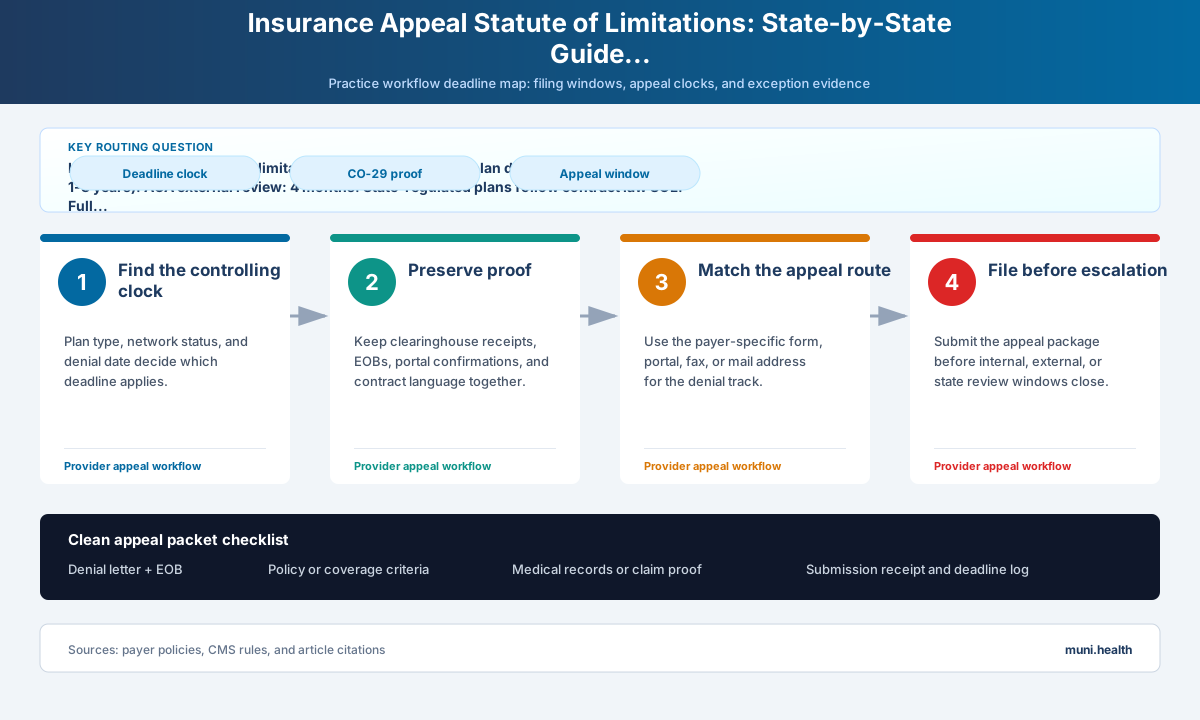
The Two Different Clocks Practices Confuse
When billing teams search for "insurance appeal statute of limitations," they're usually asking one of two different questions:
- How long do I have to request external review after my internal appeals are denied?
- How long do I have to file a lawsuit if the insurer still refuses to pay after all appeals?
These are governed by different rules, different timelines, and in many cases different legal frameworks entirely. The internal appeal deadlines — how long you have to file a first-level or second-level appeal — are covered in our insurance appeal deadlines guide. For context on what happens when a prior authorization denial isn't resolved through internal appeals, see our complete prior authorization denial guide. This post covers what comes after you've exhausted internal appeals: external review rights and court filing limitations.
The stakes are real. Missing the external review deadline waives your right to an independent third-party decision. Missing the lawsuit deadline extinguishes the claim permanently, regardless of merit.
Internal vs. External Deadlines Are Not the Same
Your 180-day internal appeal window and the 4-month external review deadline are separate clocks. Exhausting your internal appeal does not automatically start the external review window — you need to track both independently from the date of each adverse determination.
Understanding Which Rules Apply to Your Plan
Before looking at any specific deadline, you need to identify which legal framework covers the insurance plan in question. This is the most important variable — and it changes the deadline significantly.
Prepare this appeal packet with your team.
Draft the appeal, coordinate missing documents, and approve the reviewed packet. Keep your clearinghouse; your practice checks deadlines and submits through the payer’s accepted channel.
First 3 appeals free, then $20 per appeal. Start with your denial letter or EOB and available records. No meeting or clearinghouse connection required.
| Plan Type | Governing Law | External Review Deadline | Lawsuit SOL | Notes |
|---|---|---|---|---|
| Self-funded employer plan (ERISA) | Federal — ERISA | 4 months (ACA minimum) | Plan document controls — typically 1-3 years | Most mid/large employer plans are self-funded and governed by ERISA |
| Fully-insured group plan (employer-sponsored) | State insurance law + ACA | 4 months (state may extend) | State contract SOL (varies 4-10 years) | Fully insured = insurer bears risk; state insurance code applies |
| Individual market (ACA marketplace / off-exchange) | State insurance law + ACA | 4 months (state may extend) | State contract SOL (varies 4-10 years) | State-regulated; ERISA preemption does not apply |
| Medicare Advantage (Part C) | Federal — CMS | 60 days for standard; 72 hours expedited (separate process) | Administrative exhaustion required; judicial review limited | Follow Medicare appeals chain, not ERISA or state law |
| Traditional Medicare (Part A / Part B) | Federal — CMS | N/A (ALJ and MAC appeals follow separate track) | 120 days for redetermination (first level) | CMS has its own multi-level administrative appeal system |
| Medicaid (managed care) | State + federal | State-specific (varies widely) | Varies by state Medicaid statute | Check your state Medicaid agency for plan-specific rules |
The self-funded vs. fully-insured distinction trips up a lot of billing teams. If the employer — not an insurance company — is bearing the financial risk of claims, the plan is almost certainly self-funded and governed by ERISA. The UHC or Aetna name on the card is just the administrator. ERISA preempts state insurance law for self-funded plans, which means state external review mandates and state contract SOL rules do not apply.
External Review Deadlines: The 4-Month Federal Rule
For most non-Medicare, non-Medicaid health plans, the Affordable Care Act requires that participants have the right to external review by an independent review organization (IRO) after exhausting internal appeals. The federal baseline for requesting external review is 4 months from the date of receipt of the final internal adverse benefit determination.
This 4-month window applies to:
- Non-grandfathered group health plans (ERISA self-funded and fully-insured)
- Individual market health plans (ACA-compliant, non-grandfathered)
Under 29 CFR 2590.715-2719 (implementing PHSA § 2719), federal standards require that external review be available and that the request deadline be no shorter than 4 months. States with their own external review processes may extend this window, but cannot shorten it below the federal floor for ACA-compliant plans. California, for instance, allows 180 days for DMHC Independent Medical Review requests. For a full breakdown of state-specific external review laws and deadlines, see the state-by-state insurance appeal laws guide.
External Review Decisions Are Binding on the Insurer
If the independent review organization overturns the insurer's denial, the insurer is required to cover the service. External review decisions in favor of the patient or practice are legally binding under state law (for state-regulated plans) and under federal ERISA regulations (for ERISA plans that use the federal external review process).
Expedited External Review
For urgent situations — ongoing treatment that would be seriously jeopardized by waiting, or an admission or continued stay — expedited external review is available. Under federal rules, the IRO must make a decision as expeditiously as possible and no later than 72 hours from receipt of the request.
Expedited external review does not require exhausting the standard internal appeal process if the internal appeal timeframe would itself jeopardize the patient's life or health.
ERISA Lawsuit Deadlines: The Plan Document Controls
This is where ERISA gets complicated, and where practices lose winnable claims.
ERISA itself does not specify a statute of limitations for benefit claims under 29 U.S.C. § 1132(a)(1)(B) — the provision that lets plan participants sue to recover benefits. Before 2013, courts generally borrowed the most analogous state statute of limitations, which varied from 1 to 10 years depending on the state and the theory of recovery.
That changed with Heimeshoff v. Hartford Life & Accident Insurance Co., 571 U.S. 99 (2013). The Supreme Court held that a plan's contractual limitations period — specified in the plan document — is enforceable and controls over any state statute of limitations, as long as the plan-imposed period is reasonable. The plan in Heimeshoff required lawsuits within 3 years of when "proof of loss" was due, which turned out to start before the internal appeal process ended.
The practical implication: your plan document may have a lawsuit deadline that runs concurrently with the appeals process, not after it.
The Clock Can Start Before You've Exhausted Appeals
Under Heimeshoff, some plan limitations periods start from when "proof of loss" was due — not from the date of the final denial. A practice that spent 18 months pursuing internal appeals may arrive at the ERISA litigation deadline before they realize it started. Pull the plan document and identify the exact trigger date when a claim is at risk.
What to Look For in the Plan Document
Request the Summary Plan Description (SPD) or full plan document from the plan administrator. Look for language like:
- "No legal action may be brought more than [X] years after proof of loss is required to be furnished"
- "You must file any lawsuit within [X] years from the date of the adverse benefit determination"
- "Civil action must be commenced within [X] months of the date you receive notice of a final denial"
Courts have enforced contractual limitations periods as short as 1 year under Heimeshoff, so do not assume the standard state contract SOL applies to a self-funded ERISA plan.
If the Plan Has No Limitations Period
If the plan document is silent on the limitations period for lawsuits, courts revert to borrowing the most analogous state SOL — typically the state's general contract or oral/written contract statute of limitations. Which state's law applies depends on the circuit, but it's generally the state where the plan was administered or where the claimant resides.
State-Regulated Plans: Breach of Contract SOL
For individual market plans and fully-insured group plans, ERISA preemption does not apply. The relevant deadline for a lawsuit is typically the state's statute of limitations for breach of a written contract.
| State | Breach of Written Contract SOL | Key Statute | Notes |
|---|---|---|---|
| California | 4 years | CCP § 337 | Clock typically runs from date of breach (final denial) |
| Texas | 4 years | Tex. Civ. Prac. & Rem. Code § 16.004 | Insurance policy is treated as a written contract |
| Florida | 5 years | Fla. Stat. § 95.11(2)(b) | Applies to written contracts; separate rules for extra-contractual claims |
| New York | 6 years | CPLR § 213(2) | Some policies include shorter contractual limitations clauses — check policy terms |
| Illinois | 10 years | 735 ILCS 5/13-206 | Longest in the country for written contracts; courts have upheld shorter policy-imposed periods |
| Other states | Typically 3-6 years | Varies | Check your state's general contract SOL; state insurance department may publish guidance |
Shorter Policy Terms May Override State SOL for Insured Plans Too
State-regulated insurance policies often include their own contractual suit limitations clauses (commonly 1-3 years). Many states permit insurers to enforce these shorter periods as long as they comply with state insurance code minimums. Always check the policy document, not just the state SOL.
These state SOL figures apply when the insurer is directly party to the contract — fully-insured individual and group plans. They do not apply to ERISA self-funded plans, where the plan document and federal case law under Heimeshoff control.
Medicare Deadlines: A Different Framework
Medicare appeals do not follow the ERISA or state insurance statute of limitations framework. Medicare has its own multi-level administrative process, and most Medicare disputes are resolved (or extinguished) within that process before judicial review is available.
Traditional Medicare (Part A / Part B):
The first level of Medicare appeals — redetermination by the Medicare Administrative Contractor (MAC) — must be requested within 120 days of receiving the initial determination. Subsequent levels have their own deadlines, but the 120-day redetermination window is the most commonly missed.
Medicare Advantage (Part C):
Organization determination appeals must be filed within 60 days of the adverse determination for standard appeals. Expedited appeals for ongoing or urgent care: 72 hours. These are CMS-mandated windows under the Medicare Managed Care Manual, Chapter 13.
Unlike commercial insurance, Medicare Advantage appeals do not go through ERISA or state insurance law. The plan cannot shorten the federally mandated appeal windows.
How to Protect Your Practice from SOL Issues
Missing a statute of limitations — whether for external review or a potential lawsuit — is typically unrecoverable. Unlike internal appeal deadlines, SOL errors are rarely corrected on "good cause" grounds. The practical steps:
Prepare this appeal packet with your team.
Draft the appeal, coordinate missing documents, and approve the reviewed packet. Keep your clearinghouse; your practice checks deadlines and submits through the payer’s accepted channel.
First 3 appeals free, then $20 per appeal. Start with your denial letter or EOB and available records. No meeting or clearinghouse connection required.
1. Log the date of every adverse benefit determination immediately. The external review clock and, for ERISA plans, the potential lawsuit clock both start from specific dates. Get those dates into your denial tracking system the day the notice arrives, not when you get around to reviewing it.
2. Pull the plan document for every ERISA self-funded claim over a significant threshold. The Summary Plan Description should be available from the employer plan administrator within 30 days of a written request. For high-value claims, this is worth doing before exhausting internal appeals.
3. Track internal appeal and external review deadlines as separate events. See our insurance appeal deadlines guide 2026 for the internal appeal windows by insurer. The external review clock is a second, independent deadline that starts when internal appeals end. If you're dealing with a prior authorization denial that's approaching the external review window, see what happens when prior authorization is denied for a decision framework on next steps.
4. Do not assume you have more time than you do. A plan that requires lawsuits within 1 year from the date proof of loss is due — and where that trigger date is before the internal appeal decision — can extinguish a claim before you even know you have one. Heimeshoff confirmed this is legal.
How Muni Appeals Helps Practices Review Deadline Risk
Managing denial dates, internal appeal windows, external review deadlines, and plan-document limitation periods across active denials is one of the administrative burdens that causes winnable appeals to lapse. Muni Appeals organizes uploaded denial materials by insurer and surfaces deadline risk; billing teams remain responsible for verifying, calendaring, and monitoring every controlling deadline.
For independent practices without a dedicated appeals coordinator, the risk of missing a deadline on a high-value claim is exactly the kind of administrative failure that Muni is built to prevent.
Frequently Asked Questions
What is the statute of limitations for appealing a health insurance denial?
It depends on your plan type. For external review (independent third-party review), the federal minimum is 4 months from your final internal denial for most ACA-compliant plans. For filing a lawsuit: ERISA self-funded plans follow plan document terms (typically 1-3 years); fully-insured and individual market plans follow state contract SOL (generally 4-10 years, but check the policy's own limitations clause).
Does ERISA have a statute of limitations for benefit claims?
ERISA does not specify a limitations period. Under Heimeshoff v. Hartford Life (2013), if the plan document specifies a contractual limitations period, that controls — and it's been enforced as short as 1 year. If the plan is silent, courts borrow the most analogous state statute of limitations.
When does the ERISA limitations clock start?
It depends on the plan document's specific language. Some plans trigger the clock from the date of final denial. Others trigger from when "proof of loss" was due — which may precede the final denial by months or longer. Heimeshoff confirmed both approaches are enforceable. Always identify the specific trigger event in the plan document for high-value claims.
Is the insurance appeal statute of limitations the same in every state?
No. For state-regulated (non-ERISA) insurance, state statutes of limitations for breach of written contract vary from 4 years (California, Texas) to 10 years (Illinois), with New York at 6 years and Florida at 5 years. Insurance policies also commonly include their own shorter limitations clauses — many states allow this as long as it meets minimum standards. ERISA self-funded plans are not subject to state SOL rules.
Does the external review deadline reset if I file a new internal appeal?
Not automatically. If you file a new internal appeal based on new clinical information, a new adverse determination would issue and the external review clock would reset from that new denial date. But simply resubmitting the same appeal without new information generally does not reset the clock — insurers can reject duplicate appeals as untimely.
What happens if I miss the external review deadline?
For most plans, missing the 4-month external review window waives your right to independent review for that denial. You would then need to pursue any remaining options through the plan's internal grievance process or, for ERISA plans, through ERISA civil litigation — subject to the plan's own limitations period.
How does the statute of limitations differ for Medicare Advantage denials?
Medicare Advantage follows CMS-mandated appeal timelines under the Medicare Managed Care Manual, not state or ERISA law. You have 60 days for a standard organization determination appeal and 72 hours for expedited appeals involving ongoing or urgent care. Missing these windows can forfeit the appeal. Medicare Advantage plans cannot shorten these federally set windows.
Ready to Stop Losing Claims to Missed Deadlines?
Tracking internal appeal windows, external review deadlines, and plan-document SOL triggers across a full denial workload is where practices lose recoverable revenue — not from unwinnable claims, but from ones that lapsed.
Get Started:
- Track every denial date from the day the notice arrives
- Separate internal appeal deadlines from external review windows
- Pull plan documents on high-value ERISA self-funded denials
- Know whether your plan has a contractual SOL shorter than state law
This guide reflects 2026 insurance appeal procedures and federal regulations. State requirements, plan-specific limitations periods, and individual insurance policy terms vary significantly. This information is for administrative and billing purposes and is not legal advice. Consult qualified legal counsel for advice specific to your situation.