

When UHC denies a prior authorization, request a peer-to-peer review immediately — the window is often just 24 hours for clinical PA disputes. If that fails, file a written internal appeal through UHCProvider.com within 65 days (commercial) or 60 days (Medicare Advantage). Under CMS-0057-F, effective January 1, 2026, UHC must provide specific clinical denial reasons — use that language as your appeal roadmap.
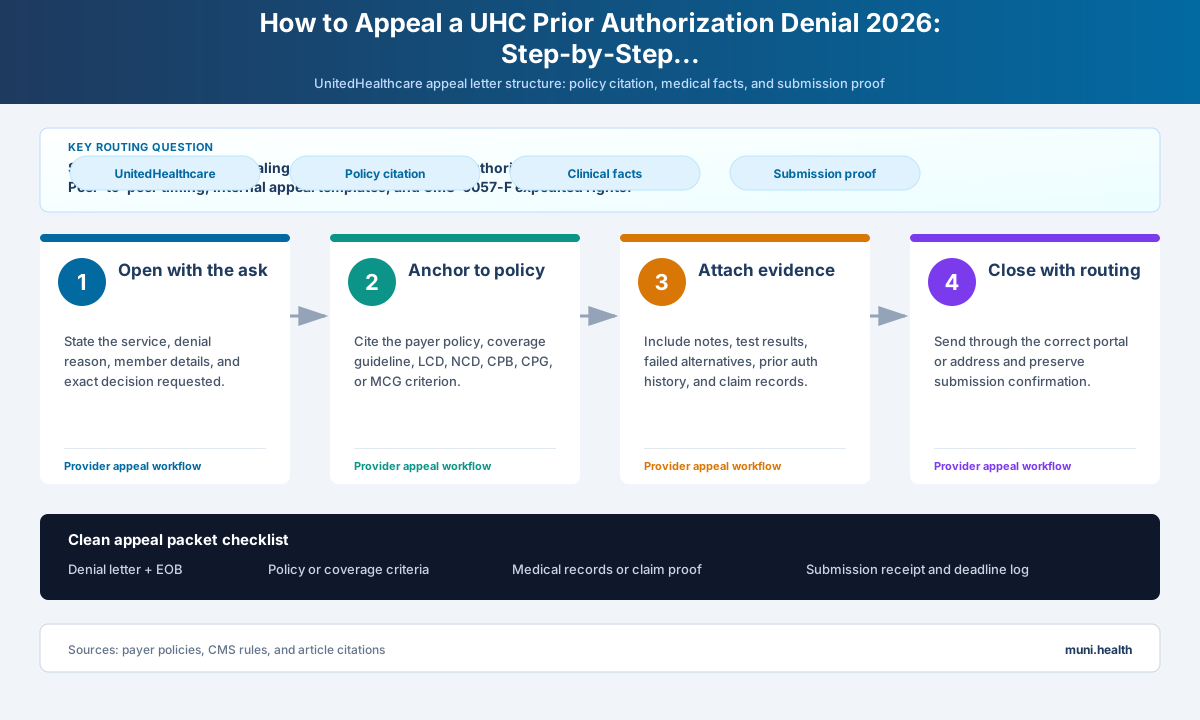
Why UHC Prior Authorization Denials Require Immediate Action
A prior authorization denial from UnitedHealthcare is not the same as a post-service claim denial. The clock starts faster, the stakes are higher, and the process runs in parallel with care decisions — not after them.
Unlike a claims denial that surfaces on a remittance advice, a PA denial often arrives via the UHC portal hours after submission, with the patient expecting the procedure to be scheduled. Missing the peer-to-peer window or filing the appeal past the deadline means the clinical case gets reviewed on paper alone — which almost always produces worse results.
UHC processes over 46 million prior authorization requests annually across its commercial, Medicare Advantage, Medicaid Community Plan, and Federal Employee programs. Denial rates vary by plan type and procedure category, but the good news is that UHC also shows among the highest reversal rates in the industry when appeals are properly constructed and timely filed. For the denial rate breakdown by plan type, see the UHC denial rate statistics guide.
What Changed January 1, 2026
CMS-0057-F took effect January 1, 2026, imposing new PA requirements on Medicare Advantage plans, Medicaid managed care organizations, and ACA Marketplace QHP issuers. For covered plan types, UHC must now: (1) issue standard PA decisions within 7 calendar days, (2) issue expedited decisions within 72 hours, and (3) provide patient-specific clinical denial reasons — not just policy number references. That last requirement is the most important for appeal strategy.
Before a PA is denied, it must be submitted through the correct portal. If a submission error contributed to the denial — wrong NPI, routing mismatch, or portal confusion — see the UHC prior authorization form guide before refiling or appealing.
Step 1: Read the Denial and Identify the Specific Reason
Before anything else, open the denial letter or portal notification and find the clinical justification for the denial. Under CMS-0057-F, MA and Medicaid plans must now provide a specific reason — not a generic "not medically necessary" with a policy number attached.
For commercial (ERISA and fully-insured) plans, UHC has used Coverage Determination Guidelines (CDGs) as the basis for medical necessity decisions. The denial letter should cite the specific CDG number and the criterion your request did not satisfy.
Look for:
- The CDG or InterQual criteria section that triggered the denial
- Whether the denial is a medical necessity denial, a step therapy denial, or a non-covered service denial — each requires a different response
- Whether the denial letter identifies the reviewing entity as UHC Medical Director or Optum Health Networks — this determines the appeal routing
Optum Routing (2026 Change)
Effective January 1, 2026, UHC routes certain Medicare Advantage prior authorization reviews through Optum Health Networks. If the denial letter identifies Optum as the reviewing entity, the peer-to-peer and appeal submission process differs — follow the contact information on the denial letter rather than the standard UHCProvider.com PA appeal path. Starting June 2026, oncology PA for MA plans routes to the Optum portal (contact 888-397-8129 to confirm routing before filing).
If your denial is from a UHC Medicare Advantage plan, the appeal rules differ significantly from commercial: CDGs replace InterQual, the expedited clock is 72 hours under CMS-0057-F, and the appeal escalates through a five-level federal ladder. See the UHC Medicare Advantage prior authorization denial appeal guide for the complete MA-specific workflow.
Step 2: Request a Peer-to-Peer Review Immediately
For medical necessity and clinical prior authorization denials, the peer-to-peer review is your highest-leverage first action. In a P2P review, the treating physician speaks directly with the UHC or Optum medical director who issued the denial. When the clinical case is strong, this call reverses a meaningful percentage of denials before any written appeal is needed.
The timing is critical. UHC's peer-to-peer request window for clinical PA disputes is often 24 hours from the denial — not 24 business hours, 24 hours. Some plan types and states allow slightly longer, but do not assume you have days.
How to request a UHC peer-to-peer review:
- Go to providerforms.uhc.com and complete the Peer-to-Peer Scheduling Request Form (takes 5–10 minutes).
- Alternatively, call UHC Provider Services at 877-842-3210 and request to schedule a P2P with the reviewing medical director — see our UHC provider services phone guide if you need the directory for a different department (claims, portal help, behavioral health).
- Have the denial reference number, member ID, date of service, and the treating physician's direct contact information ready.
- Document the request date and time — this creates a record if the P2P window is disputed later.
What to say on the call:
The most effective P2P calls are short and clinically specific. The physician should open by referencing the exact CDG criterion cited in the denial and presenting the case evidence that satisfies that criterion. Avoid restating the request; focus on the specific gap the reviewer identified and close it with documentation.
If the P2P does not reverse the denial, ask the reviewer which specific criterion was still not satisfied. That information goes directly into the written appeal letter.
P2P Success Rates
The AMA's 2024 Prior Authorization Physician Survey found that peer-to-peer review was the most effective single tool for overturning prior authorization denials. For UHC plans specifically, practices that request P2P before filing written appeals consistently achieve higher reversal rates than written-only appeals. The P2P call reveals the exact evidentiary gap — the written appeal can then close it directly.
Step 3: File the Internal Appeal — Timelines and Routing
If the peer-to-peer review does not result in approval, you have the right to file a formal written appeal. The timeline and submission path depend on the plan type.
| Plan Type | Appeal Deadline (to File) | UHC Response Time | Expedited Option | Submission Path |
|---|---|---|---|---|
| Commercial (ERISA/self-funded) | 65 calendar days from denial | 30 days (standard) | 72 hours if urgent | UHCProvider.com portal; secure fax per denial letter |
| Commercial (fully-insured/ACA) | 65 calendar days from denial | 30 days (standard) | 72 hours if urgent | UHCProvider.com portal; Availity accepted |
| Medicare Advantage | 60 days from denial (member); provider may file on member's behalf | 30 days standard / 60 hours expedited (CMS-0057-F) | 60 hours if expedited — requires clinical urgency attestation | UHCProvider.com or Optum portal if denial letter routes to Optum |
| Medicaid Community Plan | State-specific (typically 60–90 days) | Varies by state contract | 24–72 hours for urgent care | Varies by state — check denial letter for state plan routing |
Request an expedited appeal when the patient's health is at immediate risk. UHC will process expedited pre-service appeals within 72 hours (commercial) or 60 hours (Medicare Advantage under CMS-0057-F). The treating physician must attest that the standard timeline would seriously jeopardize the patient's life, health, or ability to regain maximum function.
For a complete breakdown of UHC appeal filing windows, late-filing exceptions, and plan-type-specific variations, see the UHC appeal timely filing deadlines guide.
Step 4: Build a Strong Written Appeal Letter
The written appeal should be built around the specific denial reason from Step 1. Generic appeal letters that restate the original PA request without addressing the stated denial criteria are the most common reason for second-level denials.
Required documentation for a UHC PA appeal:
- Cover letter citing the specific CDG or clinical criteria number from the denial
- Treating physician's clinical narrative addressing each criterion that was not satisfied
- Relevant medical records: office notes, imaging, lab results, treatment history
- Evidence of failed conservative treatment if the denial cites step therapy requirements
- Clinical guidelines from relevant medical societies (e.g., ACS guidelines for surgical procedures, ACR for imaging, ACC/AHA for cardiac procedures)
- Peer-reviewed literature supporting the requested service when the denial cites insufficient evidence
Internal UHC appeal letter template:
[Practice Name]
[Practice Address]
[Date]

UnitedHealthcare Appeals Department
[Address from denial letter or UHCProvider.com portal]

Re: Prior Authorization Appeal
Member Name: [Member Name]
Member ID: [UHC Member ID]
Date of Service (Requested): [DOS]
CPT/HCPCS Code(s): [Code(s)]
Denial Reference #: [From denial letter]
CDG Cited in Denial: [CDG Number and Title]

Dear UnitedHealthcare Appeals,

We are writing to appeal the prior authorization denial dated [date] for [procedure/service] for patient [name], member ID [ID].

The denial cited [CDG number/criterion] as the basis for the denial. We respectfully disagree for the following clinical reasons:

[Specific clinical narrative addressing each denial criterion. Reference your supporting documentation by exhibit. Example: "As documented in the attached office notes dated [date] (Exhibit A), the patient has completed [required prior treatment] without clinical improvement, satisfying the step therapy requirement under CDG criterion [X]."]

Supporting documentation enclosed:
- Exhibit A: Office notes dated [dates]
- Exhibit B: [Imaging/lab results]
- Exhibit C: [Medical society guidelines/peer-reviewed literature]

We request a standard review decision within 30 calendar days.
If the patient's clinical situation changes to meet the urgent/expedited criteria, we reserve the right to request an expedited redetermination within 72 hours.

Sincerely,
[Physician Name, MD/DO]
[NPI]
[Phone/Fax]
[Practice Name]
Skip the blank template. Start with a review-ready draft.
Use the template as guidance, or let Muni prepare a payer-specific draft for your team to verify, sign, and submit.
First 3 appeals free, then $20 per appeal. Start with your denial letter or EOB and available records. No meeting or clearinghouse connection required.
Submit Electronically — Paper is Slower
As of January 2025, UHC requires most network providers to submit appeals electronically through UHCProvider.com. Paper submissions are accepted but process significantly slower. Use the portal when possible, and save your confirmation number as proof of timely submission.
Step 5: Escalate to External Review If Internal Appeal Fails
If UHC upholds the PA denial after the internal appeal, you have the right to request external review by an independent review organization (IRO). External review bypasses UHC's internal process entirely — the IRO decision is binding on the insurer.
Prepare this appeal packet with your team.
Draft the appeal, coordinate missing documents, and approve the reviewed packet. Keep your clearinghouse; your practice checks deadlines and submits through the payer’s accepted channel.
First 3 appeals free, then $20 per appeal. Start with your denial letter or EOB and available records. No meeting or clearinghouse connection required.
External review rights by plan type:
- ACA-compliant fully-insured commercial plans: Federal external review rights under the ACA. Request must typically be filed within 4 months (120–130 days) of the final internal denial.
- ERISA self-funded commercial plans: Most have voluntary external review programs. ERISA does not mandate external review, but UHC's self-funded plans typically offer it under the plan document. Check the denial letter for language about external review.
- Medicare Advantage: The CMS 5-level appeal ladder applies. After internal reconsideration, escalate to the Qualified Independent Contractor (QIC) review, then ALJ, then Medicare Appeals Council, then federal district court if needed.
- Medicaid: State-level fair hearing rights under 42 CFR §431.220. Timeline and process are state-specific.
For procedural denials (no prior authorization obtained before service), external review rights apply to the determination itself, not the underlying clinical question. Those cases often require a corrected claim or retroactive authorization request rather than an external clinical review.
Common UHC Prior Authorization Denial Reasons — and How to Counter Them
| Denial Reason | Criteria Used | Primary Counter-Strategy |
|---|---|---|
| Medical necessity not established | InterQual criteria or CDG clinical criteria | Physician narrative closing each unmet criterion; peer-reviewed society guidelines; imaging and lab documentation |
| Step therapy not completed (fail-first) | CDG or plan formulary requiring prior treatment | Documented proof of failed prior therapy; contraindication letter from treating physician; applicable state step therapy exception law |
| Experimental or investigational | CDG 'Experimental/Investigational' criteria | FDA approval or clearance status; CMS National Coverage Determination or LCD; published RCT or meta-analysis support; cancer clinical trial protections (42 CFR §410.139) |
| Out-of-network — no prior auth available | Plan document — prior auth requirement | Availability of in-network alternative and clinical reason it is not feasible; continuity of care provisions for ongoing treatment |
| Duplicate prior authorization | UHC systems — prior auth already active | Provide active prior auth number; if expired, request extension through UHCProvider.com; document that prior auth was issued in error |
| Service not covered under plan | Plan benefit document | External review if plan benefit exclusion is ambiguous; Mental Health Parity analysis for behavioral health; MHPAEA comparative analysis request |
How Muni Appeals Helps with UHC Prior Authorization Denials
PA appeals are time-sensitive, documentation-heavy, and easy to lose on procedural grounds. Most billing teams do not have a structured workflow for tracking denial type, peer-to-peer request status, appeal deadline, and clinical documentation compilation simultaneously across multiple active PA denials.
Muni Appeals helps practices manage the UHC PA appeal workflow without rebuilding it from scratch on every denial:
- Surfaces deadline-risk guidance from the denial date and stated appeal instructions for staff verification
- Compiles the appeal letter with CDG citation, clinical narrative structure, and supporting documentation checklist
- Provides likely UHC or Optum submission guidance for staff to verify against the current plan
- Surfaces response-window risk from the uploaded notice; staff verifies, calendars, and monitors the payer response
Frequently Asked Questions
How long does UHC have to respond to a prior authorization appeal?
For commercial plans, UHC must respond to a standard pre-service appeal within 30 days. Expedited pre-service appeals receive a decision within 72 hours when clinical urgency is documented. For Medicare Advantage plans under CMS-0057-F (effective January 1, 2026), standard decisions must be issued within 30 days and expedited decisions within 60 hours.
What is UHC's peer-to-peer review window for a PA denial?
For most commercial and clinical PA denials, UHC requires the peer-to-peer review request within 24 hours of the coverage denial. Some plan types allow slightly more time, but treat the window as same-day. Use the Peer-to-Peer Scheduling Request Form at providerforms.uhc.com or call 877-842-3210.
Can I appeal a UHC prior authorization denial after the patient already received care?
Yes, but the process changes. A post-service appeal for care rendered without prior authorization is a retrospective authorization request, handled as a claims appeal through UHCProvider.com. The commercial deadline is 65 calendar days from the remittance advice date. These appeals require clinical medical necessity documentation and a clinical justification for why prior authorization was not obtained. See the UHC denied claim guide for the post-service process.
What happens if UHC upholds the denial after the internal appeal?
You can request external review by an independent review organization (IRO). For ACA-compliant plans, this must typically be filed within 4 months of the final internal denial. The IRO's decision is binding on UHC. For Medicare Advantage, escalate through the CMS 5-level appeal process (QIC → ALJ → Medicare Appeals Council → federal court).
Does CMS-0057-F apply to UHC commercial plans?
No. CMS-0057-F applies to Medicare Advantage plans, Medicaid managed care organizations, and ACA Marketplace QHP issuers — not ERISA self-funded commercial plans. For self-funded commercial plans, UHC must comply with ERISA appeal requirements and any applicable state laws (for fully-insured plans). The specific denial reason requirement under CMS-0057-F still creates a precedent worth citing in commercial plan appeals as evidence of appropriate practice.
What is the difference between a UHC PA appeal and a reconsideration?
For post-service claim denials, UHC requires a reconsideration before a formal appeal — this is a two-step process. For prior authorization denials, UHC's process may vary by plan type. For Medicare Advantage PA denials, the first step is an organization determination reconsideration. For commercial PA denials, check the denial letter for whether reconsideration is required before the formal appeal. The how to appeal UHC denials guide covers the two-step commercial denial process in detail.
How do I appeal a UHC PA denial for a Medicare Advantage patient?
File a reconsideration request through UHCProvider.com within 60 days of the denial. UHC (or Optum Health Networks for certain MA plan types starting January 1, 2026) must respond within 30 days (standard) or 60 hours (expedited). If denied again, escalate to the CMS 5-level MA appeal ladder. For oncology PA denials on MA plans, confirm routing with Optum oncology PA support at 888-397-8129 before filing.
Can I request a UHC prior authorization appeal if the patient is no longer in treatment?
Yes. The right to appeal exists regardless of whether care has already concluded. For services not yet rendered, a successful PA appeal means the authorization can be issued before care begins. For services already completed, the appeal becomes a retrospective authorization claim. Document the denial appeal within the applicable deadline regardless of treatment timing.
Ready to Appeal a UHC Prior Authorization Denial?
UHC PA denials are reversible — but only if you move fast and build the appeal around the specific clinical criterion the denial cited.
The most common appeal failures are:
- Missing the 24-hour peer-to-peer window
- Filing a generic letter instead of addressing the CDG criterion directly
- Using the wrong portal (UHC vs Optum routing confusion)
- Missing the 65-day commercial or 60-day MA filing deadline
Muni Appeals prepares a draft, evidence checklist, deadline-risk guidance, and likely submission context. Your billing team verifies the current deadline and route, submits through the payer's accepted channel, and records the submission.
This guide reflects UnitedHealthcare prior authorization appeal procedures and CMS-0057-F requirements as of May 2026. Commercial, Medicare Advantage, Medicaid, and self-funded plan procedures differ — always verify current procedures with the specific denial letter and UHCProvider.com. State law may impose additional rights for fully-insured plan appeals. This is not legal advice.