

Kaiser Permanente has no single national timely filing limit. The 2026 Northern California HMO manual's California billing block asks for original claims within 90 calendar days of service or discharge, subject to agreement and law. California's regulated-plan minimum is 90 days for contracted providers and 180 days for non-contracted providers; “community provider” does not identify which applies. Washington publishes separate plan-specific rules. A current 365-day Colorado original-claim limit was not verified. Identify the region, plan, contract status, and claim type before calendaring a deadline.
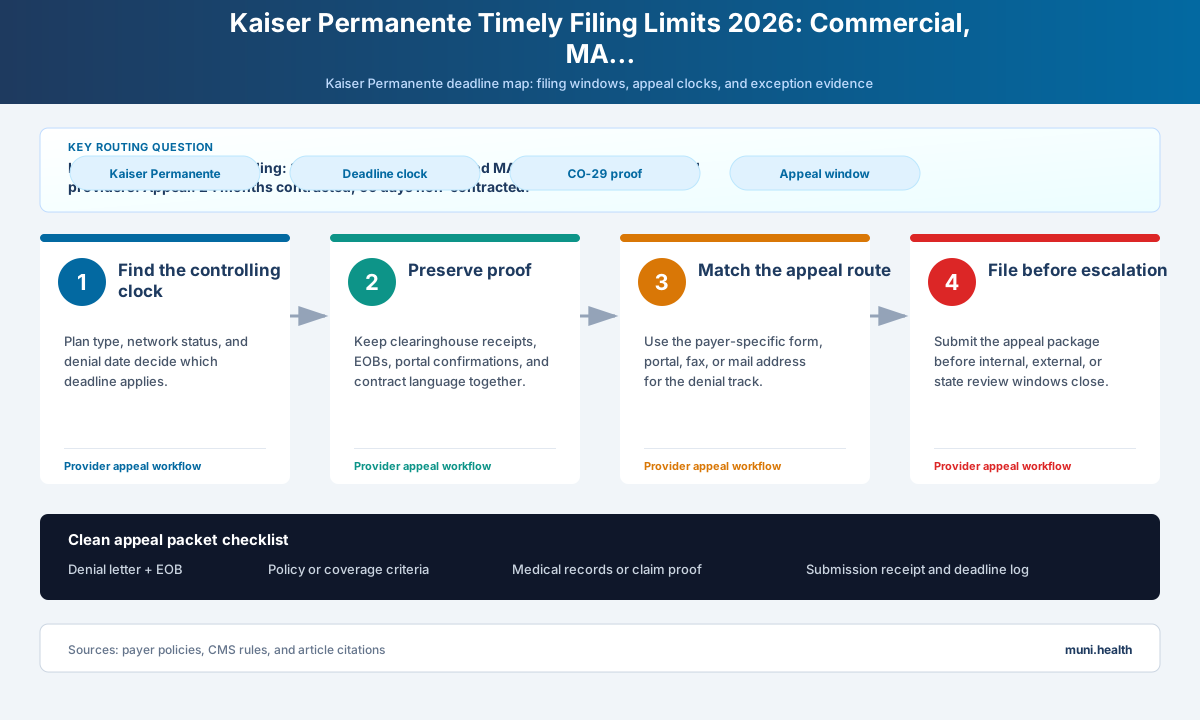
Why Kaiser deadlines need a regional check
The September 28 source review found that this page had treated regional and claim-type rules as national defaults. An original claim, a corrected claim, and an appeal have different triggers. A deadline for correcting missing information does not establish the original filing limit.
Start with the member's regional plan and your provider agreement. An outside provider may be contracted or non-contracted; location outside a Kaiser facility alone does not determine the deadline. Use the Kaiser provider contact guide to find the regional claims contact.
Read the agreement together with applicable law
A contract is not authority to shorten a statutory minimum. Confirm which rule applies to the plan and service, including any longer contractual period. If the manual, agreement, and notice disagree, ask the regional claims team to identify the controlling provision in writing and escalate promptly.
Kaiser Permanente original-claim limits by region and plan
| Region / plan | Original-claim rule | Scope and clock |
|---|---|---|
| Northern California HMO | 90 calendar days, unless agreement or law differs | 2026 manual, California-only block: service or discharge. Apply the non-contracted legal minimum where relevant. |
| California non-contracted providers | At least 180 days under the cited California rule | From service; a regulatory floor, not a universal Kaiser contract deadline. Check plan jurisdiction. |
| Southern California | Confirm applicable manual and agreement | The NorCal manual's California-only block also names SoCal; do not assume every SoCal product or provider agreement has the same terms. |
| Colorado | Current original-claim number unverified | The 2026 billing chapter confirms a correction window, not a general 365-day original-claim limit. |
| Washington (KPWA): commercial / PPO / POS and Medicaid | 12 months | From service, per KPWA section 6.2.22. |
| Washington (KPWA): Medicare Advantage HMO / PPO | One calendar year | From service, per KPWA section 6.2.22; not evidence for all Kaiser regions. |
| Georgia, Hawaii, Mid-Atlantic, Northwest | Confirm regional original-claim rule | Do not reuse the 365-day corrected-claim window as the initial filing deadline. |
| Other MA, POS, self-funded and member reimbursement claims | Check the specific plan and filing route | Provider claims and member reimbursement requests can follow different documents. |
Prepare this appeal packet with your team.
Draft the appeal, coordinate missing documents, and approve the reviewed packet. Keep your clearinghouse; your practice checks deadlines and submits through the payer’s accepted channel.
First 3 appeals free, then $20 per appeal. Start with your denial letter or EOB and available records. No meeting or clearinghouse connection required.
Sources checked September 28, 2026: 2026 Northern California HMO Provider Manual, printed page 42, California DMHC Claims Technical Assistance Guidance, Rule 1300.71(b)(1), 2026 Colorado billing chapter, and 2026 KPWA Provider Manual, section 6.2.22.
California: distinguish a manual rule from a legal minimum
“External” or “community” is not synonymous with non-contracted. Confirm participation for the actual service. The DMHC guidance sets different minimums by contract status for plans subject to that rule, except where state or federal law requires otherwise. Do not apply its non-contracted floor to every NorCal claim, or assume it governs every self-funded or Medicare product.
Colorado: the audit's historical number is not a current deadline
The audit noted an older Colorado original-claim rule. That does not justify replacing this page's unsupported 365-day claim with an unqualified current 90-day claim. The 2026 Colorado chapter, section 5.9.1 gives 90 calendar days from the original Remittance Advice for missing-information corrections to claims received on time. It does not establish that same deadline for an original claim. Obtain the current original-claim provision from your agreement and regional Provider Relations.
Which Kaiser region are you billing?
Identify Northern California, Southern California, Colorado, Georgia, Hawaii, Mid-Atlantic, Northwest, or Washington from the member's coverage and regional documents. In particular, Kaiser Permanente Northwest and Kaiser Permanente Washington have separate manuals; a Washington service address alone does not choose the correct one.
Confirm the regional payer ID, claims address, and responsible payer before submission. For a referred service, also check whether a delegated group handles payment. Keep the current routing instructions with the claim. The regional contact directory is a starting point; the plan's instructions control the specific claim.
Emergency and secondary claims: identify the right clock
An emergency claim still needs the correct regional filing rule. Document the presenting symptoms and emergency circumstances, and verify coverage and payment requirements for the member's plan. Emergency status alone does not establish a nationwide filing extension or guarantee reimbursement.
When Kaiser is secondary, do not assume a national 120-day window. California's DMHC rule prohibits a secondary COB filing deadline shorter than 90 days after the primary payer's payment, contest, denial, or notice. Check the agreement for a longer period.
For KPWA, section 6.2.22 gives COB original claims 12 months from the original primary payment and adjustments 30 months from processing. Its self-funded limits can vary by employer group. These are Washington rules, not national Kaiser defaults.
Keep the primary EOB and the date that triggers the secondary clock. If primary processing is delayed, ask how to preserve timely filing without misrepresenting payer order. Do not submit Kaiser as primary solely to bypass a secondary-claim requirement.
Provider disputes and Medicare Advantage appeals are different tracks
A provider payment dispute is not automatically a member coverage appeal. Neither the earlier national “24 months contracted / 60 days non-contracted” split nor one deadline for every appeal level is supported.
- NorCal provider payment disputes: the 2026 manual, section 6.2.3 allows 365 calendar days from the relevant action, or the specified inaction trigger, subject to longer agreement or legal periods.
- Washington reconsiderations: KPWA section 6.3 distinguishes member liability, provider liability, Medicare, and COB. Its 24-month provider-liability rule is regional. Its non-contracted MA text still says 60 days, which differs from current CMS guidance; confirm the correct route promptly and submit early.
- MA first-level plan reconsideration: CMS currently specifies 65 calendar days from the organization-determination notice. Do not apply that member-appeal rule to every provider payment dispute or later appeal level. Follow the notice's standing, authorization, and any waiver-of-liability requirements.
For help choosing the document, see the Kaiser appeal form guide and Kaiser appeal letter templates. Verify the current deadline separately from a reusable template.
Corrected claims do not reset the original deadline
If billing data are wrong, use the correction route rather than an appeal arguing that the original data were correct. The Kaiser corrected-claim guide separates missing-information corrections, correction notices, and Washington adjustments. Read the notice and keep the original remittance; a remittance-based correction window is not permission to submit the original claim late.
How to protect your timely filing evidence
- Record region, product, contract status, original-versus-correction-versus-dispute route, governing provision, and clock start.
- Retain the claim, payer acceptance acknowledgment, remittance, notices, and submission confirmation together.
- Distinguish clearinghouse transmission from payer acceptance. Fix rejected submissions promptly and preserve both the rejection and accepted resubmission.
- Calendar a working target before the actual deadline and assign an owner to check claim status.
- If a timely claim is denied as late, follow the regional dispute instructions and provide the evidence that matches the asserted receipt date.
A saved transmission report does not by itself guarantee that a payer received a complete claim or that an appeal will succeed.
Frequently Asked Questions
What is Kaiser Permanente's timely filing limit?
There is no national number. Use the regional table above, then confirm the member's product, your agreement, and applicable law. The initial claim deadline is separate from a correction or appeal deadline.
Do all Northern California community providers get 180 days?
No. Contract status matters. The current manual's default and California's non-contracted minimum serve different purposes; verify which applies to the service instead of using “community provider” as a deadline category.
Is Colorado's original-claim limit 365 days?
That number was not verified in the current billing chapter. Nor should its 90-day missing-information correction rule be relabeled as an original-claim limit. Ask the regional claims team for the current contractual provision.
Is Medicare Advantage always 365 days for filing and 60 days for appealing?
No. The Washington original-claim rule is scoped to KPWA. For a first-level MA plan reconsideration, use the current CMS notice-based rule above; other provider disputes and subsequent appeal stages need their own instructions.
What happens if my Kaiser claim is rejected by EDI?
Check whether the rejection came from the clearinghouse or the payer. Correct the identified error, resubmit promptly, and retain the rejection and acceptance records. An attempted submission is not proof that the claim met the applicable receipt deadline.
Does Kaiser accept secondary claims after Medicare primary billing?
Check the plan's coordination-of-benefits rules and include the primary adjudication information it requires. The triggering date can differ from the service date; do not use the old blanket 120-day assumption.
Prepare a Kaiser appeal with the deadline verified
Muni Appeals helps prepare an appeal letter from uploaded denial materials. Your billing team verifies the regional rule, calendars the deadline, gathers proof, and submits through the required channel. For cross-payer context, see the insurance appeal deadlines guide.
Administrative education, not legal advice or a coverage or payment determination. Sources reviewed September 28, 2026. Unverified regional limits are identified rather than presented as current rules. Confirm the applicable agreement, plan documents, notices, and law. Muni Health is not affiliated with Kaiser Permanente.