

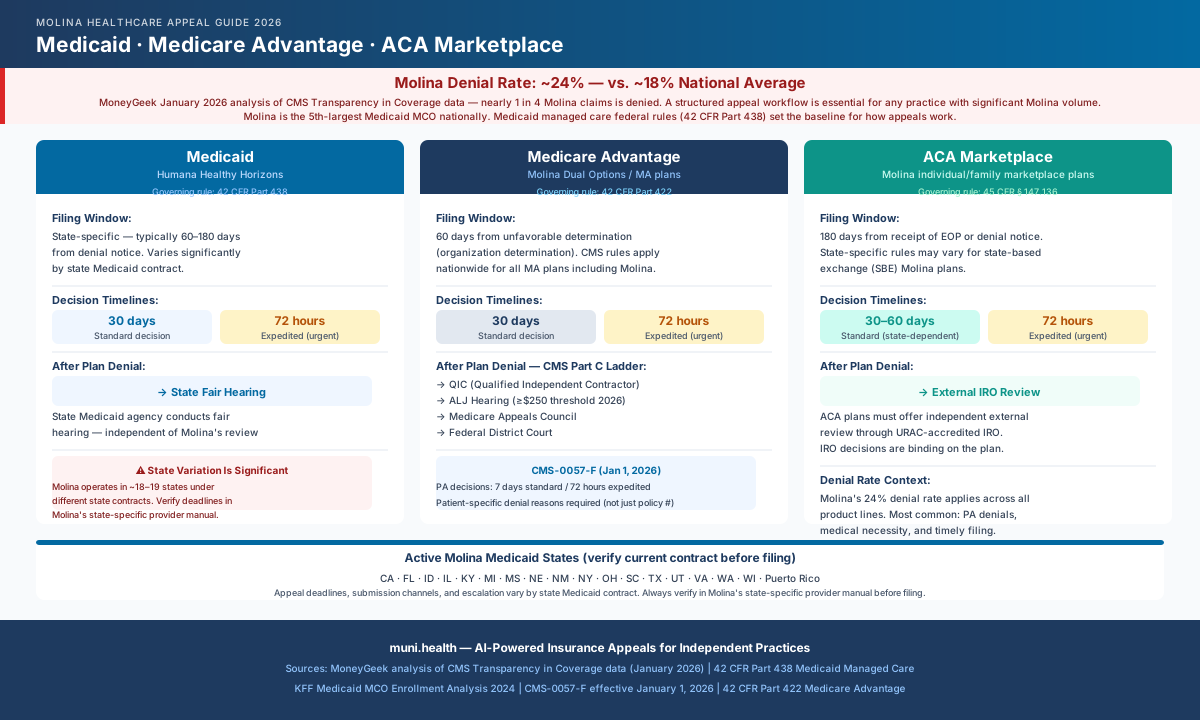
Molina Healthcare denied approximately 24% of claims in recent review periods — higher than the ~18% national average, according to MoneyGeek's January 2026 analysis of CMS data. Timely filing limits: Medicaid varies by state (typically 90–365 days from date of service); Medicare Advantage: 365 days from date of service; ACA Marketplace: 180 days from date of service. Appeal deadlines: Medicare Advantage — 60 days from the unfavorable determination; Medicaid — state-specific, often 60–180 days from denial notice. Standard appeals must be resolved within 30 calendar days; expedited appeals within 72 hours under federal Medicaid managed care rules (42 CFR Part 438).
Molina Denial or Missed Deadline?
Molina's Medicaid deadlines vary by state — missing the window forfeits the appeal right. Muni surfaces deadline risk from the materials you upload; staff verifies and calendars the controlling state and plan deadline. Start 3 free appeals.
Ready to write the appeal itself? See Molina Appeal Letter Template 2026 for copy-paste Medicaid and Medicare Advantage letter templates.
Why Molina Healthcare Denials Are Different From Commercial Denials
Most insurance appeal guides are written for commercial payers — Aetna, BCBS, UHC. Molina Healthcare operates differently, and those differences affect how you appeal.
Molina is the fifth-largest Medicaid managed care organization nationally, covering approximately 6.5% of comprehensive Medicaid MCO enrollment as of mid-2024, according to KFF analysis. In most of the states where Molina operates, Medicaid is its largest product line. That means the federal Medicaid managed care regulations — specifically 42 CFR Part 438 — set the baseline for how appeals work, not private insurer policy. If you bill Centene Corporation (WellCare, Ambetter, Peach State, Sunshine Health), the same federal framework applies — see our Centene and WellCare provider appeal guide for that payer family's brand map and submission procedures. The same 42 CFR Part 438 baseline also governs CareSource Medicaid plans in Georgia, Indiana, Michigan, Nevada, and Ohio — see our CareSource appeal guide for that MCO's state-specific dispute, appeal, and fair hearing process.
State Variation Is Significant
Molina operates in approximately 18–19 states under state-specific Medicaid contracts. Appeal deadlines, submission channels, and escalation processes vary by state. This guide covers the federal baseline; always verify your state-specific timelines in Molina's state provider manual before filing.
Molina's denial rate is also notable. MoneyGeek's January 2026 analysis of CMS Transparency in Coverage data puts Molina's average denial rate at approximately 24%, compared to the national average of roughly 18%. Nearly one in four claims is denied — a rate that makes a well-organized appeal workflow essential for any practice billing significant Molina volume. For comparison across all major insurers, see our insurance denial rate by company guide.
Common denial categories across Molina's plan types include:
- Prior authorization: Services rendered without a required preapproval or where PA was denied before service
- Medical necessity: Claims that don't meet Molina's clinical criteria for the service billed
- Timely filing: Claims submitted outside the applicable filing window (highly state-dependent for Medicaid)
- Coding and bundling: CPT or ICD-10 errors flagged during automated adjudication
- Out-of-network: Services rendered by non-participating providers in plans with network restrictions
Molina's Three Plan Types and Their Appeal Frameworks
Before filing, identify which Molina product the denied claim falls under. The appeal process, timelines, and escalation ladder are different for each.
Prepare this appeal packet with your team.
Draft the appeal, coordinate missing documents, and approve the reviewed packet. Keep your clearinghouse; your practice checks deadlines and submits through the payer’s accepted channel.
First 3 appeals free, then $20 per appeal. Start with your denial letter or EOB and available records. No meeting or clearinghouse connection required.
| Plan Type | Governing Rules | Filing Window | Standard Decision | Expedited Decision | After Plan Denial |
|---|---|---|---|---|---|
| Medicaid (managed care) | 42 CFR Part 438; state Medicaid contract | State-specific (often 60–180 days from denial) | 30 calendar days | 72 hours | State Fair Hearing |
| Medicare Advantage | 42 CFR Part 422; CMS Part C rules | 60 days from unfavorable determination | 30 calendar days | 72 hours | QIC → ALJ → Federal Court |
| ACA Marketplace | ACA; 45 CFR § 147.136 | 180 days from EOP receipt | 30–60 days (state-dependent) | 72 hours | External IRO review |
The footnotes matter here: Medicaid filing windows vary meaningfully by state. California Medicaid contracts may have different windows than Texas or Ohio Medicaid. If you are unsure, contact Molina's provider services line for your state or request the state-specific provider manual from your provider representative.
Molina Healthcare Timely Filing Limits
Timely filing limits govern two separate windows: how long you have to submit the original claim after the date of service, and how long you have to file an appeal after a denial. Both windows are plan-type-specific — and for Medicaid, state-specific.
| Plan Type | Initial Claim TFL | Appeal Filing Window | Key Notes |
|---|---|---|---|
| Medicaid (managed care) | State-specific — typically 90–365 days from DOS | 60–180 days from denial notice (state-determined) | Set by state Medicaid contract. Verify in your state's Molina provider manual before submitting. |
| Medicare Advantage | 365 days from date of service | 60 days from unfavorable determination | CMS standard; applies uniformly to all Molina MA plans nationally. |
| ACA Marketplace | 180 days from date of service | 180 days from EOP receipt | ACA rules set minimums; Molina's state marketplace contract may specify a shorter window. |
Medicaid TFL Is State-Specific — Not National
California Medi-Cal, Ohio Medicaid, and Texas Medicaid each operate under separate Molina contracts with different timely filing windows. Do not assume a national standard applies. Locate your state's TFL in the Molina provider manual, the denial notice itself, or by calling Molina's state provider services line before submitting a late claim with a TFL exception.
For a complete state-by-state breakdown of Molina Medicaid TFLs — with verified windows for Texas, California, Virginia, Washington, Iowa, Ohio, and Kentucky, plus CO-29 appeal procedures — see Molina Healthcare Timely Filing Limits 2026. Corrected claims run on a separate state-specific window (60 days in New York to 24 months in Washington); see Molina corrected claim deadlines by state. For a cross-payer comparison of all major insurer appeal deadlines, see our insurance appeal deadlines guide.
Step-by-Step: Filing a Molina Healthcare Appeal
Step 1: Pull the Denial Documentation
Obtain the Explanation of Payment (EOP) or denial notice for the claim. Molina is required — under both federal Medicaid and ACA rules — to specify:
- The reason for denial
- The clinical criteria or coverage policy applied
- Your right to appeal and the deadline
For prior authorization denials, Molina must provide the specific clinical criteria that were not met. If this information is not included in the denial notice, request it in writing before building your appeal. You are entitled to this disclosure. See our prior authorization denial complete guide for documentation strategies across major payers.
Medicaid Transparency Requirement
Under 42 CFR §438.404, Medicaid MCOs must notify providers of the specific reasons for a denial and include information about the appeal process in every adverse action notice. If Molina's denial letter is vague, request the complete clinical basis in writing — it strengthens your appeal record and puts Molina on notice.
Step 2: Identify the Correct Appeal Pathway
Medicaid claims: File a provider claim dispute or appeal through Molina's state-specific provider portal or by written submission. The address and fax number vary by state — locate these in your state's Molina provider manual or the provider directory at provider.molinahealthcare.com. Log in to the provider portal to find state-specific appeal submission instructions. For help verifying the current state/program form and submission route, including Texas's updated Availity instructions, see Molina Healthcare Appeal Form Guide 2026.
Medicare Advantage claims: File a redetermination request with the Molina Medicare Advantage plan that issued the denial. Submit in writing with the claim number, date of service, and denial reference number. Molina must acknowledge receipt and issue a decision within 30 calendar days for standard, or 72 hours for expedited determinations.
ACA Marketplace claims: Submit an internal appeal within 180 days of receiving the EOP. Follow the appeal instructions on Molina's denial notice, which will specify the submission address or portal.
Don't Use the Wrong Pathway
Medicaid and Medicare Advantage are separate products with separate appeal processes at Molina. Filing a Medicaid appeal for a Medicare Advantage denial — or vice versa — wastes your filing window and may result in a procedural denial. Check the insurance card and EOP to confirm the plan type before submitting.
Step 3: Build Your Clinical Documentation Package
For medical necessity denials, the documentation package should include:
- Medical records: Office notes, diagnostic reports, imaging, and lab results relevant to the denied service
- Letter of medical necessity: A physician-authored statement connecting the denied service to the patient's clinical condition, failed alternatives, and applicable treatment guidelines
- Clinical guidelines: References to evidence-based guidelines (AMA, specialty society, CMS LCD/NCD) supporting the medical necessity of the service
- Prior authorization history: If PA was granted and the claim was still denied for medical necessity, include the authorization number and correspondence
For coding denials:
- Corrected claim with updated CPT, ICD-10, or modifier
- Documentation supporting the specific codes billed
- Medical record demonstrating the service was performed as coded
For timely filing denials:
- Proof of original timely filing (clearinghouse confirmation, fax transmission report)
- Documentation of any systemic delay (clearinghouse outage, Change Healthcare disruption) if applicable
- State-specific timely filing exception criteria if relevant
Step 4: Submit Within the Deadline
Submit your appeal through the channel specified in Molina's denial notice for your state. Keep a complete record of:
- Date of submission
- Method (portal, fax, mail)
- Tracking number or confirmation
- All documents submitted
For Medicaid claims, timely filing windows run from the denial notice date — not date of service. For Medicare Advantage, the 60-day window runs from the date of the unfavorable determination letter.
The Medicaid State Fair Hearing: Molina's Escalation Path
When Molina upholds a Medicaid appeal at the plan level, you have the right to request a State Fair Hearing. This is an independent administrative proceeding outside of Molina's control, conducted by the state Medicaid agency.
Key points about State Fair Hearings:
- Deadline to request: Varies by state, but CMS requires that enrollees (and in many states, providers acting on their behalf) have at least 90 days from the plan's final denial to request a hearing
- Who conducts it: State administrative law judge or hearing officer — not affiliated with Molina
- Continuation of benefits: In Medicaid, if you request a State Fair Hearing before the plan's action takes effect, benefits must generally continue pending the hearing outcome
- Burden of proof: Molina must demonstrate that its denial was consistent with state coverage criteria and federal requirements
The continuation-of-benefits rule referenced above runs on its own, shorter clock than the hearing-request deadline itself, and the requirements for filing as the patient's authorized representative are federal, not Molina-specific. See our Medicaid fair hearing and provider appeal guide for the full two-track timeline and a combined request template.
State Fair Hearing vs. External IRO
Medicaid appeals escalate to a State Fair Hearing — not an external Independent Review Organization (IRO) like ACA plans. If the denied claim involves a Medicare Advantage plan, the escalation ladder goes to the Qualified Independent Contractor (QIC), then ALJ, then federal court. Understand which ladder applies before escalating. See our independent review organization appeal guide for a full breakdown of external review rights.
Medicare Advantage Appeals: The Escalation Ladder
For Molina Medicare Advantage plan denials, the appeal process follows CMS Part C rules. The process mirrors the standard Medicare Advantage appeal ladder — the same framework covered in our Medicare Advantage appeal letter template:
Prepare this appeal packet with your team.
Draft the appeal, coordinate missing documents, and approve the reviewed packet. Keep your clearinghouse; your practice checks deadlines and submits through the payer’s accepted channel.
First 3 appeals free, then $20 per appeal. Start with your denial letter or EOB and available records. No meeting or clearinghouse connection required.
| Level | Name | Filed With | Deadline to File | Decision Timeline | AIC Threshold |
|---|---|---|---|---|---|
| 1 | Redetermination | Molina Medicare Advantage plan | 60 days from unfavorable determination | 30 days standard / 72 hrs expedited | None |
| 2 | Reconsideration | Qualified Independent Contractor (QIC) | 60 days from Molina redetermination | 30 days standard / 72 hrs expedited | None |
| 3 | ALJ Hearing | Office of Medicare Hearings and Appeals (OMHA) | 60 days from QIC decision | 90 days | ~$200 (2026) |
| 4 | Medicare Appeals Council | Departmental Appeals Board | 60 days from ALJ decision | Varies | None |
| 5 | Federal District Court | U.S. District Court | 60 days from MAC decision | Varies | ~$1,960 (2026) |
The AIC (amount in controversy) thresholds for ALJ and federal court are updated annually by CMS. The figures above reflect approximate 2026 thresholds; verify current thresholds at cms.gov before filing.
What Makes a Molina Medicaid Appeal Win
Most successful Molina Medicaid appeals share the same characteristics:
1. Documentation specificity: Vague letters of medical necessity lose. The most effective appeals cite the specific CPB, LCD, or clinical guideline that supports the service — including the section and criterion that applies to the patient's condition.
2. Evidence of failed alternatives: Many Molina clinical criteria include step-therapy or failed-conservative-treatment requirements. If the denied service follows a documented treatment sequence, show it explicitly.
3. State coverage criteria alignment: Medicaid coverage criteria are set by each state. A service that Molina denies under "clinical judgment" may still be required under state Medicaid plan provisions. Check the state Medicaid plan and any applicable State Plan Amendments (SPAs) before framing your appeal.
4. Correct denial type mapping: Timely filing denials need a different response than medical necessity denials. Filing a clinical justification for a timely filing denial, or vice versa, wastes the appeal window.
Use Molina's Own Criteria
Molina is required under 42 CFR §438.404(b)(4) to disclose the specific clinical criteria used to deny a claim. When you receive that criteria, build your appeal to directly address each failed criterion. Appeals that respond point-by-point to the insurer's own language are significantly harder to uphold.
How Muni Appeals Helps With Molina Denials
Molina's state-by-state variation creates a documentation and deadline management challenge for billing teams handling multi-state practices or significant Medicaid volume.
Muni Appeals helps billing teams organize the appeal workflow:
- Surfaces denial-type, plan-type, and state context for staff to verify before choosing the appeal pathway
- Compiles clinical documentation packages connected to the denial reason — not a generic letter template
- Surfaces state and plan-type deadline risk from the uploaded notice; staff verifies and calendars the controlling window
- Provides fields for staff to record submission timestamps and confirmation numbers after filing
Frequently Asked Questions
How long does Molina Healthcare have to respond to a provider appeal?
For Medicaid claims, federal regulations (42 CFR §438.408) require Molina to resolve standard appeals within 30 calendar days of receipt. Expedited appeals must be resolved within 72 hours. Both deadlines can be extended by up to 14 days in limited circumstances. For Medicare Advantage, the standard redetermination deadline is 30 days; expedited is 72 hours. Timelines for ACA marketplace plans vary by state but are typically 30–60 days for internal appeals.
What is the filing deadline for a Molina Medicaid provider appeal?
The deadline varies by state and is set in Molina's state-specific Medicaid contract. Many states allow 60–180 days from the denial notice. Check your state's Molina provider manual or the specific denial notice for the applicable window. Do not assume a national standard applies — Medicaid filing windows are state-determined.
Can I request a State Fair Hearing if Molina denies my Medicaid appeal?
Yes. After exhausting Molina's plan-level appeal process, you — or the member, depending on state rules — may request a State Fair Hearing. The request must be filed with the state Medicaid agency within the state-specified window, often 90 days from the plan's final denial. The state hearing officer reviews whether Molina's denial was consistent with state coverage requirements.
Does Molina use prior authorization for Medicaid services?
Yes. Molina applies prior authorization requirements to many Medicaid services, including specialty care, inpatient admissions, certain outpatient procedures, DME, and home health. PA requirements vary by state and service type. PA denials can be appealed through the same appeals process as post-service claim denials. Under CMS-0057-F, effective January 1, 2026, CMS requires Medicare Advantage plans (including Molina MA) to issue standard PA decisions within 7 calendar days and expedited decisions within 72 hours — an improvement from prior deadlines.
What happens if I miss Molina's appeal deadline?
For Medicaid plans, missing the appeal deadline generally forfeits the plan-level appeal right. You may still be able to request a State Fair Hearing in some states if you can demonstrate good cause for missing the plan deadline — but this is state-specific. Document and preserve all evidence of when you received the denial notice, as the deadline runs from that date.
Does Molina Healthcare cover the same services in every state?
No. Molina's Medicaid plans are governed by state-specific Medicaid contracts. Covered services, PA requirements, and appeal rules vary significantly by state. A service covered under Molina's California Medicaid contract may not be covered under its Ohio or Texas contract. Always verify coverage against the applicable state contract or provider manual, not a national summary.
How do I appeal a Molina prior authorization denial before a service is rendered?
For pre-service PA denials, submit your appeal as soon as possible — before the service date if clinically urgent. Expedited reviews (72-hour decision requirement) are available when a standard timeline would seriously jeopardize the patient's health. The appeal should include the treating physician's clinical rationale, relevant records, and any applicable clinical guidelines. For Medicaid, escalation to a State Fair Hearing is available if the plan-level appeal is denied. For copyable member-consent appeal and Medicare Advantage reconsideration letters, see the Molina prior authorization template.
Is Molina's provider appeal process the same for Medicaid and Medicare Advantage?
No. Medicaid appeals at Molina are governed by 42 CFR Part 438 and state Medicaid contracts; they escalate to a State Fair Hearing. Medicare Advantage appeals follow 42 CFR Part 422 and CMS Part C rules; they escalate to the QIC, ALJ, and federal court. The submission channels, timelines, and escalation options are different. Using the wrong process can forfeit your appeal rights.
Ready to Reduce Molina Denial Losses?
Molina's state-by-state variation makes it one of the more administratively complex payers to appeal — especially for practices billing across multiple states or plan types. Missing the correct deadline or using the wrong pathway wastes the appeal window.
Get Started:
- Tracks Molina appeal deadlines by state and plan type
- Organizes documentation specific to the denial reason — not generic templates
- Maintains submission records for timely filing proof and audit trail
- Reduces manual back-and-forth on Medicaid and Medicare Advantage denials
This guide reflects 2026 Molina Healthcare appeal procedures and federal regulations. State Medicaid contract terms, coverage requirements, and appeal deadlines vary by state. Verify current timelines and submission channels in your state's Molina provider manual before filing. This information is for administrative and billing purposes and is not medical advice.