

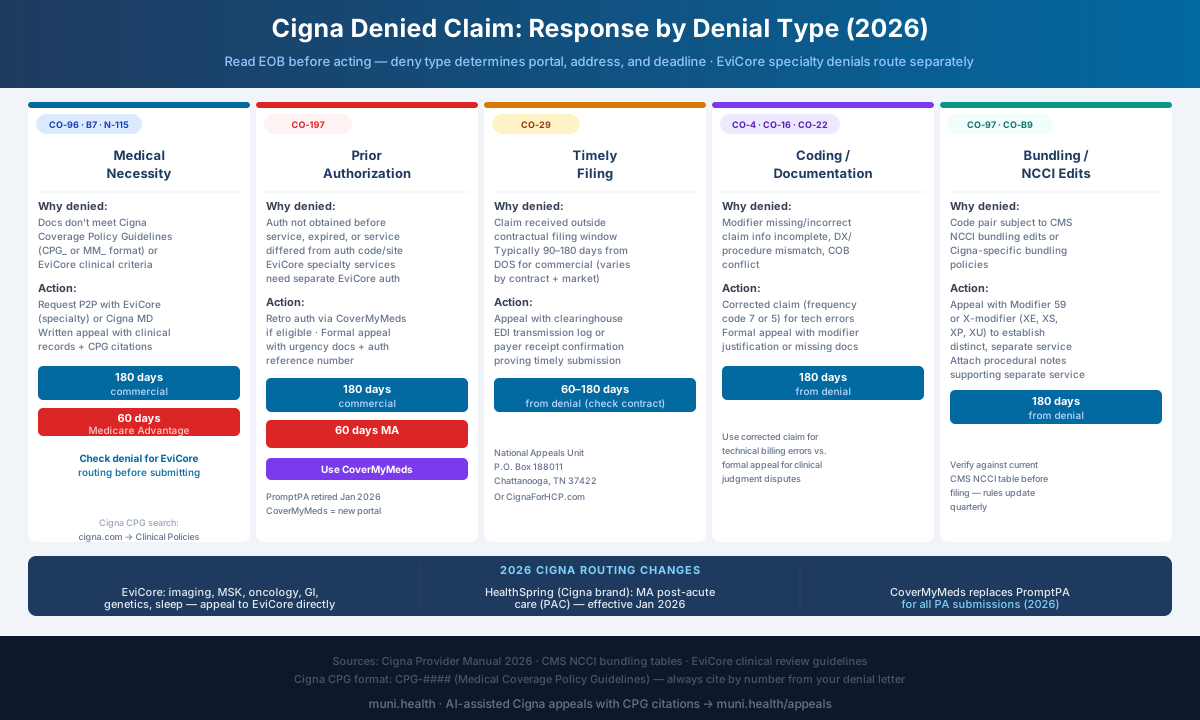
When Cigna denies a claim, identify the type from your EOB: medical necessity (CO-96), prior auth (CO-197), timely filing (CO-29), or a coding issue (CO-4). Commercial plans allow 180 days to appeal; Medicare Advantage allows 60 days. Submit through CoverMyMeds or Cigna's provider portal — for EviCore-managed specialty denials, request a peer-to-peer with EviCore before filing the written appeal.
Why Cigna Denials Require a Type-Specific Response
Cigna processes claims across a significant portfolio of plan types — commercial fully insured, self-funded employer plans (ASO), Medicare Advantage, and Medicaid managed care. The denial taxonomy is consistent across plan types: the same Claim Adjustment Reason Codes appear on Cigna EOBs regardless of whether the underlying plan is commercial or MA. What changes is the reviewing entity, the submission portal, and the deadline structure.
The most significant complication in Cigna denial management is the delegation of specialty services to third-party reviewers, plus one outright change of ownership. EviCore manages prior authorization and clinical review for delegated specialties on Cigna commercial plans. Health Care Service Corporation (HCSC) acquired Cigna's Medicare Advantage business and branded it HealthSpring, but HealthSpring still delegates high-tech radiology and diagnostic cardiology, medical oncology and radiation therapy, and musculoskeletal prior authorization to eviCore. Ownership therefore does not identify the reviewer or appeal destination; use the determination or denial notice.
The other major 2026 change affecting Cigna denial management is the retirement of Cigna PromptPA and its replacement by CoverMyMeds as the preferred portal for prior authorization submissions and documentation. Providers accustomed to the PromptPA workflow need to route new submissions and appeal documentation through CoverMyMeds.
This guide maps each Cigna denial type to the correct response path, covering the EOB codes, action steps, EviCore and HealthSpring routing, submission mechanics, and 2026-specific changes. For the full step-by-step Cigna appeal strategy — peer-to-peer review timing, Cigna CPG policy citations, and the HealthSpring MA appeal ladder — see the complete Cigna appeal guide.
For context on how Cigna's denial rates compare across commercial and MA lines, see the insurance denial rate comparison by company.
The Five Cigna Denial Categories (and What Each Requires)
| Denial Category | Common Codes | Primary Cause | Appeal Path | Deadline |
|---|---|---|---|---|
| Medical Necessity | CO-50 | Documentation does not meet Cigna Coverage Policy Guidelines (CPG_ or MM_ policy format) or EviCore clinical criteria for the service | Peer-to-peer review with EviCore (specialty) or Cigna Medical Director (standard); written appeal with clinical records and direct Cigna CPG policy citations | 180 days from denial (commercial); 60 days (Medicare Advantage) |
| Prior Authorization | CO-197 | Auth not obtained before service, authorization expired, or billed service differed from authorized code, site, or unit count | Retroactive auth request through CoverMyMeds if eligible; formal appeal with clinical urgency documentation, auth reference number, and code-match verification | 180 days from denial (commercial); 60 days (MA) |
| Timely Filing | CO-29 | Claim received after the contractual filing window — typically 90–180 days for commercial, varies by contract and market | Appeal with clearinghouse transmission log, EDI acknowledgment, or payer receipt confirmation proving timely submission | Typically 60–180 days from denial; check your provider contract |
| Coding / Documentation | CO-4, CO-16, CO-22, CO-97 | Modifier missing or incorrect, claim information incomplete, invalid data element, or coordination of benefits conflict | Corrected claim resubmission (frequency code 7 or 5) for technical errors; formal appeal with modifier justification or missing documentation supplied | 180 days from denial for appeal; corrected claims per contract terms |
| Bundling / NCCI | CO-97 | Claim includes a code pair subject to CMS National Correct Coding Initiative bundling edits or Cigna-specific bundling policies | Appeal with Modifier 59 or X-modifier (XE, XS, XP, XU) to establish distinct service; attach operative or procedural notes supporting separate service | 180 days from denial |
Prepare this appeal packet with your team.
Draft the appeal, coordinate missing documents, and approve the reviewed packet. Keep your clearinghouse; your practice checks deadlines and submits through the payer’s accepted channel.
First 3 appeals free, then $20 per appeal. Start with your denial letter or EOB and available records. No meeting or clearinghouse connection required.
Step 1: Read the EOB Before Doing Anything Else
Every Cigna Explanation of Benefits contains the routing information needed to respond correctly:
- Claim Adjustment Reason Code (CARC) — the primary code explaining why the claim was denied or adjusted
- Remittance Advice Remark Code (RARC) — additional context, often identifying the specific Cigna Coverage Policy Guideline applied or the documentation gap
- Group code — CO (contractual obligation) vs. PR (patient responsibility) vs. OA (other adjustment)
- Appeal deadline — stated on the EOB or denial letter; do not rely on general estimates when your Cigna contract may specify a different window
- Reviewing entity — the EOB will often identify whether the denial was issued by Cigna directly, by EviCore (specialty services), or by HealthSpring (Medicare Advantage PAC services)
EviCore and HealthSpring Denials Must Route to the Correct Reviewer
If the denial letter or EOB identifies EviCore as the reviewing entity, the peer-to-peer request and written appeal must go to EviCore — not to Cigna's provider services line. Similarly, HealthSpring MA denials route to HealthSpring, not to Cigna commercial. Routing to the wrong entity costs days against your deadline and typically results in a referral back, not a decision.
Step 2: Match the Denial to Its Action Path
Medical Necessity Denials (CO-50)
A Cigna medical necessity denial means the submitted clinical documentation did not meet the criteria in the applicable Cigna Coverage Policy Guideline (CPG) or the delegated reviewer's clinical criteria.
Cigna uses its own Coverage Policy Guideline framework for medical necessity decisions. CPG policies follow a naming convention of CPG_XXXX (for specialty/surgical services) and MM_XXXX (for medical/pharmacy management policies). These policies are published publicly on the Cigna provider portal (cigna.com/healthcareprovider). For behavioral health services, Cigna applies MCG Care Guidelines, 29th Edition.
Identifying whether EviCore handled the denial:
EviCore manages prior authorization and clinical review for the following specialty categories across many Cigna commercial and MA plans: radiology/imaging, musculoskeletal services, oncology, gastrointestinal endoscopy, genetics/molecular testing, and sleep studies. If EviCore issued the denial, the denial letter will reference EviCore and provide EviCore's peer-to-peer phone number and appeal address.
Immediate actions for a Cigna medical necessity denial:
- Locate the specific Cigna CPG or EviCore clinical guideline cited in the denial letter. Read the criteria the service must meet — specifically the documentation elements listed under "Coverage Criteria" or "Qualifying Criteria."
- Request a peer-to-peer review before filing the written appeal. For EviCore-managed services, call EviCore at the number on the denial letter to request a peer-to-peer with the reviewing medical director. For standard Cigna denials, call Cigna's provider services line and request a medical director review. The treating physician — not billing staff — must conduct this call.
- If peer-to-peer does not result in reversal, file a formal written appeal through CoverMyMeds (preferred for EviCore-linked services) or through Cigna's provider portal. Attach clinical records, physician narrative, and direct citations to the applicable CPG criteria language. Reference specific criteria passages by section and page number where possible.
2026: CMS-0057-F Changes Cigna Medicare Advantage PA Denials
Effective January 1, 2026, CMS-0057-F requires all Medicare Advantage plans — including Cigna MA — to issue prior authorization denials with specific clinical reasons tied to the individual patient's circumstances. Generic "not medically necessary" language without patient-specific justification is no longer compliant. If your Cigna MA denial lacks a specific clinical rationale, document this in your appeal — it is grounds for overturn at the CMS redetermination level.
For a Cigna-specific medical necessity letter template with CPG citation strategy and EviCore documentation requirements, see the Cigna medical necessity letter guide. For the full appeal workflow — including EviCore vs Cigna vs HealthSpring routing by specialty, P2P strategy, and IDR escalation — see the Cigna medical necessity denial appeal guide.
Prior Authorization Denials (CO-197)
CO-197 from Cigna means either: (a) no prior authorization was obtained before the service, (b) authorization was obtained but expired before the service date, or (c) the service billed differed from what was authorized — a different CPT code, site of service, or unit count.
Immediate actions:
- Check whether retroactive authorization is available. Cigna allows retro auth requests in limited circumstances — emergencies and situations where authorization could not be obtained in advance due to clinical urgency. Submit through CoverMyMeds with clinical urgency documentation and a statement explaining why pre-service authorization was not obtained.
- Verify the CPT code on the claim against the CPT code on the authorization. A frequent CO-197 cause at Cigna is billing a code that was not explicitly listed on the authorization even when the clinical service was equivalent. Cigna auth approvals are code-specific.
- If retroactive auth is not available, file an appeal documenting either: (a) why authorization could not be obtained prior to service, or (b) why the billed service was within the scope of the authorized service and meets the CPG criteria for the authorized code.
CoverMyMeds Replaced PromptPA for All Cigna PA Submissions
Cigna's PromptPA portal (cigna.promptpa.com) is no longer active. New Cigna prior-authorization workflows may use CoverMyMeds, but appeal filing remains separate and follows the denial notice. For HealthSpring, Availity payer ID 52192 supports electronic claims and specified PA workflows, while named specialty PAs remain delegated to eviCore. See the Cigna PromptPA guide for the transition details.
For a complete Cigna prior authorization appeal workflow and template, see the Cigna prior authorization template guide.
Timely Filing Denials (CO-29)
CO-29 means Cigna received the claim after the contractual filing deadline. Initial claim filing windows vary by Cigna plan type and contract. Cigna commercial plans generally allow 90–180 days from date of service for in-network providers; out-of-network timely filing windows and Medicare Advantage windows follow different schedules.
Your Provider Contract Controls the Deadline
Cigna's published general timely filing limits are a starting point — your specific participating provider agreement may specify a different window. If you cannot locate the deadline in your contract, call Cigna's provider services line and request the written filing limit for your network tier and plan type before the appeal deadline passes.
If you receive a CO-29 denial:
- Pull the clearinghouse transaction log or EDI acknowledgment showing when the claim was transmitted. The timestamp on your clearinghouse system does not equal Cigna's receipt date if a clearinghouse processing delay occurred.
- If you submitted within the deadline, appeal with the transmission confirmation as evidence. Cigna generally allows appeals when you can document timely transmission — even if Cigna did not receive the claim within the window due to clearinghouse or system issues outside your control.
- If the deadline was genuinely missed, check whether an exception applies: incorrect payer ID at time of service, retroactive eligibility termination, or a coordination of benefits issue that required billing a different primary payer first.
For a comprehensive breakdown of Cigna timely filing deadlines by plan type — including commercial, Medicare Advantage, and HealthSpring MA — see the Cigna timely filing limits guide.
Coding and Documentation Denials (CO-4, CO-16, CO-22, CO-97)
These denials cover billing and documentation issues that are often correctable without a formal appeal:
- CO-4: Procedure code inconsistent with the modifier used — a required modifier is missing or the applied modifier is not recognized for this code combination
- CO-16: Claim lacks required information or contains invalid data — often a missing NPI, incorrect taxonomy code, invalid diagnosis code, or missing date of onset
- CO-22: This care may be covered by another payer per coordination of benefits — Cigna is asserting it is secondary and requires primary payer information
- CO-97: Benefit included in the payment for another service already adjudicated — see bundling section below
Response by code:
- CO-4: Review modifier usage against the CPT code descriptor and CMS modifier guidelines. A frequent Cigna-specific cause: billing Modifier 25 (significant, separately identifiable E/M on the same day as a procedure) without a distinct diagnosis to support the separate E/M, or using Modifier 59 where a specific X-modifier (XE, XS, XP, XU) is required by Cigna's editing logic.
- CO-16: Identify the specific missing element from the RARC on the EOB. Resubmit as a corrected claim (frequency code 7 for replacement, or 5 for late) with the missing information completed. If the RARC references an invalid ICD-10 code, verify the code is current in the ICD-10-CM FY2026 update.
- CO-22: Collect updated coordination of benefits information from the patient — current primary insurance card, policy number, and effective dates. Resubmit with the correct primary/secondary payer order.
Bundling Denials (CO-97, NCCI Edits)
Bundling denials occur when Cigna applies CMS National Correct Coding Initiative (NCCI) edits — code pairs where one service is considered already included in the payment for another — or Cigna-specific bundling policies in their editing logic.
When to appeal a bundling denial:
Append a modifier to establish that the services were separately distinct:
- Modifier 59: Distinct procedural service (use when a more specific X-modifier does not apply)
- XE: Separate encounter
- XS: Separate anatomical structure
- XP: Separate practitioner
- XU: Unusual non-overlapping service
Include operative or procedural notes demonstrating that the services were performed separately, on distinct anatomical structures, or during a separate encounter from the bundled service. Note that Cigna's editing may apply additional payer-specific bundling logic beyond CMS NCCI — check the RARC for specifics on which edit was triggered.
Check NCCI Modifier Indicators Before Filing
CMS publishes NCCI Procedure-to-Procedure (PTP) edit tables quarterly. Before appealing a CO-97 denial, verify that the code pair has a modifier-indicator of "1" — meaning a modifier can override the bundle. A modifier-indicator of "0" means the code pair cannot be unbundled regardless of modifier, and an appeal on modifier grounds alone will not succeed. CMS NCCI tables are available at cms.gov.
Step 3: Submit Through the Correct Cigna Channel
Cigna's submission routing depends on plan type and whether the denial was issued by a delegated reviewer. Using the wrong submission method delays review and risks missing the appeal deadline. For the complete form download guide — including the three different Cigna appeal forms, step-by-step CignaForHCP.com portal navigation, and behavioral health routing — see the Cigna appeal form guide.
Prepare this appeal packet with your team.
Draft the appeal, coordinate missing documents, and approve the reviewed packet. Keep your clearinghouse; your practice checks deadlines and submits through the payer’s accepted channel.
First 3 appeals free, then $20 per appeal. Start with your denial letter or EOB and available records. No meeting or clearinghouse connection required.
| Denial Source / Plan Type | Preferred Submission Method | Portal or Route | Notes |
|---|---|---|---|
| Cigna commercial — standard medical necessity or PA denial | CoverMyMeds or Cigna provider portal | covermymeds.com or cigna.com/healthcareprovider | CoverMyMeds is the primary portal for PA documentation and appeals; Cigna provider portal for formal written appeals |
| EviCore-managed specialty denial (radiology, MSK, oncology, GI, genetics, sleep) | EviCore provider portal or fax | evicore.com or fax number on denial letter | Appeal must go to EviCore, not Cigna — confirm the denial letter identifies EviCore as the issuing entity before routing |
| HealthSpring MA claims and supported PA workflows | Availity using payer ID 52192 | availity.com | Do not treat the claims payer ID as an appeal destination |
| HealthSpring MA delegated specialty PA | eviCore when identified by the current guide or determination notice | evicore.com | Includes high-tech radiology/diagnostic cardiology, medical oncology/radiation therapy, and MSK |
| Cigna commercial — corrected claim (CO-16, CO-4 technical errors) | EDI 837 corrected claim via clearinghouse | Clearinghouse → confirm Cigna payer ID with your clearinghouse (varies by product line) | Frequency code 7 (replacement) or 5 (late); payer IDs differ across Cigna commercial, MA, and behavioral health lines |
| Cigna Behavioral Health — medical necessity denial | Cigna Behavioral Health provider portal or fax | cigna.com/behavioral-health-providers | MCG Care Guidelines 29th Ed. apply; peer-to-peer available through Cigna Behavioral Health Medical Director line |
How Muni Appeals Helps With Cigna Denials
Cigna denial management has two compounding complexity layers: the EviCore and HealthSpring delegation structure means the same denial code may require three completely different workflows depending on the service category, and the transition from PromptPA to CoverMyMeds added a submission-routing change on top of existing complexity.
Muni Appeals organizes the uploaded denial by type and reviewing entity, surfaces deadline risk and submission guidance, and prepares a review-ready packet. Billing staff verifies the current channel and deadline, then submits and records the appeal.
- EviCore-specific peer-to-peer request coordination and appeal routing
- HealthSpring MA appeal routing from the denial notice and applicable appeal form
- CoverMyMeds submission workflow for PA-linked denials
- Cigna CPG citation assistance for medical necessity appeals
- Commercial and MA deadline-risk guidance for staff verification
Frequently Asked Questions
How long do I have to appeal a Cigna denied claim?
For commercial plans, Cigna typically allows 180 days from the denial date to file a first-level appeal, though your specific provider contract may specify a shorter window — always check the denial letter and your contract. For Medicare Advantage plans, Cigna must follow CMS rules: 60 days from the denial notice for providers to file a redetermination request. The deadline on the denial letter controls — do not rely on general estimates when your contract or plan type may differ.
My Cigna claim was denied by EviCore, not by Cigna directly. Who do I appeal to?
Appeal to EviCore (evicore.com), not to Cigna. EviCore manages prior authorization and clinical review for radiology, musculoskeletal, oncology, GI, genetics, and sleep services under delegation from many Cigna commercial and MA plans. The denial letter will identify EviCore as the issuing entity and provide EviCore's peer-to-peer phone number and appeal submission address. Sending an EviCore-managed appeal to Cigna's provider services line will result in a referral back to EviCore — which costs days against your deadline.
Can I request a peer-to-peer review on a Cigna medical necessity denial?
Yes. Peer-to-peer reviews are available for Cigna medical necessity denials. For EviCore-managed services, call EviCore directly at the number on the denial letter. For standard Cigna denials, call Cigna's provider services line and request a clinical peer-to-peer with the reviewing medical director. Peer-to-peer reviews are physician-to-physician — the treating provider, not billing staff, must make the call. Request peer-to-peer before filing the written appeal when possible, as a successful peer-to-peer avoids the need to write the formal appeal entirely.
What Cigna Coverage Policy Guidelines (CPGs) apply to my denial?
Cigna publishes its Coverage Policy Guidelines publicly on the Cigna provider portal at cigna.com/healthcareprovider under "Medical Coverage Policies." CPG policies use the prefix CPG_XXXX for specialty and surgical services and MM_XXXX for medical management policies. Behavioral health services are governed by MCG Care Guidelines, 29th Edition. EviCore clinical criteria are published at evicore.com. The denial letter should cite the specific CPG or EviCore guideline applied — look for the policy number and title in the denial text before researching which criteria need to be addressed.
What happened to Cigna PromptPA?
Cigna's PromptPA portal (cigna.promptpa.com) has been retired and is no longer active. New Cigna PA submissions may use CoverMyMeds, but appeal documentation follows the denial notice rather than the PA portal. For HealthSpring, use Availity payer ID 52192 for electronic claims and supported PA workflows, and eviCore for the specialty PA categories identified in HealthSpring's current guide. See the Cigna PromptPA guide for details.
How do Cigna Medicare Advantage denials differ from commercial Cigna denials?
Cigna MA claims follow the federally mandated 5-level CMS appeal chain, not Cigna's internal commercial process. The appeal sequence is: organization determination → reconsideration (by the MA plan) → automatic Independent Review Entity review if the plan upholds → Administrative Law Judge → Medicare Appeals Council → federal court (42 CFR Part 422, Subpart M). Note that Cigna's Medicare Advantage business now belongs to HCSC and operates as HealthSpring, so follow the reviewer named on the notice. CMS-0057-F, effective January 1, 2026, requires Cigna MA to issue PA denials with specific clinical reasons tied to the individual patient — generic "not medically necessary" language without patient-specific justification is worth challenging at the reconsideration level. The financial threshold for an ALJ hearing is approximately $200 (adjusted annually by CMS).
What if Cigna denies my first-level appeal?
File a second-level internal appeal with Cigna. If the second-level is also denied, you can request external review through an Independent Review Organization (IRO) for fully insured commercial plans. Note that ERISA governs self-funded employer plans — external review rights for self-funded plans depend on whether the plan has voluntarily adopted external review, as ERISA generally preempts state external review mandates. For Medicare Advantage, escalate to the QIC reconsideration track. See the independent review organization appeal guide for IRO eligibility and the insurance appeal statute of limitations guide for external review deadlines.
Does Cigna use AI to review prior authorization requests and claims?
Cigna, like other major commercial payers, uses automated clinical decision-support tools to screen prior authorization requests and flag claims for review. EviCore's specialty review process uses evidence-based criteria algorithms as part of its initial screening before physician review. Under CMS-0057-F, Medicare Advantage prior authorization denials cannot be based on AI or algorithm alone — a qualified clinician must review the individual patient circumstances. If you believe a Cigna MA denial was generated algorithmically without physician review, note this in your appeal and request written confirmation that a licensed physician reviewed the specific clinical records submitted. See the guide to fighting AI-driven insurance denials for documentation strategies specific to algorithm-generated denials.
Ready to Recover Your Denied Cigna Claims?
Cigna denial management is complicated by plan ownership, delegated review, and separate claims/PA/appeal channels. The same denial code may require an eviCore peer-to-peer, a HealthSpring appeal form routed by the denial notice, or a standard Cigna CPG appeal, depending on the plan and service. Getting the routing right before the deadline closes is the difference between a recovered claim and a write-off.
Get Started:
- EviCore peer-to-peer coordination and appeal routing for specialty denials
- HealthSpring MA appeal routing from the denial notice and applicable appeal form
- CoverMyMeds workflow for PA-linked appeal documentation
- Cigna CPG citation assistance for medical necessity appeals
- Commercial and MA deadline-risk guidance for staff verification
This guide reflects 2026 Cigna appeal procedures across commercial, self-funded, and Medicare Advantage plan lines. Individual plan timely filing deadlines and submission requirements vary by contract. Always verify requirements against your specific Cigna participating provider agreement and the denial letter for each claim. Medicare Advantage procedures are governed by CMS regulations including CMS-0057-F (effective January 1, 2026). EviCore delegation applies to participating Cigna plans; HealthSpring is a separate matter — it is Health Care Service Corporation's Medicare Advantage business, built on the book HCSC acquired from Cigna in a deal that closed March 19, 2025, not a Cigna delegate. Confirm the applicable reviewer from the denial letter before routing your appeal.