

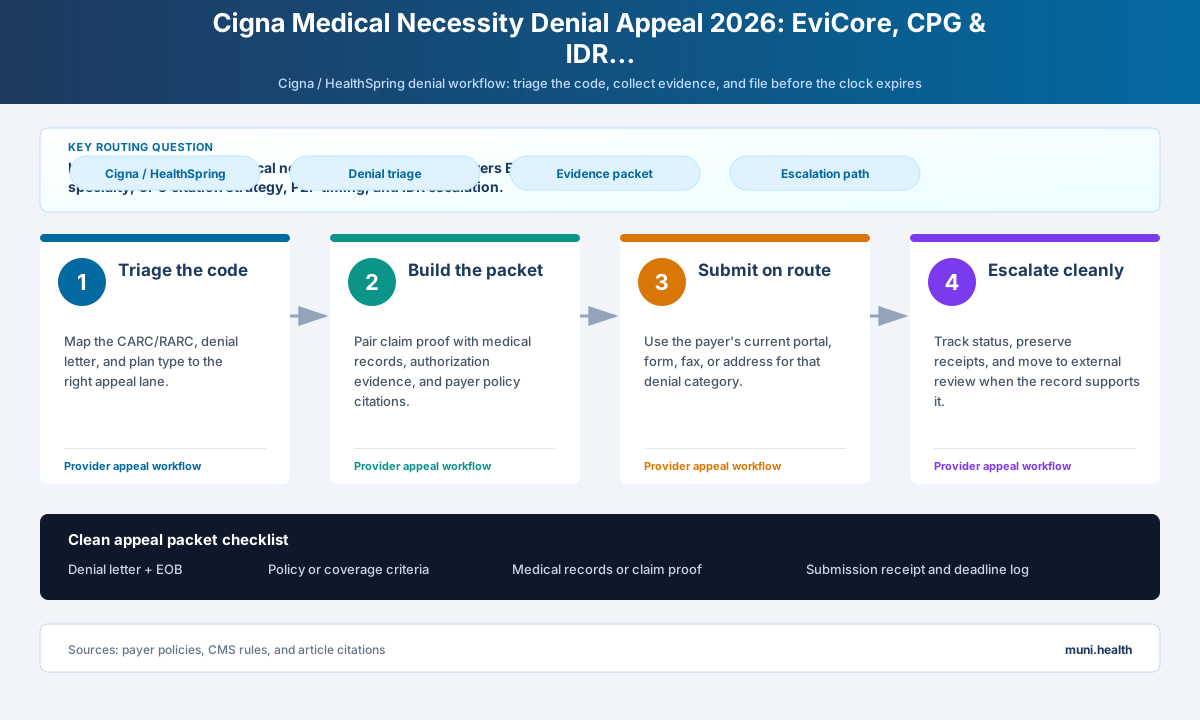
To appeal a Cigna medical necessity denial in 2026, identify the reviewing entity first — EviCore for specialty services (MSK, radiology, oncology, cardiology), HealthSpring for Medicare Advantage PAC, or Cigna's National Appeals Unit for all others. Request a peer-to-peer review within 2 business days. For EviCore denials, the appeal goes to EviCore first, then Cigna. Commercial deadline: 180 days. MA deadline: 60 days. Cite the specific Cigna Coverage Policy Guideline (CPG) number from the denial letter in every written appeal.
Why Cigna Medical Necessity Denials Require a Different Approach
Cigna medical necessity denials are harder to reverse than they look on paper because three different reviewing entities can issue one — and each requires a completely different appeal path, documentation package, and submission address.
The billing teams that win the most Cigna medical necessity appeals share one habit: they read the denial letter before drafting anything. The denial notice identifies the reviewing entity, the specific clinical policy cited, and the exact criterion the service failed to meet. An appeal that ignores any of those details lands in the wrong queue or fails review on first pass.
According to the AMA's 2024 Prior Authorization Physician Survey (n=1,004 physicians), 89% of physicians report that PA requirements delay access to necessary care. For specialty services in particular — the categories Cigna has delegated to EviCore — the documentation standards are stricter than most practices expect.
If you need the Cigna-specific denial letter format and clinical documentation template, see the Cigna medical necessity letter template guide. For a full breakdown of how to identify and route any type of Cigna denial — not just medical necessity — see how to appeal Cigna denials in 2026.
The EviCore vs. Cigna Routing Split: Which Track Are You On?
The most common mistake in Cigna medical necessity appeals is sending an EviCore-issued denial to Cigna's National Appeals Unit. That appeal will be returned unfiled or rejected on procedural grounds — Cigna does not handle EviCore-delegated appeals directly until the EviCore appeal process is exhausted.
EviCore (a Cigna-owned subsidiary operating under Evernorth) manages prior authorization and utilization review for Cigna across a defined set of specialty categories. A denial from EviCore requires:
- A peer-to-peer review request to EviCore within 2 business days of denial
- A formal written appeal submitted to EviCore, not Cigna
- Escalation to Cigna's National Appeals Unit only if EviCore upholds the denial
The denial letter identifies the reviewing entity. If EviCore issued the denial, the letter header will reference EviCore, and the contact information (fax, mailing address, phone number) will point to EviCore, not Cigna.
| Service Category | Reviewing Entity | P2P Contact | Appeal Address | Key Notes |
|---|---|---|---|---|
| Radiology / Diagnostic Imaging (MRI, CT, nuclear imaging) | EviCore | 1-866-668-9250 | EviCore Claim Appeals, P.O. Box 5620, Hartford, CT 06102 | Cite EviCore clinical guidelines + Cigna CPG in appeal |
| Musculoskeletal (MSK) / Spine procedures | EviCore | 1-866-668-9250 | P.O. Box 5620, Hartford, CT 06102 | Effective for most Cigna commercial markets |
| Cardiovascular imaging & procedures | EviCore | 1-866-668-9250 | P.O. Box 5620, Hartford, CT 06102 | Cardiac CT, stress echo, nuclear stress test |
| Oncology | EviCore | 1-866-668-9250 | P.O. Box 5620, Hartford, CT 06102 | Chemotherapy regimen reviews, imaging surveillance |
| Gastroenterology (selected) | EviCore | 1-866-668-9250 | P.O. Box 5620, Hartford, CT 06102 | Colonoscopy frequency, endoscopy indications |
| Genetics / Genomic testing | EviCore | 1-866-668-9250 | P.O. Box 5620, Hartford, CT 06102 | Hereditary cancer panels, pharmacogenomics |
| Sleep medicine (CPAP, sleep studies) | EviCore | 1-866-668-9250 | P.O. Box 5620, Hartford, CT 06102 | CPAP supplies and polysomnography |
| HealthSpring Medicare Advantage | Reviewer named on determination notice; eviCore remains delegated for specified specialties | Per denial letter | HealthSpring appeal form plus denial-notice fax or mail route | Availity payer ID 52192 is for claims and supported PA workflows, not a universal appeal destination |
| All other medical necessity denials | Cigna National Appeals Unit | 1-800-882-4462 (state 'peer-to-peer request') | PO Box 188011, Chattanooga, TN 37422 (GWH-Cigna 'G' IDs: PO Box 188062) | Commercial Cigna routing; confirm the denial notice |
Do Not Cite CPG Policies in EviCore Appeals Alone
EviCore uses its own clinical review guidelines, not Cigna's CPG policies, when evaluating specialty service requests. In an EviCore appeal, cite both the relevant EviCore clinical guideline (available at evicore.com/resources) and the relevant Cigna CPG. Citing only the CPG without addressing the EviCore-specific criteria weakens the appeal on the merits EviCore will actually evaluate.
For the complete EviCore appeal ladder — including formal reconsideration, written appeal timelines, documentation checklist, and how to escalate to Cigna's NAU after EviCore denies — see the Cigna EviCore appeal guide.
Step 1: Request a Peer-to-Peer Review Within 2 Business Days
A peer-to-peer review is the highest-leverage first step for Cigna medical necessity denials. It is a direct call between the ordering physician and the reviewing entity's medical director — not billing staff. Many medical necessity denials are reversed at P2P without requiring a formal written appeal. For a detailed P2P preparation guide across all major payers, see the peer-to-peer review for insurance denials guide.
For EviCore-delegated denials:
Call EviCore's Physician Support line at 1-866-668-9250 (7 a.m.–7 p.m. ET, Monday–Friday). Request a P2P discussion within 2 business days of the denial date. Scheduling and completion typically take 5–7 days. EviCore connects the ordering physician with a medical director from the same specialty — bring the following to the call:
- The EviCore case number from the denial letter
- The specific EviCore clinical criterion cited for denial
- Objective clinical findings that meet the criterion
- Prior treatment history and response
- Relevant peer-reviewed literature (1–2 key citations)
For Cigna direct denials:
Call Cigna Provider Services at 1-800-882-4462 and state "peer-to-peer review request." Request within 2 business days of the denial. The ordering physician must be available to join the call when Cigna schedules it. Same preparation applies: bring the CPG number cited in the denial, the specific criterion failed, and supporting chart documentation.
P2P Doesn't Waive Appeal Rights
Requesting and completing a peer-to-peer review does not waive your right to file a formal written appeal. If the P2P does not resolve the denial, your standard appeal window (180 days commercial, 60 days Medicare Advantage) continues to run from the original denial date.
Step 2: Pull the Relevant Cigna Coverage Policy Guideline
If P2P does not resolve the denial, the written appeal must engage the clinical policy directly. Cigna evaluates medical necessity against its own Coverage Policy Guidelines (CPGs) — not InterQual, not MCG alone for most specialties.
Where to find Cigna CPGs:
The public policy index is at static.cigna.com/assets/chcp/resourceLibrary/coveragePolicies/index.html. No login is required. Policies are organized by category and named with a series prefix:
- CPG_xxxx series: standard clinical coverage policies
- MM_xxxx series: medical management policies (inpatient and post-acute)
- EviCore guidelines: available at evicore.com/resources — look for the Cigna-specific clinical content library
The denial letter must reference a specific policy. If it does not (which violates CMS-0057-F for Medicare Advantage plans effective January 1, 2026), note that omission in your appeal letter — it is a procedural deficiency that supports your argument.
How to use the CPG in your appeal:
- Pull the specific policy cited in the denial
- Identify which of Cigna's six medical necessity criteria your service failed (the denial notice should specify)
- Build your appeal argument around each criterion, citing objective clinical data that meets the standard
- If the policy itself is outdated relative to current clinical guidelines, cite the updated professional society guideline by name, year, and recommendation level
Cigna's six medical necessity criteria require the service to be:
- Appropriate for evaluating, diagnosing, or treating an illness, injury, or disease
- In accordance with generally accepted standards of medical practice
- Clinically appropriate in type, frequency, extent, site, and duration
- Considered effective for the patient's condition
- Not primarily for patient, provider, or facility convenience
- Not more costly than an alternative service producing equivalent results
An appeal that addresses all six criteria, with clinical documentation supporting each, significantly outperforms boilerplate letters that restate the clinical summary without engaging the policy.
Step 3: Submit the Formal Written Appeal
If P2P fails or the window has passed, submit a written appeal to the correct entity.
Commercial plan appeals (EviCore denials):
- Deadline: 180 calendar days from the denial date (check your Cigna contract, which may specify a shorter window)
- Submit to: EviCore Claim Appeals, P.O. Box 5620, Hartford, CT 06102
- Decision timeline: 30 days (standard); 72 hours (expedited/urgent)
- What to include: denial letter, completed clinical documentation, CPG policy reference, EviCore clinical guideline reference, peer-reviewed literature, signed physician attestation
Commercial plan appeals (Cigna direct denials):
- Deadline: 180 calendar days from the denial date
- Submit to: Cigna National Appeals Unit, PO Box 188011, Chattanooga, TN 37422 (GWH-Cigna "G" ID plans: PO Box 188062)
- Online portal: cignaforhcp.cigna.com (provider portal login required)
- Decision timeline: 30 days (standard); 72 hours (expedited)
Medicare Advantage (HealthSpring) appeals:
- Deadline: 60 days from the denial notice
- Submit to: The fax or mailing destination on the HealthSpring denial notice, using the applicable HealthSpring appeal form
- Decision timeline: 30 days (standard); 72 hours (expedited)
- CMS-0057-F compliance note: Effective January 1, 2026, all HealthSpring/Cigna MA denials must include patient-specific clinical reasons. If your denial contains only a policy code without a clinical rationale tied to your patient, cite this deficiency in your appeal — it is a ground for reversal.
| Appeal Track | Deadline | Submit To | Standard Decision | Expedited Decision |
|---|---|---|---|---|
| Cigna Commercial (EviCore denial) | 180 days from denial | EviCore, P.O. Box 5620, Hartford CT 06102 | 30 days | 72 hours |
| Cigna Commercial (Cigna direct denial) | 180 days from denial | PO Box 188011, Chattanooga, TN 37422 | 30 days | 72 hours |
| HealthSpring Medicare Advantage | 60 days from denial | HealthSpring appeal form plus denial-notice fax or mail route | 30 days | 72 hours |
| EviCore escalation to Cigna (after EviCore appeal denied) | Per Cigna contract — typically 180 days from original denial | PO Box 188011, Chattanooga, TN 37422 | 30 days | 72 hours |
Step 4: Escalate to External Review or IDR If Internal Appeal Fails
If Cigna upholds the denial after the internal appeal, you have two escalation paths depending on the plan type.
State External Review (for fully-insured commercial plans)
Fully-insured commercial Cigna plans are subject to state insurance department oversight. If the internal appeal is denied and the denial involves medical necessity, experimental treatment, or a clinical coverage decision, you or the member may request an Independent Review Organization (IRO) review. The denial letter must include information on how to request external review under state law.
Key points:
- The member (patient) typically initiates external review, not the provider
- Deadlines vary by state but are commonly 60–120 days from the final internal denial
- The IRO decision is binding on the health plan
- 46 states plus DC follow NAIC model external review laws as incorporated in the ACA
For a guide to the external review process by state, see the independent review organization appeal guide. For a triage guide on what to do when a Cigna claim is denied and you're deciding between resubmission, corrected claim, and formal appeal, see the Cigna denied claim guide.
Federal IDR (for self-funded ERISA plans)
Self-funded employer plans — which cover the majority of commercially insured workers — are exempt from state insurance regulation under ERISA. The primary recourse after an internal Cigna denial is:
- Voluntary claims and appeals procedures under ERISA (29 CFR §2560.503-1): the standard 180-day deadline and 60-day decision apply
- Federal court litigation if the plan-level appeal is denied (costly, rarely practical for individual claims)
- No Surprises Act Federal IDR — applicable only to billing disputes for out-of-network services, not to medical necessity disputes for in-network care
No Surprises Act IDR Does Not Cover Medical Necessity Disputes
Federal IDR under the No Surprises Act resolves out-of-network billing disputes, not medical necessity denials for in-network services. If your Cigna medical necessity denial involves in-network care, federal IDR is not available as an escalation path. For self-funded ERISA plans, exhausting internal appeals before pursuing legal remedies remains the practical path.
Medicare Advantage: CMS Level 3 and Above
For Cigna Medicare Advantage (HealthSpring) medical necessity denials that survive internal appeal:
- Level 3: Request review by a Qualified Independent Contractor (QIC) — submit within 60 days of the Level 2 decision
- Level 4: Administrative Law Judge (ALJ) hearing — amounts in controversy threshold required ($200 for CY 2026)
- Level 5: Medicare Appeals Council (MAC) review
- Level 6: Federal district court
The five-level MA appeal ladder is slow, but ALJ overturn rates for MA medical necessity denials have historically been above 50% according to the Office of Medicare Hearings and Appeals (OMHA) annual report (fiscal year 2024 data).
Prepare this appeal packet with your team.
Draft the appeal, coordinate missing documents, and approve the reviewed packet. Keep your clearinghouse; your practice checks deadlines and submits through the payer’s accepted channel.
First 3 appeals free, then $20 per appeal. Start with your denial letter or EOB and available records. No meeting or clearinghouse connection required.
How to Cite Cigna CPGs Effectively in Medical Necessity Appeals
The clinical argument is the appeal. Every other element — the format, the deadline, the submission method — is process. The clinical argument wins or loses based on how directly it engages the specific criterion Cigna cited for denial.
Effective CPG citation pattern:
Cigna Coverage Policy Guideline [CPG_XXXX / MM_XXXX], effective [date], requires
[specific criterion language quoted verbatim from the policy]. The patient meets this
criterion based on [objective clinical finding], as documented in [chart note date].
[Clinical guideline or study] (published [year], [society/journal]) supports this
treatment approach for patients with [diagnosis] who have [clinical characteristic].
What weakens CPG-based appeals:
- Paraphrasing the criterion instead of quoting it (opens room for interpretation)
- Describing treatment without connecting it to each criterion
- Citing a guideline that Cigna's policy already references as a denial basis
- Omitting prior treatment history when the criterion requires it (step therapy, trial-and-fail)
Policy currency matters: Cigna updates CPGs monthly. If your denial cites a policy that has been updated since the date of service, check whether the updated version is more favorable to the patient's clinical situation. Note any policy changes in your appeal letter.
Cigna-Specific Documentation Checklist for Medical Necessity Appeals
| Document | Purpose | Notes |
|---|---|---|
| Original denial letter | Identifies reviewing entity, CPG cited, criterion failed | Required — defines the appeal argument |
| Complete chart notes for DOS | Demonstrates clinical presentation meeting CPG criteria | Include objective findings, not just diagnosis codes |
| Prior treatment history (with dates and outcomes) | Required for step-therapy and clinical appropriateness criteria | Even if payer has records — restating in appeal improves case |
| Cigna CPG referenced in denial | Framework for clinical argument | Pull from static.cigna.com policy index |
| EviCore clinical guideline (for delegated denials) | EviCore evaluates against its own criteria, not just CPG | Pull from evicore.com/resources |
| Peer-reviewed clinical literature | Supports 'generally accepted standards' criterion | Use within last 5 years; cite by author, journal, year, PMID |
| Professional society guideline | Supports 'generally accepted standards' criterion | AMA, ACS, ACC, AAOS, NCCN, etc. — include year and recommendation grade |
| Physician attestation letter | Ties clinical findings to CPG criteria explicitly | Must be signed by ordering physician, not billing staff |
| Prior authorization approval history (if any) | Shows payer previously authorized the same service | Helpful for recurring denials where prior auth was obtained before |
| CMS-0057-F non-compliance note (MA only) | Grounds for reversal if denial lacks patient-specific clinical reasons | Cite 42 CFR §422.568(d) and the January 2026 effective date |
Frequently Asked Questions
How long do I have to appeal a Cigna medical necessity denial?
For commercial plans, you have 180 calendar days from the denial date to file a written appeal. For Medicare Advantage (HealthSpring) plans, the deadline is 60 days. These are the minimum windows — your Cigna provider contract may specify a shorter deadline. Always check the denial letter, which must state the appeal deadline.
What's the difference between an EviCore denial and a Cigna denial?
EviCore is a Cigna-owned company that handles prior authorization and utilization management for specialty services on Cigna's behalf. EviCore denials come from EviCore's medical directors and cite EviCore clinical guidelines, not just Cigna CPGs. The appeal for an EviCore denial goes to EviCore first, then to Cigna's National Appeals Unit if EviCore upholds it. Sending an EviCore appeal to the Cigna address gets it returned or rejected without a merits review.
What is a Cigna CPG and where do I find it?
CPG stands for Coverage Policy Guideline — Cigna's internal clinical policy library. They serve the same function as InterQual criteria at UHC or clinical policy bulletins at other payers. You can find the public index at static.cigna.com/assets/chcp/resourceLibrary/coveragePolicies/index.html. The denial letter should reference the specific CPG number. If it doesn't — and you're appealing a Medicare Advantage denial after January 1, 2026 — note the omission in your appeal letter as a CMS-0057-F violation.
Can billing staff request a peer-to-peer review?
No. The peer-to-peer review requires the ordering physician to participate in the call with the Cigna or EviCore medical director. Billing staff can schedule the call and prepare the documentation, but the physician must be available when the call occurs. Using the wrong contact or having a non-physician respond will result in the P2P being declined.
What should I do if Cigna denies the appeal but the treatment has already been provided?
If the service has already been provided and Cigna denies the appeal, the options are: (1) request external review through the state DOI if it's a fully insured commercial plan; (2) file a grievance through the applicable appeals process; (3) contact the patient's employer if it's a self-funded ERISA plan, since plan documents sometimes contain specific appeals procedures. For Medicare Advantage, proceed up the five-level CMS appeal ladder.
Does CMS-0057-F apply to Cigna commercial plans?
No. CMS-0057-F (effective January 1, 2026) applies to Medicare Advantage, Medicaid managed care, CHIP, and ACA marketplace plans. It does not apply to commercial employer-sponsored plans regulated under ERISA. For commercial plans, the ERISA claims procedure regulation (29 CFR §2560.503-1) and your Cigna provider contract govern timelines and denial notice requirements.
When does Cigna's medical necessity standard require prior treatment failure?
Cigna's criterion for "clinically appropriate in type, frequency, extent, site, and duration" frequently incorporates step therapy requirements in specialty categories — particularly MSK procedures, behavioral health, and certain medications. The relevant CPG will specify whether prior treatment trials are required. If the CPG cites MCG Care Guidelines (29th Edition, 2025) as supplementary criteria, check those as well. Document the prior treatment history in your appeal even if not explicitly required — it strengthens the "clinically appropriate" argument.
How do I appeal a Cigna medical necessity denial for a Medicare Advantage member after the MA transition to HealthSpring?
Health Care Service Corporation (HCSC) acquired the former Cigna Medicare Advantage business and now operates it as HealthSpring. HealthSpring still delegates specified specialty PA categories to eviCore, so confirm the reviewer on the denial notice. File the appeal with the applicable HealthSpring form using the notice's fax or mailing instructions; Availity payer ID 52192 is for electronic claims and supported PA workflows, not a universal appeal route. The CMS five-level MA appeal ladder remains the same. For a detailed guide, see how to appeal Medicare Advantage denials.
Ready to Stop Losing Cigna Medical Necessity Denials?
Cigna medical necessity denials are winnable when the appeal engages the right reviewing entity, cites the correct CPG directly, and reaches the correct address by the correct deadline. Most practices lose these appeals before the clinical argument is ever reviewed — because of routing errors, missed deadlines, or letters that don't address the specific criterion Cigna cited.
Muni Appeals uses the uploaded denial to surface likely reviewing-entity context, candidate coverage-policy references, an evidence checklist, and deadline risk. Billing staff verifies the current EviCore, HealthSpring, or Cigna National Appeals Unit route and calendars the deadline.
Start 3 Free Appeals:
- Likely EviCore, Cigna, or HealthSpring context for staff verification
- CPG and EviCore clinical guideline matching per denial
- Deadline-risk guidance across commercial, MA, and state-specific external-review windows
- Peer-to-peer scheduling coordination for ordering physicians
This guide reflects the Cigna and CMS sources reviewed as of May 2026. Procedures vary by plan type, state, and employer contract. Verify current payer instructions and controlling rules before filing.