

When Humana denies a claim, start with your Explanation of Benefits to identify the denial type: medical necessity (CO-50), prior authorization (CO-197), timely filing (CO-29), or coding (CO-97, CO-16). Each requires a different action path. Medicare Advantage reconsiderations are due within 60 days after you receive the denial — effectively 65 days from the notice date, since receipt is presumed 5 days after it. Commercial deadlines depend on the plan and your contract; the denial notice states the window. Submit through Resolutions.Humana.com or mail to Humana Grievances and Appeals, P.O. Box 14546, Lexington, KY 40512-4546. For expedited MA review, call 800-867-6601.
Key statistic
Humana denied 5.8% of Medicare Advantage prior authorization requests in 2024 — below the MA average. Across all MA insurers that year, only 11.5% of denied requests were appealed, and 80.7% of appealed denials were partially or fully overturned (KFF analysis of CMS Medicare Advantage data). KFF does not publish a Humana-specific overturn rate.
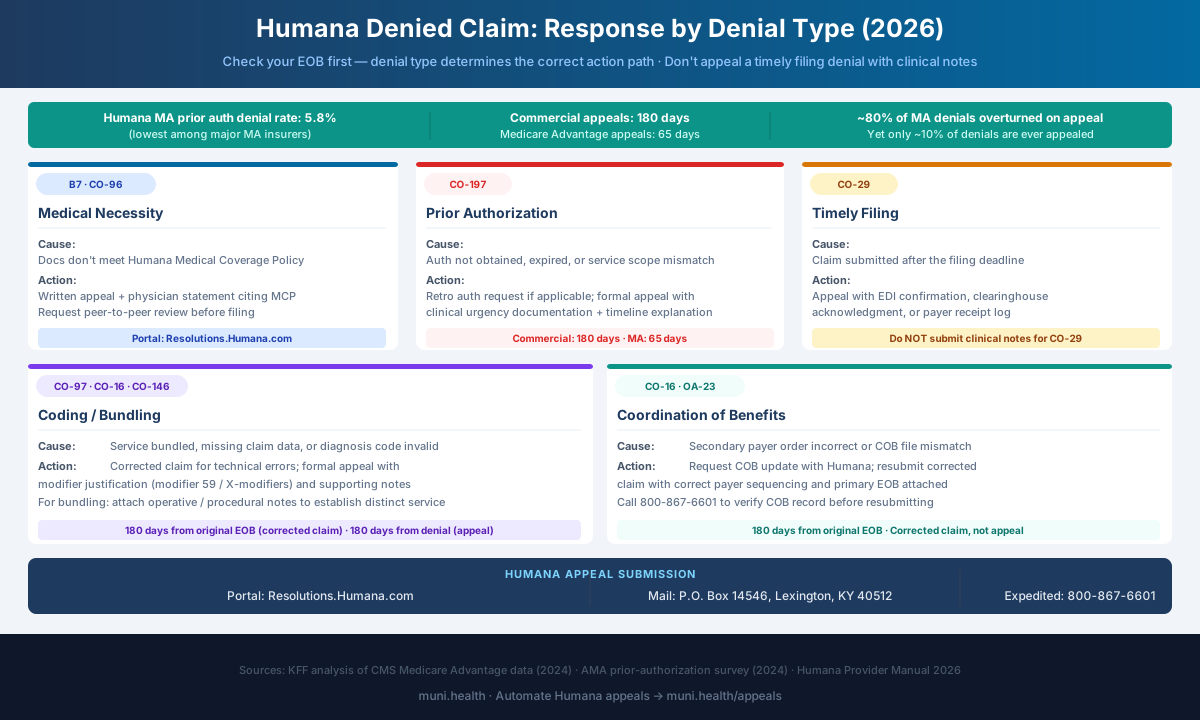
Why Humana Denials Require a Type-Specific Response
Humana is the second-largest Medicare Advantage insurer in the country, and most of its medical membership is in Medicare Advantage. For most independent practices, that means Humana denials are concentrated in the Medicare Advantage population — where federal Part C appeal rules and CMS-mandated decision timelines apply differently than they do for commercial plans.
A frequent billing-team mistake is treating all Humana denials the same — filing a medical necessity appeal on what is actually a timely filing denial, or submitting a corrected claim when a formal appeal is required. Each denial type has a specific cause, a specific fix, and a specific submission path.
For how Humana's denial rates compare to other major insurers, see the insurance denial rate by company guide. For a complete walkthrough of Humana's appeal process — including delegated specialty-review routing, Medical Coverage Policy citations, and the Medicare Advantage appeal ladder — see the step-by-step Humana appeal guide.
The Humana Denial Categories (and What Each Requires)
| Denial Category | Common Codes | Primary Cause | Appeal Path | Deadline |
|---|---|---|---|---|
| Medical Necessity | CO-50 | Documentation doesn't meet Humana Medical Coverage Policy criteria | Written appeal with clinical records + physician statement citing Medical Coverage Policy; peer-to-peer review recommended before written submission | Commercial: per denial notice; MA: 60 days after receipt of notice |
| Prior Authorization | CO-197 | Auth not obtained, expired, or service differed from authorized scope | Retro auth request if applicable; formal appeal with clinical urgency documentation and timeline explanation | Commercial: per denial notice; MA: 60 days after receipt |
| Timely Filing | CO-29 | Claim submitted after the filing deadline | Appeal with proof of timely submission: EDI confirmation, clearinghouse acknowledgment, payer receipt log | Commercial: per denial notice and contract; MA: 60 days after receipt |
| Coding / Bundling | CO-97, CO-16, CO-146 | Service bundled, missing claim data, or diagnosis code invalid | Corrected claim resubmission or written appeal with modifier justification and supporting documentation | Corrected claim and appeal windows per contract and denial notice |
| Non-Covered / Experimental | CO-96, PR-96 | Service not in plan benefits or classified investigational by Humana Medical Coverage Policy | Formal appeal with peer-reviewed literature, specialty guidelines, and FDA approval where applicable; external review if eligible | Commercial: per denial notice; MA: 60 days after receipt |
| Coordination of Benefits | CO-22, OA-23 | Secondary payer order incorrect or COB file mismatch | Request COB update; resubmit corrected claim with correct payer sequencing | Per contract |
Step 1: Read the EOB Before Doing Anything Else
Every Humana Explanation of Benefits contains the information you need to route the denial correctly:
- Claim Adjustment Reason Code (CARC) — the primary code explaining the denial
- Remittance Advice Remark Code (RARC) — additional context (often specifies which Medical Coverage Policy applies or what documentation is missing)
- Group code — tells you who is financially responsible: CO (contractual obligation) vs. PR (patient responsibility) vs. OA (other)
- Appeal deadline — stated on the EOB or denial notice; confirm it against your Humana contract rather than a general assumption
- Submission address — the mailing address or portal instructions for the appeal
Group Code Matters Before You Bill the Patient
If the group code is CO (Contractual Obligation), you cannot bill the patient for that amount — it is a contractual write-off. If it is PR (Patient Responsibility), the patient share is billable. Confusing these can breach your network contract or state and federal balance-billing protections. Verify the group code before any patient communication.
Step 2: Match the Denial to Its Action Path
Medical Necessity Denials (CO-50)
A medical necessity denial means Humana's review determined that documentation did not establish the service was clinically appropriate under the applicable Humana Medical Coverage Policy.
Immediate actions:
- Identify which Humana Medical Coverage Policy was applied. It should be referenced in the denial letter or RARC. Humana's Medical Coverage Policies are published at humana.com/medicalpolicies.
- Compare your clinical documentation against the specific policy criteria line by line. Identify exactly which criteria are unmet or undocumented in the current file.
- Request a peer-to-peer review before filing the written appeal. Call the Humana Clinical Review line listed on your EOB and ask to speak with a medical director. The treating or ordering physician — not billing staff — must make this call.
- If peer-to-peer does not result in reversal, file a formal written appeal through Resolutions.Humana.com or by mail, attaching the clinical records, a physician narrative letter, and direct citations to the Medical Coverage Policy criteria. The letter template after Step 2 gives you the structure.
For a complete appeal letter structure and Medical Coverage Policy citation strategy, see the Humana medical necessity letter guide.
Delegated Specialty Denials May Follow a Different Path
Humana delegates review of some specialty services to outside vendors. If the denial letter names a review organization other than Humana, follow that letter's peer-to-peer and appeal instructions — sending the appeal to the wrong entity delays it and does not pause your deadline.
Prior Authorization Denials (CO-197)
CO-197 means Humana is denying because either: (a) no prior authorization was obtained before the service, (b) authorization was obtained but the service date or service rendered differed from what was authorized, or (c) authorization expired before the service was rendered.
Immediate actions:
- Check whether Humana allows retroactive authorization for the specific service. For true emergencies and certain urgent situations, retro auth is available — submit with clinical urgency documentation explaining why PA could not be obtained in advance.
- Confirm whether the authorization number and CPT code on file match the service rendered. A code mismatch between the authorized procedure and the billed procedure is a common CO-197 trigger that can be resolved through clarification rather than a full appeal.
- If neither retro auth nor code correction resolves it, file a formal appeal documenting the clinical rationale and any barriers to obtaining authorization before service.
2026: Humana Has Reduced PA Requirements
Humana committed to remove approximately one-third of prior authorizations for outpatient services by January 1, 2026, including diagnostic colonoscopies, transthoracic echocardiograms, and select CT scans and MRIs. If you received a CO-197 denial on a service that is no longer on Humana's PA list, cite the current PAL (Prior Authorization and Notification List) in your appeal. Verify the current list at humana.com/PAL or by calling Customer Care at 800-457-4708.
For complete documentation requirements and prior auth appeal templates, see the Humana prior authorization guide.
Timely Filing Denials (CO-29)
Humana issues CO-29 denials when a claim is submitted after the timely filing deadline. The filing windows vary significantly by plan type:
- Medicare Advantage: 365 days from the date of service to submit the initial claim
- Commercial/Employer Plans: 90 days from date of service (default; contract may extend)
For a complete breakdown of Humana timely filing windows by plan type — including Medicaid, MA, legacy commercial, and COB exception scenarios — see the Humana timely filing limits guide 2026.
The key point: A timely filing appeal is not a clinical appeal. You are proving the claim was submitted on time. The denial is reversible if you can document the submission date.
Immediate actions:
- Pull your EDI/clearinghouse submission log showing the date the claim was sent.
- Obtain the payer acknowledgment (the 277CA claim acknowledgment, not just the 999 file-level receipt) confirming Humana accepted the claim.
- If the claim was rejected before acceptance (not denied after receipt), confirm whether the rejection date counts as timely — it typically does not unless the rejection was Humana's error.
- Submit the appeal with timestamped clearinghouse logs, payer acknowledgment, and if applicable, documentation of a payer-side error that caused the delay.
Timely Filing Is Rarely Recoverable Without Proof
Humana does not grant timely filing exceptions based on verbal explanations. You need documentary evidence — a clearinghouse submission timestamp or EDI acknowledgment. If your practice management system cannot produce this, the denial is extremely difficult to overturn.
Coding and Bundling Denials (CO-97, CO-16, CO-146)
These denials are about how the claim was submitted, not the clinical appropriateness of the service.
CO-97 — Bundling / Inclusive Service: Humana's claim system is saying the service billed is included in the payment for another service already processed. Common fix: add the appropriate modifier (59, XE, XS, XP, XU; or 25 for a significant, separately identifiable E/M) to document that the service is separately payable. If the services were genuinely distinct, include clinical notes documenting each service as separate in the appeal.
CO-16 — Missing or Invalid Claim Information: Common causes include a missing referring physician NPI, incomplete diagnosis linkage, or a COB dispute. Identify the missing field from the RARC and resubmit a corrected claim. Most CO-16 denials are resolved through corrected claim resubmission rather than a formal appeal.
CO-146 — Diagnosis Code Invalid: The ICD-10 code on the claim is not valid for the date of service or does not support the procedure billed. Verify the correct ICD-10 for the service date and resubmit. If the diagnosis is clinically accurate and documented, include a physician attestation with the corrected claim.
Humana Denied-Claim Appeal Letter Template
Use this letter for a Humana reconsideration or formal appeal. Fill in the section that matches the denial code on the EOB and delete the others. For Medicare Advantage, calendar 65 days from the date on the denial notice and submit well before then — the request counts as filed when Humana receives it.
[Date]

Humana Grievances and Appeals
P.O. Box 14546
Lexington, KY 40512-4546
[Or submitted via Resolutions.Humana.com — or the review organization and route named on the denial letter]

RE: [Reconsideration / Formal Appeal] — Denied Claim
Member Name: [Patient Full Name]
Humana Member ID: [ID from member card]
Date of Birth: [MM/DD/YYYY]
Plan Type: [Medicare Advantage / Part D / Commercial / Medicaid]
Claim Number: [Claim # from EOB]
Date(s) of Service: [MM/DD/YYYY]
Denial Notice Date: [MM/DD/YYYY]
Denial Code(s): [CARC / RARC from EOB]
Authorization / Reference #: [If applicable]
Billing Provider / NPI / TIN: [Practice Name / NPI / TIN]

To the Humana Appeals Reviewer:

We request [reconsideration / appeal] of the denial of the claim above, issued under code [CARC]. The denial should be reversed for the reasons below.

--- USE THE ONE SECTION THAT MATCHES YOUR DENIAL ---

[A] MEDICAL NECESSITY (CO-50)
The denial applied Humana Medical Coverage Policy "[policy title]" (last reviewed [date]). The patient meets each criterion:
- Criterion: "[quote policy language]" — Met by: [clinical finding, date, record page]
- Criterion: "[quote policy language]" — Met by: [clinical finding, date, record page]
[Peer-to-peer requested on [date] with [reviewer]; outcome: [result / not granted].]

[B] PRIOR AUTHORIZATION (CO-197)
[Authorization [#] covered CPT [code], [units], [dates], and the billed service falls within it. / The service does not require prior authorization under Humana's current Prior Authorization and Notification List (PAL), effective [date]. / Authorization could not be obtained before service because [clinical urgency], documented in the attached records.]

[C] TIMELY FILING (CO-29)
The claim was originally submitted on [date], within the filing limit for this plan. The attached clearinghouse acceptance report shows transaction [ID] accepted on [date].

[D] CODING / BUNDLING (CO-97 / CO-16 / CO-146)
[CPT [code 1] and CPT [code 2] were distinct services ([separate encounter / site / practitioner]); modifier [59 / XE / XS / XP / XU] is supported by the attached notes. / The missing or invalid information is corrected here: ___.]

[E] NON-COVERED / EXPERIMENTAL (CO-96)
[Service] is not investigational for this indication: [FDA approval / clearance, date]; [specialty society guideline, year]; [peer-reviewed studies, cited]. [If Medicare Advantage: the service is covered under Traditional Medicare per [NCD / LCD number].]

--- END SECTION ---

Requested action: Reverse the denial and reprocess the claim for [CPT codes / billed amount].

Enclosures:
1. Copy of EOB / denial notice
2. [Clinical records / progress notes, dates]
3. [Authorization record / PAL excerpt / clearinghouse report — as applicable]
4. [Physician letter of medical necessity — clinical denials]

Please contact [Name] at [Phone] or [Email] with questions.

Sincerely,

[Name, Credentials]
[Practice Name] | NPI: [NPI]
Skip the blank template. Start with a review-ready draft.
Use the template as guidance, or let Muni prepare a payer-specific draft for your team to verify, sign, and submit.
First 3 appeals free, then $20 per appeal. Start with your denial letter or EOB and available records. No meeting or clearinghouse connection required.
For a letter built entirely around a Humana Medical Coverage Policy, use the Humana medical necessity letter template instead.
Step 3: Choose Between Corrected Claim, Reconsideration, or Formal Appeal
Not every Humana denial requires a formal written appeal. Understanding the correct route saves time and preserves deadlines:
| Route | When to Use | How to Submit | Typical Resolution Time |
|---|---|---|---|
| Corrected Claim Resubmission | Coding error, missing data, wrong billed amount — not a clinical decision | Resubmit via clearinghouse or Availity with corrected data; use claim frequency code 7 (replacement) | Varies |
| Reconsideration (Informal Dispute) | Payment disagreement, contractual dispute, claim processing error — not a clinical denial | Resolutions.Humana.com → Reconsideration; or call Customer Care 800-457-4708 | Varies by plan |
| Formal First-Level Appeal | Medical necessity, prior auth, experimental/investigational, or reconsideration denial | Resolutions.Humana.com → Appeals; or mail to P.O. Box 14546, Lexington, KY 40512-4546 | MA reconsideration: 30 days pre-service, 60 days payment, 72 hours expedited; commercial per plan |
| External / Independent Review | After internal appeal exhausted; eligible medical necessity or experimental denial | Request through Humana after final internal denial; or state external review per your state | 45 days (standard federal external review) |
Step 4: Submit the Appeal Correctly
Via Resolutions.Humana.com (Preferred)
Humana's provider appeal portal is Resolutions.Humana.com. It is the preferred submission channel for both reconsiderations and formal appeals across commercial and Medicare Advantage plans.
- Navigate to Resolutions.Humana.com
- Select the claim and choose Reconsideration or Appeal
- Upload all supporting documentation in the portal
- Save the confirmation number — this is your proof of submission date and starts the decision clock
Alternatively, many practices submit through Availity Essentials at availity.com → Claims & Payments → Disputes & Appeals → select Humana as the payer.
By Mail
All plan types: Humana Grievances and Appeals P.O. Box 14546 Lexington, KY 40512-4546
Always use certified mail with return receipt for paper appeals — do not use standard first-class mail for a deadline-sensitive submission.
Expedited Appeal (Medicare Advantage)
For urgent clinical situations where the standard timeline could seriously jeopardize the patient's health, request an expedited review:
- Call 800-867-6601 to request expedited MA appeal processing
- Expedited reviews must be decided within 72 hours
- The treating physician must document why the standard timeline would seriously jeopardize the patient's health
For a complete Humana appeal letter structure, see the Humana appeal letter template.
Step 5: Know Your Deadlines by Plan Type
| Plan Type | Appeal Filing Deadline | Decision Timeline | Next Step After Denial |
|---|---|---|---|
| Commercial (fully insured) | Member appeals: 180 days (federal minimum); provider disputes: per contract | 30 days pre-service; 60 days post-service | External independent review if eligible |
| Medicare Advantage (standard) | 60 days after receipt of notice (≈65 days from notice date) | 30 days pre-service; 60 days payment | IRE review — Humana must forward automatically if it upholds the denial or misses the deadline |
| Medicare Advantage (expedited) | No separate window — request at Level 1 | 72 hours | Expedited IRE if Humana denies |
| Medicare Part D | Per the coverage determination notice | 7 calendar days (standard redetermination) | IRE reconsideration at Level 2 |
| Medicaid Managed Care | 60 days (state-specific) | 30 days standard; 72 hours expedited | State Medicaid fair hearing |
Prepare this appeal packet with your team.
Draft the appeal, coordinate missing documents, and approve the reviewed packet. Keep your clearinghouse; your practice checks deadlines and submits through the payer’s accepted channel.
First 3 appeals free, then $20 per appeal. Start with your denial letter or EOB and available records. No meeting or clearinghouse connection required.
Medicare Advantage: Calendar the Deadline From the Notice Date
A Medicare Advantage reconsideration must be filed within 60 calendar days after receipt of the denial notice, and receipt is presumed to be 5 calendar days after the notice date (42 CFR 422.582) — so count 65 calendar days from the date on the notice. The request counts as filed when Humana receives it, not when you mail it. A late request is dismissed unless Humana grants a good-cause extension, so do not plan around one.
For a full breakdown of how Humana's deadlines compare across all major insurers, see the insurance appeal deadlines guide.
2026 Humana Updates That Affect Denial and Appeal Decisions
Prior Authorization Reductions (January 1, 2026) Humana committed to remove approximately one-third of outpatient prior authorizations by January 1, 2026, including diagnostic colonoscopies, transthoracic echocardiograms, and select CT scans and MRIs. If you receive a CO-197 denial on a service that is no longer on the list, cite the current Humana PAL directly in the appeal letter.
Gold Card Program Humana said it would launch a gold card program in 2026 that waives prior authorization for certain services for providers whose requests consistently meet medical criteria. Gold card providers have PA requirements waived for eligible services. Contact your Humana provider relations representative or Customer Care at 800-457-4708 to confirm gold card eligibility and which services are covered.
CMS-0057-F: MA Prior Authorization Decision Timelines (January 1, 2026) Under the CMS Interoperability and Prior Authorization Final Rule (CMS-0057-F), Humana Medicare Advantage plans must issue PA decisions within 7 calendar days (standard) and 72 hours (expedited). If Humana misses one of these deadlines, the missed deadline itself counts as an adverse organization determination that you can appeal (42 CFR 422.568(f)).
AI-Driven Denials If a denial reads as templated — standardized language with no rationale tied to your patient's record — say so in the appeal. For Medicare Advantage, CMS's February 6, 2024 FAQ memo requires medical necessity decisions to be based on the individual patient's circumstances, even when an algorithm assists. For documentation and escalation strategies specific to algorithm-generated denials, see the guide to fighting AI insurance denials.
What Increases Your Appeal Success Rate
Match documentation to the Medical Coverage Policy, not just the chart. Humana reviewers evaluate your submission against specific Medical Coverage Policy criteria. Appeals fail when documentation doesn't address the exact policy criteria — not because the treatment was inappropriate. Download the applicable policy from humana.com/medicalpolicies and map your clinical documentation to it criterion by criterion.
Request peer-to-peer review before the written appeal. The treating physician calls Humana's medical director line (listed on the denial letter) to discuss the case directly. Billing staff cannot initiate a peer-to-peer — this requires the ordering or treating physician. It is most worth the physician's time on high-dollar or time-sensitive denials.
Front-load your strongest evidence. Put the physician letter, Medical Coverage Policy criteria map, and key clinical findings at the front of your submission — before bulk chart records. A reviewer should be able to see why the criteria are met without paging through the full chart.
Use specialty society guidelines as corroborating support. When the Medical Coverage Policy criteria are met, adding AMA, ACC, AAOS, or other specialty society guidelines as secondary support strengthens the file and preempts the "investigational" objection.
Track deadlines at the claim level. Build deadline alerts into your practice management system keyed to the actual denial date on each EOB. Missing one deadline — especially on a Medicare Advantage claim — forecloses the appeal chain permanently.
Medicare Advantage Appeals: The 5-Level Federal Chain
Medicare Advantage denials have a federally mandated multi-level appeal process distinct from commercial appeals. For Humana MA, the escalation chain is:
- Level 1 — Reconsideration (within Humana): 60 days after receipt of the notice (≈65 days from the notice date); decision within 30 days pre-service or 60 days for payment
- Level 2 — IRE (Independent Review Entity): Humana must forward the case automatically if it upholds the denial in whole or part, or misses the reconsideration deadline
- Level 3 — ALJ Hearing: Available when the amount in controversy reaches the CMS threshold ($200 for 2026)
- Level 4 — Departmental Appeals Board: Review of ALJ decision
- Level 5 — Federal District Court: Available when the amount exceeds the CMS federal court threshold ($1,960 for 2026)
For a complete guide to external appeal processes across insurers, see the independent review organization appeal guide and the prior authorization denial complete guide.
Frequently Asked Questions
How long do I have to appeal a Humana denial?
For Medicare Advantage, 60 calendar days after receipt of the denial notice — receipt is presumed 5 days after the notice date, so count 65 days from the date on the notice (42 CFR 422.582). For Part D, use the deadline on the coverage determination notice. For commercial fully insured plans, members get at least 180 days under federal rules, and provider disputes follow your contract. For Medicaid managed care, federal rules allow 60 days from the adverse benefit determination — verify with your state-specific Humana Medicaid manual. Check your specific provider contract rather than relying on general standards, as contract-specific windows can differ.
Can I resubmit a corrected claim instead of filing an appeal?
Yes, for denials caused by coding errors, missing data, or incorrect billing amounts — not for medical necessity or prior auth clinical decisions. Resubmit via your clearinghouse or Availity with the corrected information. For clinical denials, a formal appeal is required; corrected claim resubmission on a medical necessity denial will typically be denied again without review.
What is the difference between a Humana reconsideration and a formal appeal?
A reconsideration (informal dispute) is for payment disagreements, contractual disputes, and claim processing errors — not clinical decisions. A formal appeal is for adverse clinical decisions: medical necessity, prior authorization, and experimental/investigational denials. Miscategorizing the route delays resolution and consumes your filing deadline.
Does Humana have a peer-to-peer review process for denied claims?
Yes. Humana allows peer-to-peer reviews on medical necessity denials before or after the formal written appeal is submitted. The treating or ordering physician must call — billing staff cannot initiate a P2P. The phone number for Humana's Clinical Review team is on the denial letter. Request the call promptly after receiving a medical necessity denial; some Humana lines have limited P2P availability windows.
What if Humana denies my internal appeal?
For Medicare Advantage, if Humana upholds its denial at reconsideration, it must automatically forward the case to the federally contracted Independent Review Entity (IRE) — you do not need to separately initiate this. For commercial fully insured plans, request external independent review through Humana after the internal appeal is denied. For self-funded ERISA plans, the external review track depends on your plan documents. See the independent review organization guide for detail.
How do I appeal a Humana denial issued by a specialty review vendor?
If the denial letter names a delegated review organization rather than Humana, follow that letter's instructions for the peer-to-peer and the appeal. Check the letter carefully before sending anything — an appeal sent to the wrong entity is delayed, and the filing deadline keeps running.
What is a Humana Medical Coverage Policy and where do I find it?
Humana's Medical Coverage Policies are Humana's clinical criteria documents — similar to Aetna's Clinical Policy Bulletins or UHC's medical policies and Coverage Determination Guidelines. They define which services Humana considers medically necessary, covered, or investigational. They are published publicly at humana.com/medicalpolicies and searchable by service type or CPT code. Every medical necessity appeal should cite the specific policy and address each listed criterion directly.
Can billing staff handle a Humana Medicare Advantage appeal?
Yes — billing staff can prepare and submit the written appeal, upload documentation, and track deadlines. However, the peer-to-peer review (if requested) requires the treating physician to call directly. For MA claims with significant dollar value, have the physician review and co-sign the appeal letter before submission.
How Muni Helps Independent Practices Manage Humana Denials
Humana denials are predictable in type — medical necessity, prior auth, timely filing, coding — but time-consuming to resolve one by one. The documentation requirements, Medical Coverage Policy lookups, deadline tracking by plan type, and appeal formatting add up fast for small billing teams.
Muni Appeals works from the denial packet you upload: it identifies the denial reason, matches the case to a Humana-specific appeal structure, and generates a Medical Coverage Policy-informed draft for physician review. The practice verifies the deadline, clinical record, and submission route before sending it.
If you are weighing whether to keep writing these letters by hand, the appeal automation cost vs. manual comparison lays out staff time per appeal against software cost.
Explore Muni Appeals to see how it works for Humana and other major payers.
Related Humana Resources
- Humana Appeal Form Guide 2026 — Which Form to Use & How to Submit
- Humana Appeal Letter Template 2026 — Free Formats
- Humana Medical Necessity Letter Template 2026
- Humana Prior Authorization Template 2026
- Humana Medicare Advantage Timely Filing Guide 2026
- Insurance Denial Rate Comparison by Company 2026
- Insurance Appeal Deadlines: Full Guide
This guide reflects Humana's publicly available provider manuals, Medical Coverage Policies, and CMS regulations as of April 2026. Appeal deadlines and submission requirements vary by plan type and provider contract. Always verify current deadlines from your Humana provider agreement and Explanation of Benefits. This is not legal advice.