

A Humana medical necessity letter must include: (1) patient name, DOB, and Humana policy/member ID, (2) specific diagnosis with ICD-10 codes and clinical presentation, (3) documented functional limitations or severity of condition, (4) failed conservative treatments with dates and outcomes, (5) evidence-based justification citing clinical guidelines and Humana coverage policies, (6) physician signature with credentials and NPI. Medicare Advantage members must submit within 65 days; commercial members within 180 days.
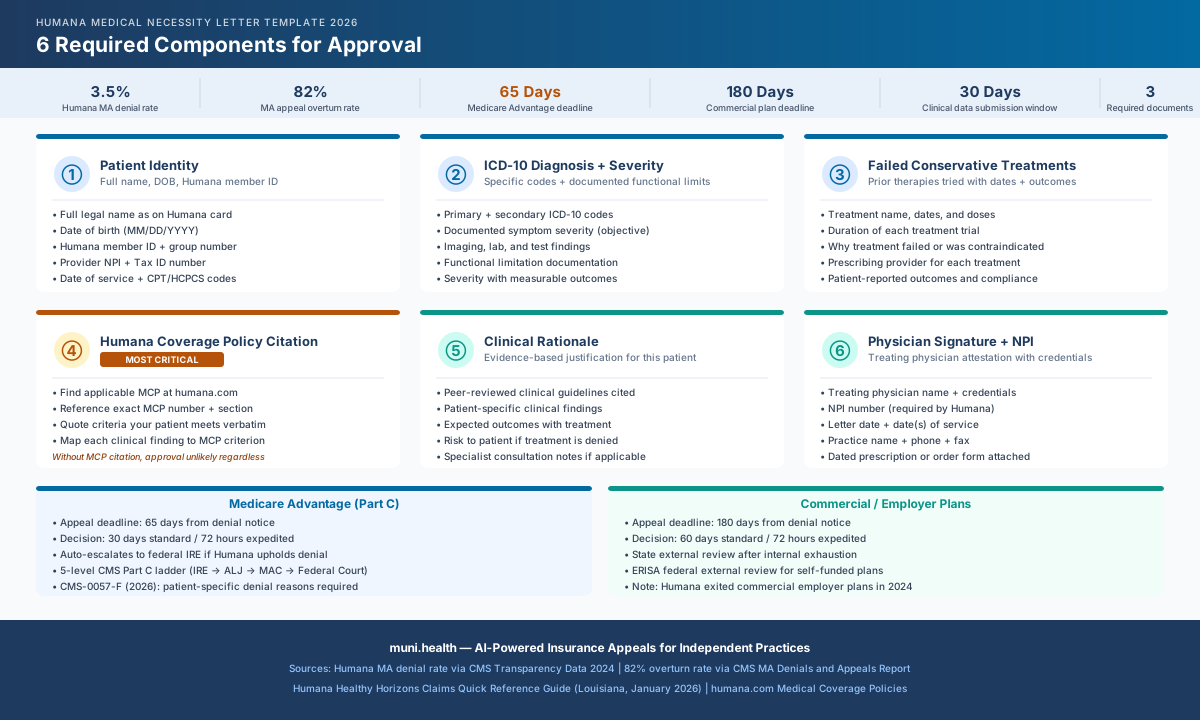
Understanding Humana Medical Necessity Requirements
Humana denies claims or prior authorization requests when documentation fails to establish medical necessity—even when the service is clinically appropriate. For independent medical practices, this creates a double burden: you must treat the patient AND prove to Humana why the treatment was necessary.
Per KFF's analysis of 2024 Medicare Advantage prior authorization data, Humana denied 5.8% of prior authorization requests—below the 7.7% industry average, though no longer the lowest among major insurers (Elevance Health held that spot at 4.2% in 2024). That is a share of prior-authorization request counts, not billed dollars, so it cannot be multiplied by a practice's Humana revenue to estimate denied revenue. Practices should use their own request volume, allowed amounts, and denial records for financial planning.
The good news? The same KFF analysis found 80.7% of Medicare Advantage prior authorization appeals were partially or fully overturned in 2024. The problem isn't your clinical judgment—it's documentation that doesn't match Humana's specific coverage policies and review criteria.
Key Statistics
- 5.8% Humana MA denial rate — below the 7.7% industry average (KFF, 2024 data)
- 80.7% appeal overturn rate for Medicare Advantage plans (KFF, 2024)
- 11.5% of denials are appealed (most practices leave money on the table)
- 65-day deadline for Medicare Advantage members (vs 180 days commercial)
Common Humana Medical Necessity Denial Reasons
Humana denies claims for specific, predictable documentation gaps:
1. Insufficient Clinical Information for Medical Necessity Review Humana requires "clinical information to perform a medical necessity review" when prior authorization is requested. Generic documentation like "patient requires treatment" doesn't meet this standard. You must demonstrate functional limitations, symptom severity with objective measures, and treatment necessity.
2. Failed Conservative Treatment Not Documented Humana's medical coverage policies frequently require documented failure of less intensive treatments before approving advanced procedures, specialty medications, or therapies. If you don't explicitly document what you tried first and why it didn't work, the request gets denied.
3. Diagnosis Codes Don't Support Medical Necessity ICD-10 codes must match the requested service and demonstrate severity. A diagnosis of "knee pain" (M25.561) without documented functional limitations won't justify advanced imaging or injections. You need specificity: "Severe osteoarthritis of knee with documented loss of joint space, functional mobility limitation, and failed conservative treatment."
4. Missing Humana Coverage Policy Citations Humana uses specific medical coverage policies (similar to Aetna's CPBs). When your documentation doesn't address the criteria in the relevant Humana policy, reviewers have no framework to approve the request—even if it's medically sound.
5. Timely Filing Violations Providers must submit "all Humana-required clinical data within 30 days of the date of service." Missing this deadline triggers automatic denials that are difficult to overturn, regardless of medical necessity.
6. Inadequate Supporting Documentation Humana requires three primary documents for authorization: (1) dated prescription/order from qualified provider, (2) clinical documentation supporting medical necessity, (3) evidence meeting Humana's clinical review criteria. Missing any one element results in denial.
Humana Medicare Advantage vs Commercial: Key Differences
Humana Gold Plus and other Medicare Advantage plans have different requirements than commercial (employer-sponsored) plans. Understanding these differences prevents missed deadlines and improves success rates.
Timeline Comparison
| Appeal Type | Medicare Advantage (Part C) | Commercial Plans | |------------|----------------------------|------------------| | Filing Deadline | 65 days from denial date | 180 days (varies by plan) | | Standard Decision | 7 days (Part D) / 30 days (Part C) | Varies by plan document | | Expedited Decision | 72 hours (if delay could harm health) | Varies by plan | | Automatic IRE Forwarding | Yes (if Level 1 denied) | No (commercial appeals process differs) |
Critical Deadline Difference
Medicare Advantage members have only 65 days to appeal (reduced from 180 days that commercial plans typically allow). Mark your calendar immediately when you receive a denial—this deadline is strictly enforced.
Coverage Policy Differences
Medicare Advantage Plans (Humana Gold Plus, etc.):
- Follow CMS Medicare Advantage regulations
- Use Medicare National Coverage Determinations (NCDs) and Local Coverage Determinations (LCDs)
- Apply MCG care guidelines and ASAM criteria for utilization management
- Automatic Level 2 IRE (Independent Review Entity) review if Level 1 denied
- Can escalate to ALJ hearing if claim value ≥$200 (CY2026 threshold)
Commercial Plans (Employer-Sponsored):
- Use Humana-specific medical coverage policies
- May have different criteria than Medicare plans
- Appeal process defined by plan document (not federal regulation)
- No automatic IRE forwarding
- Different formularies and prior authorization lists
Medical Necessity Criteria Overlap
Both plan types require:
- Documented clinical rationale with objective findings
- Failed conservative treatment attempts (when applicable)
- Evidence-based support from clinical guidelines
- Functional impact or symptom severity documentation
- Qualified provider signature with credentials
Humana Medical Necessity Letter Template (Medicare Advantage)
Use this template for Humana Gold Plus and other Medicare Advantage plans. Customize clinical details to match your patient's specific case.
[Your Practice Letterhead with NPI]

[Date]

Humana Medicare Advantage
Grievance and Appeals Department
P.O. Box 14165
Lexington, KY 40512-4165

RE: Medical Necessity Appeal - Organization Determination
Patient Name: [Full Name]
Date of Birth: [MM/DD/YYYY]
Humana Member ID: [Number]
Medicare ID: [Number]
Claim/Authorization Number: [Number]
Date(s) of Service: [Date or date range]
Procedure/Service: [Description]
CPT/HCPCS Code(s): [Codes]
Diagnosis: [Primary diagnosis with ICD-10 code]
Denial Date: [Date from denial notice]
Denial Reason: [As stated on denial notice]

Dear Humana Medical Review Team:

I am writing to appeal the denial of [service/procedure/medication] for the above-referenced patient and respectfully request reconsideration based on medical necessity. This [service/procedure/medication] is medically necessary, clinically appropriate, and consistent with evidence-based standards of care for [condition].

PATIENT CLINICAL PRESENTATION

[Patient name] is a [age]-year-old [gender] with [primary diagnosis - ICD-10 code] who presented to my practice on [date] with the following clinical findings:

Chief Complaint: [Patient's presenting symptoms]

Objective Clinical Findings:
- [Lab value 1]: [Result] (normal range: [range])
- [Physical exam finding 1]: [Specific observation]
- [Imaging finding 1]: [Specific result with date]
- [Functional assessment]: [Objective limitation measurement]

The patient's condition results in the following functional limitations:
- [Specific ADL/IADL limitation 1]
- [Specific ADL/IADL limitation 2]
- [Work or quality of life impact]

CONSERVATIVE TREATMENT FAILURES

Prior to recommending [service/procedure/medication], the following conservative treatments were attempted without adequate clinical response:

1. [Treatment 1]: [Dates tried], [Dosage/frequency], [Outcome/reason for failure]
2. [Treatment 2]: [Dates tried], [Dosage/frequency], [Outcome/reason for failure]
3. [Treatment 3]: [Dates tried], [Dosage/frequency], [Outcome/reason for failure]

Despite compliance with the above treatments for [duration], the patient continued to experience [specific ongoing symptoms with objective measurements], necessitating escalation to [requested service/procedure/medication].

MEDICAL NECESSITY JUSTIFICATION

The requested [service/procedure/medication] is medically necessary for the following clinical reasons:

1. **Evidence-Based Indication**: [Service] is the standard of care for [condition] according to [medical specialty society] clinical practice guidelines (Year). Studies demonstrate [specific outcome benefit with citation if available].

2. **Meets Humana Coverage Criteria**: This request satisfies the medical necessity criteria outlined in [reference Humana medical coverage policy if known, or state "Humana's medical coverage policies for this service category"].

3. **Expected Clinical Benefit**: Based on the patient's clinical presentation and evidence-based medicine, [service] is expected to [specific outcome: reduce pain, improve function, prevent progression, etc.]. Without this intervention, the patient faces [specific clinical risk or deterioration].

4. **No Reasonable Alternative**: Conservative treatments have been exhausted. Alternative treatments [list alternatives if any] are not appropriate because [medical reason why alternatives unsuitable].

SUPPORTING CLINICAL GUIDELINES

This treatment approach is supported by:
- [Medical society name] Clinical Practice Guidelines for [condition] (Year)
- Medicare National Coverage Determination [NCD number if applicable]
- Medicare Local Coverage Determination [LCD number if applicable]
- [Additional peer-reviewed evidence if relevant]

RESPONSE TO DENIAL REASON

[Directly address the specific reason stated on the denial notice. Examples:]

[If denied for "not medically necessary"]: The clinical documentation clearly establishes medical necessity through objective functional limitations, failed conservative treatment trials, and evidence-based support for this intervention.

[If denied for "experimental/investigational"]: This [service/procedure/medication] is FDA-approved for [indication] and widely accepted as standard of care per [medical society] guidelines.

[If denied for "lack of documentation"]: I have enclosed comprehensive documentation including [list enclosed materials]. Additional clinical records are available upon request.

HUMANA COVERAGE POLICY COMPLIANCE

[If you can identify the specific Humana coverage policy, address its criteria here:]

The patient meets the following Humana coverage criteria for [service]:
- Criterion 1: [How patient meets this criterion]
- Criterion 2: [How patient meets this criterion]
- Criterion 3: [How patient meets this criterion]

CLINICAL URGENCY (If applicable)

[For expedited appeals only]: This appeal requires expedited review because waiting for standard review timeline could seriously harm the patient's health or ability to regain maximum function. Specifically: [describe clinical urgency—pain level, progression risk, functional deterioration].

SUPPORTING DOCUMENTATION ENCLOSED

- Complete clinical notes from [date(s)]
- [Diagnostic test] results from [date]
- [Imaging study] report from [date]
- Failed treatment documentation (pharmacy records/prescription history)
- [Medical specialty] consult note from [date]
- Relevant clinical practice guidelines excerpt
- [Any additional supporting documents]

REQUESTED ACTION

I respectfully request that Humana overturn this denial and authorize [service/procedure/medication] for [patient name] based on clear medical necessity and compliance with Humana's coverage criteria.

The total service value is $[amount]. This patient's health and functional status depend on timely access to this medically necessary care.

Please contact me at [phone] or [email] if additional clinical information is required to complete your review. I am available to discuss this case further.

Sincerely,

[Physician Name], [Credentials: MD/DO/etc.]
[Medical License Number]
[NPI Number]
[Practice Name]
[Phone]
[Fax]
[Email]

Enclosures: [List all attached documents]
Skip the blank template. Start with a review-ready draft.
Use the template as guidance, or let Muni prepare a payer-specific draft for your team to verify, sign, and submit.
First 3 appeals free, then $20 per appeal. Start with your denial letter or EOB and available records. No meeting or clearinghouse connection required.
Humana Commercial Plan Medical Necessity Template
For employer-sponsored Humana commercial plans, use this template (note the 180-day timeline difference):
[Your Practice Letterhead with NPI]

[Date]

Humana Health Plan
Appeals Department
P.O. Box 14165
Lexington, KY 40512-4165

RE: Commercial Plan Appeal - Medical Necessity
Patient Name: [Full Name]
Date of Birth: [MM/DD/YYYY]
Humana Member ID: [Number]
Group Number: [Group number]
Claim/Authorization Number: [Number]
Date(s) of Service: [Date or date range]
Procedure/Service: [Description]
CPT/HCPCS Code(s): [Codes]
Diagnosis: [Primary diagnosis with ICD-10 code]
Denial Date: [Date from denial notice]
Appeal Filing Date: [Date - verify within 180 days]

Dear Humana Appeals Review Team:

I am writing to appeal the denial of [service/procedure/medication] for the above-referenced patient under [Patient Name]'s commercial health plan. This appeal is submitted within the 180-day filing deadline pursuant to the plan document.

[Follow the same structure as Medicare Advantage template with these modifications:]

PLAN-SPECIFIC COVERAGE

Per [Patient Name]'s employer-sponsored plan document, [service/procedure] is a covered benefit when medically necessary. The patient meets all coverage requirements:
- [Coverage requirement 1 from plan]: [How patient meets this]
- [Coverage requirement 2]: [How patient meets this]
- Prior authorization was [obtained on date / not required per Humana's prior authorization list]

[Rest of letter follows Medicare Advantage template structure, adapted for commercial plan language]

Sincerely,

[Physician signature and credentials]
Commercial vs MA Template Differences
Commercial plan appeals should reference the specific plan document and employer group rather than Medicare regulations. Verify the appeal timeline in the patient's plan documents—while 180 days is typical, some plans may have different deadlines.
How to Submit Your Humana Medical Necessity Letter
Humana accepts appeals through multiple channels. Choose the method that provides the best tracking and fastest response.
Submission Methods
1. Fax (Fastest for Urgent Cases)
- Fax number: 888-556-2128
- Advantages: Immediate delivery, can request fax confirmation
- Recommended for: Expedited appeals, deadline-sensitive cases
- Tip: Always get a fax confirmation receipt
2. Mail
- Standard appeals: P.O. Box 14165, Lexington, KY 40512-4165
- Expedited appeals: Humana Expedited Appeals Unit, P.O. Box 14165, Lexington, KY 40512-4165
- Advantages: Can send certified mail with tracking
- Timeline: Add 3-5 business days for mail delivery
3. Online Provider Portal
- Access: provider.humana.com
- Advantages: Electronic tracking, can upload supporting documentation
- Recommended for: Routine appeals with extensive documentation
- Requires: Active Humana provider portal account
4. Phone (For Expedited Appeals Only)
- Call: 800-867-6601
- Use for: Expedited Medicare Advantage appeals when delay could harm patient
- Follow up: Must submit written documentation within 48 hours
What to Include in Your Submission Package
✅ Required Documents:
- Completed medical necessity letter (using template above)
- Copy of Humana denial notice
- Clinical notes from relevant visits
- Diagnostic test results (labs, imaging reports)
- Documentation of failed treatments (prescription history, prior notes)
- Physician prescription/order for requested service
✅ Recommended Additional Documentation:
- Excerpt from clinical practice guidelines supporting treatment
- Peer-reviewed journal article abstracts (if relevant)
- Specialist consultation notes
- Functional assessment scores or outcome measures
- Patient history timeline showing progression
30-Day Documentation Deadline
Humana requires providers to submit "all Humana-required clinical data within 30 days of the date of service." Late submissions may be denied regardless of medical necessity. Set up a system to track and submit documentation promptly.
Humana Medicare Advantage IRE Process (Level 2 Appeals)
If your Level 1 appeal to Humana is denied, Medicare Advantage plans automatically forward your case to an Independent Review Entity (IRE) for Level 2 review. You don't need to take additional action—but understanding the process helps you prepare.
Prepare this appeal packet with your team.
Draft the appeal, coordinate missing documents, and approve the reviewed packet. Keep your clearinghouse; your practice checks deadlines and submits through the payer’s accepted channel.
First 3 appeals free, then $20 per appeal. Start with your denial letter or EOB and available records. No meeting or clearinghouse connection required.
How IRE Review Works
Automatic Forwarding: If Humana upholds the denial (makes an "adverse reconsideration decision"), they must automatically submit your case to the IRE within the required timeline. You'll receive a notice that your case has been forwarded.
Current IRE Contractor: CMS transitioned the Medicare Advantage Part C IRE contract from MAXIMUS Federal Services to C2C Innovative Solutions, effective for appeal requests received on or after May 1, 2026. MAXIMUS Federal Services handled Part C IRE reviews under contract with CMS for requests received through April 30, 2026. Confirm current IRE contact information via your denial notice or the CMS/plan provider portal.
IRE Review Timeline:
- Standard appeals: 30 days from receipt
- Expedited appeals: 72 hours if delay could harm health
IRE Decision Options:
- Fully favorable: IRE overturns Humana's denial entirely
- Partially favorable: IRE approves some but not all of the request
- Unfavorable: IRE upholds Humana's denial
What Happens After IRE
If the IRE decision is unfavorable and your service value is at least $200 (CY2026 threshold), you can appeal to:
Level 3: Administrative Law Judge (ALJ)
- File within 60 days of IRE decision
- Hearing conducted by Office of Medicare Hearings and Appeals (OMHA)
- Can present additional evidence and testimony
Level 4: Medicare Appeals Council
- Review of ALJ decision
- No minimum dollar threshold
Level 5: Federal District Court
- Requires claim value ≥ $1,960 (CY2026)
- Final level of administrative appeals
Most cases resolve at Level 1 (Humana) or Level 2 (IRE). Only 2-3% of Medicare Advantage appeals reach ALJ hearings.
Common Mistakes That Sink Humana Medical Necessity Letters
Even strong clinical cases fail when letters contain these documentation errors:
❌ Generic Symptoms Without Objective Measures Wrong: "Patient has severe pain." Right: "Patient reports pain level 8/10 on VAS scale, limiting ambulation to 5 minutes before requiring rest. Unable to perform job duties as delivery driver."
❌ Missing Failed Treatment Documentation Wrong: "Patient tried medications without relief." Right: "Patient trial of ibuprofen 600mg TID × 6 weeks (prescribed 6/1/25) provided insufficient relief (pain decreased from 9/10 to 7/10). Subsequently trial of meloxicam 15mg daily × 8 weeks (prescribed 7/15/25) discontinued due to GI side effects (nausea, gastritis)."
❌ No Functional Impact Described Wrong: "Patient's shoulder range of motion is limited." Right: "Shoulder flexion limited to 95° (normal: 160-180°), preventing patient from reaching overhead cabinets, washing hair independently, and performing work duties as electrician requiring overhead wiring."
❌ Failing to Address Specific Denial Reason Don't write a generic letter. If Humana denied for "not medically necessary," directly state: "This service meets medical necessity criteria because [specific evidence]." If denied for "experimental," cite FDA approval date and clinical guidelines.
❌ Missing Humana-Specific Language Generic appeals don't reference Humana's specific coverage policies or review criteria. When possible, cite "Humana medical coverage policy for [service category]" or "MCG care guidelines used by Humana for utilization management."
❌ No Clinical Guidelines Referenced Insurance reviewers expect evidence-based support. Always cite at least one clinical practice guideline from a relevant medical specialty society (AAFP, ACP, AHA, APTA, etc.).
How Muni Appeals Supports Humana Medical Necessity Letters
Writing Humana medical necessity letters manually takes 45-60 minutes when done properly. You must:
- Review the patient's clinical history
- Document failed treatments with dates and outcomes
- Research relevant clinical practice guidelines
- Format the letter per Humana's requirements
- Gather and organize supporting documentation
- Verify and calendar the controlling 65-day or 180-day deadline from the current notice and plan
For a low-value denial, an hour of physician or staff time may outweigh the recoverable amount. Practices should compare the claim's allowed amount, evidence strength, filing window, and review time instead of applying an industry request-denial percentage to annual revenue.
Muni Appeals reduces the drafting and evidence-organization work for Humana medical necessity letters while staff retains clinical review, deadline, submission, and follow-up responsibility.
How It Works for Humana Appeals
1. Upload Denial (30 seconds) Photograph or upload your Humana denial notice. Muni extracts available member, denial, service, and deadline context and surfaces any uncertainty for staff review.
2. AI Compiles Medical Necessity Letter (4 minutes) Muni's AI organizes the materials you upload into a review-ready draft:
- Relevant clinical data from the uploaded records
- Failed treatment timeline with dates and outcomes
- Relevant clinical practice guidelines for the diagnosis
- Humana-specific coverage policy language
- Proper Medicare Advantage vs commercial plan terminology
- Complete submission package checklist
3. Physician Review and Customization (1 minute) Review the compiled letter for clinical accuracy. Add any case-specific context or clinical judgment that strengthens the appeal. Edit as needed.
4. Verify and Submit to Humana Confirm the current Humana address and deadline from the denial notice, submit by the required fax, mail, or portal channel, and record the submission in Muni.
Why Muni Wins More Humana Appeals
Medicare Advantage vs Commercial Context: Muni surfaces the likely plan context from the uploaded denial and uses it to prepare the draft. Staff verifies the plan type, appeal timeline, submission address, and controlling language.
65-Day Deadline Review: Missing the Medicare Advantage deadline can forfeit appeal rights. Muni surfaces deadline risk from the uploaded denial; staff must verify and calendar the exact deadline.
Humana Coverage Policy Citations: Muni references Humana-specific medical coverage policies and MCG care guidelines (which Humana uses for utilization management) in the appeal letter, giving reviewers the framework they need to approve.
Failed Treatment Documentation: Muni organizes uploaded medication history and visit notes into a failed-treatment timeline for staff and physician review.
IRE Escalation Guidance: For Medicare Advantage appeals, Muni can include IRE escalation guidance in the packet. Staff must confirm forwarding and track the IRE timeline with the payer.
ROI for Practices with Humana Claims
Manual Medical Necessity Letter:
- Time: 45-60 minutes per letter
- Cost: $45-90 in staff/physician time (at $60-90/hour)
- Success rate: Varies by payer, denial reason, and documentation quality
- Economic threshold: Not worth appealing claims under $150
With Muni Appeals:
- Time: 5 minutes per letter
- Cost: $20 appeal credit plus a few minutes of physician review time after the first 3 free appeals
- Outcome: Varies by plan, denial reason, evidence, and payer decision
- Staff responsibility: Verify the clinical record, sign, and submit the letter
Estimate with your own data:
- Count eligible Humana denials and their actual claim values.
- Apply your practice's measured overturn rate, not a generic Muni benchmark.
- Subtract the $20 per-appeal price after the first 3 free appeals and the staff review cost.
For a multi-payer comparison of medical necessity criteria frameworks — including how Humana MCPs compare to Aetna CPBs, UHC CDGs, BCBS InterQual, and Cigna CPG policies — see our medical necessity justification letter guide.
Frequently Asked Questions
What is a letter of medical necessity for Humana?
A letter of medical necessity for Humana is a formal document from a licensed physician explaining why a specific service, procedure, or medication is medically necessary for a patient's condition. It must include: patient and policy information, diagnosis with ICD-10 codes, clinical presentation with objective findings, failed conservative treatments, evidence-based justification citing clinical guidelines, and physician signature with credentials. Humana uses these letters to determine coverage for prior authorizations and appeals.
How do I appeal a Humana denial?
To appeal a Humana denial: (1) Note the deadline—65 days for Medicare Advantage, typically 180 days for commercial plans, (2) Write a medical necessity letter addressing the specific denial reason, (3) Gather supporting documentation (clinical notes, test results, failed treatment records), (4) Submit via fax (888-556-2128), mail (P.O. Box 14165, Lexington, KY 40512-4165), or online provider portal, (5) Request expedited review if delay could harm patient health. Humana will decide within 7-30 days depending on plan type and urgency.
What is Humana's appeal deadline?
Humana Medicare Advantage members have 65 days from the denial date to submit an appeal. Commercial plan members typically have 180 days, but this varies by specific plan document—check your denial notice for the exact deadline. Missing these deadlines forfeits your right to appeal regardless of medical necessity. For expedited appeals (when delay could harm health), you can request 72-hour review by calling 800-867-6601.
What should be included in a Humana medical necessity letter?
A Humana medical necessity letter must include: (1) Patient name, DOB, and Humana member ID, (2) Diagnosis with ICD-10 codes and clinical severity, (3) Objective clinical findings (labs, imaging, exam results), (4) Functional limitations caused by condition, (5) Failed conservative treatment attempts with dates and outcomes, (6) Evidence-based justification from clinical practice guidelines, (7) How the service meets Humana coverage policy criteria, (8) Physician signature with license number and NPI, (9) Supporting documentation (clinical notes, test results). Address the specific denial reason stated on the denial notice.
Does Humana accept electronic appeals?
Yes. Humana accepts appeals through their online provider portal at provider.humana.com, which allows electronic submission with uploaded supporting documentation. You can also submit via fax (888-556-2128) for faster delivery than mail. For prior authorizations, Humana also accepts electronic requests through CoverMyMeds and Availity platforms. Electronic submission is recommended because it provides automatic tracking and confirmation of receipt—critical for meeting the 65-day Medicare Advantage deadline.
What is Humana's expedited appeal process?
Expedited (fast-track) appeals are available when waiting for standard review could seriously harm the patient's life, health, or ability to regain maximum function. To request expedited review: (1) Call 800-867-6601 and state the clinical urgency, (2) Submit written documentation within 48 hours explaining why delay poses health risk, (3) Humana will decide within 72 hours for Medicare Advantage members. Expedited appeals are most common for pre-service denials (authorization for upcoming treatment) when the patient's condition could deteriorate during standard review timeline.
How long does Humana take to decide appeals?
Humana decision timelines vary by plan type: Medicare Advantage: 7 days for Part D pharmacy appeals, 30 days for Part C medical appeals, 72 hours for expedited appeals. Commercial plans: Varies by plan document, typically 30-60 days for standard appeals. If your Level 1 Medicare Advantage appeal is denied, it automatically forwards to Independent Review Entity (IRE) for Level 2 review within 30 days. Track your case via the provider portal or by calling Customer Care on your member ID card.
What is the Humana Medicare Advantage appeal process?
Humana Medicare Advantage appeals follow a 5-level process: Level 1 - Humana reconsideration (65-day filing deadline, 7-30 day decision). Level 2 - Automatic IRE (Independent Review Entity) review if Level 1 denied — C2C Innovative Solutions effective May 1, 2026 (MAXIMUS Federal Services previously). Level 3 - ALJ (Administrative Law Judge) hearing if claim ≥$200 (CY2026 threshold). Level 4 - Medicare Appeals Council review. Level 5 - Federal District Court if claim ≥$1,960 (CY2026). Most cases resolve at Level 1 or 2. You don't need to take action for automatic IRE forwarding—Humana handles this if they uphold the denial.
Can Muni Appeals automate Humana medical necessity letters?
Yes. Muni Appeals prepares Humana medical necessity drafts for Medicare Advantage and commercial plans, including deadline context, clinical-guideline citations, Humana policy language, and plan-specific formatting. The practice must verify the deadline, clinical facts, plan type, and submission destination. The first 3 appeals are free, then pricing is $20 per appeal.
Should I appeal a Humana denial even if it's a small amount?
Manual appeals can consume more staff time than a low-value claim justifies. Muni reduces the blank-page drafting work, but each practice should compare the claim value, $20 per-appeal price after the first 3 free appeals, physician or staff review time, evidence strength, and filing window before deciding whether to appeal. Outcomes vary and are not guaranteed.
Ready to Stop Losing Revenue to Humana Denials?
KFF reports that Humana denied 5.8% of Medicare Advantage prior authorization requests in 2024, below the 7.7% industry average. That request-count measure does not determine a practice's denied dollars; use your own denial volume and allowed amounts when deciding what to appeal.
Muni Appeals reduces drafting effort, but not every Humana denial is worth challenging. Compare the claim value, filing window, evidence, staff review time, and $20 per-appeal price.
With Muni Appeals for Humana, you get:
- ⚡ Review-ready drafting instead of starting from a blank document
- 📅 Deadline-risk guidance for Medicare Advantage, with staff verification
- 📈 Policy-specific structure tied to the denial reason
- 💰 Transparent $20 per-appeal pricing after the first 3 free appeals
- 🎯 MA vs commercial plan context extracted for staff review
- 📋 Humana coverage policy citations
- 🔄 IRE escalation checklist for staff follow-up on Medicare Advantage appeals
- 📤 Submission instructions for the practice to verify and use
Results vary by practice, plan, claim value, and documentation. Use your own measured outcomes when estimating recovery.
Start 3 Free Appeals and see how much Humana revenue you're leaving unclaimed.
This guide reflects the 2026 Humana sources reviewed for publication. Humana policies may vary by state and specific plan type. Verify the current policy, deadline, and submission instructions before filing.