

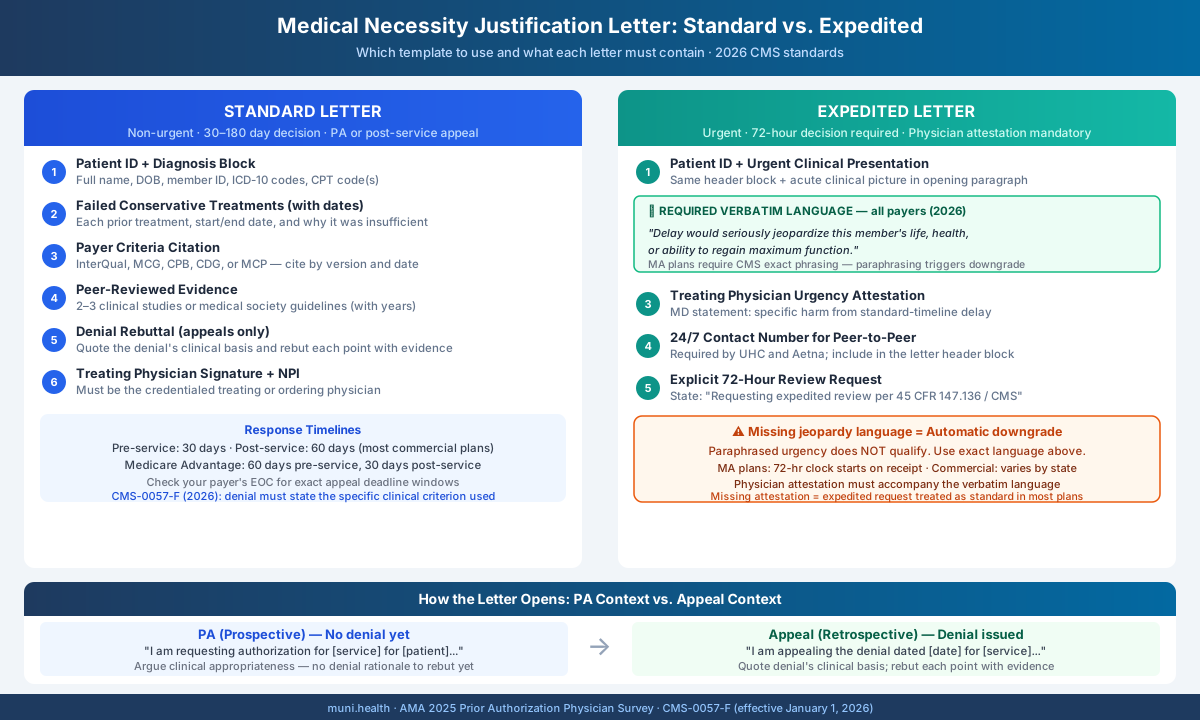
A medical necessity justification letter explains why a specific treatment is clinically required for a patient. In 2026, there are two structurally different letter types: a standard letter for most PA requests and post-service appeals, and an expedited letter for situations where a standard review timeline would seriously jeopardize patient health. Using the wrong template — or missing the verbatim jeopardy language — triggers an automatic downgrade to standard review, extending wait times by weeks.
A medical necessity denial doesn't mean the treatment isn't justified. It means the documentation didn't prove it to the reviewer's standard. Understanding exact appeal deadlines by payer before you write helps ensure the letter arrives within the window where it can still be acted on.
According to the AMA's 2025 Prior Authorization Physician Survey (n=1,004 physicians), practices complete an average of 40 prior authorizations per week and spend 13 hours of combined physician and staff time managing them. Ninety-four percent of physicians report that PA contributes to burnout — and 26% report it has led to serious adverse patient events including hospitalization or permanent impairment.
The documentation problem sits at the center of this. Most letters are too general, cite the wrong criteria, or use the wrong template for the situation. This guide covers both issues: which type of letter to write, and what goes in each.
What Changed in 2026: CMS-0057-F and the New Specificity Standard
Beginning in 2026, CMS-0057-F requires impacted payers to provide a specific reason for a denied prior authorization. The provision covers non-drug prior authorization decisions by Medicare Advantage organizations, state Medicaid and CHIP fee-for-service programs, Medicaid and CHIP managed care entities, and Qualified Health Plan issuers on Federally-facilitated Exchanges.
The rule requires a specific reason, but it does not guarantee an exact policy number, criterion, or quoted guideline section. Use the stated reason as primary rebuttal material. If the response also identifies an exact criterion, address it directly; if not, request the applicable criteria rather than inventing a citation.
If an Aetna Medicare Advantage denial states that the patient did not meet Clinical Policy Bulletin #0648 criterion 3.b ("failure of conservative therapy for at least six weeks"), your letter must address criterion 3.b directly — document the conservative therapy attempted, its duration, and why it was insufficient. Generic clinical narratives that don't address the named criterion are still rejected even when the underlying clinical case is strong.
2025 AMA Survey Finding
Nearly one in three physicians (32%) report that prior authorization requests are often or always denied. Three-quarters (74%) report denials have increased over the past five years, and 93% say PA causes care delays at least some of the time (AMA Prior Authorization Physician Survey, 2025).
For commercial plans not subject to CMS-0057-F, the same principle applies. Cite the denial's stated reason verbatim and address it in your letter. Reviewers compare the denial basis against the appeal argument — a mismatch is grounds for rejection even when the clinical facts support approval.
Standard vs. Expedited Letters: The Core Structural Difference
A standard medical necessity letter and an expedited letter are two distinct documents — not variations of the same template. The expedited version adds mandatory verbatim language and a physician urgency attestation that the standard version does not require, and submitting a standard letter when expedited review is warranted leaves the patient waiting weeks for a decision that should arrive in 72 hours.
Standard review applies to most prior authorization requests and post-service appeals. Timelines are 30 days for pre-service (most commercial plans) and 60 days for post-service appeals. The letter's job is to build a clinical argument: diagnosis, failed prior treatments, payer criteria alignment, peer-reviewed evidence, and (for appeals) a point-by-point rebuttal of the denial's stated rationale.
Expedited review applies when the standard timeline would seriously jeopardize the patient's health. Under CMS Medicare Advantage rules and most commercial plan requirements derived from 45 CFR 147.136, a 72-hour decision is required when the standard timeframe poses a risk to the member's life, health, or ability to regain maximum function. The expedited letter must include:
- The verbatim jeopardy language (exact wording varies slightly by plan type — see Template 2 and the payer table below)
- A treating physician urgency attestation explaining the specific clinical harm from delay
- A 24/7 physician contact number for peer-to-peer if the plan requests one
- An explicit statement requesting expedited review under the applicable regulatory citation
Verbatim Language Is Not Optional
Expedited requests are routinely downgraded to standard review when the jeopardy language is missing or paraphrased. For Medicare Advantage plans, CMS requires exact phrasing. For commercial plans, most plan documents specify that the request must "state" or "indicate" that the standard timeline would seriously jeopardize health — paraphrase at the cost of the expedited clock.
Template 1: Standard Medical Necessity Justification Letter
The standard template covers the full range of PA requests, Level 1 appeals, and post-service medical necessity denials — it handles 85–90% of cases. The structure is consistent across payers, though the criteria you cite in Section 4 should be payer-specific (see the criteria table in a later section).
[Date]

Medical Review Department
[Insurance Company Name]
[Mailing Address or Fax Number]

RE: Medical Necessity Justification
Patient Name:      [Full Legal Name]
Date of Birth:     [MM/DD/YYYY]
Member ID:         [Insurance Member ID]
Group Number:      [Group #, if applicable]
Claim/Auth Number: [Claim # or Auth # from denial letter]
Date(s) of Service:[MM/DD/YYYY – MM/DD/YYYY]
CPT Code(s):       [e.g., 27447 — Total Knee Arthroplasty]
ICD-10 Code(s):    [e.g., M17.11 — Primary osteoarthritis, right knee]
Ordering Physician:[Name, MD/DO, NPI: ##########]
24-Hour Contact:   [Physician phone number]

Dear Medical Review Team:

I am writing to [provide medical necessity justification for / appeal the denial
dated MM/DD/YYYY for] [specific procedure or service] for the above-referenced
patient. The requested service is medically necessary as documented below.

CLINICAL PRESENTATION:
[Patient name] is a [age]-year-old [male/female] with a diagnosis of [primary
diagnosis] (ICD-10: [code]). [2–3 sentences describing current clinical status,
severity, and functional impact on daily activities or quality of life.]

FAILED CONSERVATIVE TREATMENT:
The following treatments were attempted and proved insufficient:
• [Treatment 1] ([start date] – [end date]): [specific outcome and why insufficient]
• [Treatment 2] ([start date] – [end date]): [specific outcome and why insufficient]
• [Additional treatments as applicable]

MEDICAL NECESSITY JUSTIFICATION:
[Procedure/service] is medically necessary for this patient because [specific
clinical rationale tied to patient's condition and failed prior treatment].

This is consistent with [Payer Name] [Policy Name/Number, e.g., Aetna Clinical
Policy Bulletin #0648, updated January 2026], which establishes that [direct
quote or precise paraphrase of the relevant criterion the patient meets].

Supporting clinical evidence includes:
• [Citation 1: Author(s), journal name, year — specific finding relevant to case]
• [Citation 2: Medical society guideline name, year — relevant recommendation]

[APPEALS ONLY — DENIAL REBUTTAL:
The denial cited [exact language from denial letter]. This is incorrect because
[specific clinical rebuttal with evidence]. The patient's documentation, attached
hereto, demonstrates [specific finding that addresses the denial criterion].]

REQUESTED ACTION:
Based on the clinical evidence presented, I respectfully request [approval of
the prior authorization / reconsideration and approval of the claim] for
[procedure/service].

Physician Name:   ______________________________
Signature:        ______________________________
NPI:              ______________________________
Date:             ______________________________
Contact Phone:    ______________________________
Skip the blank template. Start with a review-ready draft.
Use the template as guidance, or let Muni prepare a payer-specific draft for your team to verify, sign, and submit.
First 3 appeals free, then $20 per appeal. Start with your denial letter or EOB and available records. No meeting or clearinghouse connection required.
What makes this template work
Section specificity is the variable, not the structure. The header block, treatment history format, and closing request are consistent across payers. The elements that change by case are: the criteria citation in Section 4 (must match the payer's current policy), the denial rebuttal language (must directly address the named criterion from the denial), and the number of failed treatments documented.
For PA requests (no denial yet), omit the denial rebuttal block entirely. The opening sentence changes from "I am appealing..." to "I am requesting authorization for..." and the argument structure shifts from rebutting a denial to establishing prospective clinical necessity.
The criteria citation is the highest-leverage element. Reviewers check whether the letter addresses the plan's specific policy framework. A letter that cites InterQual Level of Care criteria to a Cigna reviewer — who uses Cigna's own Clinical Coverage Policies (CPG) — signals the writer is working from a generic template. Cite the plan's own criteria by name and number. The relevant CPB, CDG, or MCG number typically appears in the denial letter itself.
Template 2: Expedited Medical Necessity Justification Letter
The expedited template adds two elements the standard template does not have: verbatim jeopardy language and a physician urgency attestation. Both are required — a letter with the urgency attestation but without the verbatim jeopardy language is still treated as a standard request by most plans.
[Date]

Expedited Review Department
[Insurance Company Name]
[Expedited Review Fax or Submission Address]

RE: REQUEST FOR EXPEDITED REVIEW — Medical Necessity Justification
Patient Name:      [Full Legal Name]
Date of Birth:     [MM/DD/YYYY]
Member ID:         [Insurance Member ID]
Date(s) of Service:[MM/DD/YYYY]
CPT Code(s):       [Procedure codes]
ICD-10 Code(s):    [Diagnosis codes]
Ordering Physician:[Name, MD/DO, NPI: ##########]
24/7 Emergency Contact: [Direct physician phone — available for P2P]

Dear Expedited Review Team:

We are requesting expedited review of this prior authorization pursuant to
[45 CFR 147.136 / CMS Medicare Advantage regulations / applicable state law].

Applying the standard timeframe for review to this case would seriously
jeopardize this member's life, health, or ability to regain maximum function.

URGENT CLINICAL PRESENTATION:
[Patient name] is a [age]-year-old [male/female] with [acute diagnosis] (ICD-10:
[code]). [2–3 sentences describing the urgent clinical picture and the specific
harm that would result from a standard-timeline review.]

PHYSICIAN URGENCY ATTESTATION:
I, [Physician Name, MD/DO, NPI: ##########], the [treating/ordering] physician
for this patient, attest that delay of [service/procedure] beyond the standard
review timeline would result in [specific clinical harm — e.g., disease
progression, increased risk of hospitalization, irreversible functional decline,
or significant unmanaged pain that cannot be controlled by alternative means].

The patient requires this service within [timeframe, e.g., 24–48 hours] to
prevent [specific adverse outcome].

MEDICAL NECESSITY:
[Service/procedure] is urgently medically necessary for this patient because
[specific clinical rationale]. This is consistent with [payer criteria name and
number] and the following supporting evidence:
• [Citation 1]
• [Citation 2]

REQUESTED ACTION:
We request a 72-hour expedited decision on this authorization. The treating
physician is available 24 hours at [phone number] for peer-to-peer review.

Physician Name:   ______________________________
Signature:        ______________________________
NPI:              ______________________________
Date:             ______________________________
24/7 Contact:     ______________________________
Payer-specific verbatim threshold language
The core phrase "seriously jeopardize this member's life, health, or ability to regain maximum function" appears in some variation across all major payers. For Medicare Advantage plans, CMS requires this exact phrasing — it derives from the CMS Managed Care Appeals and Grievances regulations. For commercial plans, the language in your letter should match what your plan's Evidence of Coverage specifies for expedited review eligibility.
| Insurer / Plan Type | Verbatim Threshold Language | Submission Route |
|---|---|---|
| Medicare Advantage (all plans) | "Seriously jeopardize the enrollee's life, health, or ability to regain maximum function" — CMS standard language required | Plan-specific expedited fax or portal |
| UnitedHealthcare Commercial | "Standard review timeline would seriously jeopardize the member's life, health, or ability to regain maximum function" | Provider Portal > Appeals > Expedited |
| Aetna Commercial | "Delay in decision making might seriously jeopardize the life or health of the member or jeopardize the member's ability to regain maximum function" | Availity > Expedited PA or fax |
| Cigna Commercial | "Standard timeframe could seriously jeopardize the life or health of the covered individual" | eviCore portal or Cigna provider portal |
| BCBS (most affiliates) | "Seriously jeopardize the life or health of the enrollee or ability to regain maximum function" | Varies by affiliate — check BluePrint or BAP |
| Humana Commercial | "Standard timeframe could seriously jeopardize the life or health of the member or ability to regain maximum function" | Availity > Humana provider portal > PA |
The language difference between plans is minor — the key is to use the phrase "seriously jeopardize" explicitly in the letter. Plans do not accept paraphrased equivalents like "delay would harm the patient" or "urgent medical situation." The reviewer is checking for the trigger phrase, not evaluating your clinical description.
PA Context vs. Appeal Context: How the Opening Changes
The underlying clinical argument in a medical necessity letter is the same whether you're submitting a PA request or appealing a denial — but the framing, opening paragraph, and rebuttal structure are materially different.
Prepare this appeal packet with your team.
Draft the appeal, coordinate missing documents, and approve the reviewed packet. Keep your clearinghouse; your practice checks deadlines and submits through the payer’s accepted channel.
First 3 appeals free, then $20 per appeal. Start with your denial letter or EOB and available records. No meeting or clearinghouse connection required.
Prior authorization context (prospective): No denial has been issued. The letter argues that the treatment should be approved before it happens. The opening statement is forward-looking: "I am requesting authorization for [service] for [patient name]." The body establishes clinical necessity from scratch using diagnosis, treatment history, and evidence — there is no denial to rebut.
For PA requests, the most critical element is alignment with the payer's prospective review criteria. UHC uses InterQual criteria (since May 2021) for most acute care services. Aetna uses Clinical Policy Bulletins (CPBs). Cigna uses Clinical Coverage Policies (CPG/MM). For a BCBS request, use the denial notice or authorization response, current member plan, affiliate, line of business, and any delegated-program materials to determine whether an affiliate policy, Carelon guideline, MCG, InterQual, or another source applies. Citing the wrong criteria set in a PA request signals to the reviewer that the letter was written without consulting the plan's specific policy.
Appeal context (retrospective): A denial has been issued. The letter rebuts the stated basis. The opening is backward-looking: "I am appealing the denial dated [date] for [service] for [patient name]." For a non-drug prior authorization denial by an impacted payer, CMS-0057-F requires a specific reason, not necessarily an exact criterion citation. Address the reason provided and any criterion actually named.
For appeals, the highest-value element is the denial rebuttal block. Address the denial's stated reason first. When the notice also supplies an exact clinical criterion, quote it and present evidence that the patient meets it or that it does not apply to this clinical presentation. If no exact criterion is supplied, request it rather than inventing a citation.
Two Different Opening Paragraphs
PA: "I am requesting authorization for [service] for the above-referenced patient. The following documentation establishes clinical necessity..."
Appeal: "I am appealing the denial dated [date] for [service], which cited [denial criterion] as the basis for non-coverage. The following documentation demonstrates that [patient name] does meet this criterion..."
Payer-Specific Criteria: What to Cite by Insurer
Citing the criteria that actually govern the member's request is one of the highest-leverage changes you can make to a medical necessity letter. For payer-specific deep dives, see the Aetna medical necessity letter guide, the UHC medical necessity letter template, the Anthem medical necessity letter template, the UMR medical necessity letter template for self-funded employer plans, the Premera Blue Cross medical necessity letter template for Washington and Alaska plans, and the Kaiser Permanente medical necessity letter template, which routes criteria selection through the denial notice, benefit plan, affiliate, line of business, and any delegated program rather than a universal service map. Address the stated denial reason and only the policy or criteria supported by the current member-specific materials.
| Insurer | Criteria System | Policy Source | Where to Find It | Notes |
|---|---|---|---|---|
| UnitedHealthcare | InterQual (replacing Milliman/MCG since May 2021) | Clinical Decision Guidelines (CDGs) | myuhcprovider.com > Policies & Protocols | CDG number appears in UHC denial letters; cite CDG version and date |
| Aetna | Clinical Policy Bulletins (CPBs) | Aetna CPB library | aetna.com > Professionals > Clinical Policy Bulletins | CPB # and criterion letter appear in denial; cite directly |
| BCBS affiliates | Plan-, affiliate-, and line-of-business-dependent | Benefit plan, affiliate policies, and any delegated-program criteria | Check the denial, member plan, and current affiliate provider portal | Do not infer MCG, InterQual, or Carelon routing from the service alone |
| Cigna | Clinical Coverage Policies (CPG) and Medical Necessity Guidelines (MM) | Cigna Coverage Policies library | cigna.com > Health Care Professionals > Coverage Policies | CPG and MM designations on denial; cite policy number and section |
| Humana | Medical Coverage Policies (MCPs) | Humana Coverage Determinations | humana.com > Providers > Coverage Determinations | MCP number in denial; also check Humana Medicare PA tool on Availity |
| Kaiser Permanente | Washington guidance describes Kaiser Clinical Review Criteria and MCG/ASAM for some services; confirm the criteria applied to the denial | Regional Kaiser provider site (documented for Washington) | Confirm the member's plan, service, network, and region | Washington uses Aetna medical clinical policies for care through the Aetna Signature Administrators network, not all PPO/POS claims |
| Medicare Advantage (all) | LCD/NCD (where applicable) + plan-specific CDG/CPB | CMS LCDs at cms.gov; plan supplement | cms.gov/medicare-coverage-database | MA plans must follow LCDs/NCDs; also apply own supplemental criteria |
How to find the right criteria for a specific denial:
The fastest path is the denial letter itself. Under CMS-0057-F, impacted payers must provide a specific reason for denied non-drug prior authorization decisions; the rule does not say that every response must name an exact clinical criterion. For a commercial or other plan outside that provision, use the notice and governing plan materials, and request the applicable policy or criteria through the listed provider route when they are not supplied.
For PA requests (no denial yet), the relevant criteria are typically listed in the payer's pre-authorization code lookup tool or in the plan's current Prior Authorization Requirements document, updated annually. For a step-by-step breakdown of what happens after a PA denial and which intervention to use first, see the prior authorization denial complete guide.
Some specialties layer additional structure on top of this general framework. Gynecologic surgery is a clear example: payers require documented failure of conservative management for benign indications (fibroids, abnormal uterine bleeding) but waive that requirement entirely for malignancy or life-threatening hemorrhage — see the OB/GYN claim denials guide for the specific criteria split and the Medicaid consent-form requirement that denies hysterectomy claims independent of medical necessity. Cataract criteria vary by Medicare Administrative Contractor. First Coast L38926 is one jurisdiction-specific example that treats a single Snellen visual-acuity score as insufficient by itself; other claims must use the governing MAC's current acuity, testing, functional, and exception criteria. See the ophthalmology claim denials guide for the First Coast and CGS contrast and the related anti-VEGF documentation pattern.
How Muni Appeals Helps With Medical Necessity Documentation
Writing a medical necessity letter from scratch for every denial is time-consuming, and the most common failure point isn't clinical knowledge — it's knowing which criteria system applies, which criterion number to cite, and how to structure the rebuttal section to match the specific denial.
Muni Appeals organizes the documentation process for independent practices:
- Identifies the relevant payer criteria by plan type and service code
- Compiles the denial rebuttal structure from the denial's stated clinical basis
- Shows which criterion the draft cites so staff can verify that the appeal addresses the stated reason
- Surfaces candidate CPB, CDG, and MCG references for staff to verify against the payer's current source
- Supports standard and expedited draft formats with candidate jeopardy language for staff verification
The result is a letter that is specific to the payer's criteria, directly responsive to the denial, and formatted correctly for the submission channel.
Frequently Asked Questions
What is the difference between a letter of medical necessity and an appeal letter?
A letter of medical necessity is used proactively — either with a prior authorization request or alongside a claim submission — to establish clinical justification before a denial is issued. An appeal letter responds to a denial that has already been issued and must directly rebut the denial's stated clinical basis. The clinical content often overlaps, but the structure and framing are different: appeal letters require a denial rebuttal section that PA letters do not.
Does the insurer need to specify which criteria they used to deny my request in 2026?
For non-drug prior authorization decisions by impacted payers, CMS-0057-F requires a specific denial reason beginning in 2026. Impacted payers include Medicare Advantage organizations, state Medicaid and CHIP fee-for-service programs, Medicaid and CHIP managed care entities, and Qualified Health Plan issuers on Federally-facilitated Exchanges. That requirement is not the same as a mandate to quote the exact criterion. For commercial plans governed by ERISA, the plan must provide the specific reason or reasons for an adverse benefit determination, though not always a criterion number. If the notice is vague, request the applicable criteria through the plan's listed route.
Can I use the same medical necessity letter for multiple insurers?
You can use the same structural template, but the criteria citation section must be member- and plan-specific. Before sending, replace every sample citation with the policy or criteria identified by the denial notice and current plan materials. The denial rebuttal section must also be updated to address the specific reason and any criterion actually supplied by that insurer.
How long should a medical necessity justification letter be?
One to three pages. Longer is not better — reviewers have limited time, and a six-page letter that buries the key criteria argument in the middle is less effective than a two-page letter that leads with the criteria alignment and failed treatment history. The QuickAnswer test: if a reviewer reads only the first half of your letter, do they already know which criterion the patient meets and why? If not, reorder.
What happens if my expedited request is downgraded to standard review?
The plan will notify you of the downgrade (usually within 24 hours of receiving the request) and apply the standard timeline from there. You can re-submit with the corrected verbatim language and physician attestation, but you lose any days already elapsed against the standard timeline. For Medicare Advantage plans where the 72-hour expedited clock is CMS-mandated, a wrongful downgrade is a grievable event — file a grievance if the clinical urgency was genuine and the downgrade was based on missing language rather than a substantive determination that urgency wasn't present.
Do I need a physician to sign the medical necessity letter?
Yes, and it must be the treating or ordering physician — not a nurse, medical assistant, or non-credentialed staff member. For expedited requests, most plans require the ordering physician's signature on the urgency attestation specifically, and UHC and Aetna require a 24/7 physician contact number in the letter header. A signed letter from a practice administrator or unlicensed staff member is grounds for rejection regardless of the clinical strength of the argument.
What is different about a medical necessity letter for behavioral health?
Behavioral health medical necessity letters must address MHPAEA (Mental Health Parity and Addiction Equity Act) parity standards — the criteria applied to a mental health or substance use disorder service must not be more restrictive than the criteria applied to an analogous medical or surgical condition. If the denial is for a behavioral health service, check whether the payer applied a more restrictive level-of-care criterion than it would apply for a comparable medical service. If so, the appeal should include a parity analysis arguing that the criterion itself violates MHPAEA — this is a different legal argument from standard clinical necessity and typically requires a separate section in the letter citing MHPAEA's non-quantitative treatment limitations (NQTL) standard. For more on MHPAEA-specific appeal strategy, see the peer-to-peer review guide for insurance denials.
Ready to Stop Writing Medical Necessity Letters from Scratch?
Independent practices spend hours per week writing letters that follow the same structure — the variation is in the payer-specific criteria and the denial rebuttal language. Getting those two elements right consistently is the difference between a first-round approval and multiple rounds of appeals.
What structured documentation looks like in practice:
- Letters organized around the payer's actual criteria, not generic clinical guidelines
- Denial rebuttal section that directly quotes and responds to the stated clinical basis
- Correct template type — standard vs. expedited — matched to the clinical situation
- Verbatim jeopardy language included when expedited review is warranted
- Current CPB, CDG, MCG, and MCP references maintained as payers update policies
This guide reflects 2026 medical necessity documentation standards, including CMS-0057-F requirements effective January 1, 2026, and AMA 2025 Prior Authorization Physician Survey data. Payer-specific criteria systems, policy bulletin numbers, and appeal deadlines vary by plan type, affiliate, and state. Verify current requirements in your payer's provider manual or by contacting the plan's provider services line before submitting.