

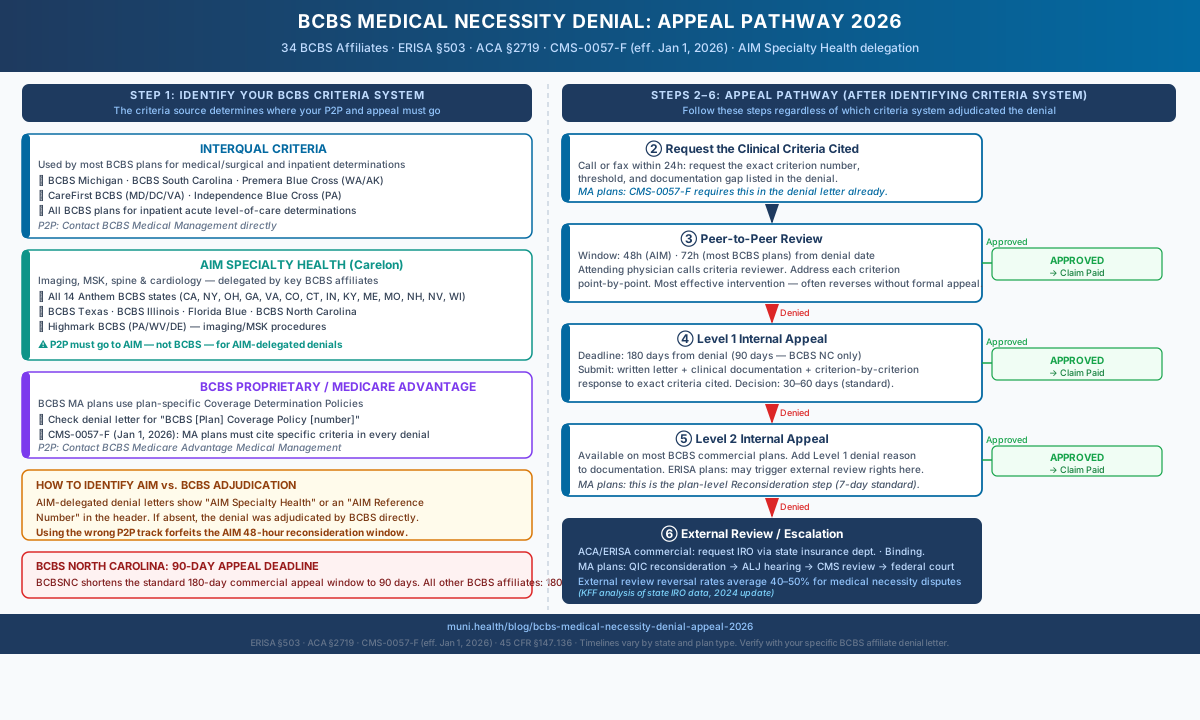
Appealing a BCBS medical necessity denial starts with identifying whether your denial was adjudicated by BCBS directly or delegated to AIM Specialty Health — that determination changes where your peer-to-peer review must go. Request a P2P within 48–72 hours of denial, then file a written Level 1 appeal within 180 days (90 days in North Carolina) with a criterion-by-criterion response to the exact clinical rationale cited in the denial notice.
Why BCBS Medical Necessity Appeals Require a Different Strategy
BCBS medical necessity appeals fail more often than they should — not because the clinical case is weak, but because the appeal goes to the wrong place with the wrong argument.
Blue Cross Blue Shield is not one insurer. It is a federation of 34 independent companies, each with its own clinical criteria policies, delegation arrangements, and appeal routing. A denial from Florida Blue follows different rules than a denial from BCBS Michigan or Anthem BCBS of California. The most consequential difference: which criteria system adjudicated the denial.
Most BCBS affiliates use InterQual (Change Healthcare) for inpatient and medical/surgical decisions. But key affiliates — all 14 Anthem BCBS states, BCBS Texas, BCBS Illinois, Florida Blue, BCBS North Carolina, and Highmark BCBS — delegate imaging, MSK, and spine procedure reviews to AIM Specialty Health (now operating under the Carelon brand). An AIM-delegated denial requires an AIM peer-to-peer review. Filing a BCBS peer-to-peer review instead forfeits the AIM 48-hour reconsideration window and delays the fastest path to reversal.
Since January 1, 2026, BCBS Medicare Advantage plans must also comply with CMS-0057-F, which requires specific clinical criteria — not just denial codes — in every MA denial notice. This change gives practices a clearer target for their appeal argument.
AMA Prior Authorization Survey, 2024 (n=1,004 physicians)
86% of physicians reported that prior authorization and medical necessity requirements cause treatment delays. 34% reported a serious adverse event tied to a PA or medical necessity denial.
Step 1: Identify Your BCBS Affiliate's Criteria System
Before writing a single word of your appeal, confirm which criteria system issued the denial. This single step determines the P2P route, the appeal format, and the clinical argument structure.
How to identify AIM vs. BCBS adjudication: Open the denial letter and look at the header. AIM-delegated denial letters will show "AIM Specialty Health" or include an "AIM Reference Number" prominently in the top section. If neither appears, the denial was adjudicated by BCBS directly using InterQual or a BCBS proprietary policy.
The three criteria systems you will encounter:
InterQual (Change Healthcare): Used by most non-Anthem BCBS affiliates for medical and surgical decisions, and by all affiliates for inpatient acute level-of-care determinations. BCBS Michigan, BCBS South Carolina, Premera Blue Cross (WA/AK), CareFirst BCBS (MD/DC/VA), and Independence Blue Cross (PA) are consistently InterQual-based for outpatient procedures. Appeals against InterQual-based denials should cite the specific InterQual criterion shortfall identified in the denial and map the patient's clinical record to each criterion point-by-point.
AIM Specialty Health (Carelon): Covers imaging, musculoskeletal, spine, and cardiology procedures for Anthem BCBS affiliates across all 14 states, plus BCBS Texas, BCBS Illinois, Florida Blue, BCBS North Carolina, and Highmark BCBS (PA/WV/DE). AIM updated its clinical criteria guidelines for musculoskeletal and spine procedures in Q2 2025, adding more specific conservative treatment duration requirements. P2P for AIM denials goes to AIM — not BCBS. The AIM P2P window is 48 hours from the denial date.
BCBS Proprietary / Medicare Advantage: BCBS MA plans use plan-specific Coverage Determination Policies. The denial letter will cite a BCBS policy number (e.g., "Blue Cross Blue Shield Coverage Policy: Lumbar Spine Surgery 1.01.XX"). Under CMS-0057-F, effective January 1, 2026, MA plans must now state the specific clinical criteria and documentation that led to the denial — if the denial letter lacks this detail, the determination may itself be procedurally defective and grounds for an expedited reconsideration request.
Step 2: Request the Specific Clinical Criteria Cited
You cannot write a criterion-by-criterion appeal without knowing which criteria the reviewer applied. Request this within 24 hours of receiving the denial.
For commercial plans, call the number on the denial letter and ask: "Please provide the specific InterQual or AIM criterion number, the threshold that was not met, and the documentation gap identified by the reviewer." Most plans will fax or portal-message this within 24–48 hours.
For BCBS Medicare Advantage plans, the CMS-0057-F requirement (effective January 1, 2026) means the specific clinical rationale must already be in the denial notice. If the denial only lists a code or a general reason, file a complaint with your BCBS MA plan's Provider Relations line citing the CMS-0057-F noncompliance — this often triggers an expedited re-review before formal appeal is necessary.
Do Not Start the Appeal Letter Without This Information
A generic medical necessity argument ("the treatment is clinically necessary for this patient") fails because it does not address the specific criterion shortfall the reviewer identified. Criterion-by-criterion responses achieve materially higher overturn rates than narrative-only appeals.
Step 3: Peer-to-Peer Review (48–72 Hour Window)
Peer-to-peer review is the fastest path to reversing a BCBS medical necessity denial — and it must happen before the window closes.
Window: AIM Specialty Health — 48 hours from denial date. Most BCBS plans directly — 72 hours from denial date. Missing the P2P window does not forfeit the formal appeal right, but it removes the lowest-friction reversal path and forces a full written appeal instead.
Who should request it: The attending or ordering physician, not a billing staff member. P2P reviewers are licensed physicians; the conversation is clinical, not administrative.
What to cover in the P2P call:
- State the exact criterion shortfall identified in the denial notice
- Walk through how the patient's documented clinical course meets each criterion
- Reference failed conservative treatments, prior clinical responses, and relevant guidelines
- For AIM: ask which AIM Clinical Appropriateness Guideline version was applied — AIM updates guidelines regularly, and an appeal may be strengthened if the wrong version was used
For imaging and MSK procedures under AIM delegation, the P2P is often more effective than the written appeal, because AIM's clinical reviewers can modify the determination in real time on the call. According to the AMA's 2024 Prior Authorization Survey, physicians who complete peer-to-peer reviews report approval on the first P2P contact at significantly higher rates than those relying on written appeals alone.
Step 4: Level 1 Internal Appeal
If the P2P review does not reverse the denial, file a formal Level 1 written appeal.
Deadline: 180 days from the denial date for most BCBS commercial plans. Exception: BCBS North Carolina — 90 days. For BCBS Medicare Advantage: 60 days from the organization determination date.
Submit to: The appeals address on the denial letter — not the general claims address. Each BCBS affiliate routes appeals separately; submitting to the wrong address starts a delay clock that can eat into your deadline.
What to include:
- Denial letter (original)
- Patient clinical records relevant to the denied service (targeted — not the entire chart)
- Physician attestation letter structured as a criterion-by-criterion response
- Peer-reviewed literature supporting medical necessity (if criteria are proprietary or more restrictive than guidelines)
- BCBS Medical Policy or Clinical Policy Bulletin (CPB) number cited in the denial, with your response to each section
- For AIM denials: the AIM Clinical Appropriateness Guideline version and section
Level 1 appeal letter template:
[Date]

[BCBS Affiliate] Appeals Department
[Address from Denial Letter — do not guess]

Re: Level 1 Medical Necessity Appeal
Member Name: [Full Name]
Member ID: [Member ID]
Date of Service: [DOS]
Claim Number: [Claim Number]
Service Denied: [Service/CPT Description]
Denial Date: [Denial Date]

Dear Appeals Reviewer,

We are filing a formal Level 1 appeal of the medical necessity denial dated
[Denial Date] for [Service Description] for the above-referenced member.

RESPONSE TO CLINICAL CRITERIA CITED IN DENIAL
[Criterion or policy section cited in denial notice]:

Criterion 1 ([exact criterion text or number]):
The patient's records document [specific clinical finding] as of [date],
which satisfies this criterion because [explanation].
See: [Attached document, page/date].

Criterion 2 ([exact criterion text or number]):
[Repeat structure above for each criterion.]

SUPPORTING CLINICAL EVIDENCE
Per [Guideline Source, Year and version], [clinical statement]. This is
consistent with [BCBS Medical Policy / CPB number] section [X].

DOCUMENTATION ENCLOSED
- Office notes: [dates]
- Imaging / lab results: [as applicable]
- Ordering physician attestation
- Relevant clinical guidelines (citation and excerpt)

We request a determination within [30/60] days per [BCBS affiliate] appeal
policy. Please direct any questions to [contact name, phone, fax].

Sincerely,
[Physician Name, Credentials]
[Practice Name]
[NPI]
[Phone / Fax]
Skip the blank template. Start with a review-ready draft.
Use the template as guidance, or let Muni prepare a payer-specific draft for your team to verify, sign, and submit.
First 3 appeals free, then $20 per appeal. Start with your denial letter or EOB and available records. No meeting or clearinghouse connection required.
Criterion-by-Criterion Format
Appeals that address every criterion cited in the denial — not just the primary one — achieve significantly higher overturn rates. Reviewers are evaluating each criterion independently; leaving any unaddressed gives the reviewer grounds to uphold even if you win the main argument.
BCBS Affiliate Appeal Requirements
The table below covers key affiliates. Verify the current submission address and deadline on the specific denial letter — BCBS affiliates update portal routing periodically.
| BCBS Affiliate | Criteria System | P2P Route | Commercial Appeal Deadline | Notable |
|---|---|---|---|---|
| Anthem BCBS (14 states) | AIM (imaging/MSK); InterQual (inpatient) | AIM P2P for AIM-denied; Anthem for others | 180 days | CA, NY, OH, GA, VA, CO, CT, IN, KY, ME, MO, NH, NV, WI |
| BCBS Texas | AIM Specialty Health | AIM P2P | 180 days | AIM updated MSK criteria Q2 2025 |
| BCBS Illinois | AIM Specialty Health | AIM P2P | 180 days | Availity for claim appeal submission |
| Florida Blue | AIM (imaging/MSK); InterQual (inpatient) | AIM P2P for AIM-denied | 180 days | Dominant FL payer; ~5M members |
| BCBS North Carolina | AIM Specialty Health | AIM P2P | 90 days ⚠ | Shorter deadline — calendar carefully |
| BCBS Michigan | InterQual | BCBSM Medical Management | 180 days | Separate behavioral health criteria |
| Highmark BCBS (PA/WV/DE) | AIM (imaging/MSK); InterQual (inpatient) | AIM or Highmark | 180 days | NaviMed portal for PA; Availity for appeals |
| Premera Blue Cross (WA/AK) | InterQual | Premera Medical Management | 180 days | AK plans may differ — check denial letter |
| CareFirst BCBS (MD/DC/VA) | InterQual | CareFirst Medical Management | 180 days | Separate ERISA and non-ERISA tracks |
| BCBS Massachusetts | Carelon (AIM affiliate) | Carelon/BCBSMA | 30 days ⚠ | Shorter commercial appeal window |
Sources: BCBS affiliate provider manuals and appeal procedure guides, current as of May 2026. Verify deadline and routing on each denial letter — affiliates update submission addresses without notice.
For Anthem-specific appeal letter templates, AIM P2P routing, and Availity submission steps across all 14 Anthem states, see the Anthem appeal letter template guide.
Step 5: Level 2 Internal Appeal
If Level 1 is denied, most BCBS commercial plans offer a Level 2 internal appeal or formal reconsideration.
Prepare this appeal packet with your team.
Draft the appeal, coordinate missing documents, and approve the reviewed packet. Keep your clearinghouse; your practice checks deadlines and submits through the payer’s accepted channel.
First 3 appeals free, then $20 per appeal. Start with your denial letter or EOB and available records. No meeting or clearinghouse connection required.
Level 2 appeals should add: the Level 1 denial rationale (include it verbatim), a direct rebuttal to the reviewer's Level 1 reasoning, any new clinical records generated since the Level 1 submission, and — if the denial cites criteria that conflict with established clinical guidelines — a peer-reviewed literature citation that directly contradicts the criteria.
For ERISA-governed plans (most employer-sponsored commercial plans), federal regulations under ERISA §503 require that the plan's final internal determination trigger external review rights. Keep track of which level you are on — some BCBS affiliates label Level 2 as "Formal Reconsideration" rather than "Level 2 Appeal," but the external review trigger is the same.
For BCBS Medicare Advantage plans, the Level 2 equivalent is the QIC Reconsideration — submitted to the Qualified Independent Contractor, not to BCBS. QIC reconsiderations must be filed within 60 days of the BCBS plan-level denial. The QIC is independent and issues a binding determination within 60 days (standard) or 72 hours (expedited).
Step 6: External Review and Escalation Rights
After a final internal denial, you have the right to external review — and that review is binding on the plan.
ACA-compliant commercial plans: Under ACA §2719, you may request an Independent Review Organization (IRO) review through your state insurance department after exhausting internal appeals. The IRO is independent from BCBS, the review is binding, and BCBS cannot appeal an IRO determination in most states. External review overturn rates for medical necessity disputes average 40–50%, according to KFF's 2024 analysis of state IRO data.
ERISA plans: Federal external review rights apply. The plan must provide access to an IRO after the final internal denial. ERISA plans are not subject to state insurance department jurisdiction, but the ACA external review rules apply to all non-grandfathered ERISA plans.
BCBS Medicare Advantage: MA plans follow the CMS appeal ladder — plan-level denial → QIC Reconsideration → ALJ Hearing (if amount in controversy ≥ $180 in 2026) → Medicare Appeals Council → Federal District Court. The ALJ stage has historically had the highest overturn rate in the MA ladder.
For a detailed walkthrough of external review procedures across BCBS affiliates, see the BCBS external review process guide.
External Review Is Underused
Most practices exhaust internal appeals and stop there. IRO external review is an independent, binding path that costs nothing to file in most states — and it is appropriate any time the plan has issued a final internal denial based on medical necessity criteria that conflict with established clinical guidelines.
How Muni Appeals Helps With BCBS Medical Necessity Denials
BCBS medical necessity appeals are documentation-intensive. The criteria-system identification step, P2P scheduling, and criterion-by-criterion letter format each add time before a single word of the actual clinical argument is written.
Muni Appeals organizes the appeal workflow for BCBS denials across affiliates:
- Identifies AIM vs. InterQual vs. proprietary adjudication from the denial notice
- Surfaces peer-to-peer deadline risk from the uploaded denial; staff verifies and calendars the controlling AIM or BCBS window
- Builds criterion-by-criterion appeal letters mapped to the specific criteria cited in the denial
- Surfaces deadline risk across affiliates for staff verification and calendaring
- Surfaces candidate BCBS CPB and AIM guideline references for staff to verify against current sources
Frequently Asked Questions
What is the difference between a BCBS medical necessity denial and a prior authorization denial?
A prior authorization denial means BCBS refused to approve a service before it was performed. A medical necessity denial means BCBS reviewed the claim after service was rendered (or after a PA was filed) and determined the service did not meet clinical criteria. The appeal process is similar, but post-service medical necessity denials use your completed clinical records as evidence — which is often stronger than a pre-service PA appeal based on anticipated need.
Can I request the clinical criteria BCBS used to deny my claim?
Yes. For commercial plans, request the specific InterQual or AIM criterion version, criterion number, and the documentation shortfall identified by the reviewer. Most affiliates will provide this on request. For BCBS Medicare Advantage plans, CMS-0057-F (effective January 1, 2026) requires this information to appear in every denial notice — if the notice only lists a code, the determination may be procedurally deficient.
What happens if I miss the 48-hour AIM P2P window?
Missing the AIM peer-to-peer window does not forfeit the formal written appeal. You still have 180 days (or 90 days for BCBS NC) to file a Level 1 internal appeal. The written appeal requires more documentation than a P2P, but it covers the same clinical ground. Missing the P2P window simply eliminates the fastest reversal path.
How long does BCBS take to respond to a medical necessity appeal?
Most BCBS affiliates process standard Level 1 appeals within 30–60 days for commercial plans. Expedited appeals — where a delay would seriously jeopardize the patient's health — must be decided within 72 hours. BCBS Medicare Advantage standard appeals: 7 calendar days for organization determinations; 30 days for plan-level appeal reconsideration. Always confirm the specific timeline with your affiliate's denial letter.
Does the criteria system change if my BCBS patient has a Medicare Advantage plan?
Yes. BCBS Medicare Advantage plans use proprietary Coverage Determination Policies and are governed by CMS regulations, not state insurance law. The AIM Specialty Health delegation that applies to commercial procedures may or may not apply to MA — BCBS MA denial letters will identify the specific policy applied. MA plans also follow the CMS 5-level appeal ladder rather than the ACA external review process.
What is AIM Specialty Health, and why does it affect my BCBS appeal?
AIM Specialty Health (now operating as Carelon) is a radiology benefit management company that major BCBS affiliates have delegated authority to review and deny imaging, musculoskeletal, spine, and cardiology procedures. When AIM issues the denial, the peer-to-peer review and initial reconsideration must go through AIM — not BCBS. The formal written appeal at Level 1 still goes to BCBS. Failing to distinguish between AIM and BCBS adjudication is one of the most common reasons P2P windows are missed.
When should I request external review instead of a second internal appeal?
Request external review when the denial is based on criteria that are more restrictive than established clinical guidelines, when internal reviewers have consistently applied the same criterion regardless of your documentation, or when the denial involves a procedure that clinical societies have designated as standard of care. External review is also worth pursuing when the claim amount justifies the process — there is no filing fee in most states, and IRO decisions are binding on the plan.
How do I appeal a BCBS medical necessity denial for a service that was already performed?
Post-service medical necessity denials follow the same appeal process as pre-service denials. The key advantage is that you have complete clinical records as evidence. Build the appeal around the actual clinical course — documenting the diagnosis, the failed alternatives, the clinical decision point, and the outcomes — rather than projected medical need. Post-service appeals that include physician attestation letters mapped to the denial criteria have a higher reversal rate than appeals relying on records alone.
Ready to Stop Losing BCBS Medical Necessity Denials?
Most BCBS medical necessity denials are overturned when the appeal addresses the exact criteria cited in the denial notice. The work is documentation and format — identifying the right criteria system, requesting the specific criterion shortfall, and responding point-by-point in the appeal letter.
Get Started:
- Identify AIM vs. InterQual vs. BCBS proprietary adjudication before drafting
- Request specific clinical criteria within 24 hours of receiving the denial
- File P2P within 48–72 hours — the fastest path to reversal
- File Level 1 appeal with criterion-by-criterion response within 180 days (90 days BCBS NC)
- Use external review rights after final internal denial
This guide reflects 2026 BCBS medical necessity appeal procedures and CMS-0057-F requirements effective January 1, 2026. BCBS affiliate procedures, criteria systems, and appeal deadlines vary by state and plan type. Always verify submission addresses, deadlines, and criteria sources from your specific denial letter. This guide does not constitute legal or clinical advice.