

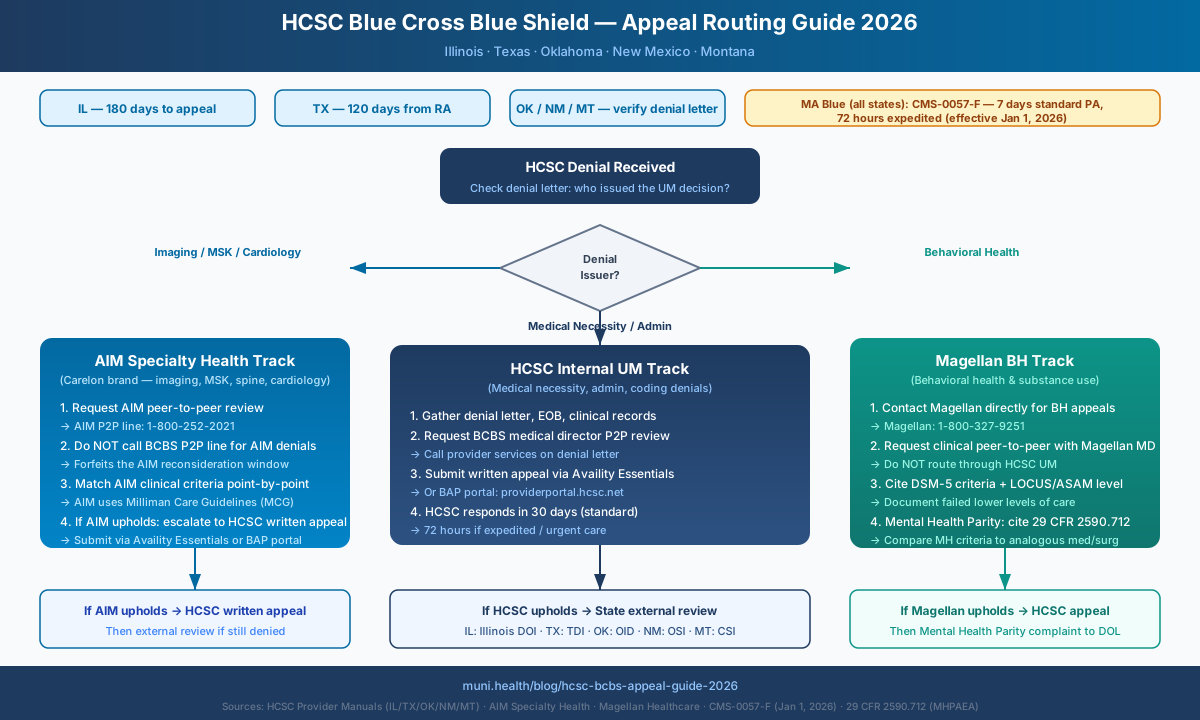
Health Care Service Corporation (HCSC) operates BCBS plans in five states — Illinois, Texas, Oklahoma, New Mexico, and Montana — under a single parent company with shared UM policies. Provider appeal deadlines range from 120 days (TX) to 180 days (IL) from the denial date. The critical routing rule: imaging and MSK denials go through AIM Specialty Health (not HCSC's internal UM team), and behavioral health denials go through Magellan Healthcare. Sending an appeal to the wrong reviewer delays resolution by weeks.
What Makes HCSC Different from Other BCBS Affiliates
HCSC is not the same as Anthem, Highmark, or Florida Blue. It is a single mutual legal reserve company that holds BCBS licenses for all five states — meaning its medical policies, UM vendor delegations, and appeal procedures travel across state lines far more consistently than affiliates like Highmark (which operates five separate regional companies) or the BCBS BlueCard host-plan system.
This shared structure has a practical upside: the clinical criteria HCSC uses for imaging PA in Texas are the same criteria it uses in Illinois. The delegated vendor stack is the same. The Blue Access for Providers (BAP) portal at providerportal.hcsc.net is shared across all five states. Billing teams that learn the HCSC appeal workflow in one state can apply it in all five.
The downside: HCSC's delegated UM structure sends different service categories to entirely different vendors — and filing an appeal with the wrong vendor resets the clock.
The #1 HCSC Appeal Mistake
Filing a peer-to-peer review with HCSC's medical director for an imaging or MSK denial. HCSC has delegated these to AIM Specialty Health (operating under the Carelon brand). The AIM P2P line is separate from HCSC's. Calling HCSC instead of AIM does not preserve the AIM reconsideration window — and AIM's window closes faster than HCSC's standard review period.
HCSC 5-State Affiliate Map and Appeal Deadlines
HCSC operates as five separately licensed BCBS affiliates. Each carries its own regulatory obligations under its state's insurance code, which affects the external review pathway if an internal appeal fails.
| State Affiliate | Standard Appeal Deadline | HCSC Response Time | External Review Body |
|---|---|---|---|
| BCBS of Illinois (BCBSIL) | 180 days from denial date | 30 days (standard) | Illinois DOI |
| BCBS of Texas (BCBSTX) | 120 days from RA receipt | 30 days (standard) | Texas Dept of Insurance (TDI) |
| BCBS of Oklahoma (BCBSOK) | Verify in denial letter — typically 120–180 days | 30 days (standard) | OK Insurance Dept (OID) |
| BCBS of New Mexico (BCBSNM) | Verify in denial letter — typically 120–180 days | 30 days (standard) | NM OSI |
| BCBS of Montana (BCBSMT) | Verify in denial letter — typically 120–180 days | 30 days (standard) | MT CSI |
| HCSC Medicare Advantage Blue (all states) | 60 days from denial notice | 7 days (CMS-0057-F, Jan 1 2026) | CMS — not state DOI |
The denial letter controls. If your letter specifies a shorter window than the state default, that shorter window applies. For Texas specifically, BCBSTX requires reconsideration requests within 120 calendar days of the remittance advice date — not 180 days — and this catches billing teams who apply the BCBSIL timeline to Texas claims.
MA Blue: Federal Override Since January 1, 2026
Under CMS-0057-F (effective January 1, 2026), all HCSC Medicare Advantage Blue plans must decide standard prior authorization requests within 7 calendar days and expedited requests within 72 hours. If an HCSC MA Blue plan misses these federal timelines, the request defaults to approved under federal regulations — escalate directly to CMS, not the state DOI.
The Three HCSC UM Tracks: Who Reviews What
HCSC delegates medical management to three separate entities depending on service type. The denial notice header identifies which entity made the determination. Read it before routing an appeal.
Track 1 — AIM Specialty Health (Carelon): High-tech diagnostic imaging (MRI, CT, PET), musculoskeletal procedures, spine surgery, outpatient cardiology, sleep studies, and select radiation oncology. AIM issues the denial under its own letterhead with its own criteria references. The appeal goes to AIM first.
Track 2 — HCSC Internal UM: Medical necessity determinations for inpatient admissions, length of stay, general outpatient procedures not delegated to AIM, and all coding and administrative denials (timely filing, authorization absent, coordination of benefits). These go through HCSC's standard provider appeal process.
Track 3 — Magellan Healthcare: Behavioral health and substance use disorder authorization and utilization management for commercial plans. Magellan issues the denial and handles the initial appeal. The HCSC internal appeal process is the escalation step if Magellan upholds.
If the denial notice doesn't clearly identify the issuer, call the provider services number on the denial. Ask whether the denial originated from AIM, Magellan, or HCSC UM directly before filing anything.
Step-by-Step: Appealing an AIM Specialty Health Denial (HCSC Plans)
AIM-delegated denials require a specific sequence. The fastest path to reversal is an AIM peer-to-peer review before a written appeal.
Step 1: Identify the AIM Denial Indicator
The denial letter will reference AIM Specialty Health or Carelon as the issuing reviewer. The clinical criteria cited will typically reference Milliman Care Guidelines (MCG) or AIM's proprietary clinical protocols — not HCSC's Medical Policy Bulletins.
Step 2: Request AIM Peer-to-Peer Review
Call AIM's provider peer-to-peer line at 1-800-252-2021 (not HCSC's provider services line). Identify the AIM authorization number from the denial letter. AIM peer-to-peer reviews must be requested promptly after the denial — do not wait for the HCSC written appeal deadline.
Prepare to address the AIM clinical criteria point-by-point. AIM reviewers evaluate against Milliman Care Guidelines, not just HCSC's general medical necessity standard. Have the patient's imaging history, failed conservative treatment documentation, and relevant clinical guidelines (ACR, AAOS, ACC as applicable) ready during the call.
Step 3: If AIM Upholds After Peer-to-Peer
A denial upheld by AIM after peer-to-peer escalates to HCSC's internal appeal process. Submit the written appeal through Availity Essentials (preferred for electronic submission) or through the Blue Access for Providers portal at providerportal.hcsc.net. Include:
- AIM denial letter with authorization number
- Peer-to-peer review summary or confirmation
- Complete clinical documentation addressing AIM's stated denial criteria
- Applicable clinical guidelines cited by source, edition, and page
Step 4: If HCSC Internal Appeal Is Upheld
Request independent external review through your state's external review body (see the table above). External review is available at no cost to the practice and is binding on HCSC.
Step-by-Step: Appealing an HCSC Internal UM Denial
Standard medical necessity, inpatient, and administrative denials follow HCSC's direct appeal process.
Step 1: Analyze the Denial Code and Reason
HCSC denial letters include a reason code and narrative. Common codes for medical necessity denials reference HCSC Medical Policy Bulletins — these are public and accessible through the Blue Access for Providers portal under "Medical Policies." Pull the specific bulletin cited and compare its criteria to your clinical documentation before writing the appeal.
Step 2: Request HCSC Medical Director Peer-to-Peer
Call the provider services number on the denial letter and request a peer-to-peer review with the HCSC medical director who reviewed the case. Peer-to-peer for standard cases typically occurs within 2–3 business days of the request.
For a detailed framework on preparing for insurance peer-to-peer reviews — including what to say, what documentation to have ready, and how to counter specific denial rationales — see the BCBS medical necessity denial appeal guide 2026.
Step 3: Submit Written Appeal via Availity or BAP
HCSC accepts electronic claim reconsideration submissions through Availity Essentials for most commercial claim denials. Upload the completed reconsideration form, supporting clinical records, and your written appeal letter. Monitor status directly in Availity.
For non-electronic submissions, fax or mail the appeal using the address or fax number on the denial letter. Always use certified mail with return receipt for mailed appeals — the postmark date establishes timely filing if HCSC disputes receipt.
Step 4: HCSC Response Timeline
HCSC processes standard provider appeals within 30 calendar days. Expedited appeals (for situations where standard timing would seriously jeopardize health) must be decided within 72 hours. If HCSC does not respond within these periods, escalate to your state DOI and reference the specific regulatory timeline requirement.
Standard HCSC Appeal Letter Header:

[Date]
Blue Cross Blue Shield of [State]
Provider Appeals Department
[Address from denial letter]

RE: Provider Appeal — Medical Necessity Reconsideration
Member Name: [Name]
Member ID: [ID]
Claim/Auth Number: [From denial letter]
Date of Service: [DOS]
Rendering Provider NPI: [NPI]
Denial Reason: [From denial notice]

This appeal is submitted within [state] Blue Cross Blue Shield's
[120/180]-day provider appeal window per the denial notice
dated [Date].
Skip the blank template. Start with a review-ready draft.
Use the template as guidance, or let Muni prepare a payer-specific draft for your team to verify, sign, and submit.
First 3 appeals free, then $20 per appeal. Start with your denial letter or EOB and available records. No meeting or clearinghouse connection required.
Step-by-Step: Appealing a Magellan Behavioral Health Denial (HCSC Plans)
Behavioral health and substance use disorder denials on HCSC commercial plans route through Magellan Healthcare, not HCSC's internal UM team. The appeal process starts with Magellan.
Step 1: Contact Magellan Directly
Call Magellan Healthcare's provider line at 1-800-327-9251 for HCSC/BCBSTX commercial behavioral health denials. For HCSC IL commercial BH denials, the Magellan provider contact is identified on the denial letter — the number may differ by state.
Step 2: Request Magellan Clinical Peer-to-Peer
Magellan's peer-to-peer process requires the treating clinician (not billing staff) to speak directly with the Magellan medical director. Have the following ready:
- DSM-5 diagnosis with specific specifiers
- Current GAF or PHQ-9/Columbia Severity scores
- LOCUS or ASAM level of care justification
- Documentation of failed lower levels of care (required for higher-intensity settings)
- Safety plan or risk assessment if relevant
Step 3: Cite Mental Health Parity (29 CFR 2590.712)
If Magellan is applying more restrictive criteria for behavioral health than HCSC applies to analogous medical/surgical benefits, that is a potential Mental Health Parity and Addiction Equity Act (MHPAEA) violation. Under 29 CFR 2590.712, non-quantitative treatment limitations (NQTLs) for mental health and substance use disorders cannot be more restrictive than those applied to comparable medical/surgical benefits.
Document the comparison explicitly in the appeal letter: what criteria Magellan is applying, what criteria HCSC applies to analogous medical/surgical services, and why the difference constitutes an NQTL violation. If Magellan upholds the denial, this parity argument escalates directly to the DOL Employee Benefits Security Administration.
Magellan vs. HCSC: Who Gets the Second Appeal
After Magellan upholds a denial, the escalation goes to HCSC's internal appeal process — not back to Magellan. HCSC makes the final internal determination. If HCSC also upholds, the external review pathway opens (state DOI for commercial plans, CMS for MA Blue plans).
HCSC Medicare Advantage Blue: 2026 Appeal Changes
HCSC Medicare Advantage Blue plans in all five states are subject to CMS-0057-F, which took effect January 1, 2026. The key changes affecting provider appeals:
Prepare this appeal packet with your team.
Draft the appeal, coordinate missing documents, and approve the reviewed packet. Keep your clearinghouse; your practice checks deadlines and submits through the payer’s accepted channel.
First 3 appeals free, then $20 per appeal. Start with your denial letter or EOB and available records. No meeting or clearinghouse connection required.
PA denial notices must now cite specific clinical criteria. Generic "not medically necessary" language without specific criteria is a deficient notice under CMS-0057-F. If an HCSC MA Blue denial does not cite the specific clinical criteria used to deny the request, the notice itself is procedurally deficient — document this and reference it in the appeal.
Standard PA decisions must be made within 7 calendar days. If HCSC MA Blue misses this deadline, the authorization request is automatically approved by operation of federal regulation. Do not withdraw the request if HCSC is running late — let the 7-day clock expire and then document the date of submission vs. the missed deadline.
AIM delegation continues for MA plans. AIM Specialty Health manages imaging, MSK, and cardiology PA under HCSC MA Blue plans the same way it does for commercial plans. The AIM P2P process described above applies to MA denials as well.
Common HCSC Denial Codes and What They Mean
| Denial Code | Reason | HCSC Track | First Response |
|---|---|---|---|
| CO-197 | Authorization absent or invalid | HCSC Internal | Request retro-auth or prove no auth required |
| CO-96 / N130 | Non-covered or experimental per plan | HCSC Internal | Check HCSC Medical Policy Bulletin cited |
| CO-50 | Service not medically necessary | HCSC Internal or AIM | Identify who issued the denial first |
| PR-96 | Experimental — member liability | HCSC Internal | Cite FDA approval or established clinical guidelines |
| CO-22 | COB — coordination of benefits | HCSC Internal | Verify primary/secondary payer order |
| CO-29 | Timely filing exceeded | HCSC Internal | Document earliest timely filing date with proof |
| AIM denial — RQI | Imaging not clinically appropriate | AIM Specialty Health | Request AIM P2P immediately — do not call HCSC |
| Magellan H0037 | Not medically necessary — BH level | Magellan Healthcare | Request Magellan P2P; prepare LOCUS/ASAM justification |
For billing-specific denials like CO-29 (timely filing) across HCSC and other BCBS affiliates, see the BCBS timely filing limits 2026 guide for affiliate-by-affiliate deadlines and evidence of timely filing requirements.
HCSC BlueCard: When the Member Is From Another BCBS State
If a patient carries BCBS coverage from a state other than your practice's state, HCSC may be acting as the host plan. Identify the alpha-prefix on the member ID card:
- Alpha-prefix starts with Z (ZKA, ZKB, ZKG…): HCSC is the home plan — use BAP and HCSC's standard appeal process
- Alpha-prefix from another BCBS plan: Your local HCSC plan is the host plan, and the home plan's policies apply to medical necessity determinations
For the complete BlueCard routing logic and how to identify the home plan for appeal submissions, see the BCBS BlueCard provider appeal guide 2026.
How Muni Appeals Handles HCSC Denials
HCSC's three-track UM structure creates a common failure point: a team receives an AIM denial and submits a BCBS internal appeal, forfeiting the AIM peer-to-peer window. Muni Appeals surfaces the likely issuing UM vendor and track from the uploaded notice; staff verifies the current route and deadline before filing.
For HCSC denials, Muni:
- Identifies whether the denial originated from AIM, Magellan, or HCSC UM using the denial notice header and denial code
- Generates an appeal draft with candidate AIM, Magellan, or HCSC criteria for staff verification
- Surfaces AIM, Magellan, and HCSC deadline context from the uploaded notice; staff verifies and calendars the controlling timer
- Flags potential MHPAEA violations in Magellan BH denials where the criteria are more restrictive than comparable med/surg benefits
- Supports all five HCSC state affiliates with state-specific external review guidance
Frequently Asked Questions
Does HCSC use Availity or Blue Access for Providers for appeals?
HCSC uses both. Availity Essentials is the preferred electronic channel for claim reconsideration submissions at BCBS Illinois and is supported across HCSC commercial plans. Blue Access for Providers (BAP) at providerportal.hcsc.net is the primary HCSC provider portal for eligibility, claims status, and PA management. For most billing teams, Availity Essentials is the faster path for electronic appeal submissions; the BAP portal is required for PA-related appeals and authorization requests.
Why do I need to call AIM instead of HCSC for imaging denials?
HCSC has contractually delegated imaging, MSK, and cardiology PA management to AIM Specialty Health (now Carelon). When AIM issues a denial, AIM is the first-level reviewer. HCSC's medical director peer-to-peer line does not have authority over AIM's determination at the first appeal level. Requesting a BCBS peer-to-peer for an AIM-issued denial delays resolution and may forfeit the AIM reconsideration window — which is time-limited and separate from HCSC's written appeal deadline.
What is the appeal deadline for HCSC Texas versus Illinois?
BCBS Texas requires reconsideration requests within 120 calendar days of the remittance advice date. BCBS Illinois allows 180 days from the denial date. If your practice bills across HCSC states, do not assume the Illinois timeline applies to Texas claims — this is one of the most common HCSC billing errors. Always read the deadline in the denial letter, which controls over the state default.
Can I request external review for an HCSC denial?
Yes. After HCSC's internal appeal process is exhausted, you can request independent external review through your state's external review body: Illinois DOI, Texas Department of Insurance (TDI), Oklahoma Insurance Department (OID), New Mexico OSI, or Montana CSI. External review is binding on HCSC and is available at no cost. For Medicare Advantage Blue plans, external review is through a CMS-contracted Qualified Independent Contractor (QIC), not the state DOI.
Does HCSC use EviCore or Carelon for imaging PA?
HCSC uses AIM Specialty Health, which now operates under the Carelon brand (Carelon Medical Benefits Management). HCSC does not use eviCore. This is a key difference from Anthem BCBS, which uses Carelon/AIM in some states and eviCore in others. For HCSC plans across all five states, AIM/Carelon is the imaging and MSK PA vendor.
What criteria does Magellan use for behavioral health denials on HCSC plans?
Magellan applies its own clinical protocols for level-of-care determinations, typically aligned with LOCUS (Level of Care Utilization System) for mental health and ASAM (American Society of Addiction Medicine) criteria for substance use disorder. Magellan's criteria must not be more restrictive than HCSC's criteria for analogous medical/surgical benefits under the Mental Health Parity and Addiction Equity Act (29 CFR 2590.712). When preparing a Magellan BH appeal, document the patient's current symptom severity, failed lower levels of care, and safety risk — these are the clinical elements Magellan's reviewers weigh most heavily.
Is HCSC the same as Anthem?
No. Anthem (now Elevance Health) and HCSC are separate BCBS licensees. Anthem operates in 14 states (including California, New York, Ohio, and Georgia). HCSC operates in Illinois, Texas, Oklahoma, New Mexico, and Montana. They share the BCBS brand but have separate UM vendor contracts, medical policies, and appeal procedures. Anthem uses Carelon/AIM for imaging PA in some states but also uses eviCore; HCSC uses AIM/Carelon exclusively. For Anthem-specific appeals, see the BCBS appeal guide.
What if the HCSC denial involves a BlueCard member from another state?
If the member's ID card alpha-prefix indicates a home plan other than your HCSC state affiliate, the home plan's medical policies govern the denial. The appeal still goes through HCSC (as the host plan), but the clinical criteria used are the home plan's. Contact HCSC's BlueCard provider services line for routing confirmation before submitting the written appeal.
Ready to Stop Losing HCSC Claims to Routing Errors?
The most preventable HCSC claim losses aren't bad medicine — they're billing teams sending appeals to the wrong vendor, missing the AIM peer-to-peer window, or applying the Illinois deadline to a Texas claim. Muni Appeals surfaces likely track context and prepares a review-ready draft; staff verifies the vendor, deadline, and documentation before filing.
Get Started:
- Likely AIM, Magellan, or HCSC UM context from the uploaded notice for staff routing verification
- Appeal letters matched to AIM MCG, Magellan clinical protocols, or HCSC Medical Policy Bulletins
- State-specific deadlines tracked across all five HCSC affiliates
- MHPAEA parity analysis for Magellan BH denials
- Support for HCSC Medicare Advantage Blue under CMS-0057-F
This guide reflects HCSC Blue Cross Blue Shield provider appeal procedures as of June 2026 for Illinois, Texas, Oklahoma, New Mexico, and Montana. State regulatory requirements, UM vendor delegations, and plan-level policies are subject to change. Always read the specific denial letter for deadlines and submission instructions that control your individual appeal. This guide does not constitute legal advice.