

When a BCBS BlueCard member's claim is denied, submit the appeal to YOUR LOCAL BCBS plan — the host plan — not the member's home state plan. The host plan coordinates with the home plan. Use the member's 3-character alpha prefix to identify the home plan, submit via Availity, and use the new standardized IPP BlueCard appeal form effective December 18, 2025.
Understanding the BlueCard Program: Who Handles What
The BlueCard program is the most misunderstood appeal scenario in BCBS billing — because it involves two separate insurance entities with two entirely different roles.
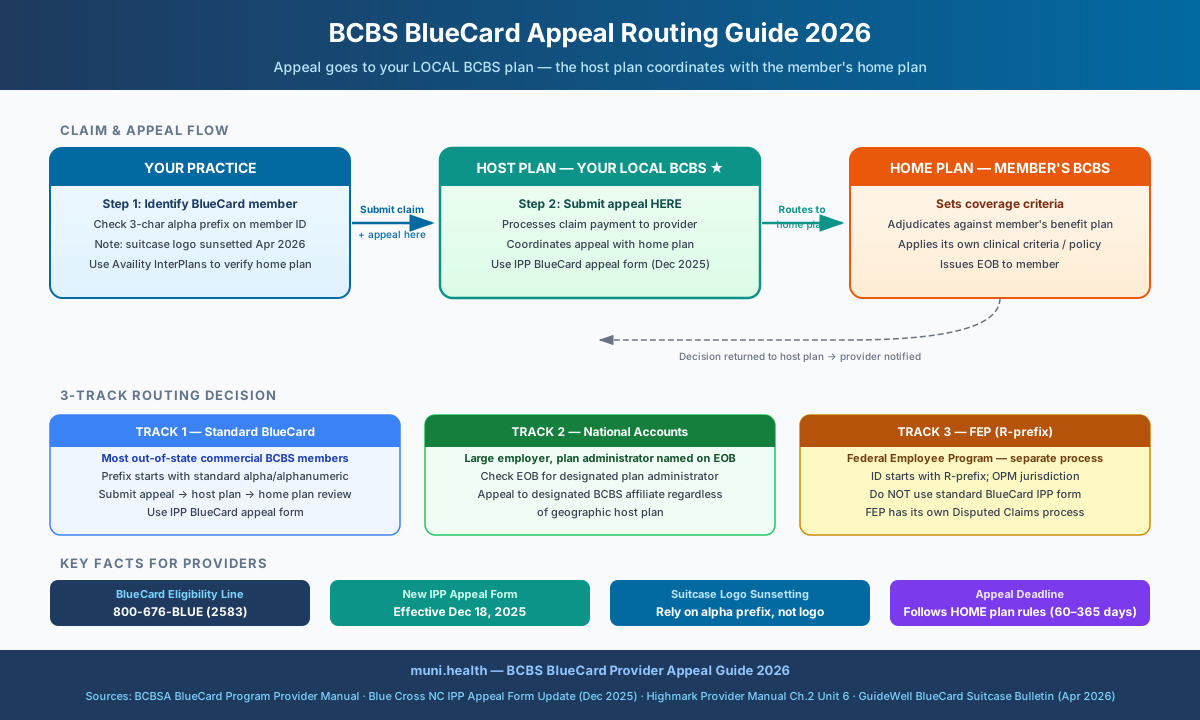
When a member insured by, say, BCBS of New York receives care at your practice in Texas, your local BCBS Texas (the host plan) processes your payment. But BCBS New York (the home plan) sets the member's benefits, applies its clinical criteria, and makes the actual coverage decision.
That split ownership is what causes practices to misdirect appeals. Getting the routing right — and building the appeal argument against the correct plan's policy — is the fix.
Host plan (your local BCBS):
- Receives and processes your claim submission
- Pays you at your contracted rate
- Handles all provider-facing interactions, including reconsiderations and formal appeals
- Coordinates appeal review with the home plan internally
Home plan (the member's originating BCBS):
- Adjudicates the claim against the member's specific benefit plan
- Applies its own clinical criteria and medical policy
- Issues the Explanation of Benefits to the member
- Makes the final coverage determination
The practical consequence: the home plan's clinical policy may be more restrictive or more permissive than your local plan's for the same procedure. You need to research the home plan's criteria — not your local plan's — when building a clinical appeal argument.
How to Identify a BlueCard Member: Alpha Prefix and 2026 ID Card Changes
The three-character alpha prefix at the start of a member's ID number is the most reliable BlueCard identifier. It automatically routes claims, eligibility requests, and prior authorization submissions to the correct home plan through the BlueCard system.
Prepare this appeal packet with your team.
Draft the appeal, coordinate missing documents, and approve the reviewed packet. Keep your clearinghouse; your practice checks deadlines and submits through the payer’s accepted channel.
First 3 appeals free, then $20 per appeal. Start with your denial letter or EOB and available records. No meeting or clearinghouse connection required.
Prefixes have been alphanumeric since 2018 — a format like "XYZ" or "X1A" — so do not assume a mixed character string means the member is not BCBS. Record the member ID exactly as shown on the card; do not alter or truncate the prefix. For the full identification workflow — including how to recognize an FEP "R" prefix and route to the correct licensee once you know it's not BlueCard — see our BCBS appeal form guide.
Important 2026 change: As of April 2026, BCBS began sunsetting the suitcase logo on member ID cards. Historically, a suitcase icon confirmed BlueCard coverage at a glance. New and replacement cards no longer carry the logo — they display the product type (PPO, HMO, EPO) instead. Rely on the alpha prefix, not the logo, going forward.
To verify which home plan a prefix belongs to:
- Use the InterPlans Medical Policy and Pre-Certification tool on Availity (no charge; Availity login required)
- Call the BlueCard Eligibility Line: 800-676-BLUE (2583) for routing assistance
For BlueCard claim or provider-appeal status, use your local host plan's current provider route — see our BCBS provider phone numbers guide 2026 for the licensee-by-licensee directory. Use the home-plan information for benefits and clinical-policy research, not as a reason to bypass the host plan's provider workflow.
Do Not Call the Home Plan Directly
Your contract is with the host plan — your local BCBS. Calling the home plan directly for claim disputes creates confusion and can delay resolution. All provider-facing appeal inquiries go through your host plan. If the member is appealing on their own behalf, they contact the home plan directly using the customer service number on their ID card.
The BlueCard Appeal Routing Rule: Three Tracks to Know
Submit your appeal to your local BCBS — the same entity you bill for that patient's claims. This holds even when the denial is based entirely on the home plan's clinical policy. Your host plan coordinates the review with the home plan; you do not contact the home plan directly to initiate an appeal.
There are three distinct routing tracks for out-of-area BCBS situations:
Track 1 — Standard BlueCard commercial plan (most common)
The member is insured by a BCBS affiliate in another state. Submit the appeal to your host plan. The host plan routes it to the home plan for adjudication. This covers the vast majority of out-of-state BCBS claims.
Track 2 — National account plans
Some large employers designate a specific BCBS affiliate as the plan administrator regardless of where services are delivered. The EOB will name a specific plan administrator rather than simply listing the geographic host plan. Appeal to that named affiliate — not just your local plan.
Track 3 — Federal Employee Program (FEP, R-prefix members)
FEP members carry subscriber IDs beginning with the letter R. FEP operates under OPM jurisdiction — separate from standard BlueCard. Do not file a standard BlueCard appeal for FEP members; FEP uses its own internal review and OPM Disputed Claims escalation path. Contact your host plan's FEP desk directly — do not use the standard IPP BlueCard appeal form for FEP claims. For the complete FEP appeal process, including OPM Disputed Claims deadlines and why state DOI complaints do nothing for FEP denials, see our BCBS FEP claim denial appeal guide.
Step-by-Step: Filing a BlueCard Denial Appeal
Step 1: Identify the Home Plan and Understand the Denial
Pull the EOB or Remittance Advice. Confirm:
- The 3-character alpha prefix (identifies the home plan)
- The denial reason code and remark code (clinical vs. administrative)
- Whether the denial requires a clinical argument (medical necessity, prior auth) or an administrative correction (coding, authorization number missing, timely filing)
For clinical denials, retrieve the home plan's specific clinical policy from Availity's InterPlans Medical Policy tool before drafting the appeal. The argument must address that plan's criteria — a generic argument built on your local plan's policy is a common failure point.
Step 2: Use the Correct Appeal Form
Since December 18, 2025, a standardized Inter-Plan Programs (IPP) BlueCard appeal form applies across all BCBS affiliates. Use this form for BlueCard claim disputes.
Do not submit both the standard commercial appeal form and the IPP BlueCard form for the same denial. Duplicate submissions delay processing and risk both being denied on procedural grounds.
For appeal letter templates and documentation guidance, see the BCBS appeal letter template guide 2026.
Step 3: Submit via Availity to the Host Plan
Log into Availity Essentials and follow this path:
- Open Claim Status and locate the denied claim
- Initiate an adjustment request via Claims Investigation Inquiry
- Upload the IPP BlueCard appeal form, supporting medical records, and clinical documentation
- For clinical denials: include the home plan's own policy criteria alongside peer-reviewed literature or specialty guidelines that support medical necessity
For paper submissions, mail to your host plan's provider appeals address — not the home plan's mailing address.
Step 4: Request a Peer-to-Peer Before the Written Deadline
If the denial is clinical, request a peer-to-peer (P2P) review through your host plan before filing the formal written appeal. The host plan schedules the P2P between your physician and the home plan's medical director.
P2P Window
Request the peer-to-peer within 5–7 business days of the denial date. The host plan coordinates scheduling with the home plan's medical director. After that window, most BCBS affiliates transition to written appeal only.
Step 5: Track the Appeal Through the Host Plan
The appeal is assigned a case number by your host plan. All status updates and correspondence come through your host plan — not the home plan. Do not expect the home plan to contact you directly.
BlueCard Appeal Deadlines: Home Plan Rules Govern
This is the second place practices get tripped up. Appeal deadlines follow the home plan's rules — not the host plan's. Because BCBS operates as 34 independent companies, appeal windows vary significantly by affiliate.
Prepare this appeal packet with your team.
Draft the appeal, coordinate missing documents, and approve the reviewed packet. Keep your clearinghouse; your practice checks deadlines and submits through the payer’s accepted channel.
First 3 appeals free, then $20 per appeal. Start with your denial letter or EOB and available records. No meeting or clearinghouse connection required.
| Scenario | Typical Appeal Window | How to Verify |
|---|---|---|
| Standard commercial BlueCard (most affiliates) | 60–180 days from denial date | Availity InterPlans tool or 800-676-BLUE |
| Medicare Advantage BlueCard member | 60 days from denial notice | CMS regulations govern MA — not the host state's DOI |
| National account (plan administrator named on EOB) | Varies by plan document | Check EOB for specific affiliate and timeline |
| FEP member (R-prefix) | Separate OPM Disputed Claims process | Do not apply standard BlueCard deadlines |
Because the home plan sets the appeal clock, always verify the specific deadline using the InterPlans tool on Availity or by calling 800-676-BLUE (2583) when the prefix identifies an unfamiliar affiliate. The general 180-day default may be shorter for some plans.
For initial claim timely filing (not appeals), BlueCard TFL also follows the home plan's rules. See the BCBS timely filing limits guide 2026 for affiliate-by-affiliate deadlines.
For the broader BCBS appeal process covering all denial types, see how to appeal BCBS denials 2026.
How Muni Appeals Handles BlueCard Claims
Most BlueCard appeal failures come down to one of two problems: submitting to the wrong entity, or drafting the clinical argument against the wrong plan's criteria. Billing teams that know their local BCBS well often build appeals around the host plan's medical policy — which isn't what governs the decision.
Muni Appeals uses the uploaded denial materials to surface likely home-plan context, candidate coverage criteria, submission guidance, and deadline risk. Staff verifies the controlling plan, current IPP form and portal, policy criteria, and appeal window before filing and calendaring follow-up.
Frequently Asked Questions
Who do I send a BlueCard appeal to — the home plan or the host plan?
Send it to the host plan — your local BCBS affiliate where you are credentialed and submit claims. Your host plan manages all provider-facing interactions and coordinates the review with the home plan. Do not mail or submit directly to the home plan; that creates routing delays and can forfeit your appeal rights under your host plan contract.
How do I find the home plan for a BlueCard member?
Look at the 3-character prefix at the start of the member's ID number. Each prefix maps to a specific BCBS affiliate. Use the InterPlans tool in Availity (no charge) to look up the prefix, or call the BlueCard Eligibility Line at 800-676-BLUE (2583).
The suitcase logo is gone from the member's ID card. Is it still a BlueCard claim?
Yes — the alpha prefix, not the logo, is the authoritative BlueCard identifier. BCBS began sunsetting the suitcase logo on new and replacement ID cards as of April 2026. New cards show the product type (PPO, HMO, etc.) instead. Always rely on the prefix.
What is the new IPP BlueCard appeal form?
Starting December 18, 2025, all BCBS affiliates accept a standardized Inter-Plan Programs (IPP) BlueCard appeal form for out-of-state member claim disputes. Use this form in place of — not in addition to — your host plan's standard commercial appeal form. Submitting both for the same case delays processing.
Does the home plan's clinical criteria apply even though services were delivered in my state?
Yes. The home plan sets the member's benefits and coverage criteria. When building a clinical appeal, address the home plan's specific medical policy — not your host state's BCBS policy. Retrieve the home plan's criteria from the InterPlans Medical Policy tool on Availity before drafting.
Can I request a peer-to-peer review for a BlueCard clinical denial?
Yes. Request the P2P through your host plan. The host plan schedules and coordinates the review between your physician and the home plan's medical director. Request within 5–7 business days of the denial; most affiliates close the P2P window before the formal written appeal deadline.
What appeal window applies to a BlueCard denial?
The home plan's rules govern the deadline. Most commercial BCBS plans allow 60–180 days from denial date, but the range across affiliates is 60 to 365 days. Verify the specific home plan's timeline using the InterPlans tool on Availity or by calling 800-676-BLUE (2583). Do not assume the host plan's standard appeal window applies.
My BlueCard appeal was denied. Can I request external review?
Yes. External independent review rights follow the home plan's applicable state or federal rules. If the home plan administers a self-funded ERISA plan, federal ERISA external review rights apply. If fully insured, the home plan's state DOI has jurisdiction — not your (host) state's DOI. Submit the external review request through your host plan. For more on external review options, see the BCBS external review process guide 2026.
Ready to Handle BlueCard Appeals Without the Routing Confusion?
BlueCard appeals fail most often for two reasons: the submission goes to the wrong entity, or the clinical argument is built on the wrong plan's criteria. Fixing the routing and researching the home plan's specific policy before drafting is what changes the outcome.
Get Started:
- BlueCard member identification by alpha prefix, not the sunsetting suitcase logo
- Home plan clinical policy research via Availity InterPlans before drafting
- Correct IPP BlueCard appeal form submission (standardized Dec 18, 2025)
- Case tracked against the home plan's appeal deadline — not a default assumption
This guide reflects the 2026 BCBS BlueCard sources reviewed for publication. Routing, timelines, forms, and state requirements vary by home plan. Verify the current denial notice and home-plan instructions before filing.