

BCBS Federal Employee Program (FEP) denials follow a federal appeals path — not your state's independent review process. File internal reconsideration within 6 months of the claim decision, then escalate to OPM Disputed Claims within 90 days if the plan upholds its denial. State insurance departments have zero jurisdiction over FEP under FEHBA §8902(m)(1).
Who Is an FEP Member? Recognizing the R-Prefix ID
An FEP member's subscriber ID always begins with the letter R — for example, R12345678 — with no three-character alpha prefix. That single detail changes every step of how you bill, appeal, and escalate a denied claim.
The Federal Employees Health Benefits Act (FEHBA) covers approximately 8.2 million federal employees, annuitants, and their dependents. BCBS FEP is by far the largest carrier within FEHB — roughly two-thirds of enrollees, or an estimated 5 to 5.5 million covered lives, are in one of the three FEP plan options.
Despite being administered through local BCBS affiliates, FEP is a federally regulated program. Its rules, appeal timelines, and escalation path are entirely different from the commercial BCBS plan you handle for the same patient's employer-sponsored coverage. Getting the two confused — and applying the wrong appeal process — is how FEP denials age out.
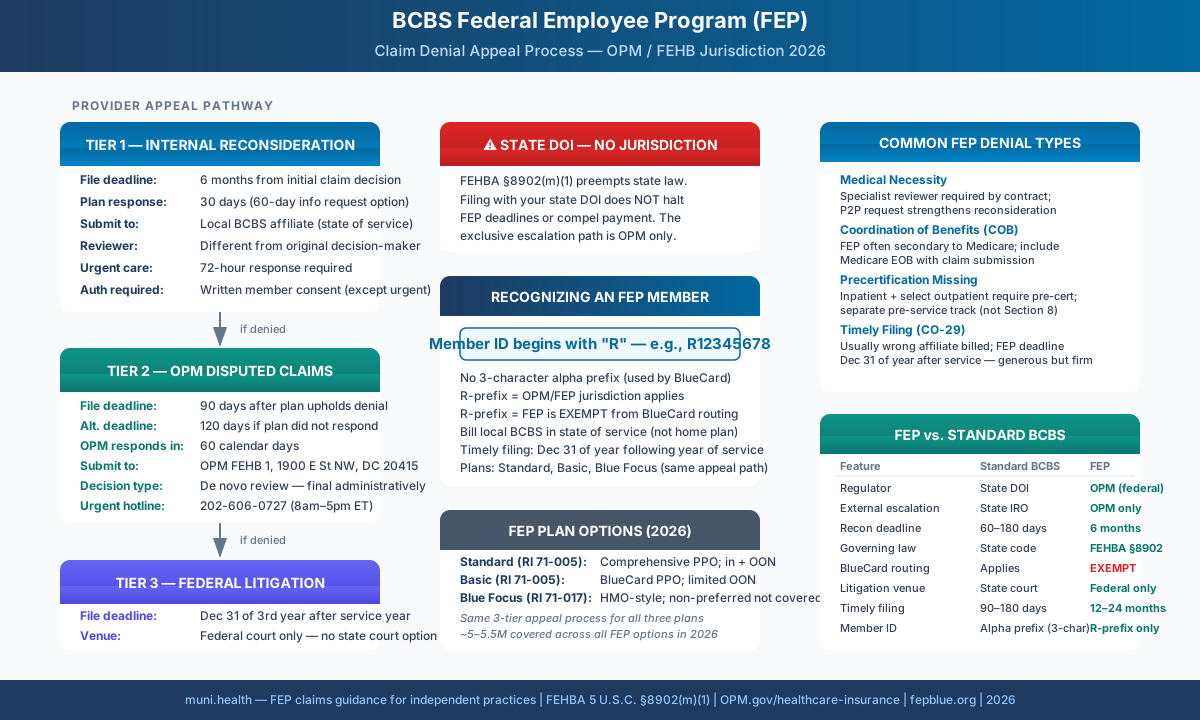
FEP Is Exempt from BlueCard
FEP members carry an R-prefix ID — not a three-character alpha prefix. The BlueCard program does not apply. Do not route FEP claims or appeals through the standard BlueCard process. File to the local BCBS affiliate in the state where services were rendered, using FEP-specific procedures. See the BCBS BlueCard Provider Appeal Guide for BlueCard rules on non-FEP out-of-state BCBS members.
Why State Departments of Insurance Cannot Help With FEP Denials
Filing with your state DOI does not pause FEP appeal deadlines, compel payment, or trigger any review of the plan's decision. This is not a procedural gap — it is federal preemption by statute.
FEHBA §8902(m)(1) states that FEHB contract terms relating to coverage, benefits, and payments "shall supersede and preempt any State or local law, or any regulation issued thereunder, which relates to health insurance or plans." The Supreme Court confirmed this preemption clause is operative in Coventry Health Care of Missouri, Inc. v. Nevils (2017, No. 16-149), stripping states of authority over FEHB benefit determinations.
In practice: when a billing team contacts their state insurance commissioner about a denied FEP claim, the state DOI will acknowledge it has no power over FEHB plans. The complaint goes nowhere. Meanwhile, the OPM Disputed Claims window keeps running.
The exclusive administrative escalation path after an internal reconsideration is the U.S. Office of Personnel Management — full stop. This is also why you cannot use an independent review organization (IRO) the way you would for a commercial BCBS denial. The IRO process that applies to state-regulated ERISA and fully insured plans simply does not exist for FEP.
Filing With State DOI Wastes Your Appeal Window
If a plan upholds its reconsideration denial, you have 90 days to request OPM review. Spending those 90 days filing a state DOI complaint that goes nowhere forfeits the only external review available. If the state DOI complaint doesn't resolve to OPM escalation, you may lose the appeal entirely.
FEP Timely Filing: More Generous Than Standard BCBS, But Still Firm
FEP's timely filing deadline is December 31 of the year following the year of service — effectively 12 to 24 months depending on when the service occurred, compared to the 90- to 180-day windows common on commercial BCBS plans.
That longer window reduces CO-29 denials for most FEP claims. However, FEP CO-29 denials still occur regularly, and they almost always trace to the same root cause: billing the wrong affiliate. Because FEP is administered locally, a claim for services rendered in Texas must go to BCBS Texas's FEP department — even if the member's home address is in Illinois and their FEP coverage originates from BCBS Illinois. Billing BCBS Illinois directly or routing through BlueCard creates a misdirected claim that triggers a timely filing denial when resubmission finally happens.
For claims returned for additional information, resubmit within 90 days of the return date or before the overall timely filing deadline expires — whichever is later.
See BCBS timely filing limits for commercial BCBS plan deadlines, which follow different rules by affiliate and state.
The FEP Claim Denial Appeal Process: Three Tiers
The FEHB disputed claims process follows a three-tier structure. Timelines are uniform across all three FEP plan options — Standard, Basic, and Blue Focus — even though their benefit designs differ substantially.
Tier 1: Internal Reconsideration
File within 6 months of the date of FEP's initial claim decision. This is longer than most commercial BCBS affiliate windows (which typically run 60 to 180 days), but the 6-month clock is uniform and not extendable across all FEP plan options per the 2025 FEP Standard and Basic Options brochure (Section 8) and the 2025 FEP Blue Focus brochure (Section 8).
Submit reconsideration to the local BCBS affiliate that administered the claim — the address shown on the member's Explanation of Benefits. Include:
- Written explanation citing specific benefit provisions from the FEP plan brochure
- Supporting clinical documentation (operative notes, diagnostic results, referring physician letter)
- Copies of all prior correspondence and the original EOB
- If you are filing on behalf of the member: a signed, written authorization from the member (required for non-urgent claims)
The plan must assign review to someone who was not involved in the original denial decision. For medical necessity denials, the reviewing clinician must have appropriate specialty training. The plan must respond within 30 days of receiving your submission.
Important exception: If the plan requests additional information during reconsideration, you have 60 days to respond. The plan then has 30 more days after receiving that information to issue its decision. For urgent care claims specifically, FEP must respond within 72 hours.
Medical Necessity Denials: Request the Reviewer's Credentials
FEP's brochure requires that medical necessity reconsiderations be reviewed by a clinician with appropriate specialty training. For experimental or investigational exclusions, the reviewing clinician must be a qualified specialist. When you receive the reconsideration decision, you can request confirmation of the reviewer's credentials — useful if you escalate to OPM.
Tier 2: OPM Disputed Claims
File your OPM review request within 90 days of the date on the plan's letter upholding its reconsideration denial. Two alternative windows apply if the plan failed to respond:
- 120 days after you first wrote to the plan — if the plan did not respond within 30 days
- 120 days after the plan requested additional information — if the plan did not send a decision within 30 days of receiving that information
OPM's review is de novo — they use both your submission and the plan's materials and reach an independent conclusion. OPM will send its decision or status notification within 60 calendar days. OPM's decision is final within the executive branch; there are no further administrative appeals after OPM rules.
Submit to:
United States Office of Personnel Management
Healthcare and Insurance, Federal Employees Insurance Operations
FEHB 1
1900 E Street NW
Washington, DC 20415-3610
Include in your OPM submission:
- Explanation of why you disagree with the plan's decision, citing the specific benefit provisions at issue
- All supporting documents (clinical records, denial letters, reconsideration correspondence)
- Copies of every prior communication with the plan
- Member contact information
- Copy of the member's written consent if you are filing as the provider representative
For urgent claim situations, OPM's healthcare line is 202-606-0727, available 8 a.m. to 5 p.m. Eastern. Non-urgent complaints can be routed to FEHB@opm.gov.
Tier 3: Federal Litigation
If OPM's decision is unfavorable, the only remaining recourse is a federal lawsuit. The filing deadline is December 31 of the third year after the year in which the disputed services were received. This deadline is absolute and not extendable. There are no further administrative appeals within the executive branch after OPM's decision. Litigation occurs in federal court only — state courts have no jurisdiction over FEHB disputes.
FEP vs. Standard BCBS Appeals: Key Differences
The table below covers the operational differences that most frequently cause billing teams to mishandle FEP denials.
| Feature | Standard BCBS (Commercial) | FEP / FEHB |
|---|---|---|
| Regulatory authority | State Department of Insurance | OPM (federal — exclusive) |
| External review escalation | State IRO or state DOI | OPM Disputed Claims only |
| Governing law | State insurance code / ERISA | FEHBA, 5 U.S.C. §8902 |
| Reconsideration deadline | 60–180 days (varies by affiliate) | 6 months (uniform, all plans) |
| OPM review window | Not applicable | 90 days after plan upholds denial |
| BlueCard routing | Applies (3-char alpha prefix) | Exempt (R-prefix only) |
| Member ID format | 3-character alpha prefix | R-prefix (e.g., R12345678) |
| Timely filing deadline | 90–180 days (commercial avg.) | Dec 31 of year after service |
| Litigation venue | State or federal court | Federal court only |
| Litigation deadline | Varies by state | Dec 31 of 3rd year after service year |
| Provider auth to appeal | Varies by state/plan | Written member consent required |
The most consequential difference for small practices is the escalation path. Every commercial BCBS plan in the country has a state-mandated external review option — an independent review organization the practice can invoke after an internal appeal fails. FEP has no equivalent. If OPM rules against you, there is no further administrative step. The only path is federal litigation, which is resource-intensive for an independent practice to pursue.
How to Submit an FEP Reconsideration: Routing and Documentation
FEP claims and appeals go to the local BCBS affiliate in the state where services were rendered, not to a central FEP mailing address and not to the member's home plan. This routing rule applies even when the member lives in a different state.
Specific routing rules for non-standard service types:
- Ambulance: Submit to the BCBS affiliate in the state where the ambulance picked up the patient
- Durable medical equipment: Submit to the BCBS affiliate in the state from which the DME was shipped
- Laboratory: Submit to the BCBS affiliate in the state where the lab work was sent for testing
Electronic claims use the local affiliate's payer ID — there is no single national FEP electronic payer ID. Confirm the correct payer ID directly with your local BCBS affiliate before resubmitting a denied claim.
For FEP Blue Focus denials specifically: Blue Focus is structured like an HMO. Services from non-preferred (out-of-network) providers receive no benefits except in emergencies. If the denial is based on out-of-network status under Blue Focus, a reconsideration on medical necessity grounds will not change the outcome — the benefit exclusion is structural. The correct path is to verify whether an emergency exception applies or whether the service can be redirected to a preferred provider.
Coordination of Benefits: Include the Medicare EOB
Many FEP annuitants carry both FEP and Medicare Part B. FEP is frequently secondary to Medicare in these cases. If the denial reads as a COB issue, confirm whether Medicare Part B has been billed first and include the Medicare EOB with your resubmission. Missing the Medicare EOB on the primary submission is one of the most common correctable FEP denials. See coordination of benefits denial appeals for multi-payer COB strategy.
FEP Appeal Letter Template
The reconsideration letter structure for FEP is similar to standard BCBS appeals, but must reference the correct program-specific materials. Use this framework:
[Practice letterhead]
[Date]

BCBS [State] — Federal Employee Program
[Local FEP Reconsideration Address from EOB]

RE: Reconsideration Request
Member Name: [Member Name]
Member ID: [R-prefix ID]
Date(s) of Service: [Date(s)]
Claim Number: [Claim #]
Service Denied: [CPT Code(s) and description]

To Whom It May Concern:

We are writing to request reconsideration of the above-referenced
claim denial. We disagree with the denial for the following reasons:

1. The services rendered were medically necessary per [FEP Standard/
 Basic/Blue Focus] Brochure Section [X], which states [specific
 benefit language].

2. [Clinical rationale: relevant diagnosis, clinical guidelines,
 treating physician's assessment, NCCN/AMA/specialty society
 guidance as applicable.]

3. [Address specific denial reason from EOB/explanation letter.]

Supporting documentation enclosed:
- [Medical records, operative notes, clinical notes]
- [Treating physician letter or P2P request if applicable]
- [Original denial letter and EOB]
- [Member written authorization — if filing on member's behalf]

We respectfully request that this denial be reversed and the claim
be reprocessed for payment. If additional information is required,
please contact [contact name] at [phone/email] within 60 days.

Sincerely,
[Physician / Practice Manager Name]
[Practice Name]
[NPI / Tax ID]
Skip the blank template. Start with a review-ready draft.
Use the template as guidance, or let Muni prepare a payer-specific draft for your team to verify, sign, and submit.
First 3 appeals free, then $20 per appeal. Start with your denial letter or EOB and available records. No meeting or clearinghouse connection required.
For a general BCBS appeal letter structure, see BCBS appeal letter template.
How Muni Appeals Handles FEP Denials
FEP denials are operationally distinct from standard BCBS denials — different jurisdiction, different deadlines, different escalation path — and that's where generic appeal workflows break down.
Prepare this appeal packet with your team.
Draft the appeal, coordinate missing documents, and approve the reviewed packet. Keep your clearinghouse; your practice checks deadlines and submits through the payer’s accepted channel.
First 3 appeals free, then $20 per appeal. Start with your denial letter or EOB and available records. No meeting or clearinghouse connection required.
Muni Appeals uses the uploaded denial materials to identify FEP context, surface the likely reconsideration and escalation windows, and prepare a review-ready federal appeal packet. Staff must verify the applicable brochure and denial notice, calendar each deadline, and submit through the required channel.
- Surfaces likely FEP versus commercial BlueCard context from the uploaded denial for staff verification
- Surfaces likely FEHB reconsideration and OPM-window context; staff verifies the current brochure and notice
- Compiles FEP brochure section citations alongside clinical documentation
- Identifies COB/Medicare coordination issues before reconsideration filing
Frequently Asked Questions
What is the appeal deadline for a BCBS FEP denial?
You have 6 months from the date of FEP's initial claim decision to file an internal reconsideration. If the plan upholds its denial, you have 90 days from the date of that reconsideration decision letter to submit a request to OPM Disputed Claims. These deadlines apply uniformly to all three FEP plan options — Standard, Basic, and Blue Focus.
Can I file a complaint with my state insurance department about an FEP denial?
No. FEHBA §8902(m)(1) preempts state insurance law for FEHB plans. State departments of insurance have no jurisdiction over FEP claims decisions, cannot compel payment, and cannot order the plan to reverse a denial. The Coventry Health Care of Missouri v. Nevils (2017) Supreme Court decision confirmed this preemption. The only external escalation path after an internal reconsideration denial is OPM Disputed Claims.
How do I know if a patient has FEP coverage?
The member's subscriber ID begins with the letter R — for example, R12345678. FEP members do not have a three-character alpha prefix like standard BlueCard members. The ID card will also reference "Blue Cross and Blue Shield Service Benefit Plan" or a specific FEP plan name (Standard Option, Basic Option, Blue Focus).
Where do I send an FEP appeal?
File reconsideration with the local BCBS affiliate in the state where you rendered services — the address is shown on the member's EOB. If the plan upholds its denial and you escalate to OPM, mail to: U.S. Office of Personnel Management, Healthcare and Insurance, Federal Employees Insurance Operations, FEHB 1, 1900 E Street NW, Washington, DC 20415-3610.
Does FEP use the BlueCard appeal process?
No. FEP is explicitly exempt from the BlueCard program. Do not use the standard BlueCard alpha-prefix routing or the BlueCard IPP appeal form for FEP claims. Bill the local BCBS affiliate in the state of service using FEP procedures, and file any appeal directly with that same local affiliate's FEP department.
What happens if OPM rules against me?
OPM's decision is final administratively — there are no further executive-branch appeals. The only remaining option is to file suit in federal court. The litigation deadline is December 31 of the third year after the year in which the disputed services were received. State courts have no jurisdiction over FEHB disputes.
Can a practice file an FEP appeal on behalf of the patient?
Yes, but you must have the member's written, signed authorization — except for urgent care claims. Without that written consent, OPM will not accept a provider-filed Disputed Claims request. Obtain the authorization at the time of service or as soon as the denial is received; do not attempt to obtain it after the OPM deadline has lapsed.
Are FEP appeal rules the same for Standard, Basic, and Blue Focus plans?
The appeal process — deadlines, OPM escalation path, litigation window — is identical across all three FEP plan options. The differences are in what gets denied. Blue Focus functions like an HMO: services from non-preferred providers receive no coverage except emergencies, which creates structural denials that reconsideration cannot reverse. Standard and Basic are PPO structures with broader out-of-network benefits, so most denials are medical necessity or COB-related and potentially overturnable on appeal.
Ready to Stop Losing FEP Denials to Deadline Errors?
FEP is one of the most commonly misrouted payers for independent practices — the R-prefix gets identified as BCBS and the appeal goes through the commercial workflow, missing the OPM escalation entirely. Practices lose those claims not on the clinical merits, but on process.
Getting FEP appeals right means:
- Catching the R-prefix before the claim routes through commercial BlueCard
- Filing reconsideration to the local affiliate, not the member's home state plan
- Tracking the 90-day OPM window independently from your state-based external review calendar
- Knowing when a Blue Focus denial is a structural network issue (not reversible) versus a medical necessity issue (potentially reversible with a P2P)
This guide reflects the 2026 FEHB and FEP sources reviewed for publication. FEP plan options, benefit provisions, and timely filing rules may vary. Consult the current FEP Standard/Basic (RI 71-005) or Blue Focus (RI 71-017) brochure and verify the controlling instructions before filing.