

A coordination of benefits (COB) denial means the insurer disputes which plan is primary or requires the primary payer's EOB before paying. To appeal: identify the applicable priority rule (birthday rule, MSP, COBRA, or active/retired), obtain the primary payer's EOB, then submit either a corrected claim (if the billing order was wrong) or a formal written appeal (if the payers disagree on priority). Most COB denials resolve with the primary EOB attached to a corrected claim — not a formal appeal.
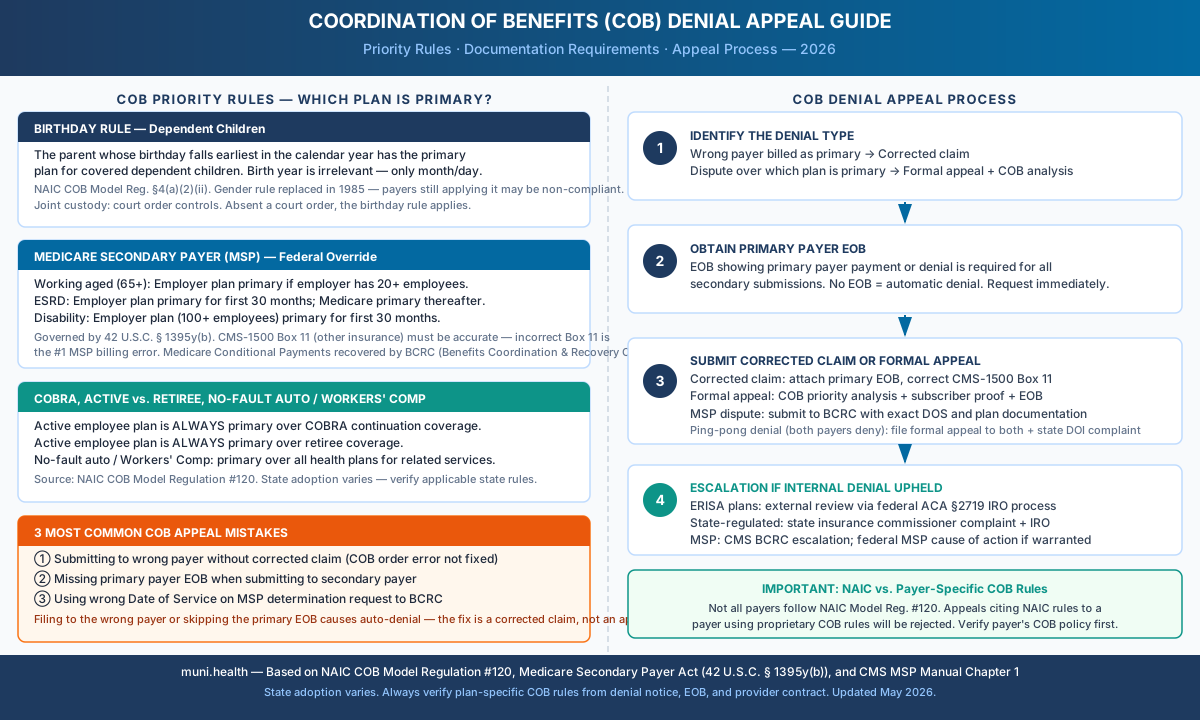
Understanding Coordination of Benefits Denials
A COB denial is not a medical necessity denial — it is an administrative dispute about who pays first. When a patient carries two or more insurance plans, federal and state rules require the plans to coordinate so that combined payments do not exceed 100% of the actual charge.
COB denials fall into four categories: (1) the wrong plan was billed as primary; (2) the secondary payer requires the primary payer's EOB before processing; (3) one or both payers dispute the priority determination; or (4) Medicare's Secondary Payer rules apply and were not followed on the claim. The correct resolution path depends entirely on which of these applies — and most practices misidentify the category, which is why COB denials persist through multiple resubmissions. On your remittance advice, COB denials typically appear as CO-22 (coordination of benefits) or OA-23 (impact of prior payer adjudication); see the EOB denial code guide for a full breakdown of both codes and their response paths.
According to the NAIC's ongoing review of COB model regulation adoption, most states have adopted some version of NAIC COB Model Regulation #120, but adoption is uneven and payer-specific deviations are common. A payer whose COB policy deviates from the NAIC model will reject appeals that cite NAIC rules as controlling authority — knowing which framework your payer actually follows is prerequisite to any successful appeal.
CMS Medicare Secondary Payer Manual, Chapter 1
COB and MSP issues are among the most frequently cited causes of claim delays and secondary-payer billing errors. CMS estimates that improper MSP billing — including incorrect CMS-1500 Box 11 entries — results in hundreds of millions of dollars in improperly paid or denied claims annually.
Step 1: Identify Which COB Priority Rule Applies
The first step in resolving a COB denial is determining which priority rule controls — because that rule determines both the correct payer order and which documentation to gather. Four frameworks cover the vast majority of COB disputes.
The Birthday Rule (dependent children): When a dependent child is covered by both parents' plans, the plan of the parent whose birthday falls earliest in the calendar year is primary. Birth year is irrelevant — only month and day matter. This rule derives from NAIC COB Model Regulation §4(a)(2)(ii) and has been the standard since NAIC replaced the gender rule in 1985. If a court order addresses dependent coverage, the court order controls over the birthday rule. If parents share a birthday, most payer-specific rules default to the plan that has covered the child longer.
Medicare Secondary Payer (MSP) rules: Federal law — 42 U.S.C. § 1395y(b) — governs when Medicare is secondary to another payer. Key triggers:
- Working aged (age 65+): If the patient is actively employed and the employer has 20 or more employees, the employer group health plan (EGHP) is primary; Medicare is secondary.
- End-Stage Renal Disease (ESRD): The EGHP is primary for the first 30 months of ESRD eligibility; Medicare becomes primary after that coordination period.
- Disability: If the patient is under 65 and disabled, and the employer has 100 or more employees, the EGHP is primary for the first 30 months.
COBRA vs. active coverage: Active employee health coverage is always primary over COBRA continuation coverage. If a patient has an active employer plan through a current job and is also maintaining COBRA from a prior employer, the active plan pays first.
Active vs. retiree coverage: Active employee plans are always primary over retiree plans, regardless of when the retiree plan was established or which plan has higher benefits.
NAIC Model vs. Payer-Specific COB Rules
Not all payers follow NAIC COB Model Regulation #120 verbatim. Some payers use proprietary COB rules that deviate on sequencing logic, non-duplication vs. maintenance of benefits calculations, or how they handle coordination with self-insured plans. An appeal that cites NAIC §4(a)(2) as controlling authority may be rejected by a payer whose plan document uses a different COB framework. Always verify the payer's actual COB policy from the denial letter, the plan document, or the provider agreement before citing a specific regulatory source in your appeal.
Step 2: Gather the Required COB Appeal Documentation
The primary payer's EOB is the single most important document in any COB appeal — without it, secondary payers will auto-deny. The rest of the documentation depends on which priority rule and denial type you are working.
Required for all COB denials:
- Primary payer's Explanation of Benefits (EOB) showing adjudication of the same claim (same patient, DOS, and service)
- The original denial notice from the secondary (or disputing) payer
- CMS-1500 claim form — verify Box 11 (other insurance information) is completed correctly and matches the priority determination
Additional documentation by denial type:
Birthday rule disputes: Both parents' subscriber ID cards, dates of birth documentation, and the patient's date of birth. If a court order exists addressing custody and coverage, include a copy.
MSP disputes: Completed MSP Questionnaire (CMS requires providers to collect MSP data); documentation of employer size (20+ or 100+ employees); date of Medicare entitlement; date of ESRD or disability onset if applicable. For ESRD cases, include documentation of the 30-month coordination period.
COBRA vs. active coverage: Proof that the active employer plan was in force on the date of service; employer name and group plan number for the active plan.
Conditional Payment disputes (Medicare already paid but should have been secondary): BCRC correspondence; exact date of service on all submissions; proof of primary plan coverage on the DOS.
Step 3: Corrected Claim vs. Formal Appeal
The fastest resolution for most COB denials is a corrected claim — not a formal appeal. Choose the right path based on the actual reason for the denial.
Submit a corrected claim when:
- The claim was filed with the wrong payer as primary (billing order error)
- Box 11 on the CMS-1500 was blank or incorrect
- The secondary payer auto-denied for missing primary EOB — resubmit the secondary claim with the primary EOB attached
- The primary payer's payment information was not included on the secondary submission
File a formal written appeal when:
- The secondary payer has the primary EOB but still denies, disputing the priority determination
- The primary payer denies, claiming the patient has other primary coverage, but your analysis shows they are primary under the applicable priority rule
- Both payers deny and each claims the other is primary (a ping-pong denial)
- The payer disputes the MSP priority determination itself, not just missing documentation
| Situation | Best Path | Key Document | Notes |
|---|---|---|---|
| Wrong payer billed as primary | Corrected claim + primary EOB | Primary payer EOB | Resets timely filing clock if submitted within TFL |
| Secondary payer missing primary EOB | Resubmit secondary with EOB attached | Primary payer EOB | Not an appeal — this is a documentation correction |
| Payer disputes priority determination | Formal appeal + COB priority analysis | Priority rule documentation + subscriber proof | Cite controlling rule; dispute payer's COB policy if needed |
| Ping-pong denial (both payers deny) | Formal appeal to both + state DOI complaint | All correspondence from both payers | Document all filings; state DOI can compel resolution |
| MSP dispute — Medicare claims it is secondary | BCRC process + corrected claims | MSP questionnaire + employer size proof + EOB | Use exact DOS; incorrect DOS is the #1 BCRC rejection reason |
For more context on when each path applies, see the corrected claim vs. insurance appeal guide.
COB Denial Appeal Letter Template
When a formal written appeal is required — typically for priority determination disputes or ping-pong denials — include a specific COB priority analysis in the appeal body, not a generic medical necessity argument.
[Date]

[Insurer] Appeals Department
[Address from denial notice]

Re: Coordination of Benefits Denial Appeal — Level 1 Internal

Member Name:         [Full Name]
Member ID:           [Primary Plan Member ID]
Date of Birth:       [DOB]
Date of Service:     [DOS]
Claim Number:        [Denied Claim Number]
CPT Code(s):         [CPT + Description]
Denial Date:         [Denial Date]
Denial Reason:       [Reason code and language from denial notice]
Secondary Member ID: [Secondary Plan Member ID, if applicable]

Dear Appeals Reviewer,

We are filing a formal Level 1 appeal of the adverse determination
dated [Denial Date], which denied the above claim on the basis of
coordination of benefits.

COORDINATION OF BENEFITS PRIORITY ANALYSIS

The applicable priority rule in this case is [identify the rule —
birthday rule / MSP working aged / COBRA vs. active / active vs.
retiree / other].

[Birthday rule example:]
Under NAIC COB Model Regulation §4(a)(2)(ii), the parent whose
birthday falls earliest in the calendar year has the primary plan
for covered dependents. [Parent A] has a birthday of [Month/Day],
and [Parent B] has a birthday of [Month/Day]. [Parent A's plan]
is therefore primary. Enclosed: both parents' subscriber ID cards
and dates of birth confirming this priority determination.

[MSP example:]
Under 42 U.S.C. § 1395y(b) (Medicare Secondary Payer Act), for a
working-aged beneficiary (age 65+) whose employer has 20 or more
employees, the employer group health plan is primary and Medicare
is secondary. [Employer] employed [Patient] as of [DOS] and has
[N] employees. Documentation enclosed. Accordingly, [Employer Plan]
is the primary payer for this claim.

PRIMARY PAYER DOCUMENTATION ENCLOSED
- Primary payer EOB dated [Date] for the same DOS and service
- [CMS-1500 Box 11 documentation, if applicable]
- [Subscriber cards, court order, employer size proof, as needed]

We request a determination within [30/60] days per your appeal
policy. Please direct questions to:

[Contact Name, Title]
[Practice Name]
[Phone] | [Fax]
[NPI]

Sincerely,
[Authorized Signer, Title]
[Practice Name]
[Date]
Skip the blank template. Start with a review-ready draft.
Use the template as guidance, or let Muni prepare a payer-specific draft for your team to verify, sign, and submit.
First 3 appeals free, then $20 per appeal. Start with your denial letter or EOB and available records. No meeting or clearinghouse connection required.
Ping-Pong Denials — File a State Insurance Commissioner Complaint
When both payers deny claiming the other is responsible, a formal appeal to each payer is necessary but often insufficient on its own. Filing a complaint with the state insurance commissioner simultaneously gives regulators the authority to compel the payers to resolve the dispute — most state commissioners have a specific COB dispute resolution process for this scenario. Document all correspondence from both payers before filing the complaint.
Medicare Secondary Payer COB Appeals
MSP disputes require a separate process from standard COB appeals and are governed by federal law rather than state insurance regulation. When Medicare pays a claim it should not have paid as primary, or when Medicare denies claiming another insurer is primary and that insurer also denies, the process runs through CMS's Benefits Coordination and Recovery Center (BCRC).
Prepare this appeal packet with your team.
Draft the appeal, coordinate missing documents, and approve the reviewed packet. Keep your clearinghouse; your practice checks deadlines and submits through the payer’s accepted channel.
First 3 appeals free, then $20 per appeal. Start with your denial letter or EOB and available records. No meeting or clearinghouse connection required.
If Medicare paid but should have been secondary (Medicare Conditional Payment):
Medicare's payment in this situation is conditional — it is subject to recovery once the primary insurer pays. The BCRC tracks these payments and sends a Conditional Payment Notice (CPN) once it identifies that another insurer was primary. Providers and patients must notify Medicare of any primary plan settlements, judgments, or payments. If Medicare is seeking recovery, the BCRC handles the coordination.
If Medicare denies claiming another plan is primary:
- Obtain the MSP Questionnaire from the primary insurer or CMS and complete it with accurate employer information, plan effective dates, and dates of service
- Verify the patient's Medicare entitlement date and the employer's size on the relevant DOS
- Submit the completed MSP questionnaire and supporting employer documentation to the primary insurer, with a copy to Medicare/BCRC
- If the primary insurer also denies, file the COB formal appeal to the primary insurer, citing 42 U.S.C. § 1395y(b) and the CMS MSP Manual Chapter 1
The DOS error: The most common reason MSP determination requests fail at the BCRC is using the wrong date of service. The BCRC matches requests against Medicare's claims database by exact DOS — a transposed date or a date range instead of the specific DOS causes the request to return unmatched, which BCRC treats as unresolvable without a new submission.
CMS MSP Manual, Chapter 1, Section 40
According to CMS MSP Manual Chapter 1, Section 40, a provider who has reason to believe Medicare is the secondary payer must bill the primary plan first. Billing Medicare first when another payer is primary — even if it is faster — creates an MSP overpayment liability that CMS can recover.
Payer-Specific COB Verification and Submission
Major payers handle COB questionnaires and secondary payer submissions through different portals. Submitting through the wrong channel causes delays even when your documentation is complete.
| Payer | COB Questionnaire Portal | Secondary Claim Submission | Notes |
|---|---|---|---|
| Aetna | Availity — COB questionnaire within claim workflow | Availity or fax per denial notice | Aetna uses NAIC birthday rule; deviation noted in some ASO plans |
| Cigna (Evernorth) | Cigna for Health Care Providers portal or Availity | Availity or fax per denial | Cigna applies its own COB calculation — verify non-duplication vs. coordination method |
| UnitedHealthcare | Availity — COB questionnaire within claim edit workflow | Availity or fax per denial | UHC may request COB verification before processing any secondary claim |
| BCBS (varies by affiliate) | Availity (most affiliates) or affiliate provider portal | Availity or fax per specific denial letter | BlueCard COB: contact the HOME plan (not host plan) for COB verification |
| Humana | Availity or Humana Provider Portal | Availity or fax per denial | MSP questionnaire required for Medicare Advantage COB situations |
| Anthem | Availity | Availity or fax per denial | AIM-delegated services: COB dispute still routes through Anthem, not AIM |
For BCBS BlueCard plans specifically, COB disputes go to the home plan — the plan in the state where the member's employer is headquartered — not the host plan in the state where the service was rendered. Filing a COB dispute with the host plan is one of the most common BCBS-specific mistakes. See the BCBS denial appeal guide for BlueCard routing details.
For appeals that exhaust the internal process without resolution, see the independent review organization (IRO) appeal guide and the insurance appeal deadlines guide for escalation timelines.
Three COB Appeal Mistakes That Cause Denials
Most COB appeals that fail do so for one of three reasons — and all three are preventable. The most effective prevention happens before the claim is even submitted: asking the coordination-of-benefits question directly during eligibility verification catches a wrong billing order before it becomes a denial.
Mistake 1: Submitting to the wrong payer without a corrected claim. When the billing order was wrong, a formal appeal to the secondary payer will be upheld because the secondary payer is correctly applying COB rules — the primary payer should have been billed first. The fix is a corrected claim to the correct primary payer, followed by a secondary submission once the primary EOB is obtained. An appeal without first correcting the billing order is misdirected effort.
Mistake 2: Missing the primary payer's EOB on the secondary submission. Secondary payers auto-deny when no primary EOB is attached. This is not a coverage decision — it is an administrative auto-deny that never reaches a human reviewer. Resubmitting the secondary claim with the EOB attached typically resolves this without any formal appeal. If your billing system allows secondary claims to be submitted without an attached EOB, that is a process control gap worth closing.
Mistake 3: Using the wrong date of service on MSP determination requests. When Medicare's BCRC is involved — because Medicare paid conditionally or because the patient disputes which plan is primary under MSP rules — the BCRC matches the request to its claims database by exact date of service. A wrong DOS (wrong day, transposed digits, or a DOS range instead of a specific date) causes a no-match result that the BCRC cannot resolve without a corrected submission. Always verify the exact DOS against the original claim before submitting any BCRC request.
How Muni Appeals Handles COB Denials
COB denials require a different workflow than standard medical necessity appeals — the resolution path depends on quickly identifying the denial type and the applicable priority rule before any documentation is gathered or letters are drafted.
Muni Appeals organizes the COB workflow across major payers:
- Identifies the COB denial category (billing order error, missing EOB, priority dispute, or MSP) from the denial notice
- Determines the applicable priority rule — birthday rule, MSP, COBRA, or active/retiree — and maps the required documentation for that specific situation
- Suggests a likely path for staff verification: corrected claim resubmission or formal written appeal with a COB priority analysis
- Provides likely payer-specific portal and COB questionnaire guidance for staff to verify before submission
- Surfaces deadline risk across concurrent COB disputes; staff verifies and calendars each controlling window
Frequently Asked Questions
What is a COB denial and how is it different from a medical necessity denial?
A COB denial means the insurer disputes which insurance plan is primary or requires documentation from the primary payer before processing the claim. It is an administrative billing dispute, not a clinical decision about whether the service was medically necessary. The resolution almost always involves documenting the correct payer order, obtaining the primary payer's EOB, and resubmitting — not drafting a clinical argument.
How does the birthday rule work for COB disputes?
The birthday rule determines which parent's plan is primary for dependent children when both parents have separate coverage. The parent whose birthday falls earliest in the calendar year — based on month and day only, not birth year — has the primary plan. If both parents share a birthday, most payer-specific COB policies default to the plan that has covered the child longer. A court order governing custody and health coverage takes precedence over the birthday rule.
When does Medicare pay secondary to an employer plan?
Medicare is secondary to an employer group health plan (EGHP) in three main situations under the Medicare Secondary Payer Act (42 U.S.C. § 1395y(b)): when the patient is actively employed, age 65 or older, and the employer has 20 or more employees; during the first 30 months of ESRD eligibility when an EGHP exists; and during the first 30 months for disabled patients under 65 when the employer has 100 or more employees. The CMS-1500 Box 11 must accurately reflect the other insurance information or the claim will be rejected.
Should I file a corrected claim or a formal appeal for a COB denial?
Start with a corrected claim if the billing order was wrong or if the secondary payer is simply missing the primary EOB — this resolves the majority of COB denials without formal appeal. File a formal written appeal only when both payers have the correct documentation and are still disputing the priority determination. Misidentifying a billing-order error as a priority dispute and filing a formal appeal is one of the most common COB workflow mistakes.
What is a ping-pong denial and how do I resolve it?
A ping-pong denial occurs when both payers deny the same claim, each claiming the other plan is primary. To resolve it: file formal written appeals to both payers simultaneously, documenting the COB priority analysis for each. Simultaneously file a complaint with the state insurance commissioner — most states have a specific COB dispute resolution mechanism that compels the two payers to coordinate directly. Document all correspondence, denial dates, and appeal tracking numbers before filing the state complaint.
Does COBRA coverage affect COB priority?
Yes. Active employee health coverage is always primary over COBRA continuation coverage, regardless of which plan has higher benefits or which was obtained first. If a patient is covered by both an active employer plan and COBRA from a prior employer, bill the active plan as primary. This rule is consistent across NAIC-compliant payers — it is one of the clearest COB priority rules and rarely requires a formal appeal when documented correctly.
What happens if both payers follow different COB rules?
This is the most complex COB scenario. If one payer follows NAIC COB Model Regulation #120 and the other uses proprietary COB rules, the priority determination may produce conflicting results — both payers may correctly apply their own policy and still reach opposite conclusions about who is primary. In this situation, the formal appeal to each payer must address that payer's specific COB policy language (not NAIC rules if the payer's policy deviates), and a state insurance commissioner complaint is often the most effective escalation path, since the commissioner can compel resolution under the applicable state COB statute.
Ready to Resolve COB Denials?
COB denials are among the most commonly mishandled denials in provider billing — because they require identifying the denial category and applicable priority rule before gathering any documentation, and most billing teams skip that diagnostic step.
COB denial checklist:
- Identify the denial type: billing order error, missing EOB, priority dispute, or MSP
- Determine which priority rule applies: birthday rule, MSP, COBRA/active, or active/retiree
- Obtain the primary payer EOB before any secondary submission or appeal
- Submit a corrected claim if the billing order was wrong — not a formal appeal
- File a formal appeal with a COB priority analysis only when both payers dispute priority
- For MSP disputes: verify the exact DOS before any BCRC submission
- For ping-pong denials: appeal to both payers and file a state DOI complaint simultaneously
This guide reflects 2026 coordination of benefits denial appeal procedures under NAIC COB Model Regulation #120, the Medicare Secondary Payer Act (42 U.S.C. § 1395y(b)), and CMS MSP Manual Chapter 1. State COB regulation adoption varies. Payer-specific COB policies, plan documents, and provider contract terms control in the event of conflict. This guide does not constitute legal advice. Always verify the applicable priority rules and submission requirements from the denial notice and the relevant payer policy.