

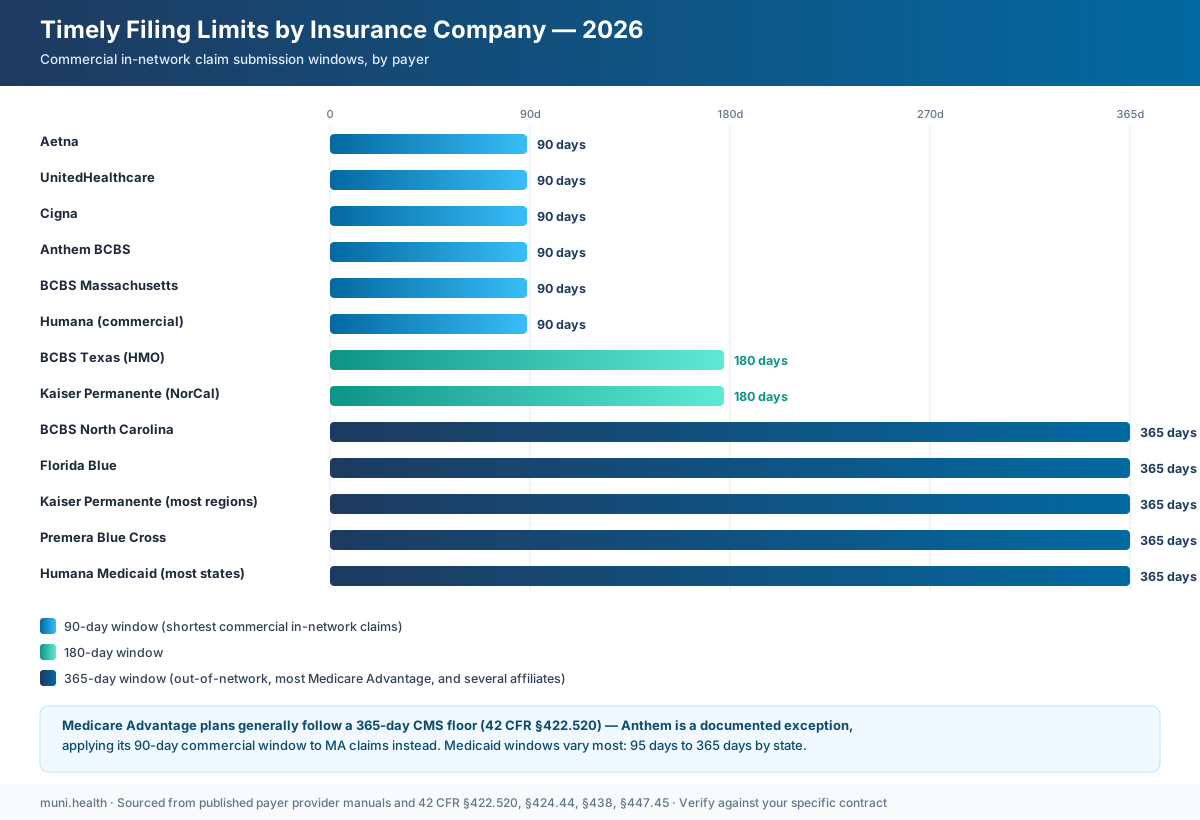
Timely filing limits for original claims range from 90 days to 365 days depending on the insurance company, and the window is usually shorter for in-network commercial claims than for out-of-network, Medicare Advantage, or Medicaid claims. Aetna, Cigna, UnitedHealthcare, and Anthem commercial in-network windows are 90 days from the date of service; Florida Blue, Kaiser Permanente (most regions), Premera Blue Cross, and Humana Medicaid windows run 365 days; Medicare Advantage plans follow a 365-day CMS floor in most cases. Every payer sets its own rules by plan type and state, so the exact window always depends on your specific contract.
Why Timely Filing Limits Aren't the Same Across Payers
There is no single "industry standard" timely filing limit — each insurance company sets its own window by plan type, network status, and state, which is why the same claim can have a 90-day deadline with one payer and a 365-day deadline with another.
Billing teams that work with three or more payers are effectively tracking three or more different deadline clocks at once, and the clocks don't all start from the same event. Most commercial in-network windows run from the date of service. Some Medicaid and corrected-claim windows run from the remittance advice date instead. A team that applies one payer's rule to another payer's claim either files too late for no reason or assumes a deadline has passed when it hasn't.
This guide consolidates the timely filing limits covered by Muni Health's public payer guides into a single reference table, then breaks out the plan-type and state variation that generic "insurance timely filing limits" lists tend to flatten into a single number. For deadlines specific to one payer — CO-29 appeal documentation, corrected-claim windows, or state-by-state detail — the payer-specific guides linked throughout go deeper than a comparison table can.
This table covers original claim filing, not appeals
Timely filing limits (TFL) govern when you must submit the original claim. Appeal deadlines — how long you have to contest a denial after it's issued — run on a separate, usually shorter clock. See Insurance Appeal Deadlines by Company 2026 for appeal-specific windows, and the section below for how the two interact.
Timely Filing Limits by Insurance Company: 2026 Master Table
The table below reflects original (initial) claim submission windows as published in each payer's current provider manual or CMS/state regulation. Every figure links to a dedicated guide with the full plan-type breakdown, exceptions, and appeal documentation for that payer.
| Insurance Company | Commercial In-Network | Out-of-Network / Non-Par | Medicare Advantage | Medicaid / State Plans |
|---|---|---|---|---|
| Aetna | 90 days from DOS | 365 days from DOS (since Jan 1, 2022) | 365 days (CMS floor) | 180 days (Aetna Better Health) |
| UnitedHealthcare | 90 days from DOS (up to 180 in some contracts) | Varies by contract | 365 days (CMS floor) | 90–180 days, state-specific (Community Plan) |
| Cigna | 90 days from DOS | 180 days from DOS | Now HealthSpring (HCSC): 180 days in-network, 365 days out-of-network | Varies by state contract |
| Anthem BCBS | 90 days from DOS (standardized Oct 2019) | 15 months (Empire BCBS non-par, NY) | 90 days — Anthem applies its commercial window, not the CMS floor | Varies by state Medicaid MCO |
| Humana | 90 days from DOS (legacy commercial agreements) | Verify participation agreement | 365 days (CMS floor) | 365 days (Healthy Horizons, most states) |
| BCBS (varies by affiliate) | 90–365 days depending on state affiliate | Varies by affiliate | 365 days (CMS floor, most affiliates) | Varies by state — see breakout below |
| Florida Blue | 365 days from DOS | 365 days from DOS | 365 days (BlueMedicare) | 180 days (FL Medicaid MCOs, separate entity) |
| Kaiser Permanente | 365 days (most regions); 180 days (NorCal HMO, external providers) | 90–180 days (POS/Added Choice, per plan EOC) | 365 days (CMS floor) | Varies by region |
| Molina Healthcare | N/A — Medicaid/marketplace focused | N/A | 365 days (CMS floor) | 95–365 days by state — see breakout below |
| Premera Blue Cross | 365 days from DOS (WA/AK) | Follows member's home-plan BlueCard rules | 365 days (CMS floor) | N/A |
| UMR (self-funded TPA) | ~90 days typical, governed by the plan's Summary Plan Description | Per SPD | N/A — self-funded plans, not Medicare Advantage | N/A |
Every window above is subject to your specific participation agreement, plan document, or state contract — the table gives you the published default so you know what to verify, not a substitute for checking your own contract. For the full plan-type breakdown, corrected-claim rules, and CO-29 appeal documentation for each payer, see the dedicated guides: Aetna, UnitedHealthcare, Cigna and Cigna Medicare Advantage (HealthSpring), Anthem, Humana, BCBS, Florida Blue, Kaiser Permanente, Molina Healthcare, Premera Blue Cross, and UMR.
Prepare this appeal packet with your team.
Draft the appeal, coordinate missing documents, and approve the reviewed packet. Keep your clearinghouse; your practice checks deadlines and submits through the payer’s accepted channel.
First 3 appeals free, then $20 per appeal. Start with your denial letter or EOB and available records. No meeting or clearinghouse connection required.
Initial Claim vs. Corrected Claim vs. Appeal Deadline: Three Different Clocks
A single denied claim can involve up to three separate deadlines, and confusing them is one of the most common — and most preventable — sources of lost revenue in independent practice billing.
- Initial claim timely filing limit (this guide): how long you have to submit the original claim after the date of service. This is the deadline the master table above tracks.
- Corrected claim window: if a claim is denied or adjudicated with a billing error (wrong modifier, incorrect NPI), the corrected claim runs on its own clock — and for several payers, that clock starts from the remittance advice date rather than the date of service, which often gives you more time than the original TFL suggests. UnitedHealthcare allows 180 days from the original ERA/EOB date; Cigna allows 90 days in-network from the remittance date; Anthem and Humana measure from the date of service instead and don't reset the clock. The full payer-by-payer breakdown, including CMS-1500 Box 22 frequency codes, lives in Corrected Claim Timely Filing Limits 2026.
- Appeal deadline: how long you have to contest a denial after it's issued — separate from both claim deadlines above, and usually much shorter. UnitedHealthcare's commercial appeal window is 65 days, the shortest among major payers; most others run 60–180 days depending on plan type. See Insurance Appeal Deadlines by Company 2026 for the full comparison.
The costliest version of this mix-up: a billing team receives a CO-29 timely filing denial, assumes the claim is dead, and never checks whether it actually qualifies as a corrected claim under a more generous remittance-based window. Before writing off a CO-29 denial, confirm which of the three clocks actually applies.
BCBS Timely Filing Limits by State: Why One Number Doesn't Exist
Blue Cross Blue Shield is not one company — it's 34 independent, state-licensed affiliates, so "the BCBS timely filing limit" only has a real answer once you specify which state affiliate is on the claim.
| BCBS Affiliate / State | Commercial TFL | Medicaid / Managed Care | Notes |
|---|---|---|---|
| BCBS North Carolina | 365 days from DOS | 365 days (Healthy Blue Medicaid, same window) | One of the more generous affiliate windows |
| BCBS Massachusetts | 90 days from DOS | N/A | Reinstated to 90 days Dec 1, 2024 after a temporary post-COVID extension |
| BCBS Texas | 365 days (PPO); 180 days (HMO) | Varies by MCO contract | Network type changes the window, not just plan type |
| Florida Blue | 365 days from DOS | 180 days (separate FL Medicaid MCOs, not Florida Blue itself) | See the dedicated Florida Blue guide for BlueMedicare and FEP detail |
| Anthem BCBS (multi-state) | 90 days from DOS (standardized Oct 2019) | Varies by state Medicaid MCO | Anthem operates as its own affiliate brand across 14 states |
| BCBS FEP (national) | 365 days from DOS | N/A | Federal Employee Program follows one national rule regardless of state |
| BCBS Illinois (HCSC) | Verify current provider manual | Verify current provider manual | Published day-count not confirmed in current public HCSC provider resources — confirm directly before relying on a specific number |
| BCBS Minnesota | Verify current provider manual | Verify current provider manual | Affiliate-specific window not published in a general public resource — confirm with your BCBS MN participation agreement |
Two things to take from this table. First, the spread is real — 90 days at BCBS Massachusetts versus 365 days at BCBS North Carolina is a 4x difference for claims that both get filed under the same "BCBS" name. Second, honest sourcing means acknowledging what isn't public: BCBS Illinois and BCBS Minnesota don't publish a single day-count timely filing figure in general provider resources the way North Carolina, Texas, and Massachusetts do. If you bill either state, the fastest path is calling provider services or checking your specific participation agreement rather than trusting a number that isn't sourced. For the full BCBS breakdown — including COB rules and appeal deadlines by affiliate — see BCBS Timely Filing Limits 2026.
Medicare Advantage Timely Filing: The CMS 365-Day Floor (and the Exception That Trips People Up)
Most Medicare Advantage plans follow a CMS-mandated 365-day timely filing floor measured from the date of service — but at least one major payer applies its shorter commercial window to MA claims instead, which catches billing teams who assume MA always means a full year.
Federal regulation (42 CFR §422.520) sets the Medicare Advantage claims processing framework that most MA plans build their timely filing policy around, and the 365-day window is the floor you'll see cited across Aetna, UnitedHealthcare, Cigna, Humana, Florida Blue's BlueMedicare, Kaiser Permanente, Premera, and Molina Medicare Advantage plans. Anthem is the documented exception in this corpus: Anthem applies its standard 90-day commercial timely filing window to its Medicare Advantage plans as well, rather than extending to the CMS floor — a detail specific enough that it's worth double-checking if your practice bills Anthem MA claims under the assumption that "Medicare Advantage means a year." For Blue plans specifically, the BCBS Medicare Advantage timely filing guide breaks the window down by licensee.
Corrected claims on Medicare Advantage plans generally follow the same 365-day DOS window as the original claim, though UnitedHealthcare and Aetna both measure MA corrected claims from a 180-day remittance-based window instead — shorter than their own MA original-claim window, which is a detail generic MA guides frequently miss. For a payer-specific MA deep dive, see Aetna Medicare Advantage Timely Filing, Humana Medicare Advantage Timely Filing, and Humana MA Corrected Claim Timely Filing.
Medicaid Timely Filing: Why the Range Runs from 95 Days to 365 Days
Medicaid timely filing limits vary more than any other plan category because each state runs its own Medicaid program under 42 CFR §438 and §447.45, and managed care organizations set their claims windows within that state-specific framework rather than following one national rule.
Molina Healthcare's state-by-state Medicaid claims data illustrates the range clearly: Texas requires initial claims within 95 days of the date of service — the tightest window in this guide — while Ohio and Kentucky both allow 365 days. California, Virginia, and Washington sit at 180 days. That's nearly a 4x spread across a single payer's Medicaid book of business, driven entirely by which state's Medicaid contract governs the claim. Humana's Healthy Horizons Medicaid plans run 365 days in most states, with a shorter 180-day window when Medicare is the primary payer and the claim is COB-based.
The practical implication for multi-state practices: don't build one Medicaid timely filing rule into your billing workflow. Confirm the window state by state, and treat any Medicaid claim touching a dual-eligible or COB scenario as running on a separate, usually shorter clock than the standard state window. For the full state-by-state Molina Medicaid breakdown, see Molina Healthcare Timely Filing Limits 2026.
How Muni Appeals Supports Timely-Filing Review
Tracking timely filing limits manually means maintaining a different deadline rule for every payer, every plan type, and in some cases every state — and one missed rule is a fully preventable denial.
Muni Appeals uses the denial and remittance materials you upload to organize payer and plan context, surface deadline risk, and prepare a review-ready CO-29 appeal when appropriate. Staff must verify the applicable timely-filing rule against the provider agreement and current payer instructions, then calendar and submit the claim or appeal directly.
- Payer-specific timely filing windows tracked by plan type (commercial, MA, Medicaid)
- Deadline alerts before the filing window closes, not after
- Appeal drafting connected to the specific denial reason and payer policy
- Documentation compiled from your clearinghouse and submission records
Frequently Asked Questions
What is the timely filing limit for most insurance companies?
There's no single answer — commercial in-network windows commonly run 90 days from the date of service (Aetna, UnitedHealthcare, Cigna, Anthem), while others run considerably longer: Florida Blue, Premera Blue Cross, and most Kaiser Permanente regions use 365 days. Medicare Advantage plans generally follow a CMS-mandated 365-day floor, and Medicaid windows vary by state from as short as 95 days to 365 days. Always confirm the specific payer, plan type, and state before relying on a general number.
Does the timely filing clock start on the date of service or the date I bill?
For the large majority of payers and plan types in this guide, the clock starts on the date of service, not the date you submit the claim. The exceptions are corrected claims at UnitedHealthcare and Cigna, which start from the original remittance advice (RA/ERA) date instead, and coordination-of-benefits secondary claims, which typically start from the primary payer's EOB date rather than the date of service.
What happens if I miss a timely filing deadline?
The payer issues a timely filing denial, most commonly coded CO-29. This denial is difficult to overturn on appeal unless you can document that the claim was actually submitted within the payer's window — through a clearinghouse acceptance report, an EDI 999/277CA transaction log, or a portal submission confirmation. If you have that proof, the denial itself is procedural and appealable; if the claim genuinely was filed late, most payers only make exceptions for documented system failures or payer-caused delays, not administrative error.
Is the timely filing limit the same for in-network and out-of-network providers?
No, and the difference is often significant. Aetna's non-participating provider window is 365 days versus 90 days in-network. Cigna's out-of-network window is 180 days versus 90 days in-network. Out-of-network windows are generally longer because non-par providers have less direct integration with the payer's claims systems, but that's not universal — always verify both figures for any payer you bill out-of-network.
Do Medicare Advantage plans always give you 365 days to file a claim?
Not always. Most Medicare Advantage plans follow the CMS-mandated 365-day floor from the date of service, but Anthem is a documented exception — Anthem applies its 90-day commercial timely filing window to Medicare Advantage claims rather than extending to the federal floor. Confirm the specific MA plan's policy rather than assuming every "Medicare Advantage" claim automatically gets a year.
How is a corrected claim deadline different from the original timely filing limit?
A corrected claim replaces a claim that was already submitted with a billing error — it runs on a separate deadline from the original timely filing limit, and for some payers (UnitedHealthcare, Cigna) that deadline starts from the remittance date rather than the date of service, which can give you more time than you'd expect. For other payers (Anthem, Humana), the corrected claim uses whatever time remains in the original date-of-service window. See Corrected Claim Timely Filing Limits 2026 for the full payer-by-payer breakdown.
Why does the BCBS timely filing limit seem to change depending on the source I check?
Because Blue Cross Blue Shield is a federation of 34 independent, state-licensed affiliates rather than one company, and each affiliate sets its own timely filing policy. BCBS Massachusetts (90 days) and BCBS North Carolina (365 days) are both legitimately "the BCBS timely filing limit" — just for different states. Always confirm which state affiliate is on the specific claim before applying a BCBS timely filing figure.
Ready to Stop Tracking Deadlines by Memory?
Timely filing limits span a 4x range depending on the payer, the plan type, and sometimes the state — and every one of those variables changes which deadline actually applies to a given claim. A single missed window is a fully preventable denial.
Get Started:
- Payer-specific timely filing and corrected-claim reference guidance
- Deadline-risk guidance for staff-managed calendars and alerts
- Appeal drafting tied to the actual denial reason and payer policy
- Insurer-specific guidance across commercial, Medicare Advantage, and Medicaid plans
This guide reflects 2026 timely filing policies consolidated from the cited payer manuals, state Medicaid program regulations, and CMS Medicare Advantage claims processing rules. Timely filing limits vary by plan type, network status, and state and are controlled by your participation agreement. Always verify the applicable window directly with the payer before relying on a published default.