

Aetna Medicare Advantage plans require claim submission within 365 days from the date of service — not the 90-day commercial window. Billing teams that apply Aetna's commercial TFL to MA claims generate preventable CO-29 denials on claims that are still within the federal filing window. CO-29 appeals on MA claims must be filed within 65 days of the denial notice — per Aetna's own published non-contract-provider appeal guidance — shorter than the 180-day commercial window — and follow the CMS 5-level Medicare Advantage appeal ladder, not Aetna's commercial appeals process.
Why Aetna MA Timely Filing Is Different From Commercial
Aetna Medicare Advantage timely filing is 365 days from date of service — more than four times longer than Aetna's 90-day commercial in-network window. The two products operate under entirely different regulatory frameworks, and applying commercial TFL logic to MA claims is one of the most common sources of preventable CO-29 denials for practices with mixed Aetna panel types.
The regulatory basis matters here. Aetna MA plans are part of the CMS Medicare Advantage program, which sets minimum timely filing standards that Aetna cannot undercut. For non-contracted providers, this floor is 12 months (365 days) from the date of service. For contracted MA providers, the specific window is in the MA participation agreement — but 365 days is the standard benchmark.
Compare that to Aetna commercial: in-network providers have 90 days. Out-of-network (non-par) providers have 12 months — a limit reduced from 27 months effective January 1, 2022. If your billing workflow tracks commercial and MA claims in the same queue without differentiating plan type, MA claims are almost certainly being evaluated against the wrong deadline.
For a complete overview of all Aetna timely filing limits — commercial, Medicaid, and COB — see the Aetna timely filing limits guide. This post focuses specifically on the MA product line and the billing errors that are unique to it.
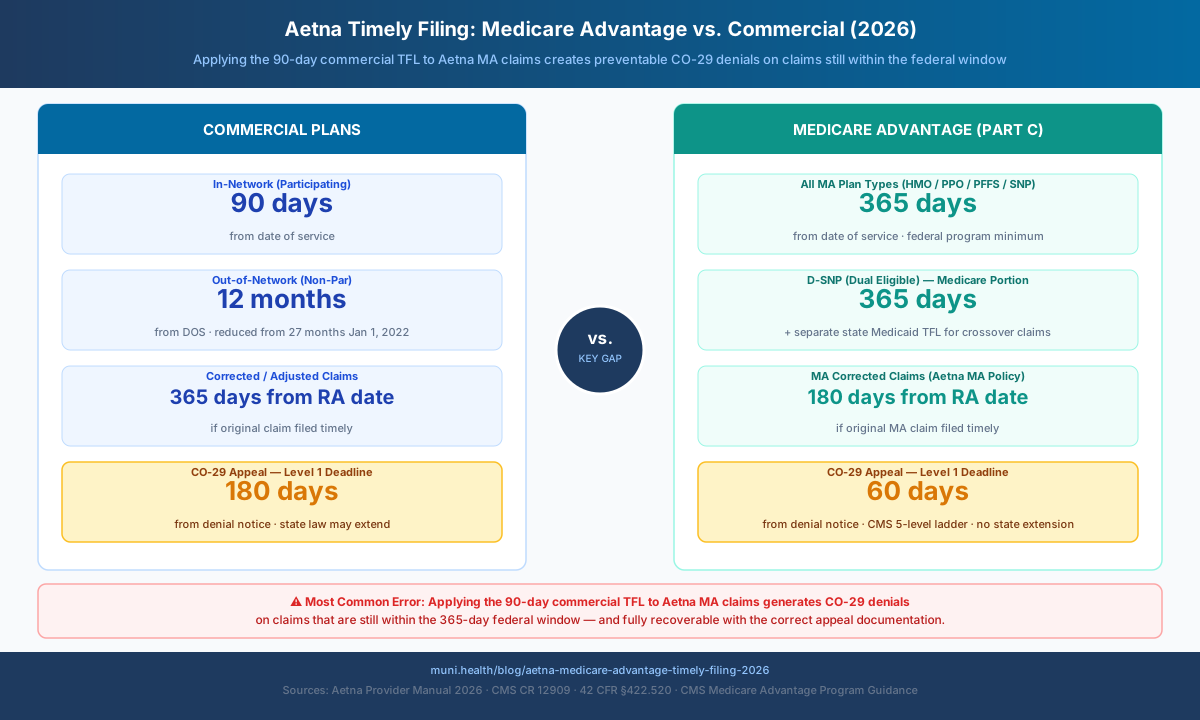
Aetna Medicare Advantage Timely Filing Limits by Plan Type
The 365-day TFL applies across all Aetna MA product types — HMO, PPO, PFFS, D-SNP, and I-SNP. The regulatory framework is the same; what changes is the network structure and the claim routing path.
| Aetna MA Plan Type | Timely Filing Limit | Clock Starts | Key Notes |
|---|---|---|---|
| MA HMO | 365 days | Date of service | In-network only except emergency/urgently needed care; all claims go through Aetna MA, not commercial |
| MA PPO | 365 days | Date of service | In-network and out-of-network MA PPO claims — same 365-day window regardless of network status |
| MA PFFS (Private Fee-for-Service) | 365 days | Date of service | Any willing provider who agrees to PFFS terms; 365-day TFL applies to all submitted claims |
| D-SNP (Dual Eligible Special Needs Plan) — Medicare portion | 365 days | Date of service | Medicare is always primary; Medicaid secondary crossover has a separate, shorter state TFL |
| I-SNP (Institutional Special Needs Plan) | 365 days | Date of service | Long-term care facility-based MA plans; same 365-day federal TFL as standard MA products |
| MA Corrected / Adjusted Claims (all plan types) | 180 days from Remittance Advice | Date of RA | Aetna MA corrected claim window is measured from the EOB/RA date; verify in your MA participation agreement |
Check Your MA Provider Agreement Separately From Commercial
Your Aetna MA participation agreement is a distinct contract from your Aetna commercial agreement. Contracted participating Aetna MA providers may have different TFL windows specified in the MA addendum. Always verify your MA contract language before assuming the 365-day default applies — and note that the commercial and MA contracts are not interchangeable.
Why Plan Type Matters for CO-29 Disputes
When a CO-29 denial arrives on an Aetna MA claim, the first question is whether Aetna applied the correct TFL. MA HMO claims denied for timely filing within month three are almost certainly a commercial-TFL misapplication — the 365-day window governs, not the 90-day in-network commercial limit. MA PPO claims denied for filing in month five are in the same category.
If you can show the claim was submitted within 365 days of the date of service, the CO-29 denial on an MA claim is incorrect and winnable through the Level 1 redetermination.
Corrected Claims Under Aetna Medicare Advantage
Aetna MA corrected claims have a separate TFL that runs from the Remittance Advice date — not from the original date of service. Per Aetna MA policy, the corrected claim window is 180 days from the RA date, provided the original claim was submitted within the applicable 365-day DOS window.
This matters for:
- Claims where the initial Aetna MA payment applied incorrect member cost-sharing
- Claims where ICD-10 or CPT coding was updated after the remittance
- Claims where coordination with another payer changed the Aetna MA liability after the original payment
Note that CMS Change Request 12909 (which extends corrected claim filing windows) applies to traditional Medicare FFS claims, not Medicare Advantage plans. Aetna MA corrected claim rules are governed by your MA participation agreement — always verify the specific window in your contract.
Frequency Codes for MA Corrected Claims
Use frequency code 7 (replacement of prior claim) for corrected MA claims. Frequency code 5 (late charge) is for additional charges not on the original claim. A corrected claim submitted with the wrong frequency code may be processed as a duplicate or cause a new CO-29 denial. For the full Aetna corrected claim breakdown — commercial vs. MA vs. Medicaid windows, exact Availity steps, and CO-29 appeal documentation — see the Aetna Corrected Claim Timely Filing Limits 2026 guide. For a multi-payer look at corrected claim TFL rules including both FFS and MA plans, see the corrected claim timely filing limits guide.
D-SNP and Dual-Eligible Billing: Two Clocks to Track
D-SNP billing requires tracking two separate timely filing deadlines: the 365-day Aetna MA window for the Medicare primary claim and a shorter state Medicaid TFL for the Medicaid secondary crossover claim. This dual-clock structure is the source of most D-SNP billing errors.
Track 1 — Aetna MA (Medicare primary): Submit the claim to Aetna MA within 365 days of the date of service. Aetna MA pays its portion and issues a Remittance Advice. For D-SNP members, this works the same as any other Aetna MA claim.
Track 2 — State Medicaid (secondary crossover): After Aetna MA issues the RA, any remaining patient cost-sharing (copays, coinsurance, deductibles) should cross over to the state Medicaid program — D-SNP members typically have Medicaid coverage that reduces or eliminates their cost-sharing obligations. The state Medicaid program's crossover TFL is measured from the Aetna MA RA date, not from the original date of service.
The problem: state Medicaid programs have much shorter TFLs for crossover claims than the 365-day MA window — often 90 to 180 days from the RA date, depending on the state. A practice that correctly files the Aetna MA primary claim within 365 days but then delays Medicaid secondary billing past the state's crossover deadline loses the Medicaid cost-sharing recovery. Verify your state Medicaid program's crossover TFL separately; it is not the same as the MA primary TFL.
D-SNP Prior Authorization Routing
D-SNP prior authorization requests should be submitted through AetnaForHCP.com under the member's MA plan ID. Using the commercial PA routing path for a D-SNP member can result in PA approvals that do not appear in Aetna's MA claims system, causing unnecessary claim denials even when the service was approved.
Submitting Aetna MA Claims Through Availity
Electronic Aetna MA claims route through the Availity Essentials platform (availity.com). Confirm with your clearinghouse that the claim is routing to Aetna's Medicare Advantage payer ID — not to a commercial Aetna payer ID — as some clearinghouses route MA and commercial Aetna claims separately. The plan type in the claim must identify the member's MA coverage to ensure the correct TFL and processing rules apply.
Submission path in Availity:
- Availity Essentials → Claims & Payments → Create Claim
- Confirm the member's plan type from the Aetna MA ID card before submission
- Attach clinical documentation through Availity if the claim requires medical necessity review
The 277CA acknowledgment — Aetna's electronic acceptance confirmation returned by the clearinghouse — is your proof-of-timely-submission document for any CO-29 appeal. Save every 277CA transaction for MA claims. The date and time stamp on the 277CA shows exactly when Aetna's system accepted the claim, and it is the strongest evidence in a CO-29 appeal disputing the submission date.
For paper Aetna MA claims:
- Use the mailing address printed on the Aetna MA member's ID card — it varies by plan and state
- For any claim approaching the 365-day window, use certified mail with return receipt to create a submission timestamp
Losing MA Revenue to CO-29 Denials?
Muni Appeals uses the denial materials you upload to surface deadline risk and build a review-ready CO-29 appeal packet. Your staff verifies the controlling window, submits the packet, and records the submission.
First 3 appeals free, then $20 per appeal. Start with your denial letter or EOB and available records. No meeting or clearinghouse connection required.
How to Appeal a CO-29 Timely Filing Denial on an Aetna MA Claim
A CO-29 denial on an Aetna MA claim is often incorrect — generated by Aetna applying the 90-day commercial TFL to a claim that is still within the 365-day MA window. If your claim was submitted within 365 days of the date of service, you have a clear factual basis for a Level 1 redetermination.
Step 1: Confirm Which TFL Applied
Before building the appeal, confirm the claim's date of service and the actual submission date from your clearinghouse records. If the submission was within 365 days, the CO-29 should not have been issued under the MA program rules. If the claim was genuinely filed after day 365, the denial is enforceable — see the exception circumstances below.
Step 2: Pull the 277CA or Availity Acceptance Log
Your appeal must prove when the claim reached Aetna's system. Required documentation:
- 277CA clearinghouse acceptance report — the payer-side acknowledgment with exact date and time Aetna accepted the claim; this is the strongest evidence
- Availity submission log — if filed directly through Availity, the submission timestamp serves the same function
- Practice management batch report — showing transmission date and payer confirmation
For paper claims: certified mail receipts or Aetna mailroom confirmation timestamps.
Step 3: File the Level 1 Redetermination
Aetna MA CO-29 appeals follow the CMS Medicare Advantage appeal process — not Aetna's commercial appeals process. The filing deadline, submission route, and decision timeline are all different:
- Deadline: 65 days from the denial notice (not 180 days as in commercial appeals), per Aetna's own published non-contract-provider appeal guidance
- Route: Availity portal (preferred) or mail to the address on the Aetna MA EOB — not the commercial Aetna appeals address; non-contracted providers must include a signed Waiver of Liability form
- Decision timeline: Aetna has 60 days to issue a Level 1 redetermination for post-service claims
Your appeal letter should reference CARC code 29, state the actual submission date, attach the 277CA, and note that the CMS MA program framework governs the TFL for this claim — not Aetna's commercial contract TFL.
| Appeal Level | Who Decides | Your Deadline | Decision Timeline |
|---|---|---|---|
| Level 1 — Redetermination | Aetna Medicare Advantage | 65 days from denial notice | 60 days post-service; 30 days pre-service |
| Level 2 — Independent Review (IRE) | C2C Innovative Solutions (as of May 1, 2026) | Auto-forwarded — no filing needed | Auto-forwarded if Aetna upholds; 60 days to decide |
| Level 3 — ALJ Hearing (OMHA) | Office of Medicare Hearings and Appeals | 60 days from Level 2 decision | Amount in controversy ≥ $200 (2026 threshold) |
| Level 4 — Medicare Appeals Council (DAB) | Departmental Appeals Board | 60 days from Level 3 decision | Standard Council review timeline |
| Level 5 — Federal District Court | Federal judiciary | 60 days from Level 4 decision | Amount in controversy ≥ $1,960 (2026 threshold) |
For most practices, Levels 1 and 2 resolve the majority of MA CO-29 denials where the claim was within the federal window. For Aetna MA denials beyond timely filing — including clinical denials, prior authorization disputes, and concurrent review — see the Aetna Medicare Advantage denial appeal guide.
IRE Contractor Changed May 1, 2026
CMS transitioned the Part C Independent Review Entity contract from Maximus Federal Services to C2C Innovative Solutions, effective for appeal requests received on or after May 1, 2026. Maximus continued processing requests received through April 30, 2026. Aetna's own non-contract-provider appeal guidance reflects the C2C handoff.
TFL Exceptions Aetna MA Will Consider
If a claim was genuinely filed after day 365, CO-29 is enforceable — but narrow exceptions exist:
- FEMA-declared natural disaster affecting the provider's facility during the filing window
- Verified Availity or clearinghouse outage — documented system downtime that prevented submission
- Retroactive MA enrollment — the member's MA coverage was not confirmed until after the window closed
- Aetna administrative error — incorrect MA plan ID or claim routing issued by Aetna caused the delay
Document any of these with contemporaneous records before filing the appeal.
How Muni Appeals Handles Aetna MA Timely Filing Denials
CO-29 denials on Aetna MA claims are preventable billing workflow errors — the denial exists because a commercial TFL was applied to a federally regulated MA product. The fix is plan-type differentiation at intake, not clinical rebuttal.
Muni Appeals keeps the Aetna MA TFL workflow organized:
- Plan-type tracking that separates Aetna MA from Aetna commercial at claim intake
- 365-day deadline monitoring with alerts before MA claims age past recovery
- 277CA documentation pulls for CO-29 appeal packets
- Appeal letter generation with the correct CMS framework language for Aetna MA CO-29 denials
- D-SNP secondary billing reminders to surface Medicaid crossover windows before they close
Frequently Asked Questions
What is Aetna's timely filing limit for Medicare Advantage claims?
Aetna Medicare Advantage plans require claim submission within 365 days from the date of service. This applies to Aetna MA HMO, PPO, PFFS, D-SNP, and I-SNP plan types. The 365-day window is consistent with the CMS MA program framework — Aetna cannot impose a shorter TFL on MA claims than the federal program minimum.
Is Aetna MA timely filing really different from the 90-day commercial TFL?
Yes — this is the most consequential TFL distinction for practices with mixed Aetna commercial and MA patient panels. Aetna's in-network commercial TFL is 90 days. Aetna MA's TFL is 365 days. A claim filed in month four is a CO-29 denial under commercial rules and a clean submission under MA rules. Billing workflows that don't differentiate plan type will generate preventable MA denials on a regular basis.
What is the TFL for Aetna MA corrected claims?
Aetna MA corrected claims can be filed within 180 days of the Remittance Advice date — provided the original claim was submitted within the 365-day original filing window. The corrected claim clock starts from the Aetna MA RA, not from the date of service. Verify the specific window in your Aetna MA participation agreement; the 180-day figure is the standard Aetna MA corrected claim policy.
How long do I have to appeal a CO-29 on an Aetna MA claim?
You have 65 days from Aetna's denial notice to file a Level 1 redetermination, per Aetna's own published non-contract-provider appeal guidance. This is significantly shorter than the 180-day commercial appeal window. Missing the 65-day MA appeal deadline makes the CO-29 final — the claim cannot be recovered through any level of the CMS appeal ladder after that window closes.
Does state law extend Aetna MA appeal deadlines like it does for commercial plans?
No. Medicare Advantage falls under federal CMS jurisdiction (42 CFR Part 422, Subpart M), not state insurance law. State insurance commissioners have no authority over MA disputes, and state mandates that extend commercial appeal windows do not apply to MA claims. Aetna's 65-day Level 1 deadline is set under this federal framework and not subject to state extension.
What documentation do I need to appeal a CO-29 on an Aetna MA claim?
The strongest documentation is a 277CA clearinghouse acceptance report showing Aetna's system accepted the claim within the 365-day window. Availity submission timestamps and practice management transmission logs serve the same function. For paper claims, certified mail receipts or Aetna mailroom confirmations. The appeal letter should state the actual submission date, reference CARC code 29, and note that the CMS MA program framework — not Aetna's commercial TFL — governs the filing window.
How do D-SNP timely filing limits work?
D-SNP billing involves two separate TFL clocks. The Medicare primary claim to Aetna MA has a 365-day TFL from the date of service. After Aetna MA pays and issues a Remittance Advice, the Medicaid secondary crossover claim has a separate, shorter TFL set by the state's Medicaid program — typically 90 to 180 days from the RA date, depending on the state. Missing the Medicaid crossover window does not affect the MA primary claim but forfeits the Medicaid cost-sharing recovery.
What happens if my Aetna MA claim genuinely missed the 365-day window?
If the claim was submitted after day 365 with no qualifying exception, the CO-29 is enforceable. The exception categories Aetna MA will consider are narrow: FEMA-declared disaster affecting the practice, verified Aetna or Availity portal outage, retroactive MA enrollment discovery, or Aetna administrative error in plan ID or routing. Each exception requires contemporaneous documentation — general oversight, staff changes, or billing software transitions are not accepted.
Ready to Stop Losing Aetna MA Revenue to Timely Filing Errors?
CO-29 denials on Aetna Medicare Advantage claims are among the most preventable revenue losses in medical billing. The most common cause — applying the 90-day commercial TFL to a federally regulated 365-day MA product — is a billing workflow problem, not a clinical one.
Get Started:
- Plan-type separation so Aetna MA and Aetna commercial claims never share a TFL deadline
- 365-day MA deadline monitoring with proactive alerts before claims age out
- D-SNP secondary billing reminders before state Medicaid crossover windows close
- CO-29 appeal documentation with the correct federal framework language for MA denials
This guide reflects 2026 Aetna Medicare Advantage timely filing procedures based on CMS Medicare Advantage program guidance and the Aetna Provider Manual. Contracted Aetna MA provider TFLs may differ from program defaults — verify your MA-specific provider agreement separately from your Aetna commercial contract. D-SNP Medicaid crossover TFLs are governed by each state's Medicaid program and are separate from the Aetna MA primary claim deadline. Aetna MA appeals follow the CMS 5-level Medicare Advantage appeal ladder under 42 CFR Part 422, Subpart M.