

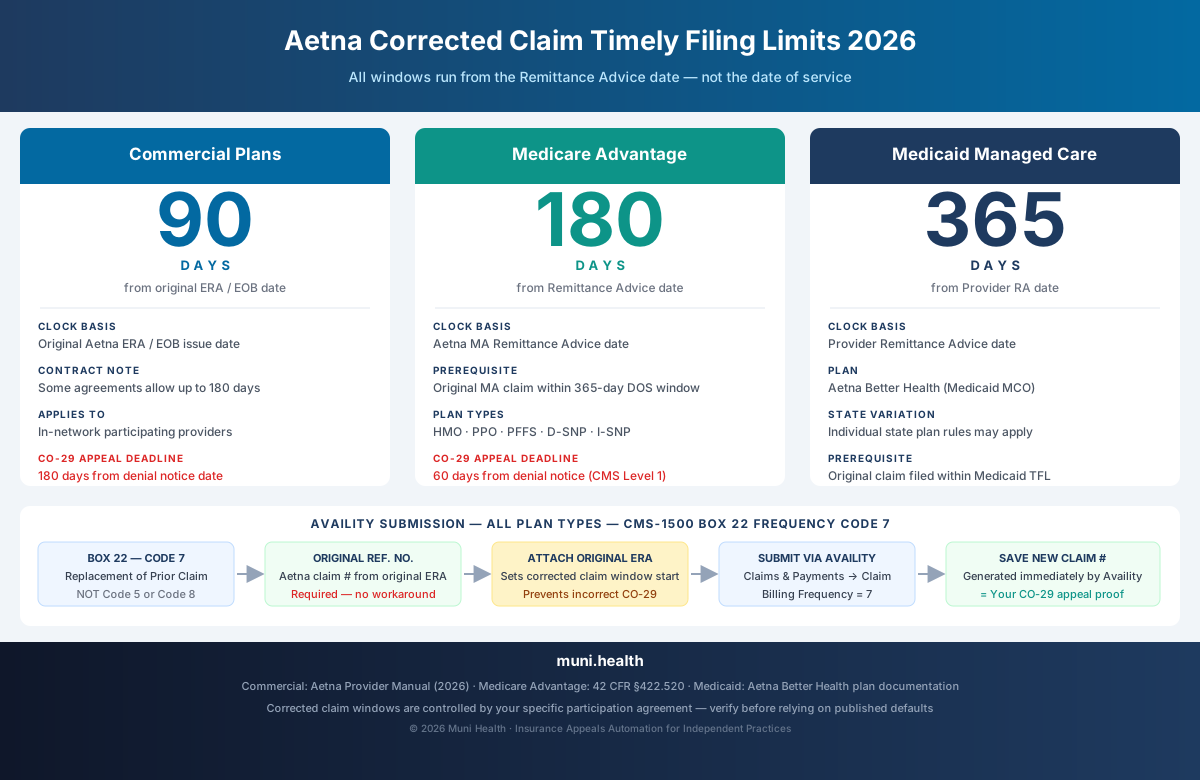
Aetna's corrected claim timely filing limits differ by plan type and all run from the remittance date — not the date of service. Commercial in-network: typically 90 days from the original ERA/EOB date (your contract may allow up to 180 days). Medicare Advantage: 180 days from the Remittance Advice date. Medicaid managed care (Aetna Better Health): 365 days from the Provider Remittance Advice date. Submitting a corrected claim without the original claim number in CMS-1500 Box 22 causes Aetna to process it as a duplicate new claim, generating a CO-29 or CO-97 denial regardless of timing.
What Is an Aetna Corrected Claim — vs. an Appeal vs. a New Submission?
A corrected claim replaces a previously submitted claim that contained a billing error and runs on its own deadline, separate from both the original claim TFL and the appeal window. Understanding which administrative track applies is the first decision, because each routes to a different Aetna processing unit with different timelines.
The three tracks billing teams most frequently confuse:
| Submission Type | Code / Track | Purpose | Resets TFL Clock? |
|---|---|---|---|
| Corrected claim | CMS-1500 Box 22, Code 7 (Replacement) | Fix a billing error on a previously adjudicated claim — wrong NPI, diagnosis code, modifier, or rendering provider | No — runs from original RA date |
| Late charge addition | CMS-1500 Box 22, Code 5 (Late Charge) | Add charges discovered after the original claim was already paid | No — supplements existing adjudication |
| Void prior claim | CMS-1500 Box 22, Code 8 (Void) | Cancel the original claim entirely; a separate new original must then be submitted | Yes — new original restarts from DOS |
| Claim appeal / reconsideration | Aetna dispute channel (Availity, mail, fax) | Contest Aetna's adjudication decision — clinical denial, underpayment, or incorrect processing | N/A — 180-day commercial or 60-day MA window from denial date |
Filing an appeal when you should be filing a corrected claim routes the submission to Aetna's appeals team instead of the claims reprocessing unit. Aetna processes each track independently — the wrong track delays resolution without creating any new deadline in either queue. Billing teams that discover a modifier error or wrong NPI on a denied claim sometimes file a formal reconsideration when a corrected claim is the correct path; the reconsideration fails on the merits because the underlying billing error was never corrected.
Aetna Corrected Claim Timely Filing Limits by Plan Type
All Aetna corrected claim windows run from the remittance date — not the date of service — which gives practices a meaningful correction window after initial adjudication, even when the original claim DOS window has closed.
Prepare this appeal packet with your team.
Draft the appeal, coordinate missing documents, and approve the reviewed packet. Keep your clearinghouse; your practice checks deadlines and submits through the payer’s accepted channel.
First 3 appeals free, then $20 per appeal. Start with your denial letter or EOB and available records. No meeting or clearinghouse connection required.
| Plan Type | Corrected Claim Window | Clock Starts From | Key Condition |
|---|---|---|---|
| Commercial — In-Network (Participating) | Typically 90 days | Original ERA/EOB date | Your specific participation agreement controls — some contracts allow up to 180 days |
| Commercial — Out-of-Network (Non-Par) | Verify in contract | Original ERA/EOB date | Non-par corrected claim windows vary by contract; confirm with Aetna provider services |
| Medicare Advantage (all plan types) | 180 days | Remittance Advice date | Original MA claim must have been submitted within the 365-day DOS window |
| Medicaid Managed Care (Aetna Better Health) | 365 days | Provider Remittance Advice date | State-specific plan rules may apply; verify with your state's Aetna Better Health plan |
| FEHB (AetnaFeds) | Verify in OPM plan documents | EOB date (typically) | OPM program rules govern; call 888-238-6240 for plan-specific corrected claim window |
The most consequential implication of this table: applying the original DOS-based TFL logic to corrected claims understates the window on every Aetna product line. A commercial claim with a 90-day DOS window denied at day 85 does not leave five days to correct — it leaves 90 days from the date Aetna issued the denial ERA, which is a significantly larger recovery window.
Commercial Corrected Claims: Typically 90 Days from the ERA/EOB Date
For commercial in-network (participating) Aetna plans, the corrected claim timely filing window is typically 90 days from the date of the original Explanation of Benefits or Electronic Remittance Advice. The clock starts when Aetna issues the remittance on the original claim — not from when you receive it and not from the date of service.
This distinction is operationally significant. A commercial claim for a February service may generate a remittance in early April. The 90-day corrected claim window runs from that April RA date, giving the billing team until early July to submit the correction — even though the date of service was four months earlier. A team applying the original 90-day DOS rule would assume the window closed in May and write off the claim. The ERA-based rule means the claim is still recoverable.
Your Participation Agreement Controls the Window
Aetna's published default for commercial corrected claims is 90 days from the ERA/EOB date, but individual participation agreements sometimes specify a longer window — up to 180 days from the original EOB. Always verify your specific contract language before assuming the published default applies. Aetna enforces the terms in your contract; the provider manual is the fallback when no contract term differs.
For non-participating (out-of-network) Aetna commercial corrected claims, the window is not standardized the same way as in-network and varies more significantly by contract and plan. Aetna reduced its non-par original claim TFL from 27 months to 12 months effective January 1, 2022, but non-par corrected claim windows are not uniformly documented. Verify with Aetna provider services (1-888-MD-AETNA) or in your specific contract before assuming the in-par corrected claim window applies to non-par submissions.
Aetna Medicare Advantage: 180 Days from the RA Date
Aetna Medicare Advantage corrected claims must be submitted within 180 days of the original Remittance Advice date, provided the original MA claim was submitted within the 365-day date-of-service window. Per Aetna's provider documentation, this is the standard Aetna MA corrected claim policy, and it applies across all Aetna MA plan types — HMO, PPO, PFFS, D-SNP, and I-SNP.
The 180-day MA corrected claim window is entirely separate from both the commercial corrected claim window (typically 90 days) and the original MA TFL (365 days from DOS). Practices with mixed Aetna commercial and MA patient panels must track these as three distinct deadline types, not one.
CMS CR 12909 Does Not Apply to Aetna Medicare Advantage
CMS Change Request 12909 (effective February 2025) extended the corrected claim filing window for traditional Medicare fee-for-service when the original claim was timely filed. That provision does not apply to Medicare Advantage plans. Aetna MA corrected claims are governed by the 180-day RA-based window in your Aetna MA participation agreement — not by the CMS CR 12909 exception. Do not cite CR 12909 when appealing an Aetna MA corrected claim CO-29 denial.
For D-SNP (Dual Eligible Special Needs Plan) corrected claims, note that Aetna MA processes the Medicare primary portion. If the correction changes what Aetna MA paid, the Medicaid crossover secondary claim may also need correction — and the state Medicaid crossover window is typically shorter than Aetna MA's 180-day corrected claim window. Track D-SNP Medicare and Medicaid corrections on separate timelines. For D-SNP billing details, see the Aetna Medicare Advantage timely filing guide.
Aetna Medicaid Managed Care: 365 Days from the Remittance Advice
Aetna Better Health (Aetna Medicaid managed care) allows 365 days from the Provider Remittance Advice date for corrected claim submissions — the most generous corrected claim window in Aetna's product line, per Aetna's Medicaid plan billing documentation. The original claim must have been filed within the applicable Medicaid timely filing window first.
This is one of the most frequently misapplied Aetna billing rules: practices billing Aetna Better Health alongside Aetna commercial often apply the 90-day commercial corrected claim logic to Medicaid accounts, leaving 10 months of recoverable Medicaid corrected claims on the table.
State-specific Aetna Better Health plans operate under individual state Medicaid contracts, and particular state plan rules may specify different windows. The 365-day RA-based window reflects Aetna Better Health's standard published policy. Verify with your state's Aetna Better Health plan if you are in a state with known Medicaid TFL variations.
How to Submit an Aetna Corrected Claim Through Availity
The fastest and safest path for Aetna corrected claim submissions is Availity Essentials — it provides an immediate new claim number and submission confirmation timestamp, which is the document you need if Aetna issues a CO-29 denial on the correction.
Step-by-step for corrected claims in Availity Essentials:
- Log in at availity.com → Claims & Payments in the menu bar
- Select Professional Claim (CMS-1500) or Facility Claim (UB-04) under Claims
- In the Claim Information section, locate the Billing Frequency drop-down
- Select 7 — Replacement of Prior Claim
- In the Original Ref. No. field (immediately adjacent to Billing Frequency), enter the original Aetna claim number from the original ERA/EOB — this links the corrected submission to the prior adjudication
- Correct only the specific field(s) that caused the billing error; do not alter clinical content unless it was documented incorrectly
- Submit — Availity generates a new claim number immediately; record it before closing the session
For EDI 837 submissions through clearinghouses (Change Healthcare, Trizetto, or other certified Aetna EDI clearinghouses), the equivalent is CLM05-3 = 7 on the 837P or 837I, with the original claim number in the 2300 REF~F8 segment.
For paper CMS-1500 submissions, use Box 22: enter 7 in the Resubmission Code field and the original Aetna claim number in the Original Ref. No. field. Paper submissions provide no immediate confirmation — use certified mail and retain the receipt as proof of the submission date.
Code 8 Is Not Code 7
Code 8 (Void Prior Claim) cancels the original claim entirely and requires a separate new original submission. It does not correct the original claim — it deletes it. Using code 8 when you intended code 7 voids an existing payment and resets the timely filing clock to the original date of service, creating a new original claim that may already be outside the DOS-based TFL. Use code 7 for corrections. Use code 8 only when the original claim needs to be completely withdrawn.
The Duplicate-Claim Trap: Why Aetna Auto-Rejects Without the Original Claim Number
The most preventable corrected claim denial at Aetna is caused by a missing original claim number in Box 22. Without it, Aetna's adjudication system cannot locate the prior claim to replace and processes the submission as a new original claim.
Two outcomes result, depending on Aetna's system state:
- Original claim was paid: Aetna generates a CO-97 or duplicate-claim denial — the new submission matches the original paid claim and creates a duplicate rather than a replacement
- Original claim was denied: Aetna processes the new submission under original claim TFL rules measured from the date of service, which may now be outside the 90-day DOS window even though the corrected claim ERA-based window was still open
In both cases, the billing error is never corrected. The corrected claim window is not credited, and the billing team must restart the process with the correct submission — now closer to the deadline.
The fix is straightforward: pull the original Aetna claim number from the ERA or from Availity's claim status portal before initiating any corrected claim. The original claim number appears on every Aetna ERA remittance and in the Availity claim history. Include it on every corrected claim as non-negotiable procedure, not an optional field.
CO-29 Denials on Aetna Corrected Claims: When to Appeal
A CO-29 denial (CARC 29 — "timely filing expired") on an Aetna corrected claim is not automatically valid. Aetna most commonly issues incorrect CO-29 on corrected claims when the original ERA is missing from the submission and the system defaults to measuring from the date of service rather than the RA date.
When a CO-29 on a corrected claim should be appealed:
- The original claim was submitted within the applicable Aetna DOS-based TFL
- The corrected claim was submitted within Aetna's actual corrected claim window (90 days commercial, 180 days MA, or 365 days Medicaid — measured from the original RA date)
- Aetna issued CO-29 because the original ERA was missing or the original claim number was absent, causing the system to measure from the date of service instead
Documentation for the appeal:
- 277CA clearinghouse acceptance report with timestamp showing the original claim was submitted within the applicable DOS window
- Original ERA/EOB from Aetna showing the date the original claim was adjudicated (this establishes the RA date from which the corrected claim window starts)
- Availity corrected claim submission confirmation (new claim number + submission timestamp)
- Copies of both the original and corrected CMS-1500 claim forms
Appeal deadlines:
- Commercial CO-29 appeal: 180 days from the denial notice date (Aetna Level 1 dispute)
- MA CO-29 appeal: 60 days from the denial notice date (CMS Level 1 redetermination — missing this is final)
Submit through Availity Essentials (Claims & Payments → Dispute) or by mail to the address printed on the EOB. For the full Aetna dispute workflow including medical necessity and prior authorization denials, see the Aetna Denied Claim Guide 2026 and how to appeal Aetna denials.
One Document Wins Most CO-29 Appeals on Corrected Claims
The original ERA/EOB with its issue date is the controlling document in a CO-29 appeal on a corrected claim. It establishes when the corrected claim window started and demonstrates the corrected submission was within the window. Present the ERA date, the corrected claim submission date, and the math showing you were within the applicable window. Aetna's appeals team does not typically contest this when the documentation is clear.
How Muni Appeals Handles Aetna Corrected Claim Workflows
Aetna corrected claim management requires tracking two separate deadlines per claim — the original DOS-based TFL and the RA-based corrected claim window — across three product lines with materially different time limits. It also requires storing the original ERA at the time of initial submission so it is immediately available when a CO-29 arrives weeks or months later.
Prepare this appeal packet with your team.
Draft the appeal, coordinate missing documents, and approve the reviewed packet. Keep your clearinghouse; your practice checks deadlines and submits through the payer’s accepted channel.
First 3 appeals free, then $20 per appeal. Start with your denial letter or EOB and available records. No meeting or clearinghouse connection required.
Muni Appeals organizes the Aetna corrected-claim response for staff review:
- Surfaces corrected-claim deadline risk from the uploaded remittance; staff verifies the governing Aetna plan window and calendars it
- Uses an uploaded 277CA to surface possible timely-original-submission evidence for staff review
- Generates Aetna-specific corrected-claim reconsideration drafts that reference an uploaded original ERA
- Organizes uploaded ERAs with the draft so staff can include the right evidence in a CO-29 response
Frequently Asked Questions
What is Aetna's corrected claim timely filing limit for commercial plans?
For in-network commercial plans, the corrected claim timely filing limit is typically 90 days from the date of the original ERA/EOB. The clock starts from Aetna's remittance date, not from the date of service. Your specific participation agreement may specify a different window — some contracts allow up to 180 days from the EOB date. Always verify your contract language before assuming the published default applies.
What is the corrected claim deadline for Aetna Medicare Advantage?
Aetna Medicare Advantage corrected claims must be submitted within 180 days of the Remittance Advice date, provided the original MA claim was submitted within the 365-day date-of-service window. This applies to Aetna MA HMO, PPO, PFFS, D-SNP, and I-SNP plan types. Verify the specific window in your Aetna MA participation agreement, as MA addenda sometimes specify different terms.
What frequency code do I use to submit a corrected claim to Aetna?
Use frequency code 7 (Replacement of Prior Claim) on CMS-1500 Box 22 Resubmission Code, and enter the original Aetna claim number in the Original Ref. No. field. On the EDI 837, use CLM05-3 = 7 with the original claim number in the 2300 REF~F8 segment. On a UB-04, change the third digit of the Type of Bill to 7 (for example, 137 for outpatient). Code 8 voids the original claim entirely — it does not correct it.
Does filing a corrected claim to Aetna reset the timely filing clock?
No. Filing a corrected claim does not reset or extend the original timely filing clock. The corrected claim window is a separate RA-based deadline that runs independently of the original DOS-based TFL. The original DOS window continues to run and is unaffected by a corrected claim submission.
What happens if I submit an Aetna corrected claim without the original claim number?
Without the original claim number in Box 22 (or in the 2300 REF~F8 EDI segment), Aetna cannot locate the prior adjudication to replace. Aetna processes the submission as a new original claim. If the original was paid, this generates a CO-97 duplicate denial. If the original was denied, Aetna re-measures timely filing from the date of service — potentially generating a CO-29 even though the RA-based corrected claim window was still open.
Can I appeal a CO-29 on an Aetna corrected claim?
Yes — and you should if the corrected claim was submitted within Aetna's actual corrected claim window. The most common trigger for an incorrect CO-29 on a corrected claim is a missing original ERA, causing Aetna's system to measure from the date of service. Attach the original ERA establishing the RA date, the corrected claim submission confirmation, and a cover letter showing the days elapsed are within the 90-day commercial, 180-day MA, or 365-day Medicaid window. Commercial appeal deadline: 180 days from denial. MA appeal deadline: 60 days from denial.
How does Aetna Medicaid corrected claim timing differ from commercial?
Aetna Better Health (Medicaid managed care) allows 365 days from the Provider Remittance Advice date for corrected claims — significantly more time than the 90-day commercial default. Practices billing both Aetna commercial and Aetna Medicaid plans must track them separately to avoid applying the shorter commercial corrected claim window to Medicaid accounts.
Does Aetna accept corrected claims by paper or fax?
Yes, but electronic submission through Availity Essentials is strongly preferred. Availity provides an immediate new claim number and submission timestamp — the proof you need for any CO-29 appeal on the corrected claim. Paper submissions create no immediate confirmation; use certified mail and retain the receipt as your proof of submission date if paper is necessary.
Ready to Stop Losing Aetna Corrected Claims to CO-29 Denials?
Aetna corrected claim CO-29 denials are recoverable — but only within the applicable RA-based window and only with the original ERA as documentation. The most common failure point is tracking corrected claim deadlines against the date of service rather than the Aetna remittance date.
Get Started:
- RA-based corrected-claim deadline guidance, separate from original DOS TFLs, for staff verification
- Upload support for the relevant remittance or clearinghouse evidence used in CO-29 appeal documentation
- Aetna-specific corrected claim appeal letters with ERA documentation attached
- CO-29 detection and appeal generation across commercial, MA, and Medicaid plans
This guide reflects 2026 Aetna corrected claim timely filing procedures based on Aetna's published provider billing guidelines, Aetna Provider Manual, and Aetna Medicare Advantage program documentation. Commercial corrected claim windows are controlled by your individual participation agreement — always verify the specific window in your contract before relying on published defaults. Aetna Medicaid (Aetna Better Health) corrected claim windows are governed by state Medicaid contracts and may vary by state. For related Aetna billing guidance, see our Aetna Timely Filing Limits 2026, Aetna Medicare Advantage Timely Filing 2026, and Corrected Claim Timely Filing Limits 2026.