

Corrected claim timely filing limits are separate from original claim deadlines and differ significantly by payer. UHC's commercial corrected-claim window is commonly cited at 180 days from the original ERA/EOB date — though UHC's own published claim-correction guidance describes a date-of-service-based window governed by your Participation Agreement instead, so confirm which basis your contract uses. Cigna allows 90 days (in-network) or 180 days (out-of-network) from the remittance date. Anthem corrected-claim rules vary by plan and state; confirm the applicable policy and its starting event. Humana does not reset the clock — you have whatever time remains in the original DOS window.
Why Corrected Claim Deadlines Are Separate from Original Claim Deadlines
A corrected claim is not an appeal — it runs on its own deadline clock, and that clock often starts from the remittance date rather than the date of service.
When a claim is adjudicated and paid or denied with a billing error — wrong modifier, incorrect NPI, mismatched patient date of birth — a corrected claim replaces the original. That correction is tracked as a separate administrative event, not as a new claim and not as an appeal. Each major payer sets its own window for accepting that correction, and those windows are often more generous than most billing teams realize.
The problem is that practices routinely apply original claim timely filing rules to corrected claims. If your original claim window is 90 days from the date of service and your remittance arrives on day 75, applying the original TFL logic leaves you only 15 days to file a corrected claim. For payers whose contracts genuinely reset the clock at remittance, that mismatch costs real revenue — but for UHC specifically, confirm whether your contract actually grants the commonly-cited 180-day RA-based window before assuming it applies; UHC's own guidance points to a DOS-based window instead. For the original-claim TFL by payer that this corrected-claim clock builds on, see Timely Filing Limits by Insurance Company: 2026 Master Guide.
CO-29 on Corrected Claims: The Most Over-Accepted Denial
CO-29 denials on corrected claims are routinely accepted as valid when they are not. Payers issue CO-29 on a corrected claim when the original ERA/EOB is missing from the submission and the payer defaults to measuring from the date of service. If the corrected claim was submitted within the payer's actual corrected-claim window, that CO-29 is incorrect and appealable within the standard appeal window. Attaching the original ERA to every corrected claim submission is the single most effective prevention step.
CMS-1500 Box 22 and Type of Bill Code 7: The Administrative Gate
Every corrected claim must carry the right frequency code or it will be processed as a new claim — creating duplicate-claim denials instead of replacements.
Prepare this appeal packet with your team.
Draft the appeal, coordinate missing documents, and approve the reviewed packet. Keep your clearinghouse; your practice checks deadlines and submits through the payer’s accepted channel.
First 3 appeals free, then $20 per appeal. Start with your denial letter or EOB and available records. No meeting or clearinghouse connection required.
For professional claims on the CMS-1500, Box 22 has two fields: the Resubmission Code and the Original Ref. No. For a corrected (replacement) claim, enter 7 in the Resubmission Code field and the original claim number in the Original Ref. No. field. Code 8 identifies void/cancellation, not replacement. The Anthem Wisconsin policy definitions do not grant more filing time when a claim is cancelled; verify the applicable payer instructions before using either transaction.
For facility claims on the UB-04, the Type of Bill's third digit identifies the frequency code. A Type of Bill ending in 7 (for example, 117 for inpatient or 137 for outpatient) tells the payer this is a replacement claim. The corresponding EDI 837 equivalent is CLM05-3 = 7 on the 837P or 837I, with the original claim number carried in the 2300 REF~F8 segment.
Without the correct code and the original claim number, the payer cannot link the submission to the prior adjudication. Most payers will then process the corrected claim as a new claim, deny it as a duplicate of the original paid claim, or reject it outright. The claim history audit trail breaks, and the corrected-claim filing window is typically not credited.
One Code Change, Very Different Outcome
Replacement and cancellation serve different purposes. Confirm the claim-type and payer instructions before using either. Cancelling a claim does not establish an extension or a mandatory new-original workflow.
Corrected Claim Timely Filing Limits by Payer
| Payer | Corrected Claim Window | Clock Starts From | MA / Out-of-Network Rules | Key Note |
|---|---|---|---|---|
| UnitedHealthcare | 180 days (commonly cited — unconfirmed) | Original ERA/EOB date (commonly cited) — UHC's own guidance points to DOS-based instead | MA: 365 days from DOS (CMS mandate, confirmed) | Submit via UHCProvider.com; verify commercial window and basis against your Participation Agreement; paper no longer accepted for most network providers |
| Cigna | 90 days (in-network); 180 days (OON) | Original RA/EOB date | GWH-Cigna OAP: 90 days from RA; MA: through Dec 31 of year following service | Always attach original ERA — without it Cigna defaults to DOS, generating an incorrect CO-29 |
| Anthem BCBS | Plan- and state-specific | Check the applicable policy | Verify the particular product and provider agreement | The WI Medicaid and IN Medicaid examples use different limits and starting dates |
| Humana | Remaining time in original DOS window | Date of service (clock never resets) | MA: 365-day DOS window; commercial: 90–180 days from DOS | A denial on day 300 of a 365-day window leaves approximately 65 days to correct |
| Aetna | Verify in participation agreement; typically 90–180 days from EOB | Original EOB/RA date (commercial); verify for each plan | MA: verify with Aetna MA provider manual | Aetna enforces strict timely filing; confirm corrected-claim window in your specific contract |
| Traditional Medicare | Within original 12-month DOS window; exception for timely-filed originals | Date of service | CMS CR 12909 (Feb 2025): corrected claims may exceed 12 months if original was timely | Frequency code 7 required; reference original claim number on 837 or CMS-1500 Box 22 |
The most consequential difference across this table is not the length of the window — it is when the clock starts. RA-based windows (Cigna, and UHC per the commonly-cited but UHC-unconfirmed figure) give practices a fresh start after remittance. DOS-based windows (Anthem, Humana, and possibly UHC per UHC's own published guidance) use the time you have left in the original filing period. For a billing team managing multiple payers, applying the wrong clock to the wrong payer — or assuming UHC's basis without confirming it — is a common and preventable revenue loss.
For Molina Healthcare corrected claims — a Medicaid-heavy payer operating under state-specific contracts — the corrected claim window is generally 90 days from the original remittance advice date. Molina's Medicaid timely filing windows vary significantly by state (95 days in Texas to 365 days in Ohio and Kentucky), which means the underlying original claim TFL varies before the corrected claim window even opens. For Molina's state-by-state TFL guide with CO-29 appeal procedures, see Molina Healthcare Timely Filing Limits 2026.
UnitedHealthcare: 180 Days from the ERA/EOB Date
UHC's corrected claim window for commercial plans is commonly cited as 180 days from the date the original ERA or EOB was issued — not from the date of service. This is a widely-repeated industry default, though, not confirmed UHC policy: UHC's own published claim-correction guidance describes the window as date-of-service-based and governed by your Participation Agreement. Confirm which basis and day count your specific contract uses before relying on either figure to identify and correct billing errors discovered post-remittance.
The corrected claim must be submitted through UHCProvider.com. UHC eliminated paper and fax intake for most corrected claim submissions for contracted providers. When submitting electronically, use CLM05-3 = 7 (replacement) on the 837P or 8 (void) on the 837P if canceling. On a CMS-1500, use Box 22 Code 7 with the original claim number in the Original Ref. No. field.
For UHC Medicare Advantage plans — AARP MedicareComplete, UHC Dual Complete, and Group Medicare Advantage — the corrected claim window follows the CMS-mandated 365-day rule measured from the date of service (confirmed, not in dispute). The MA window is independent of the commercial corrected claim policy. For the full UHC corrected claim breakdown — including Community Plan (Medicaid) state-specific windows, UMR's plan-document-governed rules, and CO-29 appeal documentation — see the UHC Corrected Claim Timely Filing Limit 2026 guide. For UHC's claim submission and appeal deadlines by plan type, see the UHC appeal timely filing deadlines guide.
Corrected claims at UHC do not consume any of your commercial appeal window (commonly cited at 65 days, but confirm in your contract). They run on a separate administrative track. If UHC denies the corrected claim, the appeal clock starts fresh from the date of that new denial.
Cigna: 90 Days In-Network, 180 Days Out-of-Network — Clock Starts at the Remittance
Cigna's corrected claim window for in-network participating providers is 90 days from the date of the original remittance advice (ERA/EOB); out-of-network providers get 180 days from the same remittance date. GWH-Cigna (Open Access Plus) follows the standard 90-day in-network window.
This distinction — RA-based rather than DOS-based — means a January service billed to Cigna with a March remittance has until June (90 days from March) to file a corrected claim. A billing team measuring from the January date of service would assume the window closed in April, leaving recoverable corrected claims on the table.
The most important operational step for Cigna corrected claims is attaching the original ERA or EOB to the submission. Per Cigna's documented policy, without the original remittance attached, Cigna defaults to measuring from the date of service rather than the remittance date. This generates CO-29 denials on corrected claims that were actually within the 90- or 180-day window. Attaching the ERA is not optional — it is what establishes the correct clock start.
For Cigna Medicare Advantage, corrected claims may be submitted through the end of December 31 of the calendar year following the service year — a more generous window that matches CMS guidance for MA plans. Part D corrected claims follow a shorter 60-day window from the original remittance or denial notice.
For Cigna-specific corrected claim submission steps (CignaForHCP portal, EDI CLM05-3 = 7, ERA attachment requirement), the CignaForHCP reconsideration vs. appeal routing decision, and the full CO-29 appeal workflow, see the Cigna Corrected Claim Timely Filing Limits 2026 guide. For Cigna's original claim TFL rules and state exceptions, see the Cigna timely filing limits guide.
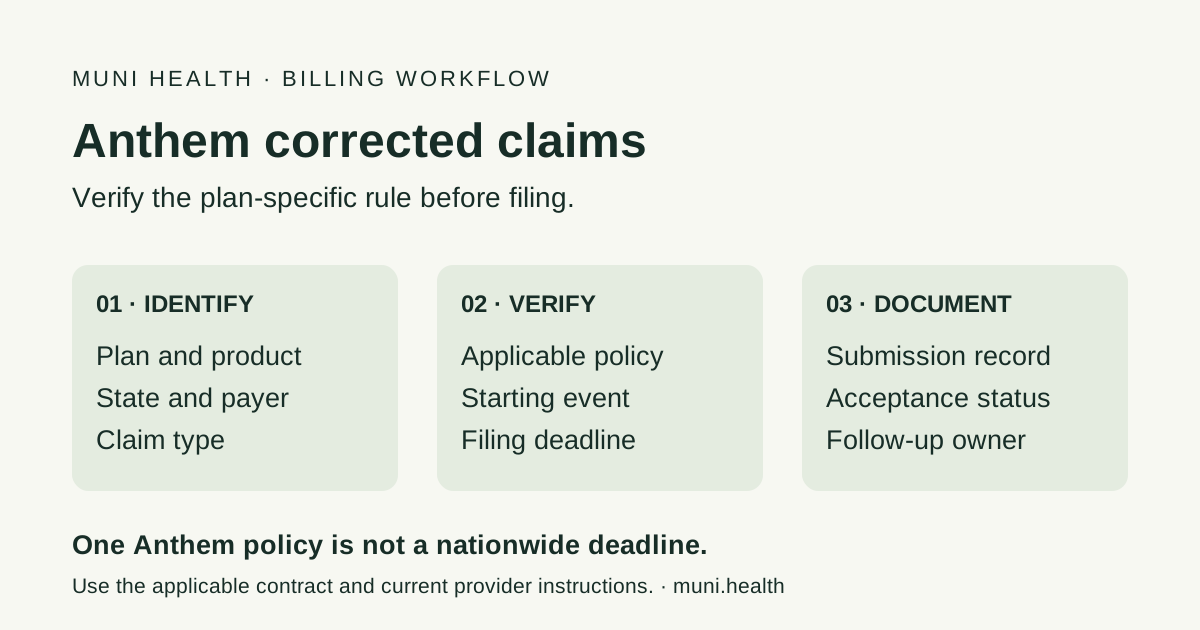
Anthem BCBS: Verify the Plan and Starting Event
Do not infer a nationwide corrected-claim deadline from the Anthem name or a shared policy number. Wisconsin BadgerCare Plus and Medicaid SSI use 365 days from service under the October 6, 2025 policy. Indiana Hoosier Healthwise, Healthy Indiana Plan, and Hoosier Care Connect instead use 60 days from the Explanation of Benefit under the policy approved August 28, 2023. Contractual and governmental exceptions may apply.
These Medicaid examples do not establish commercial, Medicare Advantage, Empire commercial, or FEP deadlines. Confirm the applicable rule, its starting event, and the evidence of receipt before calculating a deadline. The Anthem corrected-claim guide includes additional scoped examples and a copyable verification worksheet. A correction or cancellation does not by itself create more filing time.
Other BCBS licensees require separate policy checks. Highmark's PA/WV/DE notice covers Commercial, Medicare Advantage, and FEP with 455 days from original-claim finalization effective September 1, 2026, excluding BlueCard Home. BCBS Illinois and CareFirst sources have different scope and do not establish a five-state HCSC reset rule. See the BCBS corrected claim timely filing guide for the scoped comparison.
Humana: The Clock Never Resets
Humana does not grant a fresh corrected claim window from the remittance date — the original timely filing clock from the date of service continues running. A corrected claim submission does not restart or extend the filing period.
For Humana Medicare Advantage plans, the window is 365 days from the date of service — the same CMS-mandated window as the original claim. If Humana issues a denial on day 300 of that window, you have approximately 65 days to file the corrected claim, not 180 days from the denial date. The closer to the TFL end that you receive a denial, the tighter the correction window becomes.
For Humana commercial plans, the original timely filing window is typically 90–180 days from the date of service depending on your specific participation agreement. The same no-restart rule applies: whatever time remains in that original window is what you have for the corrected claim.
This rule makes expedient billing error identification critical for Humana accounts. Practices that catch errors early in the adjudication cycle — when the remittance arrives quickly — have comfortable correction windows. Practices that work backlogs or discover errors during periodic account audits may find their correction window is narrow.
Submit corrected Humana claims through the Availity portal. Humana processes corrected claims submitted through Availity within 30 days of receipt per Humana's 2026 provider billing guide.
For the full Humana MA timely filing breakdown and CO-29 appeal process, see the Humana Medicare Advantage timely filing guide and Humana timely filing limits guide. For in-depth coverage of Humana MA corrected claim rules, frequency codes, HMO-SNP Gold Plus exceptions, and CO-29 appeal steps for corrected submissions, see the Humana MA Corrected Claim Timely Filing Limits 2026.
Aetna: Verify Your Contract Window
Aetna's corrected claim timely filing limit varies by plan type and participation agreement — the most commonly cited commercial window is 90–180 days from the original EOB date, but your specific contract controls. Aetna enforces its timely filing rules strictly, and its corrected claim policy is not published uniformly across all plan types in a single provider-facing resource.
For Aetna Medicare Advantage, the corrected claim window follows CMS guidance with a 180-day window from the original EOB date. Commercial plan corrected claim windows should be verified directly in your Aetna participation agreement or by calling Aetna's Provider Services line.
Aetna does not accept administrative error, billing staff turnover, or software system transitions as valid exceptions for missed corrected claim windows. The only accepted exceptions are documented system failures, documented natural disasters, or payer-caused barriers. Document any submission attempt — a clearinghouse acknowledgment is the standard proof Aetna requires.
For the full breakdown of Aetna corrected claim windows by plan type — commercial vs. MA vs. Medicaid, the exact Availity submission sequence, and CO-29 appeal steps — see the Aetna Corrected Claim Timely Filing Limits 2026 guide. For Aetna's original claim TFL rules and CO-29 appeal process, see the Aetna timely filing limits guide. For MA-specific TFLs across all Aetna MA plan types including D-SNP corrected claim workflows, see the Aetna Medicare Advantage timely filing guide.
Medicare Fee-for-Service: The Standard 12-Month Window Applies to Corrections Too
Traditional Medicare requires corrected claims to be submitted within the same 12-month date-of-service window as the original claim — the original claim being timely does not, on its own, extend that window.
Under 42 CFR §424.44, Medicare requires all claims, including corrected (replacement) claims, to be filed within one calendar year of the date of service. A claim for January 2026 services requires any corrected claim to be filed by January 2027, regardless of how quickly the original claim was adjudicated. Medicare Administrative Contractor guidance is explicit on this point: providers are not permitted to add charges or correct an initial claim after the standard filing time limit has expired, per CMS IOM Pub. 100-04, Chapter 1.
CMS does allow a narrow set of exceptions to extend the standard 12-month limit — administrative error, retroactive Medicare entitlement, retroactive entitlement involving a state Medicaid agency, and retroactive disenrollment from a Medicare Advantage or PACE plan (CMS IOM Pub. 100-04, Ch. 1, §70.7) — but each requires the specific documented circumstance and Medicare Administrative Contractor approval. None apply automatically just because the original claim happened to be submitted on time.
For Medicare corrected claims that do fall within the standard window, use the CMS-1500 Box 22 Resubmission Code 7 for professional claims, or the UB-04 Type of Bill ending in 7 for facility claims. The 837 EDI equivalent is CLM05-3 = 7 with the 2300 REF~F8 segment carrying the original claim number.
CO-29 Denials on Corrected Claims: What to Do
A CO-29 denial on a corrected claim is not automatically valid — if the corrected claim was within the payer's actual corrected-claim window, the denial is incorrect and should be appealed immediately.
The most common trigger: the original ERA/EOB was not attached to the corrected claim submission. The payer's system defaults to measuring timely filing from the date of service. The corrected claim posts after the original DOS-based TFL window has closed. The system auto-generates a CO-29. This is a system error, not a real timely filing violation.
To appeal:
- Pull the original ERA/EOB from your clearinghouse or practice management system — you need the date stamp showing when Aetna, UHC, Cigna, or Anthem issued the original remittance.
- Calculate the corrected claim filing date against the payer's actual corrected claim window (RA-based for Cigna and commonly-cited-but-unconfirmed for UHC — verify UHC's basis against your contract; DOS-based for Anthem and Humana).
- If the corrected claim was within the actual window, draft a cover letter stating the corrected claim window start date (original RA date), the corrected claim submission date, and the days elapsed — which is within the applicable window.
- Attach the original ERA/EOB and the corrected claim submission confirmation.
- Submit through the payer's standard appeal channel within the appeal window (typically 60–180 days from the CO-29 denial date, depending on the payer).
CO-29 Appeals on Corrected Claims Win With One Document
The original ERA/EOB with its issue date is the controlling document in a CO-29 appeal for a corrected claim. It establishes the start of the corrected claim window. Payers rarely contest this when it is presented clearly. The appeal letter does not need to be long — it needs the ERA date, the corrected claim date, and the math showing you were within the window.
How Muni Appeals Supports Corrected Claim Review
Corrected claim timely filing requires tracking two separate deadlines per claim — the original claim TFL and the corrected claim window — across six payers with different clock-start rules. Manual tracking in spreadsheets is error-prone, especially in practices billing to three or more payers simultaneously.
Prepare this appeal packet with your team.
Draft the appeal, coordinate missing documents, and approve the reviewed packet. Keep your clearinghouse; your practice checks deadlines and submits through the payer’s accepted channel.
First 3 appeals free, then $20 per appeal. Start with your denial letter or EOB and available records. No meeting or clearinghouse connection required.
Muni Appeals can use the remittance and denial materials you upload to organize the likely corrected-claim window, required evidence, and appeal context. It does not file corrected claims or monitor payer clocks automatically; billing staff must verify the applicable rule, populate the claim fields, calendar the deadline, and submit through the payer's required channel.
- Payer-specific corrected-claim window guidance (UHC commonly-cited-180-day RA — unconfirmed, verify basis — Cigna 90/180-day RA, Anthem plan-specific rules, Humana remaining DOS), subject to staff verification
- CO-29 appeal generation with original ERA as proof-of-window documentation
- A checklist reminding staff to attach the applicable ERA or EOB
- Deadline alerts before the corrected claim window closes
Frequently Asked Questions
What is the difference between a corrected claim and an appeal?
A corrected claim (frequency code 7) replaces the original claim with corrected billing information — wrong modifier, incorrect NPI, or billing error. An appeal contests the payer's clinical or administrative denial decision. They run on separate tracks with separate deadlines. Filing an appeal when you meant to file a corrected claim, or vice versa, wastes the applicable deadline for each and often delays resolution by 30–60 days.
Does filing a corrected claim reset the original timely filing clock?
Only for payers that measure the corrected claim window from the remittance date — confirmed for Cigna, and commonly cited (but not confirmed by UHC's own guidance) for UHC. For those payers, the corrected claim effectively gets a fresh window starting from the RA date, assuming that basis applies to your specific contract. For Anthem and Humana, the original DOS clock continues — filing a corrected claim does not extend or reset the original TFL. For Medicare, CMS CR 12909 allows corrected claims beyond the 12-month DOS window if the original was timely, which functions as a limited reset.
Why does my corrected claim keep getting CO-29 denied?
The most common cause is a missing original ERA/EOB. Without it, the payer's system measures from the date of service rather than the remittance date, making RA-based corrected claims look late. Attach the original ERA to every corrected claim. If the corrected claim was within the actual payer window, appeal the CO-29 with the ERA as your proof document.
What is the corrected claim timely filing limit for UHC Medicare Advantage?
UHC Medicare Advantage plans follow the CMS-mandated 365-day window from the date of service — the same as the original MA claim deadline. This is separate from UHC's commercial corrected claim policy (commonly cited at 180 days from RA, though UHC's own guidance describes a DOS-based commercial window instead — confirm your contract's basis). The MA window is more generous and gives practices approximately a full year from service to correct billing errors on MA claims.
Can I file a corrected claim after the original timely filing window has closed?
Generally no — for Anthem and Humana, the original DOS window is the outer limit. For Cigna, confirmed, and for UHC per the commonly-cited (but UHC-unconfirmed) figure, the corrected claim window is described as starting from the RA date and running independently of the original DOS window — so you may still be within the corrected claim window even if the original DOS window has closed, provided your UHC contract actually uses that basis. For Medicare, CMS CR 12909 creates a limited exception when the original claim was timely. In all cases, the corrected claim must reference the original claim number.
What box on the CMS-1500 do I use for a corrected claim?
Box 22. Enter 7 in the Resubmission Code field (this identifies the claim as a replacement) and enter the original claim number in the Original Ref. No. field. Code 8 is for voiding a prior claim, not replacing it. On the UB-04, change the third digit of the Type of Bill to 7 (for example, 117 for inpatient, 137 for outpatient). On the EDI 837, use CLM05-3 = 7 and carry the original claim number in the 2300 REF~F8 segment.
Does Cigna require the original ERA when submitting corrected claims?
Yes — and missing it is the most common reason Cigna issues a CO-29 on a corrected claim that was actually within the 90-day window. Without the original ERA/EOB attached to the corrected claim, Cigna's system defaults to the date of service as the clock start. With the ERA attached, Cigna measures from the RA date. Attaching the original ERA is not optional — it is what qualifies the submission as a corrected claim rather than a late original.
What is the corrected claim timely filing window for Humana commercial plans?
For Humana commercial plans, the corrected claim window is whatever time remains in the original timely filing period measured from the date of service — typically 90 to 180 days depending on your participation agreement. Humana does not grant a fresh window from the remittance date. A commercial claim with a 90-day DOS window denied on day 80 leaves approximately 10 days to submit the corrected claim. Submit immediately through Availity; Humana processes corrected claims within 30 days of receipt.
Ready to Stop Leaving Corrected Claim Revenue on the Table?
Corrected claim TFL management requires tracking two deadline types per claim — the original DOS-based TFL and the corrected claim window — across payers with different clock-start rules. Most billing teams are operating with the wrong logic applied to at least one major payer.
Get Started:
- Payer-specific corrected claim window tracking (RA-based vs. DOS-based rules)
- CO-29 appeal generation with ERA documentation support
- A checklist reminding staff to attach the applicable ERA or EOB
- Deadline alerts before corrected claim windows close across UHC, Cigna, Anthem, and Humana
This guide reflects the 2026 payer and CMS sources reviewed for publication. Specific corrected-claim windows are controlled by your participation agreement. Verify the current window in your contract and payer instructions before relying on published defaults.