

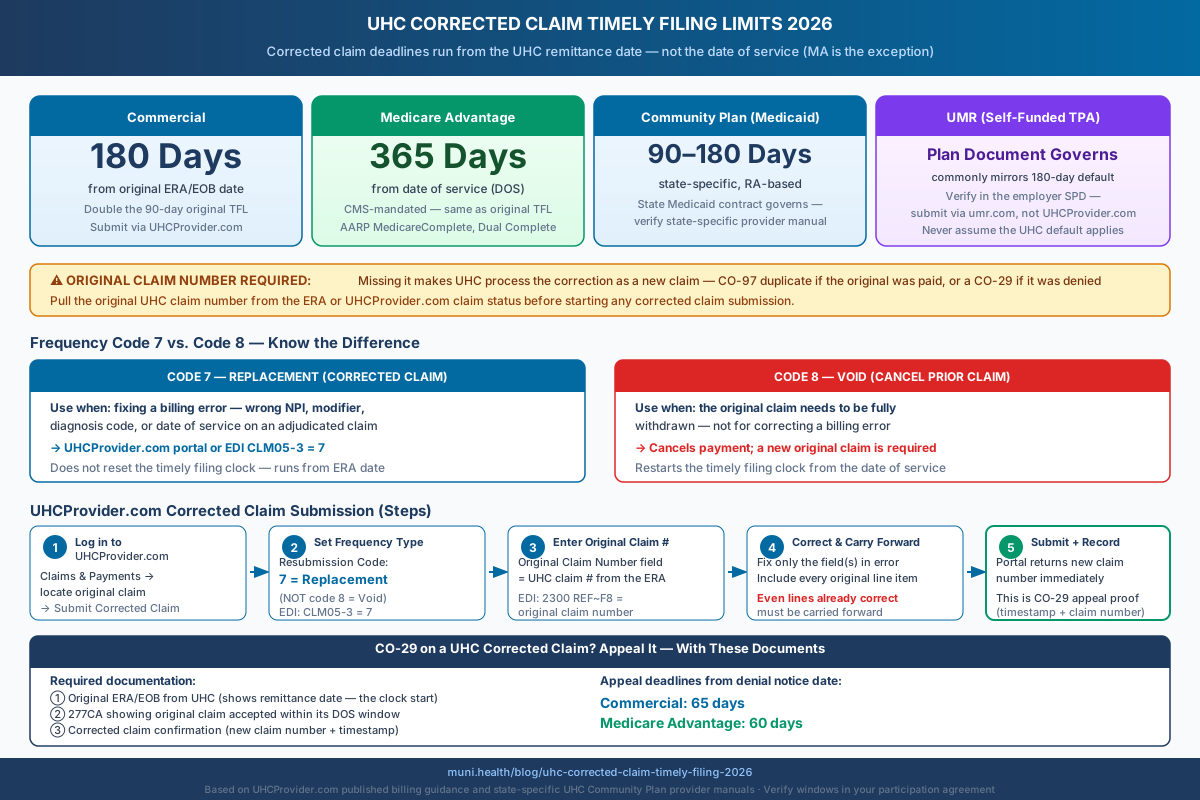
UnitedHealthcare's corrected claim TFL for commercial plans is commonly cited as 180 days from the original ERA/EOB date — but this is not confirmed UHC policy. UHC's own published claim-correction guidance describes the window as date-of-service-based and governed by your Participation Agreement, not a separate RA-based reset — confirm which basis your contract uses before relying on the 180-day figure. Medicare Advantage (AARP MedicareComplete, Dual Complete): 365 days from the date of service (CMS-mandated, not in dispute), matching the original claim window. UHC Community Plan (Medicaid): state-specific, typically 90–180 days, RA-based per state contract. UMR (UHC's self-funded TPA): governed by the employer's plan document, which commonly mirrors the 180-day RA-based figure but must be verified. Submit with frequency code 7 (replacement) — never code 8 (void) — and always include the original claim number, or UHC will process the correction as a new claim and issue a CO-97 duplicate denial.
What Is a UHC Corrected Claim — vs. an Appeal vs. a New Submission?
A corrected claim replaces a previously adjudicated UHC claim that contained a billing error, and it runs on its own deadline — separate from both the original claim TFL and UHC's commercial appeal window (commonly cited at 65 days, but confirm in your contract). Routing the correction to the wrong track is the most common reason a fixable billing error turns into a permanent write-off.
| Submission Type | Code / Track | Purpose | Resets TFL Clock? |
|---|---|---|---|
| Corrected claim | CMS-1500 Box 22, Code 7 (Replacement) | Fix a billing error on a previously adjudicated claim — wrong NPI, modifier, diagnosis code, or date of service | No — commonly cited as running from original ERA/EOB date; UHC's own guidance describes a DOS-based, contract-governed window — verify |
| Void prior claim | CMS-1500 Box 22, Code 8 (Void) | Cancel the original claim entirely; a new original claim must then be submitted | Yes — new original restarts from DOS |
| Claim reconsideration | UHCProvider.com portal | Fix a processing error — wrong modifier interpretation, COB error, or duplicate-in-error | N/A — part of the 12-month combined reconsideration + appeal window |
| Formal appeal | UHCProvider.com portal | Contest a clinical or medical necessity denial | N/A — commonly cited 65-day commercial / 60-day MA window from denial date (confirm commercial figure in your contract) |
Filing a formal appeal when a corrected claim is the right move sends the submission to UHC's clinical review team instead of the claims reprocessing queue. UHC processes each track independently, so the misrouted appeal doesn't create a new deadline — it just burns time while the underlying billing error goes uncorrected.
UHC Corrected Claim Timely Filing Limits by Plan Type
Every UHC product line runs its corrected claim window differently, and the clock-start rule — remittance date versus date of service — is the detail that trips up billing teams working mixed UHC panels. For commercial plans specifically, UHC's own published claim-correction guidance describes a date-of-service-based window governed by your Participation Agreement — not the RA-based figure widely repeated across the industry. Confirm which basis your contract actually uses before calendaring either.
Prepare this appeal packet with your team.
Draft the appeal, coordinate missing documents, and approve the reviewed packet. Keep your clearinghouse; your practice checks deadlines and submits through the payer’s accepted channel.
First 3 appeals free, then $20 per appeal. Start with your denial letter or EOB and available records. No meeting or clearinghouse connection required.
| Plan Type | Corrected Claim Window | Clock Starts From | Key Condition |
|---|---|---|---|
| Commercial (most contracts) | 180 days (commonly cited — unconfirmed) | Original ERA/EOB date (commonly cited) — UHC's own guidance points to DOS-based instead | Submit via UHCProvider.com; verify your participation agreement, since it controls both the day count and the clock-start basis |
| Medicare Advantage (AARP MedicareComplete, Group MA) | 365 days | Date of service | CMS-mandated window — same as the original MA claim TFL, not a separate reset |
| UHC Dual Complete (D-SNP) | 365 days | Date of service | Medicare portion follows the 365-day MA rule; Medicaid crossover correction runs on the state's own, often shorter, window |
| UHC Community Plan (Medicaid) | 90–180 days (state-specific) | Original remittance date | State contract governs — confirm in your state-specific UHC Community Plan provider manual |
| Surest / Oxford Health Plans | 180 days (commonly cited) | Original ERA/EOB date (commonly cited) | Both use UHC's standard commercial corrected-claim rule — subject to the same unconfirmed-basis caveat above |
| UMR (self-funded TPA) | Per employer plan document — commonly cited as mirroring 180 days | Original remittance date (plan-dependent, commonly cited) | Submit through umr.com, not UHCProvider.com; the plan document controls, not UHC's commercial default |
The operational takeaway, if your contract does follow the commonly-cited RA-based pattern: a commercial UHC claim denied at day 85 of its 90-day original TFL would not leave five days to correct it — it would leave 180 days from the date UHC issued that denial ERA, a substantially larger recovery window than DOS-based logic implies. But confirm that basis applies to your contract before treating it as settled; UHC's own guidance suggests the DOS-based window may be the operative one instead.
Commercial Corrected Claims: The 180-Day RA-Based Figure Is Widely Cited, Not UHC-Confirmed
The 180-day, remittance-based commercial corrected-claim window is the figure most widely repeated in provider billing resources — but on verification, UHC's own published claim correction and resubmission guidance does not state a separate RA-based reset. That page instead frames corrected claims as running on the same date-of-service-based window as the original claim, governed by "the required number of days" in your Participation Agreement — the same document UHC directs providers to for the original 90-day commercial TFL. No independent UHC document was found confirming a fixed 180-day RA-based figure for commercial corrected claims.
What this means in practice: treat 180-days-from-ERA/EOB as a commonly-assumed industry default, not a confirmed UHC policy. Before relying on it for a claim close to the edge of its window, confirm with your UHC Provider Relations representative or your executed Participation Agreement whether your contract actually resets the clock at remittance, or measures corrected claims from the original date of service like UHC's own guidance describes. Getting this wrong in either direction is costly: assuming a longer RA-based window when your contract is actually DOS-based risks missing the real deadline; assuming the shorter DOS-based window when your contract does grant an RA-based reset risks closing a recoverable account early.
Corrected Claims Do Not Consume the Commercial Appeal Window
UHC's commercial appeal deadline (commonly cited at 65 days, but confirm in your contract) and the corrected claim window are separate tracks regardless of which day-count and clock-start basis apply to your contract. Submitting a corrected claim doesn't use up any of your appeal time. If UHC denies the corrected claim itself, the appeal clock starts fresh from that new denial date — not from the original claim date. For the full breakdown of UHC's appeal deadlines by plan type, see the UHC appeal timely filing deadlines guide.
UHC Medicare Advantage: 365 Days from the Date of Service
UHC Medicare Advantage corrected claims — across AARP MedicareComplete, Group Medicare Advantage, and UHC Dual Complete — follow the CMS-mandated 365-day window measured from the date of service, the same clock that governs the original MA claim TFL. Unlike the commercial product, there is no separate RA-based reset for MA corrected claims; the original DOS-based year is the operative window for both the initial claim and any correction.
This means the timing discipline required for MA corrected claims is the inverse of commercial: the closer a denial lands to the end of the 365-day window, the less time remains to correct it. A denial issued on day 330 of the MA window leaves roughly 35 days to submit the correction, regardless of when the remittance was issued.
D-SNP Crossover Corrections Run on a Separate, Often Shorter Clock
For UHC Dual Complete (D-SNP) plans, a correction that changes what UHC's MA plan paid can also require a Medicaid crossover correction with the state Medicaid agency. State Medicaid corrected-claim windows are frequently shorter than UHC MA's 365-day window — track the Medicare and Medicaid crossover corrections as two separate deadlines, not one.
For the full UHC Medicare Advantage picture beyond corrected claims — claim filing by product, the non-contracted reconsideration and payment dispute tracks, the CMS 5-level appeal ladder, and D-SNP crossover mechanics — see the UHC Medicare Advantage Timely Filing Guide 2026.
UHC Community Plan (Medicaid): State-Specific, RA-Based Windows
UHC Community Plan corrected claims run on state-specific timely filing rules, typically 90 to 180 days from the original remittance date, because each Community Plan operates under its own state Medicaid contract rather than UHC's national commercial policy. Individual state Community Plan quick reference guides publish their own specific windows, and they vary by state.
Because the underlying state contract governs, confirm the exact corrected-claim window in your state-specific UHC Community Plan provider manual before assuming either the commonly-cited 180-day commercial figure or another state's published window applies. For the full UHC Community Plan Medicaid appeal process — including the two-step reconsideration and appeal sequence and state fair hearing rights — see the UHC Community Plan Medicaid appeal guide.
UMR: Why the Self-Funded TPA Diverges from Fully-Insured UHC
UMR is UnitedHealthcare's third-party administrator for self-funded employer plans, and its corrected claim window is set by the employer's plan document — not by UHC's standard commercial policy. Because UMR administers ERISA self-funded group health plans rather than fully-insured UHC contracts, the governing timely filing and corrected-claim terms live in each employer's summary plan description (SPD), and those terms can differ meaningfully from the commercial figure most commonly cited for fully-insured UHC.
In practice, many UMR-administered plans are described as mirroring a 180-day RA-based corrected claim window, but this itself is an unconfirmed pattern rather than a verified UHC-wide default — confirm the exact window and clock-start basis in the plan's SPD or by calling the number on the member's UMR ID card before calendaring the deadline. For the full breakdown of UMR's claim, appeal, and corrected-claim rules — including the 180-day ERISA appeal floor under 29 CFR §2560.503-1 — see the UMR timely filing and appeal guide.
Submit UMR Claims Through umr.com — Not UHCProvider.com
UMR claims and corrections route through umr.com, a separate portal from UHCProvider.com. A UMR-administered plan is identifiable by the "UMR" mark on the member ID card or the claims mailing address on the EOB. Submitting a UMR correction through the standard UHC commercial portal, or assuming UHC's national default without checking the plan document, is the most common UMR filing error. For UMR's ERISA-driven 180-day appeal floor (a separate deadline from the corrected claim window), see the UHC appeal timely filing deadlines guide.
How to Submit a UHC Corrected Claim: Frequency Code 7
The fastest, most audit-proof path for a UHC corrected claim is electronic submission through UHCProvider.com — it generates an immediate new claim number and submission timestamp, which becomes your primary documentation if UHC later issues a CO-29 on the correction. UHC has eliminated paper and fax intake for most corrected claim submissions from contracted network providers.
Step-by-step through the UHCProvider.com portal:
- Log in at UHCProvider.com → Claims & Payments
- Locate the original claim in claim status and open Submit Corrected Claim
- Set the Frequency Type / Resubmission Code to 7 — Replacement of Prior Claim
- Enter the original UHC claim number in the Original Claim Number field — this links the correction to the prior adjudication
- Correct only the field(s) that caused the billing error; carry forward every line from the original claim, even the lines that were already correct
- Submit — the portal returns a new claim number immediately; record it as your submission proof
For EDI 837 submissions through a clearinghouse, use CLM05-3 = 7 on the 837P or 837I, with the original claim number in the 2300 REF~F8 segment. On a UB-04, change the third digit of the Type of Bill to 7 (for example, 137 for outpatient).
Code 8 Is Not Code 7
Code 8 (Void/Cancel Prior Claim) cancels the original claim entirely rather than correcting it. Using code 8 when you meant code 7 voids the existing adjudication and requires an entirely new original claim submission — restarting the timely filing clock from the date of service, which may already be outside the 90-day commercial DOS window. Use code 7 to correct a claim. Reserve code 8 for claims that genuinely need to be withdrawn with no replacement.
The Duplicate-Claim Trap: CO-97 When the Original Claim Number Is Missing
The most preventable UHC corrected claim denial happens when the original claim number is left off the submission. Without it, UHC's adjudication system can't locate the prior claim to replace, and it processes the submission as a brand-new original claim instead.
Two outcomes follow, depending on what happened to the original claim:
- Original claim was paid: UHC generates a CO-97 duplicate-claim denial — the new submission matches an already-paid claim rather than replacing it
- Original claim was denied: UHC evaluates the resubmission under original claim TFL rules measured from the date of service, which may fall outside the 90-day commercial DOS window even though the corrected-claim window (commonly cited at 180 days, RA-based — but confirm) was still open
In both cases, the billing error goes uncorrected and the corrected-claim window isn't credited. The fix is procedural: pull the original UHC claim number from the ERA or UHCProvider.com's claim status lookup before starting any correction, and treat it as a required field, not an optional one.
CO-29 Denials on UHC Corrected Claims: When to Appeal
A CO-29 ("timely filing expired") denial on a UHC corrected claim is not automatically valid. The most common cause is a missing original claim reference, which causes UHC's system to default to measuring the submission from the date of service instead of the RA date the corrected-claim window actually runs from.
When a CO-29 on a corrected claim should be appealed:
- The original claim was submitted within UHC's applicable DOS-based TFL (90 days commercial, 365 days MA)
- The corrected claim was submitted within your contract's actual corrected-claim window (commonly cited at 180 days commercial, RA-based — confirm against your Participation Agreement — or MA's CMS-mandated 365-day DOS window) measured correctly
- UHC issued CO-29 because the original claim number or ERA reference was missing, causing the system to default to DOS-based measurement
Documentation for the appeal:
- Original ERA/EOB from UHC showing the remittance date, if your contract's corrected-claim window is RA-based
- 277CA clearinghouse acceptance report showing the original claim was submitted within its DOS window
- UHCProvider.com corrected claim submission confirmation (new claim number and timestamp)
- Copies of both the original and corrected claim forms
Appeal deadlines: UHC's commercial provider appeal deadline is commonly cited as 65 calendar days from the date of the adverse determination, though UHC's own appeals guidance defers the exact figure to your Participation Agreement; the Medicare Advantage member-level appeal window is 60 days (CMS-mandated). Both windows are covered in detail, along with the 12-month combined reconsideration-and-appeal rule, in the UHC appeal timely filing deadlines guide.
The Remittance Date Is Central to Most CO-29 Appeals on Corrected Claims — If Your Contract Is RA-Based
If your Participation Agreement uses an RA-based corrected-claim window, the original ERA/EOB with its remittance date is the controlling document in a CO-29 appeal — it establishes when the window actually started and demonstrates the correction was filed within it. If your contract instead follows UHC's own DOS-based guidance, anchor the appeal to the original date of service instead. Confirm which basis applies before building the appeal around the wrong date. Present the controlling date, the corrected claim submission date, and the math — UHC's appeals team does not typically contest clear documentation.
How Muni Appeals Supports UHC Corrected-Claim Review
UHC corrected claim management means tracking two separate deadlines per claim — the DOS-based original TFL and the corrected claim window (commonly cited as RA-based for commercial, confirmed DOS-based for MA) — across at least four distinct product lines with different rules: commercial, Medicare Advantage, Community Plan, and UMR.
Prepare this appeal packet with your team.
Draft the appeal, coordinate missing documents, and approve the reviewed packet. Keep your clearinghouse; your practice checks deadlines and submits through the payer’s accepted channel.
First 3 appeals free, then $20 per appeal. Start with your denial letter or EOB and available records. No meeting or clearinghouse connection required.
Muni Appeals organizes the uploaded UHC denial and remittance materials for review:
- Surfaces commercial, MA, and Community Plan corrected-claim deadline context for staff verification
- Highlights uploaded CO-29 and 277CA evidence relevant to a timely original submission
- Generates a review-ready CO-29 appeal packet with an ERA-documentation checklist
- Organizes uploaded ERA evidence with the appeal materials for staff review
Frequently Asked Questions
What is UHC's corrected claim timely filing limit for commercial plans?
180 days from the date of the original ERA/EOB is the figure most commonly cited for UHC's commercial corrected claim window — but it is not confirmed UHC policy. UHC's own published claim-correction guidance describes the window as measured from the date of service, governed by your Participation Agreement, rather than a separate RA-based reset. Confirm which basis and day count your contract actually uses before relying on the 180-day figure.
What is UHC's corrected claim deadline for Medicare Advantage?
UHC Medicare Advantage corrected claims — AARP MedicareComplete, Group MA, and UHC Dual Complete — follow the CMS-mandated 365-day window from the date of service, the same clock as the original MA claim TFL. There is no separate RA-based reset for MA corrected claims; whatever time remains in the original 365-day window is what's available to correct the claim.
What frequency code do I use to submit a corrected claim to UHC?
Use frequency code 7 (Replacement of Prior Claim) through UHCProvider.com, or CLM05-3 = 7 on the EDI 837 with the original claim number in the 2300 REF~F8 segment. On a UB-04, change the third digit of the Type of Bill to 7 (for example, 137 for outpatient). Code 8 voids the original claim entirely — it does not correct it, and using it by mistake restarts the timely filing clock from the date of service.
Does UHC's corrected claim window apply to UMR claims?
Not automatically. UMR is UHC's third-party administrator for self-funded employer plans, and the corrected claim window is set by the employer's plan document rather than UHC's commercial policy. Many UMR plans are described as mirroring the commonly-cited 180-day RA-based figure, but this must be confirmed in the plan's summary plan description — not assumed, especially since the underlying commercial figure it's based on is itself unconfirmed by UHC. Submit UMR corrections through umr.com, not UHCProvider.com. See the UMR timely filing and appeal guide for the full plan-specific breakdown.
What happens if I submit a UHC corrected claim without the original claim number?
Without the original claim number, UHC can't locate the prior adjudication to replace and processes the submission as a new original claim. If the original claim was paid, this generates a CO-97 duplicate denial. If the original claim was denied, UHC re-measures timely filing from the date of service — which may fall outside the 90-day commercial window even though the corrected-claim window (commonly cited at 180 days, RA-based — confirm) was still open.
Can I appeal a CO-29 denial on a UHC corrected claim?
Yes, if the corrected claim was submitted within your contract's actual corrected-claim window (commonly cited at 180 days commercial, RA-based — confirm; 365 days MA, DOS-based, CMS-mandated). The most common trigger for an incorrect CO-29 is a missing original claim reference, which causes UHC's system to default to DOS-based measurement. Attach the original ERA establishing the remittance date (if your contract is RA-based) or the date-of-service documentation (if DOS-based), the corrected claim submission confirmation, and a brief cover letter showing the days elapsed are within the applicable window. The commercial appeal deadline is commonly cited at 65 days from the denial notice (confirm in your contract); the MA appeal deadline is 60 days.
How does the UHC Community Plan (Medicaid) corrected claim window differ from commercial?
UHC Community Plan corrected claim windows are state-specific rather than governed by UHC's national commercial policy — typically 90 to 180 days from the original remittance date, depending on the state Medicaid contract. Confirm the exact window in your state-specific UHC Community Plan provider manual rather than assuming the 180-day commercial default applies everywhere.
Does filing a corrected claim reset UHC's original timely filing clock?
No. A corrected claim runs on its own deadline and does not extend, reset, or otherwise affect the original DOS-based timely filing clock. The original TFL continues to run independently. For commercial claims, the corrected claim window is a separate, longer RA-based deadline; for MA claims, the correction shares the same DOS-based window as the original claim.
Ready to Stop Losing UHC Corrected Claims to CO-29 Denials?
UHC corrected claim CO-29 denials are recoverable — but only within the applicable window, and only with the right documentation attached for whichever clock-start basis your contract actually uses. The most common failure point is assuming a remittance-based clock without confirming it against your Participation Agreement, or applying the commercial default to a UMR or Community Plan claim that runs on a different rule.
Get Started:
- RA-based commercial corrected-claim guidance, separate from MA and Community Plan guidance
- Upload support for the relevant remittance evidence used in CO-29 appeal documentation
- UHC-specific appeal packets using the remittance evidence staff uploads
- CO-29 appeal preparation across commercial, MA, Community Plan, and UMR-administered plans
This guide reflects 2026 UnitedHealthcare corrected claim timely filing procedures based on UHC's published provider billing guidance on UHCProvider.com and state-specific UHC Community Plan quick reference guides. The 180-day, RA-based commercial corrected-claim figure used throughout this guide is a widely-cited industry default, not confirmed UHC policy — UHC's own published claim-correction guidance describes a date-of-service-based window governed by your Participation Agreement instead. Always verify the specific window and clock-start basis in your contract before relying on either figure. UMR corrected claim windows are governed by each employer's plan document and may differ from the commercial default discussed here. UHC Community Plan (Medicaid) corrected claim windows are governed by state Medicaid contracts and vary by state. For related UHC billing guidance, see our UHC Appeal Timely Filing Deadlines 2026, UHC Community Plan Medicaid Appeal Guide 2026, and Corrected Claim Timely Filing Limits 2026.