

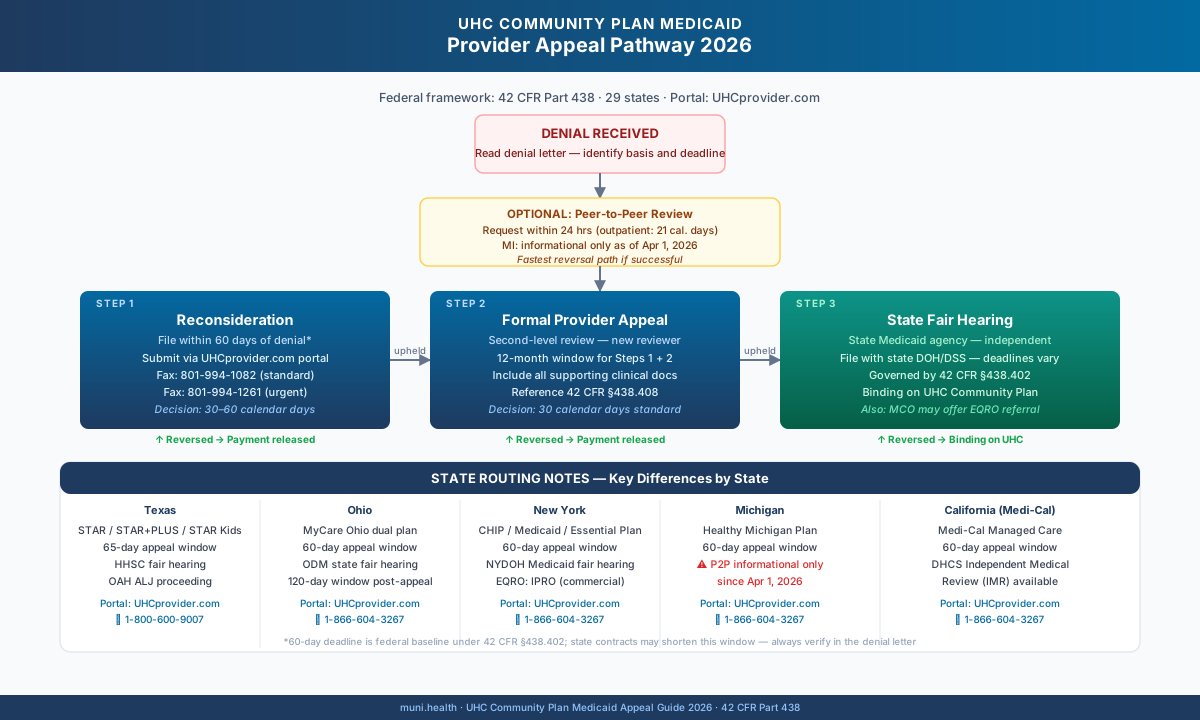
UHC Community Plan Medicaid provider appeals follow a two-step internal process — reconsideration, then formal appeal — governed by 42 CFR Part 438. The federal baseline deadline is 60 days from the denial date, though state contracts may shorten that window. After internal appeals are exhausted, providers can escalate to a state fair hearing, which is binding on UHC Community Plan. Peer-to-peer review is the fastest reversal path but must be requested promptly — typically within 24 hours of a denial for pre-service cases.
UHC Community Plan Medicaid vs. Fee-for-Service Medicaid: What Changes for Appeals
UHC Community Plan Medicaid is a Medicaid managed care organization (MCO) — not fee-for-service Medicaid administered directly by the state. That distinction controls how appeals work.
Under fee-for-service Medicaid, a denied claim goes directly to the state Medicaid agency for reconsideration. Under a Medicaid MCO like UHC Community Plan, the appeal runs through UHC first. Federal regulations at 42 CFR Part 438 require the MCO to maintain an internal grievance and appeal system before a provider or member can access a state fair hearing. You cannot skip to the state hearing without exhausting the UHC internal process.
The practical effect: providers have two bites at the UHC-level apple — reconsideration and formal appeal — before the state gets involved. Missing either step, or filing to the wrong UHC address for your state, restarts the clock or forfeits the escalation right. Other Medicaid MCOs operate under the same 42 CFR Part 438 framework with their own state-specific deadlines — see our CareSource appeal guide for how the process runs in Georgia, Indiana, Michigan, Nevada, and Ohio.
UHC Community Plan operates Medicaid contracts in 29 states and the District of Columbia, each with its own program name, state-specific portal path, and fair hearing body. The claims process is largely centralized through the national UHCprovider.com portal, but the escalation pathway after Step 2 depends entirely on the member's state.
29-State Footprint
UHC Community Plan Medicaid programs include: Arizona (AHCCCS), California (Medi-Cal), Colorado (Rocky Mountain Health Plans), Florida (SMMC), Hawaii (QUEST), Idaho, Indiana (Hoosier Care Connect), Kansas (KanCare), Kentucky, Louisiana (Healthy Louisiana), Maryland (HealthChoice), Massachusetts, Michigan (Healthy Michigan Plan), Mississippi (MississippiCAN), Missouri (Missouri HealthNet), Nebraska (Heritage Health), New Jersey (NJ FamilyCare), New Mexico, New York, North Carolina, Ohio (MyCare Ohio), Pennsylvania, Rhode Island (RIte Care), Tennessee (TennCare), Texas (STAR/STAR+PLUS/STAR Kids), Virginia (CCC Plus), Washington (Apple Health), Wisconsin, and the District of Columbia.
The Three Stages of a UHC Community Plan Provider Appeal
Three stages exist before a claim is fully exhausted: peer-to-peer review (optional but fastest), internal reconsideration, and formal appeal. If all three fail, the state fair hearing is available.
| Stage | Deadline to Request | Who Reviews | UHC Response Time | Escalation If Denied |
|---|---|---|---|---|
| Peer-to-Peer Review | Pre-service: 24 hrs from denial; Outpatient: 21 cal. days; Inpatient: 3 business days | UHC medical director (or delegated UM vendor) | Same day to 48 hours | File Step 1 Reconsideration |
| Step 1: Reconsideration | 60 days from denial date (verify in denial letter — state contracts may differ) | UHC appeals unit — new reviewer | 30–60 calendar days | File Step 2 Formal Appeal |
| Step 2: Formal Appeal | Within the 12-month overall window (Steps 1 + 2 combined) | UHC second-level reviewer — independent of Step 1 | 30 calendar days standard | State Fair Hearing |
| State Fair Hearing | Varies by state — typically 90–120 days after Step 2 denial | State Medicaid agency ALJ or hearing officer | Varies by state | Federal court (rarely pursued) |
One important constraint from federal rules: under 42 CFR §438.408, UHC Community Plan can maintain only one level of internal MCO appeal for providers. What UHC calls "reconsideration" and "formal appeal" maps to the MCO's internal grievance and appeal system — the state fair hearing is the external escalation, not a third UHC-level tier.
Step 1: Filing a UHC Community Plan Medicaid Reconsideration
File the reconsideration through the UHCprovider.com portal — electronic submission is required for most network providers. The portal generates immediate confirmation and a tracking number, which is important evidence if UHC disputes receipt or timing.
For providers unable to submit electronically, fax to:
- Standard reconsideration: 801-994-1082
- Urgent/expedited: 801-994-1261
- Mail: UHC Community Plan Provider Appeals, P.O. Box 31361, Salt Lake City, UT 84131-0364
The reconsideration package should include:
- The original denial letter (with the authorization number and denial code)
- A written appeal letter citing the specific denial reason and the clinical or billing basis for reversal
- Complete supporting clinical documentation for medical necessity denials
- Proof of timely filing if the denial basis is CO-29 (timely filing exceeded)
- Applicable CMS regulations, plan contract language, or clinical guidelines if relevant
The 60-Day Deadline is a Federal Floor, Not a Ceiling
The 60-day reconsideration deadline in 42 CFR §438.402 is the minimum states must provide — it is not the maximum. Several UHC Community Plan state contracts impose shorter windows. Texas STAR and STAR+PLUS plans allow 65 calendar days in some contexts, but other state-specific manuals may differ. Always read the deadline printed on the denial letter — it controls your individual case.
UHC Community Plan Medicaid — Standard Reconsideration Header

[Date]
UnitedHealthcare Community Plan
Provider Appeals Department
P.O. Box 31361
Salt Lake City, UT 84131-0364

RE: Provider Claim Reconsideration — [State] Medicaid
Member Name: [Name]
Member ID / Medicaid ID: [ID]
Claim Number: [From remittance advice]
Authorization Number (if applicable): [Number]
Date of Service: [DOS]
Rendering Provider NPI: [NPI]
Denial Code: [From EOB/RA]
Denial Reason: [Verbatim from denial notice]

This reconsideration is submitted within the filing deadline stated in the
denial notice dated [Date], pursuant to 42 CFR §438.402.
Skip the blank template. Start with a review-ready draft.
Use the template as guidance, or let Muni prepare a payer-specific draft for your team to verify, sign, and submit.
First 3 appeals free, then $20 per appeal. Start with your denial letter or EOB and available records. No meeting or clearinghouse connection required.
Step 2: Filing the Formal UHC Community Plan Appeal
A formal appeal is required if UHC upholds the reconsideration. Submit through the same UHCprovider.com portal, using the tracking number from Step 1 to link the submissions. The formal appeal must be reviewed by a UHC staff member who was not involved in the Step 1 reconsideration — this is a federal requirement under 42 CFR §438.406(b).
The formal appeal letter should directly address the specific rationale UHC used to uphold the Step 1 denial, not just restate the original argument. If UHC denied a medical necessity claim citing a specific clinical policy, the formal appeal should counter that policy's applicability with updated documentation or published clinical guidelines. Submitting the same documentation without new argument rarely reverses a Step 2 decision.
For pre-service denials, request an expedited appeal if the standard 30-day timeline would seriously jeopardize the member's health. Under 42 CFR §438.408, expedited appeals must be decided within 72 hours. Document the clinical urgency in writing when requesting expedited review.
When the 12-Month Window Resets
UHC Community Plan's 12-month combined window for Steps 1 and 2 starts from the denial date, not the date you file Step 1. If your Step 1 reconsideration takes 60 days to be decided and UHC upholds it, you may have limited time left to file Step 2. Track the date of the original denial — not the date of Step 1's decision — as your reference for the combined 12-month window.
State Fair Hearing: The Escalation After Internal Appeals Fail
After UHC Community Plan upholds the Step 2 formal appeal, providers have the right to a state fair hearing through the state Medicaid agency. This is governed by 42 CFR §438.402 and is conducted independently of UHC — the hearing officer is a state employee or contracted administrative law judge (ALJ), not affiliated with UHC.
The state fair hearing is binding on UHC Community Plan. If the ALJ rules in the provider's favor, UHC must pay the claim.
The window to request a state fair hearing varies significantly by state. Ohio MyCare providers have 120 days from the date of UHC's Step 2 denial to file for an Ohio Department of Medicaid (ODM) fair hearing. Texas providers must file within 90 calendar days of receiving the state hearing rights notice. Check the denial letter — UHC is required under 42 CFR §438.408(e) to notify providers of their right to a state fair hearing and the applicable deadline in the Step 2 adverse determination notice.
For dual eligible members enrolled in both Medicare and Medicaid, the appeal pathway may involve a separate Medicare Part C or Part D appeals process through UHC's Medicare Advantage structure. Do not conflate the Medicaid Community Plan appeal with Medicare Advantage appeals — they run on different timelines and through different reviewers.
The federal mechanics behind that state fair hearing right — filing as the patient's authorized representative, and the separate 10-day clock that keeps services running while the hearing is pending — apply the same way across every Medicaid MCO, not just UHC. See our Medicaid fair hearing and provider appeal guide for the full two-track breakdown and a combined fair hearing / continuation-of-benefits request template.
EQRO Is Not the Same as a State Fair Hearing
Some UHC Community Plan states offer an External Quality Review Organization (EQRO) process. The EQRO conducts periodic quality reviews of the MCO under federal contract — it is not an individual claim appeal mechanism. Do not confuse an EQRO review with the state fair hearing right. For individual denied claims, the state fair hearing is the correct escalation after Step 2 is exhausted.
State-Specific UHC Community Plan Appeal Notes
UHC Community Plan's national portal (UHCprovider.com) handles most electronic submissions, but the program name, fair hearing body, and specific deadlines differ by state. Always use the denial letter's specific program name when identifying your escalation path.
| State / Program | Appeal Deadline* | Program Name | Fair Hearing Body | Provider Services |
|---|---|---|---|---|
| Texas | 65 cal. days (verify in denial) | STAR / STAR+PLUS / STAR Kids | HHSC / OAH ALJ hearing | 1-800-600-9007 |
| Ohio | 60 cal. days | MyCare Ohio (dual plan) | Ohio Dept of Medicaid (ODM) | 1-866-604-3267 |
| California | 60 cal. days | Medi-Cal Managed Care | DHCS / CDSS fair hearing; DMHC IMR available | 1-866-604-3267 |
| New York | 60 cal. days | Medicaid / Essential Plan / CHIP | NYDOH Medicaid fair hearing | 1-866-604-3267 |
| Michigan | 60 cal. days | Healthy Michigan Plan | MDHHS state fair hearing | 1-866-604-3267 |
| Florida | 60 cal. days | SMMC (Statewide Medicaid Managed Care) | AHCA fair hearing | 1-866-604-3267 |
| North Carolina | 60 cal. days | NC Medicaid Managed Care | NCDHHS Office of Administrative Hearings | 1-866-604-3267 |
| Louisiana | 60 cal. days | Healthy Louisiana | LDOH Medicaid fair hearing | 1-866-604-3267 |
| Kansas | 60 cal. days | KanCare | KDHE / KanCare Clearinghouse | 1-866-604-3267 |
| New Jersey | 60 cal. days | NJ FamilyCare | NJDHS fair hearing | 1-866-604-3267 |
*State contracts may impose shorter windows. The deadline printed on the denial letter controls.
Michigan Update: Peer-to-Peer Review Changed April 1, 2026
Michigan providers should be aware of a significant change effective April 1, 2026. For UHC Community Plan Michigan pre-service adverse determinations on Healthy Michigan Plan service requests, post-denial peer-to-peer (P2P) discussions are now informational only. The adverse determination cannot be overturned through the P2P — it must be formally appealed.
Prepare this appeal packet with your team.
Draft the appeal, coordinate missing documents, and approve the reviewed packet. Keep your clearinghouse; your practice checks deadlines and submits through the payer’s accepted channel.
First 3 appeals free, then $20 per appeal. Start with your denial letter or EOB and available records. No meeting or clearinghouse connection required.
This is a departure from prior practice where a Michigan P2P call could result in direct reversal. Michigan billing teams that previously relied on P2P as a first-pass reversal tool now need to route denials directly into the Step 1 reconsideration process. Document the clinical justification in writing rather than depending on a verbal conversation with the medical director.
Common UHC Community Plan Medicaid Denial Codes and First Responses
| Denial Code | Reason | First Response |
|---|---|---|
| CO-50 | Medical necessity — service not covered per plan clinical criteria | Request P2P with UHC medical director; compile clinical guidelines and prior treatment documentation |
| CO-197 | Authorization absent or invalid — service required prior auth | Request retro-authorization or document that auth was not required for this service category |
| CO-29 | Timely filing exceeded | Document earliest date claim was first submitted with proof (clearing house confirmation, EDI 277 ACK) |
| CO-96 / N130 | Non-covered service under this Medicaid plan | Verify state Medicaid benefit schedule — not all services covered under FFS are covered under MCO contracts |
| CO-4 | Service inconsistent with modifier | Review modifier pairing; resubmit corrected claim if modifier error is confirmed |
| PR-96 | Non-covered — member responsibility (experimental) | Cite FDA approval, national coverage determination, or CMS guidance supporting medical necessity |
| N479 | Prior authorization number missing or invalid | Confirm auth number against UHC authorization records; contact provider services at 1-866-604-3267 |
| CO-22 | Coordination of benefits — other payer primary | Verify payer order and resubmit with primary EOB attached |
For CO-29 timely filing denials, UHC Community Plan Medicaid follows state-specific timely filing windows that differ from UHC commercial plans. Review the UHC appeal timely filing deadlines 2026 guide for the Community Plan-specific windows before filing a timely filing appeal.
How Muni Appeals Handles UHC Community Plan Medicaid Denials
UHC Community Plan's 29-state footprint means the same denial code can escalate through different state fair hearing bodies, on different deadlines, citing different state-specific program rules. Billing teams that manage Community Plan denials across multiple states routinely file to the wrong escalation body or apply the wrong deadline — particularly when a practice sees both Texas STAR and Michigan Healthy Michigan Plan members.
Muni Appeals supports UHC Community Plan Medicaid appeal preparation by:
- Surfacing the likely state-program and deadline context from the uploaded denial for staff verification
- Generating Step 1 reconsideration letters that address the specific UHC denial rationale rather than submitting a generic appeal
- Routing Step 2 formal appeals to a reviewer independent of Step 1, as required by 42 CFR §438.406(b)
- Flagging Michigan denials for direct reconsideration filing (no P2P reversal available since April 1, 2026)
- Preparing the state fair hearing escalation package with the correct state agency contact and deadline when Step 2 is upheld
Start 3 Free UHC Community Plan Appeals
Frequently Asked Questions
What is the appeal deadline for UHC Community Plan Medicaid?
The federal minimum under 42 CFR §438.402 is 60 days from the date of the adverse benefit determination. However, individual state Medicaid contracts with UHC can impose shorter windows — some states use 45 or 30-day windows for specific denial types. Texas STAR and STAR+PLUS programs use 65 calendar days in some contexts. Always read the deadline printed on the denial notice — it controls your individual case, not a national default.
Can I file directly with the state Medicaid agency without going through UHC's appeal process?
No. Under 42 CFR §438.400, providers must exhaust the MCO's internal appeal process before accessing a state fair hearing. Submitting a state fair hearing request before completing UHC's Step 1 and Step 2 process will be rejected or held pending exhaustion of internal remedies. The state fair hearing is the escalation after UHC upholds Step 2.
Does UHC Community Plan use a different portal than commercial UHC for appeals?
No — the primary submission portal is the same UHCprovider.com provider portal used for commercial and Medicare Advantage plans. Log in at secure.uhcprovider.com and navigate to the Claims section to submit reconsiderations. The payer ID for electronic submission is 87726. However, the appeal address, specific program name, and fair hearing escalation path differ by state — confirm state-specific instructions in the denial letter or your state-specific Community Plan provider manual at uhcprovider.com.
What changed with Michigan UHC Community Plan peer-to-peer reviews in 2026?
Effective April 1, 2026, post-denial peer-to-peer discussions for UHC Community Plan Michigan (Healthy Michigan Plan) pre-service adverse determinations became informational only. The medical director cannot overturn the denial during the P2P call — the practice must file a Step 1 formal reconsideration through the portal. This change applies to Michigan C&S Medicaid service requests; confirm whether it also applies to your specific Michigan Community Plan contract type.
How does a state fair hearing for UHC Community Plan Medicaid work?
After UHC upholds a Step 2 formal appeal, the denial letter must notify you of the right to a state fair hearing and the applicable deadline. Request the hearing through the state Medicaid agency — the contact varies by state (Ohio: ODM; Texas: HHSC; California: CDSS or DHCS). An administrative law judge (ALJ) or state hearing officer conducts the hearing independently of UHC. If the ALJ rules in the provider's favor, the decision is binding on UHC Community Plan, which must pay the claim.
Can I request an expedited appeal for urgent UHC Community Plan Medicaid denials?
Yes. Under 42 CFR §438.408(b), UHC Community Plan must decide expedited appeals within 72 hours when standard timing would seriously jeopardize the member's health. Request expedited review in writing and document the clinical urgency — attach the treating physician's statement that delay poses a health risk. Expedited review applies to pre-service denials where the service is time-sensitive. Post-service payment disputes do not qualify for expedited review.
Is UHC Community Plan Medicaid subject to the 2026 PA transparency reporting rule?
Yes. Beginning January 1, 2026, Medicaid MCOs including UHC Community Plan must report prior authorization data at the plan level by March 31 of each calendar year. This data includes approval and denial rates, average decision times, and percentage of requests reviewed by clinical staff. The CMS PA reporting rule (CMS-0057-F) creates a public accountability mechanism for high-volume PA deniers — UHC Community Plan PA denial patterns in each state will be publicly reported annually.
How is UHC Community Plan different from UHC Medicare Advantage for appeals?
The appeal framework differs significantly. UHC Community Plan Medicaid appeals are governed by 42 CFR Part 438 (Medicaid managed care), and the escalation path leads to a state Medicaid fair hearing. UHC Medicare Advantage appeals follow 42 CFR Part 422 and escalate to a CMS-contracted Qualified Independent Contractor (QIC), then to an Administrative Law Judge under Medicare jurisdiction, then to the Medicare Appeals Council. For dual eligible members enrolled in both programs, confirm which program covered the denied service before filing — the wrong appeal process creates filing errors and missed deadlines. See the UHC Medicare Advantage prior auth denial appeal guide 2026 for the Medicare Advantage pathway.
Ready to Recover Denied UHC Community Plan Medicaid Claims?
The most preventable losses in UHC Community Plan Medicaid aren't clinically complex — they're filing to the wrong state program, missing a state deadline, or resubmitting the same Step 2 argument. Muni Appeals surfaces likely program context and prepares a review-ready draft for the selected level; staff verifies and files through the controlling process.
Get Started:
- State-specific Community Plan program identification from the denial notice
- Step 1 reconsideration letters that address UHC's actual denial rationale
- Step 2 formal appeals with independent reviewer routing per 42 CFR §438.406(b)
- Michigan-specific workflow: direct reconsideration filing (no P2P reversal since April 2026)
- State fair hearing escalation packages with the correct state agency and deadline
Start 3 Free UHC Community Plan Appeals
This guide reflects UHC Community Plan Medicaid provider appeal procedures as of June 2026 under federal regulations at 42 CFR Part 438. State Medicaid contracts, program-specific deadlines, and escalation procedures are subject to change. Always read the specific denial notice for deadlines and submission instructions that govern your individual case. This guide does not constitute legal advice.