

A CareSource Medicaid provider appeal runs through a claim dispute (non-clinical issues), then a clinical or claim appeal (medical necessity or an upheld dispute), before a state fair hearing becomes available. Deadlines vary by state — claim disputes run 60 days to 3 months, clinical appeals are typically 60 days from the denial notice. Once CareSource upholds an appeal, escalation to a binding state fair hearing differs across Georgia, Indiana, Michigan, Nevada, and Ohio.
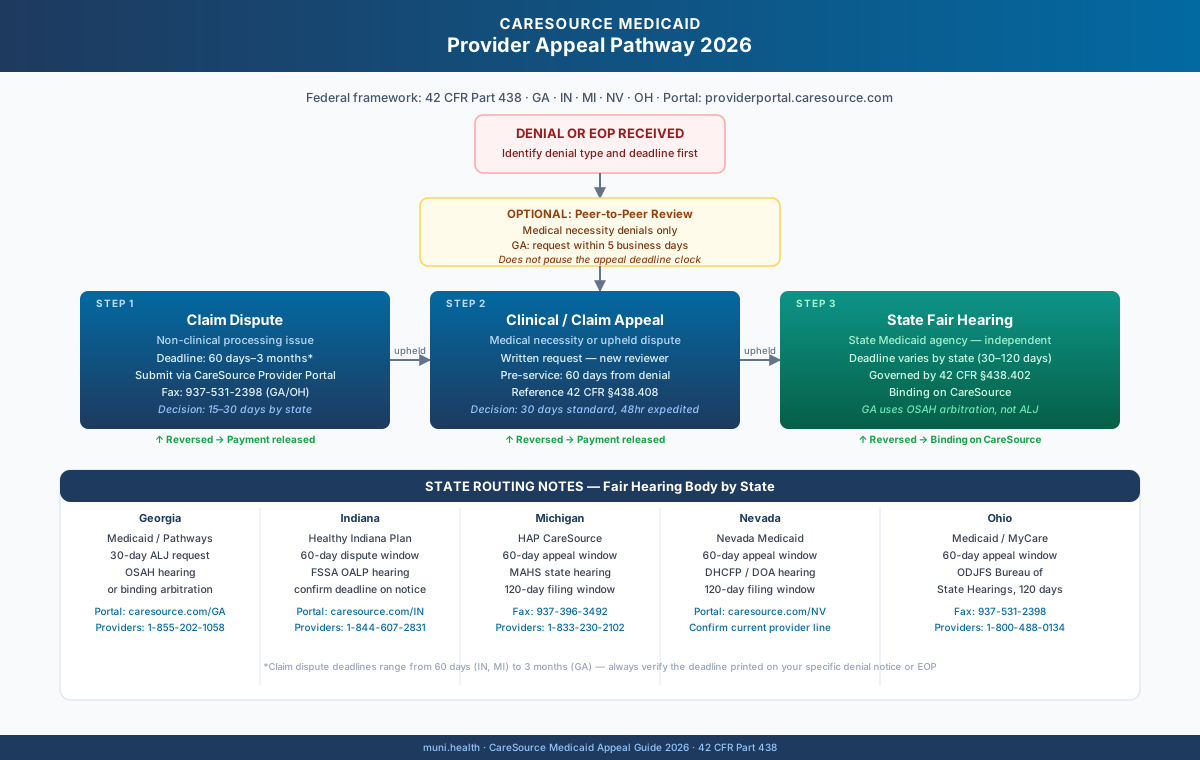
CareSource Claim Disputes vs. Clinical Appeals: Why the Distinction Matters
A claim dispute and a clinical appeal are not interchangeable, and filing the wrong one restarts the clock on a deadline you may not get back.
A claim dispute is CareSource's term for the first formal review of how a claim was processed — underpayment, a coding disagreement, a timely filing question — and it excludes denials based on medical necessity. A clinical appeal (sometimes called a claim appeal for non-medical-necessity issues) is a written request to review a prior authorization denial or an upheld dispute, evaluated against clinical criteria. CareSource's own provider manual describes the dispute as typically preceding a claim appeal for participating providers (CareSource Provider Manual, Appeals Procedures).
CareSource is a nonprofit Medicaid managed care organization headquartered in Dayton, Ohio, and currently operates Medicaid managed care plans in Georgia, Indiana, Michigan, Nevada, and Ohio (CareSource Medicaid plans). In Michigan, the Medicaid plan operates as a joint venture called HAP CareSource. Each state contract sets its own dispute and appeal deadlines, so a workflow built around one state's timeline will misfire in another.
Peer-to-Peer Review Is a Side Door, Not a Deadline Extension
Providers can request a peer-to-peer conversation with a CareSource medical director to discuss a medical necessity denial — in Georgia, this must be requested within 5 business days of the denial notice (CareSource Georgia Medicaid appeals). A peer-to-peer review does not pause the clinical appeal filing deadline. File the formal appeal on time even if a peer-to-peer call is pending.
The CareSource Provider Appeal Process: Three Stages Before a Fair Hearing
Three stages sit between a denial and a binding external decision: the claim dispute, the clinical or claim appeal, and — if both are exhausted — the state fair hearing.
| Stage | Applies To | Typical Deadline to File | CareSource Decision Time | Escalation If Upheld |
|---|---|---|---|---|
| Claim Dispute | Non-clinical processing errors (underpayment, coding, timely filing) | 60 days–3 months from payment/denial date (state-specific) | 15 business days (claim); 30 business days (medical necessity-adjacent) | File Clinical/Claim Appeal |
| Clinical / Claim Appeal | Medical necessity denials or upheld disputes | 60 days from denial notice (30 days in some states/programs) | 30 calendar days standard; 48 hours expedited | State Fair Hearing |
| State Fair Hearing | Medicaid managed care denials after internal appeals exhausted | Varies: 30 days (GA) to 120 days (OH, MI, NV) | Set by the state hearing body, not CareSource | Binding on CareSource |
Under 42 CFR §438.402, a Medicaid managed care organization like CareSource may maintain only one level of internal appeal for adverse benefit determinations — the state fair hearing is the external escalation, not a third internal tier.
Step 1: Filing a CareSource Claim Dispute
Start with a claim dispute for anything that is not a medical necessity denial: underpayment, a modifier disagreement, or a timely filing dispute. Ohio and Georgia both route disputes to the same national CareSource address.
Submit through:
- CareSource Provider Portal — the fastest method, with immediate confirmation and a tracking number (CareSource Ohio Medicaid appeals)
- Fax: 937-531-2398 (Ohio, Georgia)
- Mail: CareSource, P.O. Box 2008, Dayton, OH 45401-2008 (Ohio); CareSource Attn: Health Partner Appeals – Georgia, P.O. Box 2008, Dayton, OH 45402 (Georgia)
- Michigan (HAP CareSource): Fax 937-396-3492; Mail HAP CareSource, Attn: Grievance & Appeals, P.O. Box 1025, Dayton, OH 45401-1025
Deadlines vary meaningfully by state. Ohio gives providers 12 months from the date of service or 60 calendar days after payment/denial, whichever is later. Georgia requires disputes within 3 months of the payment date. Indiana and Michigan both use a 60-calendar-day window from the payment or determination date.
Corrected Claims Have Their Own, Shorter Window
A corrected claim is not the same submission as a claim dispute. CareSource requires corrected claims within 60 calendar days of the Explanation of Payment (EOP) date — separate from, and usually shorter than, the dispute deadline. Filing a corrected claim after the 60-day EOP window closes typically triggers a new denial rather than reprocessing. See our corrected claim vs. insurance appeal comparison if you're unsure which submission type applies.
Include with every dispute:
- The original remittance advice or denial notice with the claim number and denial code
- A written explanation of the specific processing error, not just a restatement of disagreement
- Proof of timely filing if the dispute concerns a timely filing denial (clearinghouse confirmation or EDI acknowledgment)
- Corrected coding, modifiers, or documentation if the dispute is coding-related
Step 2: Filing a CareSource Clinical or Claim Appeal
If CareSource upholds the dispute, or if the original denial was for medical necessity, the next stage is a clinical or claim appeal — reviewed by staff independent of the original decision.
CareSource Medicaid — Clinical/Claim Appeal Header

[Date]
CareSource
Attn: Health Partner Appeals — [State]
P.O. Box 2008
Dayton, OH 45401-2008 (Ohio) / 45402 (Georgia)

RE: Provider Clinical Appeal — [State] Medicaid
Member Name: [Name]
Member ID: [Medicaid ID]
Claim Number: [From remittance advice]
Authorization Number (if applicable): [Number]
Date of Service: [DOS]
Denial Reason: [Verbatim from denial notice]

This appeal is submitted within the filing deadline stated in the denial
notice dated [Date], addressing the specific clinical or coverage basis
CareSource cited for the denial.
Skip the blank template. Start with a review-ready draft.
Use the template as guidance, or let Muni prepare a payer-specific draft for your team to verify, sign, and submit.
First 3 appeals free, then $20 per appeal. Start with your denial letter or EOB and available records. No meeting or clearinghouse connection required.
Pre-service clinical appeals generally must be filed within 60 days of the authorization denial across CareSource's current Medicaid states. Post-service clinical appeal windows are shorter in some states — Georgia gives providers only 30 calendar days for a post-service clinical appeal versus 60 for pre-service (CareSource Georgia Medicaid appeals). Standard decisions typically take 30 calendar days, with expedited review available within 48 hours when a delay would seriously jeopardize the member's health.
Address the Denial Rationale, Not Just the Original Claim
An appeal that resubmits the same documentation without addressing CareSource's specific stated denial reason rarely succeeds at the second level. If the denial cited a clinical policy or coverage criterion, the appeal should directly counter that criterion with updated clinical documentation, published guidelines, or the applicable state Medicaid coverage policy.
CareSource Timely Filing: How Medicaid Windows Differ from Commercial Claims
Medicaid timely filing rules under CareSource run on a different clock than commercial plans, and mixing them up is one of the most common — and most preventable — reasons a claim gets denied before an appeal is even possible.
| Claim Type | CareSource Medicaid Window | Starts From |
|---|---|---|
| Original claim submission | 365 calendar days | Date of service or discharge |
| Corrected claim | 60 calendar days | Date of the Explanation of Payment (EOP) |
| Secondary claim (CareSource secondary payer) | 90 calendar days (not to exceed 12 months from DOS) | Date on the primary carrier's EOB |
| Claim dispute | 60 days–3 months (state-specific) | Payment or denial date |
The 365-day original submission window is significantly longer than most commercial timely filing limits, which commonly run 90–180 days. That gap matters for billing teams that manage both CareSource Medicaid and commercial payers under a single workflow: applying a commercial 180-day rule to a CareSource Medicaid claim can cause a practice to miss revenue it actually had a full year to collect, while applying the 365-day Medicaid window to a commercial claim can cause a missed deadline in the other direction.
State Fair Hearing: The Escalation CareSource Can't Overrule
Once CareSource upholds a clinical or claim appeal, providers with member consent (and members directly) have the right to a state Medicaid fair hearing — an independent proceeding that CareSource does not control and whose decision is binding on the plan. Other Medicaid MCOs use the same escalation structure — see our Wellpoint (formerly Amerigroup) appeal guide and Centene/WellCare appeal guide for how the fair hearing overlay compares across plans. For the federal rules behind "provider with member consent" and the separate deadline for keeping benefits running during the hearing, see our Medicaid fair hearing and provider appeal guide.
| State | Program | Fair Hearing Body | Filing Window | Contact |
|---|---|---|---|---|
| Georgia | Medicaid / Georgia Pathways | Office of State Administrative Hearings (OSAH) or binding arbitration | 30 days after notice of adverse action | O.C.G.A. § 49-4-153 |
| Indiana | Healthy Indiana Plan | FSSA Office of Administrative Law Proceedings (OALP) | Confirm on notice — sources cite both 120-day and shorter windows; the deadline printed on your notice controls | 402 W. Washington St., Rm E034, Indianapolis, IN 46204; fax 317-232-4412 |
| Michigan | HAP CareSource Medicaid | Michigan Administrative Hearing System (MAHS) | 120 calendar days from the notice date | MDHHS-5617 (MAHS) hearing request form |
| Nevada | Nevada Medicaid | DHCFP / Department of Administration (DOA) Appeals Office | 120 calendar days for managed care denials | Nevada DHCFP Hearings Office |
| Ohio | Medicaid / MyCare Ohio | ODJFS Bureau of State Hearings | 120 days from the date the appeal resolution was mailed (15 days to preserve benefit continuation) | 1-866-635-3748; PO Box 182825, Columbus, OH 43218-2825 |
Georgia is the outlier in this group — instead of a standard administrative law judge (ALJ) fair hearing, Georgia Medicaid providers escalate through the Office of State Administrative Hearings or binding arbitration under Georgia law, with a considerably shorter 30-day filing window than the 120-day windows common in Ohio, Michigan, and Nevada.
Indiana's Fair Hearing Deadline Needs Direct Confirmation
Publicly available Indiana sources describe both a 120-day window (measured from the internal appeal decision) and a much shorter 33-day OALP filing step (13 days to preserve continued benefits) for state fair hearing requests. Because these figures conflict across sources, treat the deadline printed on your specific CareSource notice — not a general reference — as controlling for Indiana Healthy Indiana Plan cases.
CareSource Provider Services and Submission Contacts by State
| State | Provider Services | Appeals Fax | Portal |
|---|---|---|---|
| Georgia | 1-855-202-1058 | 937-531-2398 | providerportal.caresource.com/GA |
| Indiana | 1-844-607-2831 | Check state-specific claim/clinical appeal form | CareSource Indiana Provider Portal |
| Michigan (HAP CareSource) | 1-833-230-2102 | 937-396-3492 | HAP CareSource Provider Portal |
| Nevada | Confirm current number via caresource.com/nv/providers | Confirm on Nevada provider portal | CareSource Nevada Provider Portal |
| Ohio | 1-800-488-0134 (standard); 1-833-230-2101 (appeals) | 937-531-2398 | providerportal.caresource.com/OH |
Dental, radiology, and pharmacy appeals in some states — Georgia among them — require fax or mail submission rather than the provider portal, so confirm the correct channel for the specific claim type before submitting (CareSource Georgia Medicaid appeals).
Common CareSource Denial Codes and First Responses
| Denial Code | Reason | First Response |
|---|---|---|
| CO-50 | Medical necessity — service not covered per plan clinical criteria | Request peer-to-peer review; file a clinical appeal with updated clinical documentation |
| CO-197 | Authorization absent or invalid | Confirm whether prior authorization was actually required; request retro-authorization if applicable |
| CO-29 | Timely filing exceeded | Submit proof of the original claim's earliest submission date (clearinghouse confirmation, EDI 277 acknowledgment) |
| CO-16 / MA130 | Claim lacks required information | Review the remittance for the specific missing field and resubmit a corrected claim within the 60-day EOP window |
| CO-22 | Coordination of benefits — other payer primary | Verify payer order and resubmit with the primary carrier's EOB attached, within the 90-day secondary claim window |
| CO-96 | Non-covered service under this Medicaid plan | Confirm the service against the state-specific Medicaid benefit schedule — coverage differs by state contract |
Prepare this appeal packet with your team.
Draft the appeal, coordinate missing documents, and approve the reviewed packet. Keep your clearinghouse; your practice checks deadlines and submits through the payer’s accepted channel.
First 3 appeals free, then $20 per appeal. Start with your denial letter or EOB and available records. No meeting or clearinghouse connection required.
How Muni Appeals Handles CareSource Medicaid Denials
Billing teams that manage CareSource claims across more than one state routinely apply the wrong deadline — a Georgia 3-month dispute window mistaken for Ohio's 12-month rule, or a commercial timely filing habit applied to a 365-day Medicaid claim.
Muni Appeals supports CareSource Medicaid appeal preparation by:
- Surfacing the likely state program and deadline context from the uploaded denial for staff verification
- Separating claim disputes from clinical appeals so non-clinical processing issues aren't misrouted into a medical necessity review
- Generating appeal letters that address CareSource's specific stated denial rationale rather than restating the original claim
- Surfacing corrected-claim versus original-filing deadline risk for staff verification and calendaring
- Preparing a state-fair-hearing draft and likely hearing-body guidance for staff to verify once internal appeals are exhausted
Start 3 Free CareSource Appeals
Frequently Asked Questions
What is the deadline to appeal a CareSource Medicaid claim denial?
It depends on whether the issue is a claim dispute or a clinical appeal, and which state the plan operates in. Claim disputes generally run 60 days to 3 months from the payment or denial date, while clinical appeals are typically 60 days from the denial notice for pre-service cases. Always use the deadline printed on your specific denial notice, since state contracts vary.
What is the CareSource timely filing limit for original claims?
CareSource's standard Medicaid timely filing window is 365 calendar days from the date of service or discharge across its current states. Corrected claims have a separate, shorter 60-calendar-day window measured from the Explanation of Payment date, and secondary claims must be submitted within 90 days of the primary carrier's EOB.
How is a CareSource claim dispute different from a clinical appeal?
A claim dispute addresses non-clinical processing issues — underpayment, coding errors, timely filing questions — and excludes medical necessity denials. A clinical appeal is a written request to review a medical necessity denial or an upheld dispute, evaluated by CareSource staff who were not involved in the original decision. Filing the wrong type can delay resolution or require refiling under the correct process.
Can I request a peer-to-peer review before appealing a CareSource denial?
Yes, for medical necessity denials. In Georgia, providers must request the peer-to-peer conversation with a CareSource medical director within 5 business days of the denial notice. A peer-to-peer review does not extend the formal appeal deadline, so file the clinical appeal on time regardless of whether the peer-to-peer call has occurred.
What happens if CareSource upholds my appeal?
Once CareSource upholds a clinical or claim appeal, providers (with member consent) or members can request a state Medicaid fair hearing. This is an independent proceeding conducted by the state — not CareSource — and the state's decision is binding. The hearing body and filing deadline differ by state: Georgia uses OSAH with a 30-day window, while Ohio, Michigan, and Nevada generally allow 120 days.
Does CareSource use the same appeals process in every state?
No. While the general dispute-then-appeal structure is consistent, deadlines, resolution timeframes, and the state fair hearing body all differ by state contract. Georgia's escalation runs through the Office of State Administrative Hearings or binding arbitration, while Ohio escalates to the ODJFS Bureau of State Hearings and Michigan to the Michigan Administrative Hearing System.
How do I submit a CareSource provider appeal?
The CareSource Provider Portal is the fastest method and generates a tracking number immediately. Where the portal isn't available for a specific claim type — dental, radiology, and pharmacy appeals in some states — fax or mail submission is required. Ohio and Georgia both use fax 937-531-2398, while Michigan's HAP CareSource plan uses a separate fax line, 937-396-3492.
Is CareSource's Medicaid appeal process the same as its Marketplace appeal process?
No. CareSource also operates ACA Marketplace and Dual Special Needs (D-SNP) plans in some states, and those plans follow different appeal timelines — Marketplace timely filing, for example, can run up to 365 calendar days for claim submission but follows a different appeal deadline structure than Medicaid. Confirm which CareSource product covers the member before applying a Medicaid-specific deadline.
Ready to Stop Tracking CareSource Deadlines by State Manually?
The costliest CareSource Medicaid mistakes aren't clinical judgment calls — they're a Georgia dispute filed on an Ohio timeline, a corrected claim submitted after the 60-day EOP window, or a state fair hearing request sent to the wrong body. Muni Appeals surfaces the likely state-program context and submission guidance from the uploaded denial; staff verifies and files through the controlling process.
Get Started:
- State-specific CareSource program identification from the denial notice
- Claim dispute and clinical appeal letters that address CareSource's actual stated rationale
- Separate deadline guidance for original and corrected-claim windows, with staff calendar ownership
- State-fair-hearing drafts with hearing-body and deadline guidance for staff verification
This guide reflects CareSource Medicaid provider dispute, appeal, and state fair hearing procedures as of July 2026 under federal regulations at 42 CFR Part 438. State-specific deadlines, portals, and escalation procedures are subject to change and can vary by individual plan contract. Always read the specific denial notice or Explanation of Payment for the deadlines and submission instructions that govern your case. This guide is for administrative and billing purposes and does not constitute legal advice.