

Urology claim denials often involve different rule sets: NCCI edits for same-session cystoscopy and urodynamics codes, prior authorization for mpMRI ordered before a prostate biopsy, risk-stratified coverage for BCG intravesical therapy, and product-specific coverage criteria for advanced-prostate-cancer drugs. Start with the actual denial notice and current payer policy; a coding edit, an imaging authorization, and a drug-coverage decision require different evidence.
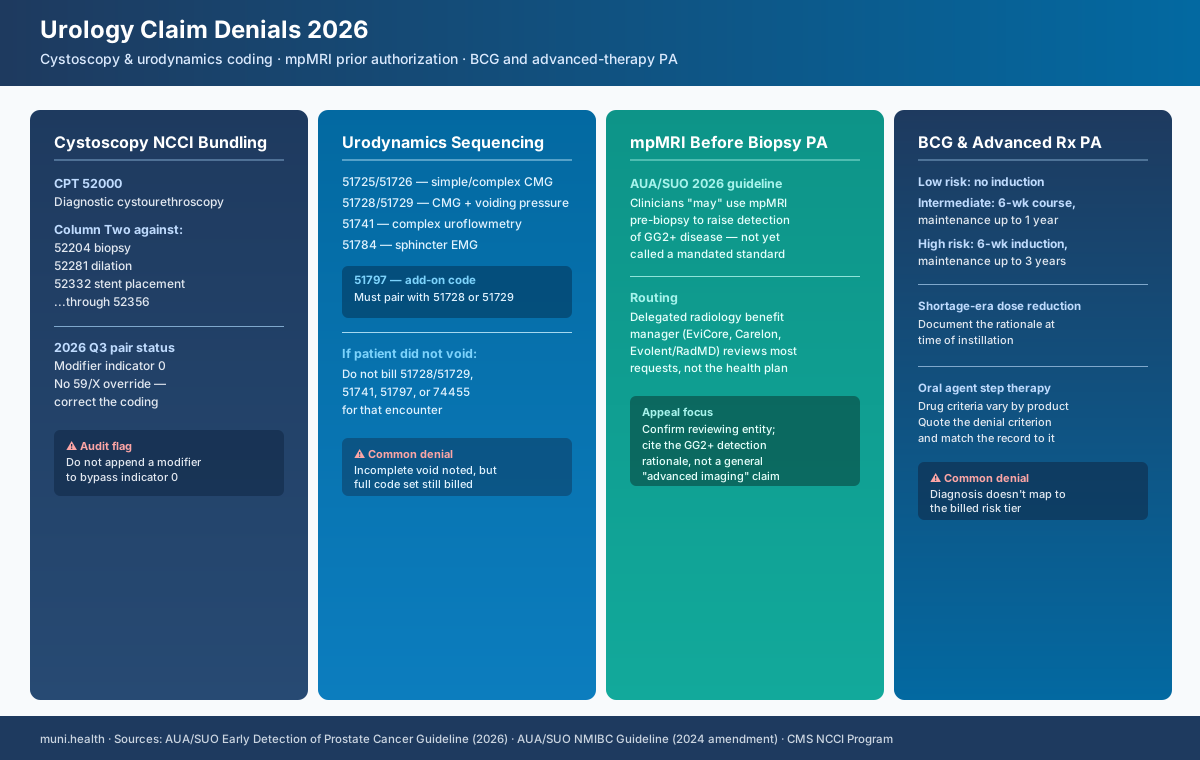
Why Urology Claims Face a Distinct Denial Pattern
Urology billing mixes two denial-prone patterns that most other specialties face separately: a high volume of same-day office diagnostics governed by strict National Correct Coding Initiative (NCCI) bundling rules, and a set of high-cost therapies — advanced imaging, intravesical immunotherapy, and oral hormone-blocking agents — that route through prior authorization gates layered with clinical-guideline nuance. A cystoscopy denial and a BCG denial come from opposite root causes, and treating them the same way is why so many urology appeals miss.
According to the 2025 AMA Prior Authorization Physician Survey (n=1,000 physicians, fielded December 2025), practices complete an average of 40 prior authorizations per physician per week, and 32% of physicians report PA requests are often or always denied. Urology carries a heavier share of the coding-bundling half of that burden than most specialties, because so much of its office volume — cystoscopy, urodynamics — is billed same-day rather than staged across visits.
For covered medical items and services, CMS-0057-F requires impacted payers, including Medicare Advantage organizations, to meet prior-authorization decision timeframes and provide a specific reason for denials. The rule excludes drugs from these prior-authorization provisions, so do not apply its medical-service timeline to a prescription-drug denial.
The 4 Most Common Urology Denial Types
Each denial type below traces to a different root cause — a coding rule, a PA routing error, or a clinical-documentation gap — and needs different evidence in the appeal.
| Denial Type | Key CPT/HCPCS Codes | Primary Trigger | Appeal Focus |
|---|---|---|---|
| Cystoscopy NCCI bundling | 52000, 52204-52356 | Diagnostic cystoscopy (52000) billed alongside any therapeutic cystoscopic procedure in the same session | Check the current-quarter PTP pair and modifier indicator; the named 52000 pairs are indicator 0 in the 2026 Q3 practitioner file, so a modifier cannot override them |
| Urodynamics sequencing/coding error | 51725, 51726, 51728, 51729, 51741, 51784, 51797 | Add-on code 51797 billed without its required primary code, or a voiding-dependent code billed when the patient did not void during the study | Confirm 51797 is paired with 51728 or 51729; confirm the study note documents a completed void where required |
| mpMRI prior authorization before prostate biopsy | 55700, MRI pelvis w/wo contrast | PA sent to the health plan instead of its delegated radiology benefit manager; imaging framed as discretionary rather than guideline-supported | Confirm the reviewing entity from the denial letterhead; cite the current AUA/SUO guideline language on mpMRI's role in detecting clinically significant disease |
| BCG / advanced prostate-cancer drug PA | J9031 (BCG), oral GnRH antagonists/CYP17 inhibitors | Risk-tier documentation is incomplete, maintenance duration is unsupported, or the request does not address the product's current plan criteria | Document the complete BCG risk profile; for oral drugs, quote the exact denial criterion and respond with the matching record or exception rationale |
Cystoscopy & Urodynamics NCCI Bundling Denials
Most urology coding denials are not medical-necessity disputes — they're an NCCI Procedure-to-Procedure edit doing exactly what it's designed to do, because the wrong code combination was billed for what was actually performed.
The cystoscopy bundling rule. Diagnostic cystourethroscopy (CPT 52000) sits as the Column Two code against nearly every therapeutic cystoscopic procedure — biopsy (52204), fulguration and tumor resection, dilation (52281), stent placement (52332), and stone or lithotripsy procedures up through 52356. When 52000 is billed on the same claim as any of those codes for the same session, the edit removes it before a human reviewer ever sees the note, because the diagnostic scope is considered the introductory step of the therapeutic procedure, not a separate service.
The specific 52000 pairs named above have modifier indicator 0 in CMS's 2026 Q3 practitioner PTP file. They cannot be bypassed with modifier 59 or an X modifier, even when the record describes a distinct site or encounter. Correct the coding instead of trying to unbundle 52000. For a different code pair whose current-quarter indicator is 1, an NCCI-associated modifier may allow separate reporting only when its criteria are actually met and the record supports the distinct service. CMS instructs practices to use a more descriptive modifier when one is available and to use modifier 59 only when no more specific modifier explains the circumstances. See the CO-97 denial code appeal guide for the general indicator-0-vs-1 decision tree this cystoscopy rule is one example of, plus a corrected-claim and appeal template for indicator-1 pairs.
Modifier 59 Draws Auditor Attention
CMS warns that modifier 59 and the XE/XP/XS/XU modifiers must not be used simply to bypass an NCCI edit. First confirm that the current-quarter pair has modifier indicator 1. Indicator 0 means no NCCI-associated modifier can override the edit.
The urodynamics sequencing rule. The urodynamics code series has a structural dependency most billers miss: CPT 51797 (intra-abdominal voiding pressure study) is an add-on code and cannot be billed by itself — it must accompany a primary code, either 51728 (complex cystometrogram with voiding pressure studies) or 51729 (the more complex variant). Billing 51797 alone, or without one of those two primary codes on the same claim, is a structural denial independent of clinical necessity.
A second, less obvious sequencing rule governs the entire voiding-dependent portion of the study: if the patient is unable to void during the encounter, the codes that depend on a completed void — 51728 or 51729, 51741 (complex uroflowmetry), 51797, and the related radiologic code 74455 — should not be billed for that encounter. A study note that documents an incomplete void but still carries all of those codes is a common and avoidable cause of "invalid procedure" denials.
What a defensible cystoscopy or urodynamics coding correction includes:
[Practice Letterhead]
[Date]

[Payer] Appeals Department
[Address from denial letter]

RE: Coding Review — NCCI Bundling / Urodynamics Sequence
Patient: [Name] | DOB: [Date] | Member ID: [ID]
Claim #: [Claim Number] | DOS: [Date of Service]
CPT Code(s) Billed: [e.g., 52000 + 52204, or 51728/51729 + 51797]
Denial Reason: [NCCI edit / bundled service / invalid code sequence]

Dear [Payer] Claims Review Team,

This claim is being reviewed after a National Correct Coding Initiative
or code-sequencing denial. We checked the exact current-quarter PTP pair
and modifier indicator before requesting any payer review.

PROCEDURE DETAILS:
Exact PTP pair and effective quarter checked: [pair / quarter]
Modifier indicator: [0 / 1]
For the named 52000 + 52204/52281/52332/52356 pairs, indicator 0
  means 52000 cannot be separately reported with an NCCI-associated
  modifier. Submit corrected coding rather than an override request.

--- OR, for urodynamics sequencing denials ---

Primary code billed: [51728 / 51729]
Add-on code billed: [51797]
Void completed during study: [Yes/No — if No, confirm 51728/51729,
  51741, 51797, and 74455 were NOT billed for this encounter]

CLAIM CORRECTION REQUESTED:
[ ] Correct the cystoscopy coding to comply with the indicator-0 edit
    (do not append modifier 59/XE/XP/XS/XU to override it)
[ ] Reprocess urodynamics codes in the correct primary/add-on
    sequence per the documented study components

SUPPORTING DOCUMENTATION:
- Complete operative or urodynamics study report
- Current-quarter PTP edit and modifier indicator used for review
- Void status and which component codes were actually performed

I am available to discuss this case or provide additional
documentation.

Respectfully,

[Provider Name, Credentials]
NPI: [Number]
Skip the blank template. Start with a review-ready draft.
Use the template as guidance, or let Muni prepare a payer-specific draft for your team to verify, sign, and submit.
First 3 appeals free, then $20 per appeal. Start with your denial letter or EOB and available records. No meeting or clearinghouse connection required.
mpMRI Prior Authorization Before Prostate Biopsy Denials
A prostate mpMRI ordered ahead of an initial biopsy gets denied for a subtler reason than most imaging PA denials: the current guideline language itself gives payers room to call it discretionary.
Per the AUA/SUO Early Detection of Prostate Cancer Guideline (2026 amendment), clinicians may use mpMRI before an initial biopsy to increase detection of clinically significant prostate cancer — defined as Gleason Grade Group 2 or higher (GG2+) disease — but the guideline stops short of calling pre-biopsy mpMRI in biopsy-naïve patients the standard of care. That "may" rather than "should" framing is exactly the gap a reviewer cites to deny the scan as not medically necessary, even though the same guideline supports its clinical value.
The appeal has to close that gap directly: cite the guideline's own detection-rate rationale rather than arguing general imaging value, and confirm the request reached the correct reviewer. Like other advanced imaging, most commercial and Medicare Advantage plans delegate prostate mpMRI review to a radiology benefit manager rather than reviewing it internally — see the imaging prior authorization denial appeal guide for the routing pattern across EviCore, Carelon, and Evolent/RadMD, and how to confirm the reviewing entity from the denial letterhead before resubmitting.
What the Guideline Actually Supports
The AUA/SUO guideline's rationale for mpMRI centers on detecting clinically significant disease while limiting detection of clinically insignificant disease. When MRI identifies a suspicious lesion, the guideline recommends targeted biopsy and says clinicians may also perform a systematic template biopsy; it does not require the systematic biopsy in every case. An appeal should use that conditional language rather than describe both biopsy approaches as universally paired.
What strengthens an mpMRI PA appeal:
- Confirmation of the correct reviewing entity (radiology benefit manager vs. health plan) from the denial letterhead
- The specific clinical indicator prompting biopsy consideration — elevated or rising PSA, abnormal digital rectal exam, or family history/genetic risk factors — stated explicitly
- Reference to the current AUA/SUO guideline's GG2+ detection rationale, not a general appeal to imaging value
- For repeat-biopsy scenarios, documentation of the prior biopsy result and why continued risk warrants reimaging
BCG & Advanced Prostate Cancer Drug PA Denials
BCG (Bacillus Calmette-Guérin) intravesical therapy and oral advanced-prostate-cancer agents get denied for opposite reasons — BCG denials usually trace to a documentation gap against the treating guideline's own risk-based schedule, while oral-agent denials trace to a step-therapy requirement the record doesn't yet satisfy.
Prepare this appeal packet with your team.
Draft the appeal, coordinate missing documents, and approve the reviewed packet. Keep your clearinghouse; your practice checks deadlines and submits through the payer’s accepted channel.
First 3 appeals free, then $20 per appeal. Start with your denial letter or EOB and available records. No meeting or clearinghouse connection required.
BCG risk-stratification and dosing. Per the AUA/SUO Non-Muscle Invasive Bladder Cancer Guideline (2024 amendment), BCG induction and maintenance recommendations are risk-tiered:
| Risk Tier | Qualifying Diagnosis | Induction | Maintenance |
|---|---|---|---|
| Low risk | Low-grade Ta, small/solitary | Guideline: should NOT receive induction intravesical therapy | Not applicable |
| Intermediate risk | Recurrent low-grade Ta, larger/multifocal | Six-week course (chemotherapy or BCG) considered | May utilize maintenance after complete response |
| High risk | CIS, high-grade T1, high-risk Ta | Six-week induction course of BCG | Continue maintenance BCG for three years, as tolerated and available |
Low-grade Ta histology alone does not establish the low-risk tier. Size, number of tumors, recurrence pattern, grade, stage, and CIS all matter to risk classification. If a BCG request is denied for risk stratification, document the full profile rather than treating “low-grade Ta” or “no recurrence noted” as dispositive by itself.
Shortage-Era Dose Reduction Needs Its Own Documentation
BCG has faced recurring national supply constraints in recent years. When full-dose BCG is unavailable, guideline-consistent practice reduces the dose (commonly to one-half or one-third strength) and may limit maintenance duration rather than skip treatment. A claim billed at a reduced unit count without a chart note explaining the shortage-driven dose reduction reads to a reviewer as an incomplete or miscoded claim, not a clinical accommodation — document the reduction and its rationale at the time of instillation, not only if the claim is denied.
Advanced prostate cancer drug coverage. Do not assume relugolix and abiraterone share a generic “injectable ADT first” requirement. Their indications, treatment roles, and payer criteria differ. Relugolix is an oral GnRH receptor antagonist for adults with advanced prostate cancer, per its FDA-approved prescribing information. For either product, read the current plan policy and denial notice, then address the exact criterion with the relevant treatment history, contraindication, intolerance, or exception evidence. Do not import a requirement from a different drug or payer policy.
What strengthens a BCG or advanced-therapy PA appeal:
- The specific pathology finding that establishes risk tier (CIS, high-grade T1, high-risk Ta, or the recurrence/multifocality detail for intermediate risk)
- Cumulative induction/maintenance instillation count to date, checked against the guideline's tier-specific schedule
- For dose-reduced claims: the shortage or clinical rationale for the reduction, documented at the time of treatment
- For oral-drug denials: the exact current plan criterion, plus the matching treatment history or exception evidence
How Muni Appeals Helps Urology Billing Teams
Many urology denials turn on a specific coding, routing, or documentation issue: an NCCI edit, an mpMRI request sent to the wrong reviewer, incomplete BCG risk stratification, or a drug request that does not address the cited plan criterion. Identify that issue before correcting the claim or drafting the appeal.
Muni Appeals organizes uploaded urology denial materials, matches documentation to the cited coding edit or clinical guideline, and surfaces likely radiology-benefit-manager or direct-payer routing for staff verification. Staff confirms the current reviewer, deadline, and submission channel. Practices comparing workflows should see the appeal automation cost comparison.
Frequently Asked Questions
Why was my cystoscopy claim denied when I billed it with another procedure?
Diagnostic cystoscopy (CPT 52000) is bundled under NCCI as the Column Two code against many therapeutic cystoscopic procedures, including the 52204, 52281, 52332, and 52356 examples above. In CMS's 2026 Q3 practitioner PTP file, those named pairs have modifier indicator 0, so modifier 59 or an X modifier cannot override the edit. Check the exact current-quarter pair and correct the coding rather than appending a modifier to those combinations.
Can urodynamics code 51797 be billed on its own?
No. CPT 51797 (intra-abdominal voiding pressure study) is an add-on code and must be billed alongside its required primary code — 51728 or 51729. A claim carrying 51797 without one of those two codes will deny structurally, independent of medical necessity.
Does insurance require prior authorization for an mpMRI before a prostate biopsy?
Most commercial and Medicare Advantage plans require prior authorization for prostate mpMRI, and route the review to a delegated radiology benefit manager rather than reviewing it internally. Denials often cite the scan as discretionary because current AUA/SUO guideline language describes pre-biopsy mpMRI as something clinicians "may" use rather than a mandated standard — the appeal should cite the guideline's own detection-rate rationale for clinically significant (GG2+) disease directly.
Why was my BCG claim denied for a low-grade bladder cancer diagnosis?
The AUA/SUO guideline advises against induction intravesical therapy for low-risk disease, but “low-grade Ta” alone does not establish that tier. Review tumor size, multiplicity, recurrence, grade, stage, and CIS, then document the complete risk classification supporting the requested treatment.
How long should BCG maintenance therapy last for high-risk bladder cancer?
The AUA/SUO guideline supports continuing maintenance BCG for three years, as tolerated and as supply allows, following a complete response to the six-week induction course in high-risk patients. Intermediate-risk patients who completely respond to induction may receive maintenance for up to one year. Claims for maintenance beyond the risk-appropriate duration, without documentation supporting continued treatment, are a common denial point.
Why does my relugolix (Orgovyx) prior authorization keep getting denied?
Relugolix coverage criteria vary by plan. Read the current policy and denial notice rather than assuming an injectable-therapy prerequisite. Respond to the exact criterion with the relevant treatment history, contraindication, intolerance, or other exception evidence the plan requests.
What's the fastest way to resolve a urology PA denial when the clinical picture is strong but documentation was incomplete?
Request a peer-to-peer review before filing a formal written appeal, when the payer or its delegate offers one — this is typically available in the days immediately following the denial and lets the ordering urologist address the reviewer's specific concern directly. For urgent cases, see the expedited appeal process guide — CMS-0057-F requires a 72-hour turnaround on urgent Medicare Advantage requests.
Ready to Stop Losing Time to Urology Coding and PA Denials?
A urology appeal is stronger when it matches the actual issue — an NCCI bundling edit, a misrouted mpMRI PA, incomplete BCG risk stratification, or an unmet product-specific coverage criterion. Submitting the same claim again without addressing the cited issue usually does not add useful evidence.
Muni Appeals helps urology billing teams:
- Organize appeals by denial type instead of treating every denial the same way
- Match documentation requirements to the specific coding edit, delegated reviewer, or clinical guideline
- Provide likely radiology-benefit-manager or direct-payer routing guidance for staff to verify before filing
This guide reflects 2026 urology billing and appeal procedures. CPT/HCPCS code requirements, NCCI edits, payer prior authorization rules, and clinical guidelines are updated regularly and vary by Medicare Administrative Contractor and commercial payer. State requirements and plan-level rules also vary. This information is for administrative and billing purposes and is not medical advice.