

CO-97 means the payer included payment for one service in another service or procedure already adjudicated. The code alone does not prove that a National Correct Coding Initiative (NCCI) edit caused the adjustment. First confirm the remittance detail, payer rule, and edit in effect for the date of service. If an NCCI Procedure-to-Procedure edit applies, CCMI 0 bars a modifier bypass, while CCMI 1 may allow a modifier when the services were genuinely distinct. Report the supported modifier once on the appropriate Column One or Column Two code under the payer's rules. Even with CCMI 0, request correction, reprocessing, or an appeal if the edit or claim context was applied incorrectly.
Understanding CO-97: An Unbundling Argument, Not a Medical-Necessity One
The official X12 definition of CARC 97 is "the benefit for this service is included in the payment/allowance for another service/procedure that has already been adjudicated." With the CO group code, the adjustment is a contractual obligation the practice absorbs — not something billed to the patient. Verify the remittance and your payer contract before assuming otherwise.
CO-97 may reflect an NCCI Procedure-to-Procedure (PTP) edit, but the CARC does not identify the underlying edit or policy. Review the RARC and remittance detail, then confirm with the payer which bundling rule and version applied to the claim on the date of service. When the payer identifies an NCCI PTP edit, CMS describes that framework directly: "NCCI Procedure-to-Procedure (PTP) edits prevent inappropriate payment of services that should not be reported together. Each edit has a Column One and a Column Two HCPCS/CPT code. If a provider reports the two codes of an edit pair for the same beneficiary on the same date of service, the Column One code is eligible for payment, but the Column Two code is denied unless a clinically appropriate NCCI PTP-associated modifier is also reported" (CMS Medicare NCCI PTP Edits).
That framing matters because CO-97 isn't a coverage decision the way CO-50 is, and it isn't a missing data field the way CO-16 is. It says payment was included elsewhere; the verified payer rule determines whether the response is a coding correction, modifier-supported resubmission, reprocessing request, or formal appeal. See the EOB denial code guide for how CO-97 fits alongside CO-4, CO-16, CO-29, and CO-50 in the broader CARC framework.
Key Statistic
The most direct federal data point cited here is historical: a 2005 HHS Office of Inspector General review found 40% of code pairs billed with modifier 59 in FY2003 didn't meet program requirements, producing an estimated $59 million in improper payments — most because the services billed weren't actually distinct (HHS-OIG, November 2005). The finding supports verifying the NCCI context and documenting the clinical distinction; it does not establish a current comparative audit ranking for modifier 59.
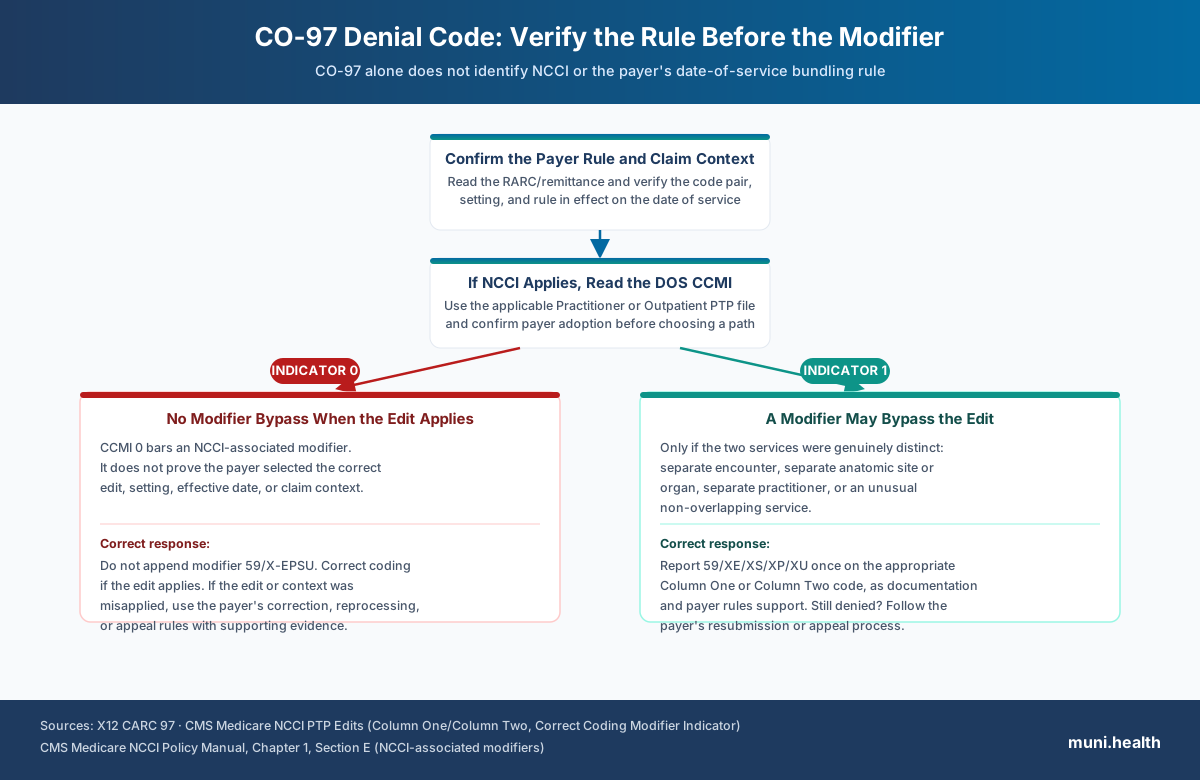
The CO-97 Payer-Rule and NCCI Decision Tree
Do not start with a modifier. First establish what rule produced the CO-97 adjustment. Only use the Correct Coding Modifier Indicator (CCMI) branch after confirming that the payer applied an NCCI PTP edit for the claim's date of service.
Step 1: Confirm the Payer Rule and Date-of-Service Context
Read the remittance and any RARC, then ask the payer which bundling edit or payment policy was applied. Confirm the code pair, provider, patient, claim setting, and date of service. A commercial payer may use its own payment policy or its own adoption of NCCI methodology, so do not substitute a current CMS file for the payer's applicable rule.
If the payer confirms a Medicare NCCI PTP edit, CMS publishes Practitioner and Hospital Outpatient PTP edit files quarterly on the Medicare NCCI PTP Edits page. Find both CPT/HCPCS codes in the file and setting that applied on the date of service — not necessarily the version live today. For another payer, use the edit reference and version that the plan says governed that claim rather than assuming the Medicare file controls.
Step 2: Read the Modifier Indicator
CMS defines the three possible values directly:
- "A CCMI of '0' indicates that NCCI PTP-associated modifiers cannot be used to bypass the edit." This bars a modifier override when the edit applies; it does not prove that the payer selected the correct edit, setting, effective date, or claim context.
- "A CCMI of '1' indicates that NCCI PTP associated modifiers may be used to bypass an edit under appropriate circumstances." The services can be separately reported if they were genuinely distinct.
- "A CCMI of '9' indicates that the use of NCCI PTP-associated modifiers is not specified" — a housekeeping value applied only when a code pair's deletion date equals its effective date, meaning the edit never had an active life. If the applicable file shows 9 or no active pair, do not force the denial into the NCCI modifier branch; confirm which payer rule and version produced the adjustment and challenge a mismatch under the payer's process (CMS NCCI FAQ Library).
Indicator 0 Bars a Modifier Bypass — Not Every Challenge
If CCMI is 0 and the payer applied the edit correctly, do not append modifier 59 or an X-EPSU modifier merely because the services were distinct; the modifier cannot bypass that edit. Correct the coding if needed. If the payer used the wrong code pair, setting, effective date, provider/patient context, or otherwise misapplied the edit, follow the payer's correction, reprocessing, or appeal rules with evidence of the mismatch.
Step 3: If Indicator 1, Confirm the Services Were Genuinely Distinct
CMS's own guidance is specific about when a modifier is appropriate: "these circumstances relate to separate patient encounters, separate anatomic sites, or separate specimens... Most edits involving paired organs or structures (e.g., eyes, ears, extremities, lungs, kidneys) have NCCI PTP modifier indicators of '1' because the two codes of the code pair edit may be reported if performed on the contralateral organs or structures. Most of these code pairs should not be reported with NCCI PTP-associated modifiers when performed on the ipsilateral organ or structure unless there is a specific coding rationale to bypass the edit" (CMS NCCI FAQ Library).
In plain terms: an indicator-1 pair on the same structure, same session, same incision usually still shouldn't carry a bypass modifier. Indicator 1 is permission to check, not permission to append.
Ophthalmology runs into this paired-organ logic directly: CMS names "eyes" as one of its examples above, and same-day eye exams and intravitreal injections can produce bundling denials in retina billing. See the ophthalmology claim denials guide for how that exam/injection bundle works and when modifier 25 may be appropriate.
Step 4: Choose the Correct Modifier
CMS's NCCI-associated modifier list includes anatomic modifiers (LT/RT, E1-E4, FA/F1-F9, TA/T1-T9), global surgery modifiers (24, 25, 57, 58, 78, 79), and — for the distinct-procedural-service scenario addressed here — modifiers 27, 59, 91, XE, XS, XP, and XU. CMS's own instruction on 59 versus the X-modifiers: it "may be used only if no other appropriate modifier describes the service" (CMS NCCI FAQ Library) — meaning a more specific X-modifier should be used ahead of modifier 59 whenever one applies.
| Modifier | Use When |
|---|---|
| XE — Separate Encounter | The service was distinct because it occurred during a separate encounter |
| XS — Separate Structure | The service was distinct because it was performed on a separate organ/structure |
| XP — Separate Practitioner | The service was distinct because it was performed by a different practitioner |
| XU — Unusual Non-Overlapping Service | The service is distinct because it doesn't overlap the usual components of the main service |
| 59 — Distinct Procedural Service | Use only when none of the four X-modifiers above more specifically describes the distinction |
Do not stack modifier 59 with an X-modifier on the same service. Pick the one that actually describes why the services were separate, and report it once on the appropriate Column One or Column Two code as supported by the documentation and payer rules.
Step 5: Document, Resubmit, and Escalate Only If Needed
Report the modifier once on the appropriate Column One or Column Two code as supported by the documentation and payer rules, add a brief clinical note stating the specific reason the services were distinct, and resubmit. If the payer denies again despite indicator 1 and real supporting documentation, file a formal appeal citing the applicable payer rule and, when relevant, the specific NCCI Policy Manual chapter and section governing that code pair — not a general "these services were both necessary" argument.
Modifier Indicator Quick Reference
| Indicator | What It Means | Can You Bill Separately? | Correct Response |
|---|---|---|---|
| 0 | An NCCI-associated modifier cannot bypass this edit | Not through a modifier when the edit applies | Verify the edit and claim context; correct coding if applicable, or seek correction, reprocessing, or appeal if the rule was misapplied |
| 1 | A modifier may bypass the edit under appropriate clinical circumstances | Yes, if genuinely distinct (separate encounter, site, or practitioner) | Report the supported modifier once on the appropriate Column One or Column Two code, document why, and follow payer resubmission or appeal rules |
| 9 | Edit's deletion date equals its effective date — it was never actually active | N/A — no active edit exists | No modifier needed; confirm which edit actually applied on your date of service |
Template: CO-97 NCCI Bundling Corrected Claim & Appeal Note
Use this for an indicator-1 pair where the documentation genuinely supports separate services. It doubles as a corrected-claim cover note on first resubmission and a formal-appeal opener if the payer denies it again — mark the bracketed line accordingly.
[Your Practice Letterhead]
[Date]

[Payer Name] Claims / Appeals Department
[Payer Claims or Appeals Address]

RE: [Corrected Claim Resubmission / Formal Appeal] — CO-97 Denial
  Patient: [Patient Name], DOB: [Date of Birth]
  Member ID: [Member ID]
  Claim Number: [Claim #]
  Date of Service: [DOS]
  Column 1 (Primary) Code: [CPT/HCPCS Code]
  Column 2 (Secondary) Code: [CPT/HCPCS Code]
  Denial Code: CO-97
  NCCI Modifier Indicator on Date of Service: 1
  Modifier Reported: [59 / XE / XS / XP / XU]
  Modifier Reported Once On: [Column One Code / Column Two Code]

To Whom It May Concern:

This [corrected claim / formal appeal] addresses the CO-97 denial of the code pair referenced above. Per the CMS NCCI Procedure-to-Procedure edit file effective for the date of service, this code pair carries a modifier indicator of 1, meaning the services may be separately reported when genuinely distinct.

The two services were distinct because: [state the specific reason — separate encounter, separate anatomic site or organ, separate practitioner, or unusual non-overlapping service; do not use a generic statement].

Supporting documentation:
[Chart note(s) establishing the separate encounter, site, or practitioner]
[Any operative or procedure note distinguishing the two services]

Modifier [59 / XE / XS / XP / XU] has been reported once on the [Column One / Column Two] code above, as supported by the documentation and [Payer Name]'s applicable rules. Please reprocess this claim for separate payment of both services.

[If this is a second-round formal appeal, add:] This is a formal appeal of the denial issued on [date]. The corrected claim submitted on [date] with the documentation above was denied without addressing the modifier indicator or the supporting clinical distinction. We request review under [Payer Name]'s formal appeal process and citation of the specific NCCI Policy Manual section relied upon if the denial is upheld.

Sincerely,

[Your Name]
[Title]
[Practice Name]
[Phone Number]
[Billing NPI / Tax ID]
Skip the blank template. Start with a review-ready draft.
Use the template as guidance, or let Muni prepare a payer-specific draft for your team to verify, sign, and submit.
First 3 appeals free, then $20 per appeal. Start with your denial letter or EOB and available records. No meeting or clearinghouse connection required.
When CO-97 Is Actually a Modifier 25 Problem
Not every CO-97 is a procedure-to-procedure bundling issue. When the bundled pair is an evaluation and management (E/M) code plus a same-day procedure, do not assume the modifier-59/X-EPSU path. Verify the payer rule; when modifier 25 applies, the question is whether the E/M service was significant and separately identifiable. Appending 59 to an E/M-versus-procedure bundle is the wrong tool even when the underlying denial reason on the remittance reads the same way. See modifier 25 denials and appeals for the chart-note architecture that governs that specific bundle.
Prepare this appeal packet with your team.
Draft the appeal, coordinate missing documents, and approve the reviewed packet. Keep your clearinghouse; your practice checks deadlines and submits through the payer’s accepted channel.
First 3 appeals free, then $20 per appeal. Start with your denial letter or EOB and available records. No meeting or clearinghouse connection required.
Urology is a clear real-world example of the indicator-0 branch above in practice: diagnostic cystoscopy (CPT 52000) is bundled as the Column Two code against several same-session therapeutic cystoscopic procedures, and those specific pairs currently carry modifier indicator 0 in CMS's file — meaning no X-modifier or 59 can bypass a correctly applied edit. Confirm the applicable date-of-service pair and payer rule; correct the coding when the edit applies, or request correction or reprocessing when it does not. See the urology claim denials guide for the named code pairs and why they're structurally different from an indicator-1 situation.
CO-97 vs. Other Codes That Look Similar
| Code | What It Means | Correct Response |
|---|---|---|
| CO-16 | Claim is missing information needed to adjudicate | Corrected claim, fixing the field the RARC identifies |
| CO-50 | Payer decided the service isn't medically necessary | Clinical appeal citing the specific coverage policy |
| CO-97 | Payment is included in another adjudicated service or procedure | Confirm the payer's date-of-service rule; then correct coding, resubmit with support, or appeal a misapplication |
| B15 | A required companion service hasn't been received or adjudicated yet | Confirm the qualifying service was billed and processed, then resubmit |
| CO-119 | Benefit maximum for this time period or occurrence has been reached | Verify the plan's frequency/session cap — not an unbundling issue |
CO-97 gets confused with B15 the most: B15 means the payer is waiting on a related claim, not refusing to pay for a bundled component — check whether the companion service was actually submitted and processed before assuming it's a modifier situation. It also gets confused with frequency-limit denials like CO-119, which cap how many units of a single code are payable in a period and have nothing to do with code-pair bundling; see the pain management claim denials guide for how CO-119 shows up on interventional procedures with per-year injection caps.
How Muni Appeals Handles CO-97 Denial Routing
Muni Appeals helps staff turn denial materials and supporting records into a review-ready appeal draft. Staff must independently confirm the payer's applicable bundling rule, the date-of-service NCCI context when relevant, and whether the case belongs in a corrected-claim, reprocessing, or appeal workflow before filing.
Weighing whether denial-routing automation is worth adding to an existing billing workflow? See appeal automation cost vs. manual processing for a breakdown of where the time actually goes.
Frequently Asked Questions
What does CO-97 mean on an EOB or remittance advice?
CO-97 means the payer determined the benefit for the service was included in payment for another service or procedure already adjudicated. It does not identify NCCI by itself. Check the remittance detail, RARC, and payer's date-of-service rule to determine whether an NCCI PTP edit or another bundling policy caused the adjustment. With the CO group code, the adjustment is a contractual obligation the practice absorbs, not something billed to the patient.
Can I appeal a CO-97 denial?
Sometimes. First confirm the payer rule that caused the adjustment. If an NCCI PTP edit applies, CCMI 0 prevents a modifier from bypassing a correctly applied edit, while CCMI 1 may support a modifier-based resubmission when the services were genuinely distinct. CCMI 0 does not prevent a correction, reprocessing request, or appeal when the payer applied the wrong edit or claim context; follow the denial notice and plan rules.
What's the difference between modifier indicator 0 and 1?
When an NCCI PTP edit applies, indicator 0 means an NCCI-associated modifier cannot bypass that edit. Indicator 1 means a modifier may bypass the edit, but only under appropriate clinical circumstances — such as a separate encounter, anatomic site, or practitioner. Neither value establishes that the payer selected the right edit or applied it to the right claim context.
Should I use modifier 59 or an X-EPSU modifier?
Use the most specific one that applies: XE for a separate encounter, XS for a separate structure, XP for a separate practitioner, or XU for an unusual non-overlapping service. CMS guidance states modifier 59 should be used only when none of those four more specific modifiers describes the situation. Report the supported modifier once on the appropriate Column One or Column Two code as the documentation and payer rules direct.
What's the difference between CO-97 and CO-50?
CO-50 is a coverage decision — the payer reviewed the documentation and concluded the service wasn't medically necessary for this patient, which is appealable with clinical evidence mapped to the payer's policy. CO-97 says the payer included payment for one service in another; the response depends on the verified bundling rule. If NCCI applies, the CCMI governs modifier bypass, while a misapplied edit may still support correction, reprocessing, or appeal.
How do I find the modifier indicator for a specific code pair?
First confirm that the payer applied an NCCI PTP edit and which setting and version it used. Then check the Practitioner or Hospital Outpatient PTP edit file covering the date of service on CMS's Medicare NCCI PTP Edits page, matching both CPT/HCPCS codes. CMS updates these files quarterly, and payer adoption may differ, so verify the payer-specific context before filing.
What happens if I use modifier 59 to bypass an indicator-0 edit?
If the payer correctly applied an indicator-0 edit, modifier 59 cannot override it. A 2005 HHS-OIG review found 40% of sampled modifier-59 code pairs didn't meet program requirements. Do not append a bypass modifier; correct the coding when appropriate, or challenge the denial under the payer's rules when the edit or claim context was misapplied.
Is a CO-97 denial the same thing as a modifier 25 denial?
No, though they can look similar on a remittance. Modifier 25 may apply to a same-day E/M service billed alongside a procedure and turns on whether the E/M was significant and separately identifiable. Verify the payer rule rather than treating every E/M/procedure CO-97 as an NCCI modifier-59 situation. See modifier 25 denials and appeals for the documentation standard.
Ready to Stop Guessing on CO-97 Denials?
CO-97 alone does not decide the fix. Confirm the payer's date-of-service bundling rule first. When NCCI applies, the CCMI tells you whether a modifier may bypass the edit; it does not validate that the payer chose the correct edit or context. That distinction keeps staff from adding an unsupported modifier while preserving correction, reprocessing, or appeal options for a misapplied denial.
Get started:
- Review-ready appeal drafting from the denial materials and supporting records staff provides
- Staff verification of the applicable payer rule, date-of-service edit context, and clinical distinction
- Staff selection of the payer's corrected-claim, reprocessing, or formal-appeal path before filing
This guide reflects 2026 CARC code definitions and the CMS NCCI Procedure-to-Procedure edit framework. CO-97 does not establish that NCCI applies. Specific code-pair modifier indicators change quarterly, and payer adoption and payment policies vary. Verify the denial notice, plan rules, payer guidance, and edit in effect for the date of service before filing. This guide does not constitute legal or billing compliance advice.