

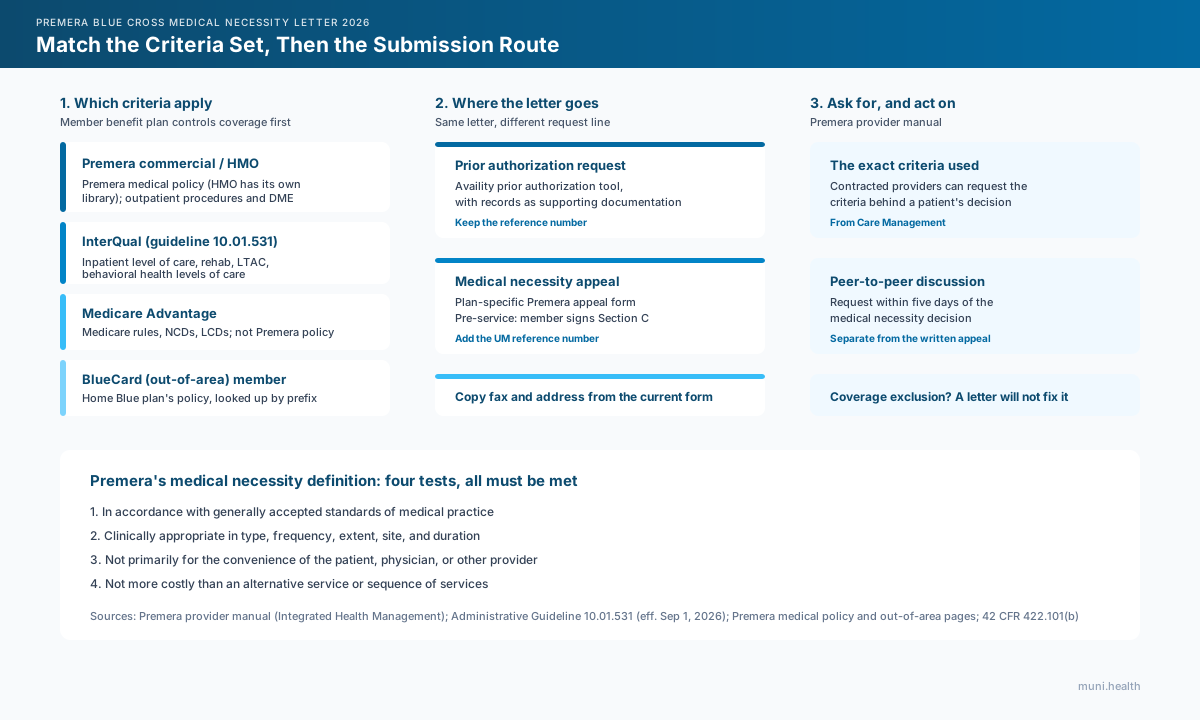
A Premera Blue Cross medical necessity letter has to answer two things. The first is Premera's own definition. The Premera provider manual requires that the service be (1) in line with generally accepted standards of medical practice, (2) clinically appropriate in type, frequency, extent, site, and duration, (3) not mainly for convenience, and (4) not more costly than an alternative. The second is the criteria set for the member's plan. That is usually a Premera medical policy, InterQual® for inpatient and behavioral health levels of care, or Medicare coverage rules for Medicare Advantage. Name the policy, map each criterion to a dated finding in the record, and send the letter with the request it supports. For a prior authorization, that is supporting documentation in Availity. For an appeal, attach it to the plan-specific Premera appeal form.
Which Criteria Does Premera Apply?
Start with the member's benefit plan, then find the criteria set for that plan and service. Premera's medical policies page says the member's benefit plan determines coverage, and that some plans exclude services even when they are medically necessary. A letter can show medical necessity. It cannot add a benefit the plan excludes.
| Member's plan or service | Criteria the reviewer uses | What to cite in the letter |
|---|---|---|
| Premera commercial (Washington or Alaska) | Premera medical policy for the service | Policy number, title, and the effective date that covers the date of service |
| Premera Blue Cross HMO | The separate HMO medical policy library | The HMO policy, not the commercial version of the same topic |
| Inpatient acute, rehabilitation, or long-term acute care level of care | InterQual, per Administrative Guideline 10.01.531 | The InterQual subset named in the denial |
| Behavioral health level of care (adult, child and adolescent, substance use disorder) | InterQual, per Administrative Guideline 10.01.531 | The InterQual subset named in the denial |
| Premera Medicare Advantage | Medicare statutes, regulations, NCDs, and LCDs; Premera's commercial policies do not apply | The NCD or LCD, or the plan's published internal criteria |
| BlueCard member of another Blue plan | The member's home Blue plan policy and requirements | The home plan's policy, looked up by ID prefix |
Premera's Administrative Guideline 10.01.531 (effective September 1, 2026) limits InterQual to inpatient and behavioral health levels of care. Its history shows that outpatient procedures and DME were taken out of InterQual review effective February 5, 2021, and are reviewed under medical policies. For an outpatient procedure, cite the Premera medical policy, not an InterQual procedure subset.
The provider manual also lists the other sources Premera uses to build its standards, including Carelon Medical Benefits Management guidelines, eviCore guidelines, ASAM criteria, and the BCBSA medical policy reference manual. If the denial letter names one of these vendors, answer that vendor's criteria.
Medicare Advantage and BlueCard Use Different Rules
Premera's medical policies page says its online policies do not apply to Medicare Advantage members. For Medicare Advantage, 42 CFR §422.101(b) requires plans to follow Medicare coverage rules, NCDs, and LCDs. Plans can use internal criteria only where Medicare criteria are not fully established, and those criteria must be public. For an out-of-area Blue member, Premera's out-of-area member resources page sends you to the home plan's medical policy using the ID-card prefix.
Premera's Four-Part Medical Necessity Definition
Your letter has to show all four parts. The provider manual defines medically necessary services as those a physician exercising prudent clinical judgment would provide to prevent, evaluate, diagnose, or treat an illness, injury, disease, or its symptoms. They must meet all four of the tests below.
| Premera test | What the reviewer looks for | Evidence to cite |
|---|---|---|
| In accordance with generally accepted standards of medical practice | Support in peer-reviewed literature, specialty-society recommendations, and the views of physicians in the field (the manual's own definition of the standard) | Guideline or society recommendation by name and year; the policy criteria met |
| Clinically appropriate in type, frequency, extent, site, and duration | The right service, amount, and setting for this patient | Objective findings, frequency or units requested, and why this site of care |
| Not primarily for the convenience of the patient, physician, or other provider | A clinical reason, not a scheduling or logistics reason | Clinical risk of the alternative; functional impact |
| Not more costly than alternative services or sequence of services | Cheaper options that are at least as likely to work have been tried or ruled out | Treatment history with dates and outcomes, or the contraindication |
The fourth test catches many letters. If a less expensive service or setting would work as well, the request fails that test. Name each lower-cost alternative, the dates it was tried, and why it failed or is not appropriate.
Premera Medical Necessity Letter Template
Use one letter for both the prior authorization request and the appeal. Pick the bracketed option that fits your case, and delete any section that does not apply. The physician who knows the patient should sign it.
[Practice Letterhead]

[Date]

Premera Blue Cross
[Prior authorization: submitted through Availity as supporting documentation]
[Appeal: attached to the current plan-specific Premera appeal form. Copy the
addressee, fax, and mailing address from that form for the member's
commercial, HMO, individual, Medicare Advantage, FEP, or BlueCard plan.]

RE: [Letter of Medical Necessity / Appeal of Medical Necessity Denial]
Patient: [Name]                    DOB: [MM/DD/YYYY]
Member ID: [Complete ID, including prefix and suffix]
Group/policy number: [Number]
Plan type: [Commercial / HMO / Individual / Medicare Advantage / FEP / BlueCard]
[Prior authorization reference / Utilization management reference /
Claim number]: [Number]
Service requested or denied: [CPT/HCPCS code(s) and description]
Diagnosis: [ICD-10 code(s) and description]
Date(s) of service: [Planned or actual date(s)]
Place of service / setting: [Office / outpatient facility / inpatient]
Ordering and rendering provider: [Name, credentials, NPI]

To the Premera Clinical Review Team:

I am writing [to request prior authorization for / to appeal the [date]
denial of] [service] for my patient, [name], whom I have treated since
[date] for [condition]. [For an appeal: The determination states that the
service is not medically necessary because "[quote the denial reason
exactly]."] The record below shows that [service] meets Premera's
definition of medical necessity and the applicable criteria.

1. DIAGNOSIS AND CURRENT CLINICAL STATUS
- Diagnosis: [condition], confirmed by [imaging / labs / exam] on [date].
- Objective findings: [measurements, scores, imaging results, lab values
with dates and reference ranges].
- Functional impact: [specific limits on work, daily activities, or
mobility, with validated scale scores if used].
- Duration and course: [onset date, progression, current trajectory].

2. TREATMENT ALREADY TRIED
- [Treatment 1]: [dates], [dose/frequency/duration], [outcome or reason
stopped].
- [Treatment 2]: [dates], [dose/frequency/duration], [outcome or reason
stopped].
- [Treatments not appropriate for this patient]: [contraindication and the
supporting record].

3. HOW THIS PATIENT MEETS THE APPLICABLE CRITERIA
Applicable criteria: [Premera medical policy number, title, and effective
date / InterQual subset named in the denial / NCD or LCD for Medicare
Advantage / home plan policy for a BlueCard member].

- Criterion: [criterion text] -> Met: [finding, date, and where in the
attached records it appears]
- Criterion: [criterion text] -> Met: [finding, date, and record location]
- Criterion: [criterion text] -> Met: [finding, date, and record location]

[If the patient does not fit a criterion exactly: explain the clinical
reason an exception is appropriate for this patient, and cite the
peer-reviewed literature or specialty-society guideline that supports it.]

4. PREMERA'S DEFINITION OF MEDICAL NECESSITY
- Generally accepted standards of medical practice: [guideline or
specialty-society recommendation, with year].
- Clinically appropriate in type, frequency, extent, site, and duration:
[why this service, these units or visits, and this setting].
- Not primarily for convenience: [the clinical reason for this service
and timing].
- Not more costly than an alternative: [each lower-cost alternative and
why it was tried and failed, or why it is not appropriate].

5. RISK OF DELAY
- [Specific clinical consequence of delay or denial, with supporting
findings.]
- [If urgent: The patient's condition requires an expedited decision
because [reason]. Please process this on the expedited timeline stated
in the member's plan or denial notice.]

6. REQUESTS
[Include for a denial or appeal. Delete for an initial request.]
- Please provide a copy of the specific criteria used in this
determination.
- Please confirm that this appeal will be reviewed by, or with, a health
care professional with appropriate training and experience in
[specialty] who was not involved in the initial decision.

7. ENCLOSURES
- [Office notes dated ___ to ___]
- [Imaging / lab / diagnostic reports dated ___]
- [Treatment and medication history]
- [Cited guideline or literature: author, title, year]
- [Denial notice dated ___, if appealing]
- [Plan-specific Premera appeal form, with Section C signed by the member
for a pre-service or other member appeal]

Based on this record, I ask that Premera [approve / reverse its
determination and approve] [service] for [patient name]. I am available
for a peer-to-peer discussion at [phone] on [days/times].

Sincerely,

[Physician name, credentials]
[Specialty]
NPI: [NPI]
[Practice name, address, phone, fax]
Contact for this request: [name, phone, fax]
Skip the blank template. Start with a review-ready draft.
Use the template as guidance, or let Muni prepare a payer-specific draft for your team to verify, sign, and submit.
First 3 appeals free, then $20 per appeal. Start with your denial letter or EOB and available records. No meeting or clearinghouse connection required.
Sections 3 and 4 do most of the work. Section 3 answers the policy criteria line by line. Section 4 answers Premera's general definition, which applies even when a policy's criteria are met. Give a date and record location for each finding so the reviewer does not have to search the attachments.
Where to Submit a Premera Medical Necessity Letter
Attach the letter to the request it supports. A letter sent by itself, without the request, is hard to match to the case.
Prepare this appeal packet with your team.
Draft the appeal, coordinate missing documents, and approve the reviewed packet. Keep your clearinghouse; your practice checks deadlines and submits through the payer’s accepted channel.
First 3 appeals free, then $20 per appeal. Start with your denial letter or EOB and available records. No meeting or clearinghouse connection required.
Prior authorization. Premera's prior authorization page for non-individual members sends providers to Availity to submit requests and check codes. The provider manual says Washington and Alaska providers can use the online prior authorization tool to submit medical records as supporting documentation. Premera says it typically responds to electronic requests within one to two days, but it can take up to three. To change an existing request, fax the matching request form with the reference number to 800-843-1114. Individual, FEP, and Medicare Advantage members use their own tools; see Premera's prior authorization resources page.
Out-of-area Blue members. Premera's out-of-area resources page says to check the home plan's requirements by ID prefix, then use the Authorization & Referrals tool in Availity to start a pre-service review.
Medical necessity appeal. Attach the letter to the current plan-specific appeal form from Premera's forms page. Premera's commercial provider appeal form (017953) treats an appeal of a pre-service denial as a member appeal. The member must complete and sign Section C to authorize the practice. The form also asks for the utilization management reference number from the denial letter. The Premera appeal form guide walks through each section, and the Premera appeal letter template explains provider-versus-member routing.
Before and After a Denial: Criteria Requests and Peer-to-Peer
Get the criteria before you write the appeal. Premera's provider manual says providers can request the specific criteria used for a medical decision about their patient from Premera's Care Management department. An appeal that answers the exact criteria is stronger than one written against a guess.
The same manual describes a physician-to-physician discussion. A provider who gets a denial based on clinical review for medical necessity, or for experimental or investigational status, can talk with a physician reviewer. Call 877-835-5672 within five days of the decision. Have the member's name, ID, and the denied services ready.
Peer-to-Peer Does Not Replace the Written Appeal
The peer-to-peer call is a discussion with the reviewer. It is not listed as an appeal, so keep the written appeal and its deadline on their own track. The peer-to-peer review call script can help you prepare.
Review Rights That Shape the Letter
The rules on who reviews an appeal depend on the plan type, so confirm the type before you cite one. For health plans regulated in Washington, WAC 284-43-3110 sets these internal review rules:
| WAC 284-43-3110 provision | What it requires | How to use it |
|---|---|---|
| Subsection (1) | Decision within 14 days of receiving the request for review, or 20 days for experimental or investigational treatment | Calendar the follow-up date; subsection (2) allows a limited extension |
| Subsection (4) | The appellant can submit records, evidence, and testimony, and can get a free copy of the documents relevant to the claim | Send the full record with the appeal and request the file if the denial reason is unclear |
| Subsection (6) | The reviewer was not involved in the first decision and is not a subordinate; medical-judgment reviews involve a professional with training in the field | Ask for a reviewer in the relevant specialty |
Other plan types follow other rules. Self-funded employer plans that Premera administers are usually governed by ERISA, not Washington insurance law. Confirm ERISA coverage from the plan documents before you cite it; the ERISA self-funded plan appeal guide covers that process. Alaska plans follow Alaska rules, and Medicare Advantage follows the federal Part C process. In every case, use the deadline and route printed on the denial notice. If internal appeals fail, the independent review organization guide explains external review.
Common Mistakes on Premera Medical Necessity Letters
Citing InterQual for an outpatient procedure. Guideline 10.01.531 limits InterQual to inpatient and behavioral health levels of care. Outpatient procedures and DME are reviewed under Premera medical policies.
Using commercial policy for a Medicare Advantage or HMO member. Medicare Advantage follows Medicare coverage rules, and the HMO has its own policy library. Check the plan type on the ID card first.
Skipping the cost test. Premera's definition requires that the service not be more costly than an alternative. List each lower-cost option with dates and outcomes.
Treating an exclusion as a medical necessity problem. If the plan excludes the service, a clinical letter will not change the outcome. Check the benefit booklet before writing.
Sending a pre-service appeal without the member's signature. The commercial appeal form treats a pre-service denial appeal as a member appeal and requires Section C to be signed.
Missing the five-day peer-to-peer window. The manual says to request the discussion within five days of the decision. Call early, and file the written appeal on its own deadline.
How Muni Appeals Supports Premera Medical Necessity Letters
The hard part of a Premera letter is matching the right criteria set to the plan and answering each criterion with dated evidence. Muni handles the document preparation. Staff still confirm the plan type, the form, the member authorization, and the deadline.
Muni Appeals helps with these steps:
- Organizes uploaded denial notices, policies, and clinical records for staff review
- Drafts a letter that addresses the denial reason and flags missing documentation
- Shows a general deadline-risk category from the uploaded text; staff verify the exact deadline
- Records the submission method and the date staff mark the appeal as submitted
To compare manual appeal-writing time with automated preparation, see Muni Appeals Pricing Explained.
Frequently Asked Questions
Does Premera have its own medical necessity form?
The letter goes with the request it supports rather than on a form of its own. For a prior authorization, send clinical records and the letter as supporting documentation in Availity. Changes to an existing request use the request forms faxed to 800-843-1114. For an appeal, attach the letter to the plan-specific appeal form on Premera's forms page.
How does Premera define medical necessity?
The provider manual uses four tests. The service must follow generally accepted standards of medical practice. It must be clinically appropriate in type, frequency, extent, site, and duration. It must not be mainly for convenience. It must not cost more than an alternative. The member's plan document can add its own terms, so check the benefit booklet.
Does Premera use InterQual?
Yes, for specific services. Administrative Guideline 10.01.531 lists InterQual for inpatient acute adult and pediatric, long-term acute care, and rehabilitation levels of care, plus adult, child, and substance use behavioral health levels of care. Outpatient procedures and DME are reviewed under Premera medical policies.
Do Premera medical policies apply to Medicare Advantage members?
No. Premera's medical policies page says its online policies do not apply to Medicare Advantage members. Medicare Advantage plans follow Medicare coverage rules, NCDs, and LCDs under 42 CFR §422.101(b).
How do I get the criteria Premera used to deny a request?
Ask Premera's Care Management department for the criteria used in your patient's decision, as the provider manual describes. Include the request in the appeal letter as well, so it is on the record.
How do I request a Premera peer-to-peer review?
Call 877-835-5672 within five days of the medical necessity decision, per the provider manual. Have the member's name, ID, and the denied services ready. The written appeal is a separate filing.
Get the Premera Letter Ready for Staff Review
A Premera medical necessity letter works when it answers the right criteria set for the member's plan, meets all four parts of Premera's definition, and reaches the right request with the records attached. Use the template above to build the criteria map. Then have staff confirm the plan type, form, authorization, and deadline before submitting.
Sources checked October 2, 2026: Premera provider manual (Integrated Health Management), Administrative Guideline 10.01.531 (effective September 1, 2026), Premera medical policies page, prior authorization pages, out-of-area member resources page, commercial provider appeal form 017953 (08-05-2025); WAC 284-43-3110; 42 CFR §422.101. Plan terms, criteria, and submission instructions vary by plan. Verify the denial notice, plan documents, and current forms before submitting. This guide is administrative information, not legal or clinical advice.