

A peer-to-peer review is really two calls. Call 1: staff follow the denial notice and current plan instructions, request the P2P, and capture the stated deadline, callback details, representative name or ID, and reference number. Call 2: a treating or ordering clinician authorized by that plan presents the problem, addresses the stated denial reason or any criterion the notice actually supplies, ties the record to the request, and makes a specific approval ask. A plan may authorize a physician, nurse practitioner, or physician assistant; billing staff should schedule and document the call, not make the clinical argument.
Why the Peer-to-Peer Call Needs Two Scripts, Not One
Most guidance on peer-to-peer (P2P) review treats it as a single event: "call and argue your case." In practice it's two calls, made by two different people, with two different failure modes. The scheduling call fails when staff don't capture a reference number or follow the request window in the denial notice or current plan instructions. The clinical review call fails when the plan-authorized clinician narrates the chart without addressing the stated denial reason — or when the person on the other end of the line isn't qualified to evaluate the case at all.
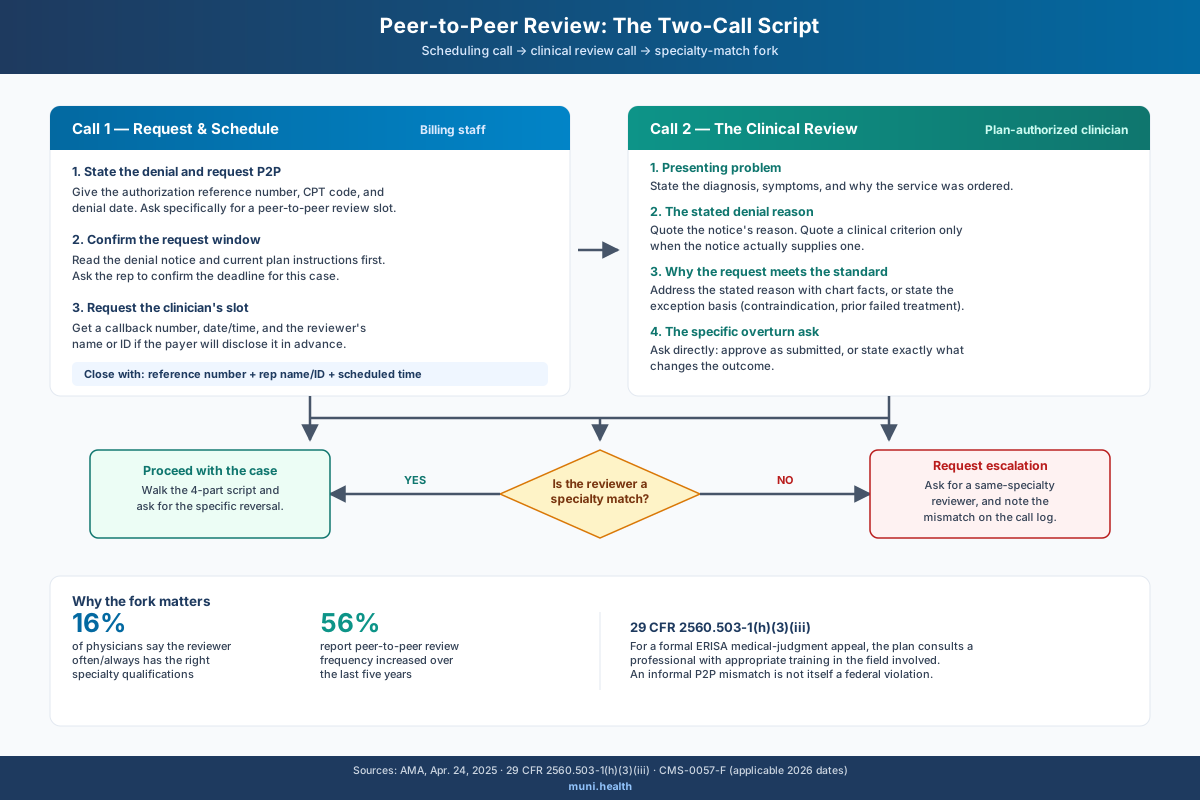
Keeping the calls separate gives staff a checklist for each stage. For the background on what a P2P is, when it's worth requesting, and how to verify current payer instructions, see our peer-to-peer review guide — this post is the phone script for the two calls that guide describes.
Call 1: Requesting and Scheduling the Peer-to-Peer
This administrative call can be made by billing staff, a scheduler, or the clinician's office manager. Its job is to follow the case-specific instructions, request a time slot, and leave with a record of what the payer representative said.
Step 1: State the denial and request the P2P
"Hi, this is [name] calling from [practice name], NPI [number]. I'm
calling to request a peer-to-peer review on a prior authorization
denial. The authorization reference number is [X], for CPT code [X],
denied on [date]. Can you schedule a peer-to-peer review call for the
ordering or treating clinician, [name and credentials]?"
Skip the blank template. Start with a review-ready draft.
Use the template as guidance, or let Muni prepare a payer-specific draft for your team to verify, sign, and submit.
First 3 appeals free, then $20 per appeal. Start with your denial letter or EOB and available records. No meeting or clearinghouse connection required.
Step 2: Confirm the window out loud
Read the denial notice and current plan instructions first, then ask the representative to confirm the deadline that applies to this case.
"What is the exact deadline to request this peer-to-peer for our plan,
and does that clock start from the denial date or the date we received
the letter?"
Common Mistake
Working from a remembered "standard" deadline. P2P procedures and request windows vary by payer, plan, service, urgency, and delegated reviewer. Use the denial notice and current plan instructions, then document the deadline the representative confirms.
Step 3: Request the clinician's slot and get the anchors
"What date and time is [clinician name and credentials] scheduled for, and what number will
the reviewer call? Can I get a reference number for this scheduling
request, and your name, in case we need to reschedule or confirm this
call was made on time?"
Hand the plan-authorized clinician the callback details, authorization reference number, and denial notice. Highlight the payer's stated reason and any clinical criterion actually included; do not infer a missing criterion.
Call 2: The Clinician's Four-Part Clinical Script
The clinical argument belongs to a treating or ordering clinician whom the specific plan authorizes. Depending on the plan and service, that may include a physician, nurse practitioner, or physician assistant. Confirm eligibility while scheduling. Billing staff can prepare the administrative record, but should not present medical necessity on the clinician's behalf. Structure the clinician's side in four parts:
Part 1 — Presenting problem:
"This is [name and credentials], calling about [patient], date of birth [X],
authorization reference [X]. I ordered [service] for [diagnosis]
because [1-sentence clinical summary: symptoms, duration, prior
treatment]."

Part 2 — The stated denial reason or supplied criterion:
"Your denial states [quote the specific reason and, if supplied, the
clinical criterion from the notice]. I want to address that reason
using the record for this request."

Part 3 — Why the request meets the applicable standard:
"[Relevant clinical fact] is documented by [specific chart finding].
[Next relevant fact] is documented by [specific chart finding]. If
the denial reason involves a required first-line step, state why:
'[Drug/treatment] is contraindicated because [reason],' or '[patient]
already tried and failed [treatment] on [date].'"

Part 4 — The specific overturn ask:
"Based on that, I'm asking you to approve this authorization as
submitted. If you can't approve it as submitted, what specific
finding or documentation would change that determination?"
Part 4 is easy to skip. Ending the call without a direct ask can leave the outcome unclear; asking what would change the determination can produce a decision or identify a documentation gap to address in a resubmission or formal appeal.
CMS-0057-F Requires a Specific Reason, Not Necessarily the Exact Criterion
For non-drug prior authorization requests, CMS-0057-F requires impacted payers to provide a specific denial reason: Medicare Advantage organizations and state Medicaid and CHIP fee-for-service programs beginning January 1, 2026; Medicaid and CHIP managed care beginning with rating periods on or after that date; and QHP issuers on Federally-facilitated Exchanges for plan years beginning on or after that date. The reason may identify a failed clinical criterion, but the rule does not guarantee that level of detail. Quote a criterion only when the notice supplies one; otherwise quote the stated reason and ask what standard was applied.
For denials where the fix is a documentation gap rather than a live argument, see the medical necessity justification letter guide for the written version of the same criterion-by-criterion structure.
When the Reviewer Isn't a Specialty Match
Ask who's reviewing the case early in the call — before walking through Part 2 and Part 3 of the clinical script. If the answer reveals a specialty mismatch, that changes what you say next.
"Before we go through the clinical details, can you tell me your
specialty and whether you're board-certified in [relevant specialty]?
I want to make sure I'm presenting this at the right level of detail."
This isn't a formality. Only 16% of physicians say a health plan's peer-to-peer reviewer often or always has the appropriate specialty qualifications, and the reviewer mismatch is a named, specific problem, not a hypothetical: an insurer-employed OB-GYN may be asked to evaluate a neurosurgery prior authorization (AMA, Apr. 24, 2025). The same AMA reporting found that 56% of physicians say peer-to-peer review frequency has increased over the last five years — the volume of these calls is rising while the qualification gap persists.
If the reviewer isn't a match, ask for escalation directly rather than proceeding with a clinical argument to someone who may not be positioned to evaluate it:
"Since you're not board-certified in [specialty], I'd like to request
direct access to a reviewer with the same training and specialty as
mine to discuss this medical necessity question. Can you transfer this
call, or schedule a new peer-to-peer with a [specialty]-matched
reviewer?"
Document the Mismatch on the Call, Not After
If the reviewer confirms they are not specialty-matched and the call proceeds anyway, document the reviewer's stated credentials, your escalation request, and the payer's response. That record can inform the separate formal appeal, but a mismatch during an informal P2P does not by itself establish a federal claims-procedure violation.
Keep the informal P2P and formal internal appeal legally distinct. For a qualifying ERISA formal appeal of a denial based on medical judgment, 29 CFR 2560.503-1(h)(3)(iii) requires consultation with a health care professional with appropriate training and experience in the field of medicine involved who is neither the original reviewer nor that person's subordinate. That rule governs the formal appeal; it does not automatically govern the earlier informal P2P. State law may add separate requirements. Massachusetts, for example, defines a "clinical peer reviewer" using relevant board certification and same-or-similar-specialty practice requirements (Mass. Gen. Laws ch. 176O, §1). Confirm the plan type, state, and governing procedure before making a legal assertion.
Closing Every P2P Call the Same Way
Whether the call ends in approval, denial, or an escalation request, close it the same way so the outcome is usable later:
Stop sitting on hold with insurers.
Muni Calls handles prior authorizations, claim follow-ups, and eligibility checks — your staff gets 15+ hours back every week.
"Before we finish, can I get your name, your specialty or
qualification, and a reference number for this call? I'd like to
confirm the outcome: [one-sentence summary — approved / denial upheld
/ escalated to a specialty-matched reviewer]. When will the written
determination be issued?"| Call | Who Makes It | Primary Goal | Close With |
|---|---|---|---|
| 1. Scheduling | Billing staff | Lock a slot inside the request window | Reference number, scheduled time, callback number |
| 2. Clinical review | Plan-authorized treating/ordering clinician | Address the stated denial reason and make a direct ask | Reviewer name/specialty, outcome, written-determination date |
If the denial is upheld, that closing information — especially the reviewer's stated specialty and the outcome — feeds directly into the written appeal. For how to check on that appeal once it's filed, see our appeal status call script.
How Muni Calls Supports Peer-to-Peer Scheduling and Follow-Up
The clinical review belongs to the plan-authorized treating or ordering clinician — no script or software replaces that conversation. Staff can own the administrative preparation and decide how to act on the payer's response.
Muni Calls can place the administrative call and capture the callback number, payer-stated request deadline, representative name or ID, and reference number for staff review. Practice staff supplies the denial reason or criterion from the notice, reviews the captured information, and owns the scheduling outcome, follow-up, and exception handling. The product does not make the clinical argument or independently interpret the denial notice.
The same reference-number discipline applies upstream, when the authorization is first submitted — see our prior authorization phone call script. For a broader comparison of what a phone-automation product should and shouldn't take on for a practice this size, see our guide to AI phone systems for medical clinics.
Frequently Asked Questions
Who should be on the peer-to-peer review call?
A treating or ordering clinician authorized by the plan should present the clinical case. Depending on the plan and service, an authorized nurse practitioner or physician assistant may participate instead of a physician. Billing staff can schedule the call and prepare the administrative record, but should remain outside the clinical argument.
What's the difference between the scheduling call and the review call?
The scheduling call requests the P2P, confirms the case-specific instructions and deadline, and seeks a time slot with a reference number. The review call is the clinical conversation between the plan-authorized treating or ordering clinician and the payer's reviewer, structured around the stated denial reason and any criterion the notice supplies.
What if the denial notice doesn't state a specific clinical criterion?
Ask for it directly at the start of the review call: "Can you tell me what clinical standard was applied?" CMS-0057-F requires a specific reason for impacted non-drug denials on the applicable 2026 dates, but does not guarantee that the notice will quote the exact failed criterion. The impacted classes are Medicare Advantage, state Medicaid and CHIP fee-for-service, Medicaid and CHIP managed care, and QHP issuers on Federally-facilitated Exchanges.
What happens if the reviewer isn't in my specialty?
Ask about the reviewer's credentials before presenting the full clinical argument. If the reviewer is not a specialty match, request escalation and document the response. Treat the formal appeal separately: for qualifying ERISA medical-judgment appeals, 29 CFR 2560.503-1(h)(3)(iii) governs the professional consulted at that formal stage; a mismatch during the informal P2P is not automatically a violation of that rule.
Can billing staff conduct the clinical review call instead of a clinician?
Billing staff should not present the clinical argument. They can make the scheduling call and prepare the administrative record. The clinical case should come from a treating or ordering clinician authorized by the plan, which may be a physician, nurse practitioner, or physician assistant depending on current plan instructions.
What if the peer-to-peer call doesn't overturn the denial?
Do not treat the informal P2P as the formal written appeal. Follow the denial notice's appeal instructions and deadlines in parallel, and request a written summary of the P2P outcome, including the reviewer's stated rationale and specialty. See our medical necessity justification letter guide for a written-appeal structure.
Does making a peer-to-peer call pause the formal appeal deadline?
Do not assume it does. Follow the denial notice and current plan instructions, document the P2P request date, and track the formal appeal deadline in parallel unless the plan confirms otherwise in writing.
Ready to Stop Losing P2P Slots to Scheduling Gaps?
A missed case-specific request window can close the informal-review opportunity, while an unprepared clinical call can leave the denial reason unanswered. Separating the administrative and clinical scripts gives staff a clearer checklist for both stages.
This guide reflects 2026 peer-to-peer review call procedures, CMS-0057-F requirements on their applicable 2026 payer dates, and 29 CFR 2560.503-1(h)(3)(iii) rules for qualifying formal ERISA medical-judgment appeals. Clinical-participant, specialty-match, and request-window rules vary by payer, plan, service, and state — confirm current instructions for each case. This information is for administrative and billing purposes and is not medical or legal advice.