

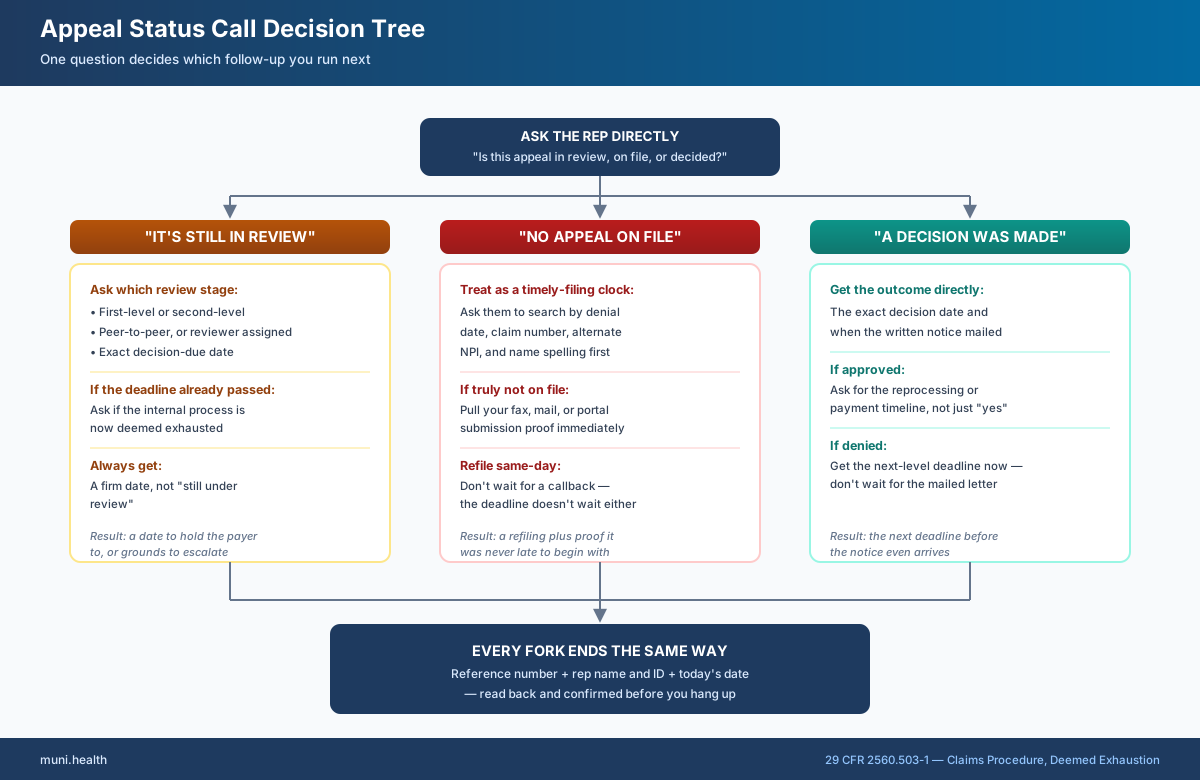
Open by asking the rep for the specific status of your appeal — in review, no appeal on file, or decision rendered — not a general update. If it's in review, get the exact stage, the assigned reviewer level, and a decision date. If there's no appeal on file, treat it as a timely-filing emergency: have your submission proof ready, refile the same day, and get the "no record" statement documented on that call. If a decision was rendered, ask for the outcome, the date it was made, and — if denied — the deadline for the next step, since the mailed notice may not have arrived yet. Every path ends the same way: a reference number, the rep's name and ID, and today's date, read back and confirmed before you hang up.
Why the Appeal-Status Call Has No Electronic Shortcut
A claim status check has a fallback: the standard 276/277 electronic transaction lets a practice query a payer's system directly and skip the phone call most of the time. An appeal status check doesn't have that option. The HIPAA-adopted electronic transaction standards — claims and encounter information, claim status, eligibility, remittance advice, referral certification and authorization, enrollment and disenrollment in a health plan, premium payment, and coordination of benefits — cover claims and referral/authorization workflows, but there is no standard electronic transaction for appeal status. When a filed appeal goes quiet, the phone is the only channel that reaches a specific person who can commit to a specific answer.
That makes the call worth doing right, because there's no faster path to fall back on if it goes badly. And unlike a routine claim-status check, an appeal-status call carries a second job most staff don't think to use it for: building the record that protects the appeal if the payer later claims it arrived late or never arrived at all.
Before You Dial: The Appeal-Status Call Checklist
Have this ready before the call connects:
- The appeal reference or confirmation number — from your submission confirmation, portal receipt, or certified mail tracking, not a guess at the date you sent it
- Original denial notice details — the denial date, the CARC/RARC codes it cited, and which appeal level you're checking on (first-level, second-level, or peer-to-peer)
- Proof of your appeal submission — the fax confirmation sheet, certified mail receipt with tracking number, or portal upload timestamp, pulled and ready before you dial
- The appeal filing deadline you were working against — so you can state, if needed, exactly how many days before the deadline you filed
- A direct callback number — not the shared front-desk line, so a promised follow-up doesn't land in a queue no one is watching
Common Mistake
Calling without the original submission proof in hand. If the rep says "we have no record of an appeal," the call becomes a timely-filing-style argument on the spot — and staff who have to say "let me find that and call you back" lose the one chance to resolve it in a single call before the clock runs further.
The Call Script: Confirm the Level, Then Ask One Precise Question
Step 1: Confirm you've reached appeals, not claims or customer service
Payer phone trees route appeals, claims status, and general member services differently, and appeals themselves often split by level — a first-level appeals line is frequently separate from second-level or peer-to-peer review.
"Hi, this is [name] calling from [practice name], NPI [number]. I'm
calling about the status of an appeal we filed. Am I speaking with the
appeals department, and is this the right line for a [first-level /
second-level / peer-to-peer] appeal?"
Skip the blank template. Start with a review-ready draft.
Use the template as guidance, or let Muni prepare a payer-specific draft for your team to verify, sign, and submit.
First 3 appeals free, then $20 per appeal. Start with your denial letter or EOB and available records. No meeting or clearinghouse connection required.
Step 2: State the appeal, then ask for the status category — not a summary
This is the question that determines everything that follows. Don't accept "it's being looked at" — ask for the specific category.
"I'm checking on an appeal for member [name and ID], regarding a claim
denied on [denial date] for date of service [date]. Our appeal was
submitted on [submission date] by [fax / mail / portal], reference
number [X] if available. Can you tell me the specific status — is
this appeal still in review, is there no appeal on file, or has a
decision already been made?"
That three-way split is deliberate: it forks the call toward the follow-up that actually matters for each answer, the same way a claim-status call forks on pending, denied, or not found — see our claim status call script for that companion decision tree.
The Decision Tree: What to Ask Next, Based on the Rep's Answer
Fork 1: "It's still in review"
In review isn't one status — ask which stage, because the escalation path and the realistic timeline differ.
"Is this appeal assigned to a specific reviewer or medical director yet,
and is it a first-level review, a peer-to-peer, or has it already moved
to a second-level appeal? What is the exact date a decision is due?"
Get the decision-due date, not an estimate, and hold the payer to it. Under 29 CFR 2560.503-1, if a group health plan misses its own appeal decision deadline — typically 30 days for a standard internal appeal, 72 hours for expedited — the claimant is generally deemed to have exhausted the plan's internal appeal process, which lets you proceed straight to external independent review without waiting further. A missed deadline does not approve the appeal — it removes your obligation to keep waiting on the plan. See our insurance appeal deadlines guide for the standard and expedited decision windows by payer.
"Your decision deadline on this appeal was [date], and that date has
passed. Under federal claims procedure rules, do you consider the
internal appeal process exhausted as of that date, or can you confirm
the exact reason for the delay and a new firm decision date?"
Common Mistake
Accepting "still under review" as a complete answer past the decision deadline. A payer that misses its own appeal deadline has created a procedural opening — ask directly whether the internal appeal process is now deemed exhausted under the plan's claims procedure, and document the date you asked.
Fork 2: "There's no appeal on file"
This is the fork your pre-call checklist exists for — and the one that turns a routine status call into a timely-filing-style emergency.
"Before we treat this as not received, can you search by the original
denial date and claim number, and also try [alternate NPI/TIN] and the
member's name with [alternate spelling], in case it was logged under a
mismatched field?"
If the rep confirms there's genuinely no record after that search, don't hang up and refile later — refile the same day, and get the "no record" statement itself documented on this call.
"I have a [fax confirmation / certified mail receipt / portal
timestamp] showing this appeal was submitted on [date], which is
[X] days before the [payer]'s appeal deadline of [date]. Since your
system shows no record, can I get a reference number for this call
specifically confirming that, and your name? I'm refiling today and
will need this call documented if the timeliness of our appeal comes
into question later."
Why the Original Submission Proof Matters Here
If your appeal deadline is close, this call log — paired with your original fax confirmation, certified mail receipt, or portal timestamp — is the evidence a later "appeal not timely filed" dispute rests on. A rep confirming "no record" on a specific date, with a reference number, turns "we never got your appeal" into a documented system-side gap instead of a missed deadline you have to argue your way out of.
Fork 3: "A decision has already been made"
Ask for the outcome directly, and don't assume the mailed notice has reached your office yet — payer decision letters routinely take longer to arrive than the decision itself takes to render.
"Can you tell me the outcome of the appeal decision, the exact date it
was made, and the date the written notice was or will be mailed? If it
was denied, what level is this — first-level, second-level, or has
this exhausted internal appeal rights?"
If approved, confirm what happens next procedurally — a claim reprocessing date, not just the word "approved."
"Since the appeal was approved, will the original claim be automatically
reprocessed, or does our office need to resubmit it? What's the
expected timeline for payment or an updated remittance?"
If denied, get the next-step deadline immediately — don't wait for the mailed notice to state it.
"Since this was denied, what's the exact deadline to file the next
level — a second-level internal appeal or external independent
review — and where does that request need to go?"| What the Rep Said | Ask For | What It Protects |
|---|---|---|
| Still in review | Reviewer level, review stage, and an exact decision-due date | A firm date to hold the payer to, and grounds for deemed exhaustion if missed |
| No appeal on file | A reference number confirming the search and today's date | Proof the gap was on the payer's side if the appeal's timeliness is disputed |
| Decision rendered | The exact outcome, decision date, and next-step deadline | The next filing deadline before the mailed notice even arrives |
Anchor Every Call the Same Way, Regardless of the Fork
Whichever branch the call takes, close it the same way — this is the step that makes the call usable later if the appeal comes back up in a later dispute.
Stop sitting on hold with insurers.
Muni Calls handles prior authorizations, claim follow-ups, and eligibility checks — your staff gets 15+ hours back every week.
"Before we finish, can I get a reference number for this call, your
name and rep ID, and today's date? I'd like to read back what we
covered: [one-sentence summary of status and next step]. Is that
correct?"
Documenting the Call So the Next Follow-Up Doesn't Start From Zero
An appeal status call log that holds up later includes:
- Date, time, and duration of the call, timestamped in the appeal record
- Rep name, rep ID, and reference number — the anchors from the close, written exactly as given
- The specific status category the rep stated — review stage, "no record," or decision outcome — not a paraphrase
- The date the appeal was originally filed and the proof source (fax confirmation, certified mail, portal timestamp), restated on every call about that appeal
- The next deadline or decision date the rep provided, as the basis for your next follow-up
Without the reference number and the exact date, a second call about the same appeal starts from nothing. With it, the next call opens with "I'm following up on reference number X for an appeal filed on [date]" instead of re-explaining the appeal from scratch — and if the payer later disputes when the appeal arrived, the call log is what backs up your submission proof.
How Muni Calls Handles Appeal Status Follow-Up
For an approved appeal-status workflow, Muni Calls can place the outbound call, ask the status-category question first, and route to the right follow-up based on the answer — capturing the reference number, rep ID, and decision date as structured fields for staff review. Payer, plan, state, and exception handling are confirmed during onboarding rather than implied across every payer line. The $499/month plan covers standardized receptionist use; managed appeal-status, claim-status, and prior authorization call operations at higher volume receive a fixed monthly quote based on call volume and workflow complexity.
The same reference-number discipline applies to the calls upstream and downstream of this one — see our claim status call script, prior authorization phone call script, peer-to-peer review call script, and eligibility verification call script. For the deadlines this call is checking against, see our insurance appeal deadlines guide. For a broader comparison of phone automation options, see our guide to AI phone systems for medical clinics.
Frequently Asked Questions
What's the single most important question to ask on an appeal status call?
Ask for the specific status category — in review, no appeal on file, or decision rendered — rather than accepting a vague summary like "it's being looked at." That one question determines which follow-up applies and what you need to get before hanging up.
Why isn't there an electronic way to check appeal status the way there is for claims?
HIPAA's administrative simplification rules adopted nine standard electronic transactions — including claim status (276/277) and eligibility (270/271) — but none of them cover appeal status specifically. That gap is why the phone remains the only reliable channel for checking on a filed appeal, and why documenting each call matters more than it would for a routine claim-status check.
What happens if the payer misses its own appeal decision deadline?
Under 29 CFR 2560.503-1, if a group health plan fails to decide an appeal within its required timeframe — typically 30 days standard, 72 hours expedited — the claimant is generally deemed to have exhausted the plan's internal appeal process, letting you move directly to external independent review. A missed deadline does not mean the appeal was approved; it means you no longer have to wait on the plan before escalating. Ask the rep directly whether they treat the internal process as exhausted as of the missed date, and get their answer on the call log.
What should I do if the rep says there's no record of my appeal?
Ask them to search by the original denial date, claim number, and an alternate NPI, TIN, or name spelling before accepting that answer. If it's confirmed genuinely missing, get a reference number for that specific call, refile the appeal the same day, and keep your original fax confirmation, certified mail receipt, or portal timestamp — that combination is your evidence if the appeal's timeliness is disputed later.
The rep told me a decision was made, but I never received the letter. What do I do?
Ask for the exact decision date, the outcome, and the date the written notice was or will be mailed — mailed notices routinely arrive after the payer has already rendered the decision internally. If the appeal was denied, get the next-step deadline verbally on the call rather than waiting for the letter, since that deadline typically runs from the decision date, not the date you receive the notice.
How is an appeal status call different from a claim status call?
A claim status call checks where a claim sits in adjudication and can often be resolved electronically through the 276/277 transaction. An appeal status call checks where a formal dispute over a denial sits in the payer's appeals process, has no electronic equivalent, and carries a second function claim-status calls don't: building the documented record that an appeal was filed and received on time, in case that timeliness is challenged later.
Should I call about appeal status before or after the standard decision deadline has passed?
Both have a purpose. A call placed a few days before the deadline confirms the appeal reached the right department and is progressing normally. A call placed after the deadline has passed is the one that matters most — it's your opportunity to invoke the deemed-exhaustion protection under 29 CFR 2560.503-1 and escalate rather than simply waiting longer.
Can a phone call by itself extend or reset an appeal deadline?
No — a phone call doesn't reset or pause a filing deadline on its own. What it can do is create documented proof of when you followed up and what the payer confirmed, which supports your position if the appeal's timely filing is later disputed. The call log is evidence for that argument, not a substitute for filing by the deadline.
Ready to Stop Chasing the Same Appeal From Zero Every Time?
An appeal status call that ends with "it's still being reviewed" and no reference number means the next follow-up starts from nothing. The fix is the same fork every time — in review, no appeal on file, or decision rendered — with the follow-up question that matches, and a reference number anchoring the call before anyone hangs up.
This guide reflects 2026 appeal status call procedures, including 29 CFR 2560.503-1 claims procedure requirements and HIPAA administrative simplification transaction standards. Specific appeal status categories, decision timelines, and deemed-exhaustion rules vary by plan type (ERISA, non-ERISA, Medicare Advantage, Medicaid) and state — confirm the applicable rules with the payer on each call. This information is for administrative and billing purposes and is not medical advice.