

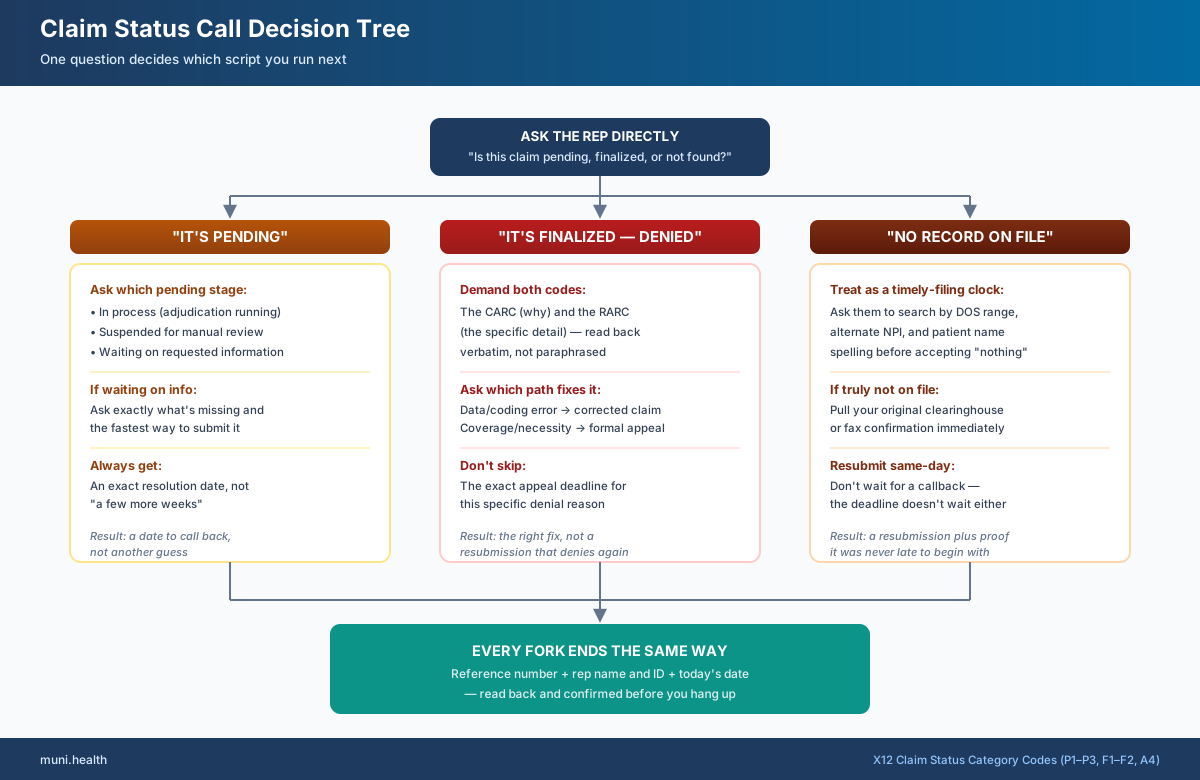
Open by asking the rep for the specific status category — pending, finalized, or rejected — not a vague update. If it's pending, ask what stage it's in and get an exact resolution date. If it's denied, demand both the CARC and RARC code read back verbatim before deciding whether to file a corrected claim or an appeal. If there's no record of the claim, treat it as a timely-filing emergency: pull your original submission confirmation and resubmit the same day. Every path ends the same way — a reference number, the rep's name and ID, and today's date, read back and confirmed before you hang up.
Why the Claim-Status Call Still Happens After Everything Went Electronic
Most claim status checks don't need a phone call anymore. Practices can query a payer electronically through the standard 276/277 transaction and get an answer in minutes. But when that answer is missing, contradictory, or just "still processing" for the third month running, the call is the only way to get a specific person to commit to a specific answer — and that call is expensive. According to the 2024 CAQH Index, a phone claim-status inquiry takes providers and staff an average of 25 minutes — the longest administrative task CAQH measures, ahead of even manual prior authorization. The same inquiry run electronically averages 7 minutes.
That gap means every claim status call your staff makes should be reserved for cases the portal can't resolve, and it should extract everything possible before hanging up. A call that ends with "they said it's still processing" wasted 25 minutes and produced nothing usable. The fix is a script built around one question that forces a specific answer, and a different follow-up depending on what that answer turns out to be.
Before You Dial: The Claim-Status Call Checklist
Have this ready before the call connects, whether or not the portal already gave you a partial answer:
- Claim number, date of service, and billed amount — from the original submission, not a guess from the patient's chart
- Rendering NPI and Tax ID — plus the exact patient name and member ID as submitted
- What the portal already showed — so the call fills a specific gap instead of re-asking a question the portal already answered
- Proof of your original submission — the clearinghouse acceptance report, fax confirmation, or portal upload timestamp, pulled and ready before you dial, not after
- A direct callback number — not the shared front-desk line, so a promised follow-up doesn't land in a queue no one is watching
Common Mistake
Calling without the original submission proof in hand. If the rep says "no record of that claim," the call becomes a timely-filing argument on the spot — and staff who have to say "let me find that and call you back" lose the one chance to resolve it in a single call before the deadline moves closer.
The Call Script: Confirm the Department, Then Ask One Precise Question
Step 1: Confirm you've reached claims, not customer service
Payer phone trees route claims, eligibility, and prior authorization differently, and a mid-call transfer resets any hold time already spent.
"Hi, this is [name] calling from [practice name], NPI [number]. I'm calling
about the status of a specific claim. Am I speaking with the claims
department, or do I need a different queue?"
Skip the blank template. Start with a review-ready draft.
Use the template as guidance, or let Muni prepare a payer-specific draft for your team to verify, sign, and submit.
First 3 appeals free, then $20 per appeal. Start with your denial letter or EOB and available records. No meeting or clearinghouse connection required.
Step 2: State the claim, then ask for the status category — not a summary
This is the question that determines everything that follows. Don't accept "it's being worked on" — ask for the specific category.
"I'm checking on claim number [X], date of service [date], for member
[name and ID]. Can you tell me the specific status — is this claim
pending, finalized as paid or denied, or was it not found in the
adjudication system?"
That three-way split isn't arbitrary — it mirrors the X12 claim status category code set: pending (P1 in process, P2 suspended for payer review, P3 waiting on requested provider information), finalized (F1 paid, F2 denied), and not found (A4, meaning the claim cannot be found in the adjudication system). A rep who answers in those terms is giving you an answer you can act on; a rep who says "it's in process" without specifying which is worth pushing on.
The Decision Tree: What to Ask Next, Based on the Rep's Answer
Fork 1: "It's pending"
Pending isn't one status — ask which stage, because the next step is different for each.
"Is this pending because it's still moving through adjudication, because
it's suspended for manual review, or because you're waiting on
information from us? And what's the exact date it should be resolved
by?"
If the answer is "waiting on information," get the specific document or data point by name before hanging up — "additional documentation" is not specific enough to act on.
"What exactly is missing, and what's the fastest way to get it to you —
fax, portal upload, or does it need to go through the requesting
provider?"
Common Mistake
Accepting "a few more weeks" as a resolution date. Payers' own claims systems track a specific adjudication timeline internally — ask for the date, not the estimate, and write it down as the date you'll call back if nothing has changed.
Fork 2: "It's finalized — denied"
The single biggest mistake on a denial call is accepting the rep's plain-language summary instead of the actual code. Ask for both codes by name.
"Can you give me the exact CARC code and the RARC code on this denial,
read to me directly rather than summarized? I want to write down both
codes exactly as they appear on the remittance."
The CARC (claim adjustment reason code) says why the claim adjusted or denied; the RARC (remittance advice remark code) supplies the specific detail the CARC alone doesn't — which is often the difference between "this needs a corrected claim" and "this needs a formal appeal." A generic CARC without its RARC is close to useless for deciding the next step.
"Based on that code, is the fix here a corrected claim, or does this
need to go through a formal appeal? And what's the exact deadline
for whichever path applies?"| CARC Code | Meaning | Usual Fix |
|---|---|---|
| CO-11 | Diagnosis inconsistent with the procedure | Corrected claim — verify ICD-10/CPT pairing |
| CO-16 | Claim/service lacks information or has a submission error | Corrected claim — see the CO-16 N-code lookup below |
| CO-29 | Time limit for filing has expired | Appeal with proof of timely submission, not a resubmission |
| CO-45 | Charge exceeds the fee schedule or contracted rate | Usually a contractual write-off — verify against the fee schedule before appealing |
| CO-50 | Non-covered because it isn't deemed medically necessary | Formal appeal with medical-necessity documentation |
| CO-97 | Benefit included in the payment for another already-adjudicated service | Appeal with bundling/modifier documentation if unbundling applies |
CARC and RARC code text sourced from X12's official Claim Adjustment Reason Code list. For a full CARC/RARC walkthrough, see our EOB denial code guide; for the CO-16 fork specifically, the fix hinges on the accompanying RARC N-code, which we cover in the CO-16 denial code guide.
Fork 3: "There's no record of that claim"
This is the fork that turns a routine status call into a timely-filing emergency, and it's the one your pre-call checklist exists for.
"Before we treat this as not received, can you search by the date-of-
service range, and also try [alternate NPI/TIN] and the patient's name
with [alternate spelling], in case it was logged under a mismatched
field?"
If the rep confirms there's genuinely no record after that search, don't hang up and resubmit later — resubmit the same day, and get the "no record" statement itself documented.
"I have a clearinghouse confirmation showing this claim was submitted
on [date]. Since your system shows no record, can I get a reference
number for this call specifically confirming that, and your name?
I'm resubmitting today and will need this call documented if timely
filing comes up later."
Why the Original Submission Proof Matters Here
If the claim's timely filing window is close to expiring, this call log — paired with your original clearinghouse acceptance report or fax confirmation — is the evidence a later timely-filing appeal rests on. A rep confirming "no record" on a specific date, with a reference number, turns "we never got it" into a documented system-side gap instead of a missed deadline you have to argue your way out of.
Anchor Every Call the Same Way, Regardless of the Fork
Whichever branch the call takes, close it the same way — this is the step that makes the call usable later if the claim comes back to the same conversation.
Stop sitting on hold with insurers.
Muni Calls handles prior authorizations, claim follow-ups, and eligibility checks — your staff gets 15+ hours back every week.
"Before we finish, can I get a reference number for this call, your
name and rep ID, and today's date? I'd like to read back what we
covered: [one-sentence summary of status and next step]. Is that
correct?"| What the Rep Said | Ask For | What It Protects |
|---|---|---|
| Pending / in process | Exact stage (P1/P2/P3) and a resolution date | A callback date instead of an open-ended wait |
| Finalized — denied | The CARC and RARC code, read verbatim | The right next step — corrected claim vs. appeal — instead of a repeat denial |
| No record on file | A reference number confirming the search and today's date | Proof the gap was on the payer's side if timely filing is disputed |
Documenting the Call So the Next Person Doesn't Start From Zero
A claim status call log that holds up later includes:
- Date, time, and duration of the call, timestamped in the claim record
- Rep name, rep ID, and reference number — the anchors from the close, written exactly as given
- The specific status category the rep stated — pending stage, CARC/RARC pair, or "no record" — not a paraphrase
- The resolution or appeal deadline the rep provided, as your basis for the next follow-up
- What happens next — resubmission sent, appeal filed, or a callback date, and who owns it
Without the reference number and the exact code or date, a second call about the same claim starts the 25-minute clock over from nothing. With it, the next call — by whoever picks it up — opens with "I'm following up on reference number X" instead of re-explaining the claim from scratch.
How Muni Calls Handles Claim Status Follow-Up
For an approved claim-status workflow, Muni Calls can place the outbound call, ask the status-category question first, and route to the right follow-up based on the answer — capturing the reference number, rep ID, and CARC/RARC pair as structured fields for staff review. Payer, plan, state, and exception handling are confirmed during onboarding rather than implied across every payer line. The $499/month plan covers standardized receptionist use; managed claim-status, eligibility, and prior authorization operations at higher volume receive a fixed monthly quote based on call volume and workflow complexity.
The same reference-number discipline applies to the calls upstream and downstream of this one — see our prior authorization phone call script and eligibility verification call script upstream, and our appeal status call script for the call that follows once a denial moves to a formal appeal. For a broader comparison of phone automation options, see our guide to AI phone systems for medical clinics.
Frequently Asked Questions
What's the single most important question to ask on a claim status call?
Ask for the specific status category — pending, finalized (paid or denied), or rejected before adjudication — rather than accepting a vague summary like "it's being worked on." That one question determines which follow-up script applies and what you need to get before hanging up.
What's the difference between a claim that's "in process" and one that's "suspended for review"?
"In process" (claim status category P1) means the claim is actively moving through the payer's standard adjudication system with no flags. "Suspended for review" (P2) means it's been pulled out for manual review, which usually takes longer and may require the payer to request specific information — ask which one applies, since the timeline and next step differ.
Why do I need both the CARC and the RARC code, not just one?
The CARC states the general reason for the denial or adjustment; the RARC supplies the specific detail behind it. A CARC alone — like CO-16, "claim lacks information" — doesn't tell you what information is missing. The paired RARC (an N-code) does, and that's what determines whether the fix is a quick corrected claim or a longer documentation request.
What should I do if the rep says there's no record of my claim?
Ask them to search by the date-of-service range and try an alternate NPI, TIN, or patient-name spelling before accepting that answer. If it's confirmed genuinely missing, get a reference number for that specific call, resubmit the claim the same day, and keep your original clearinghouse or fax confirmation — that combination is your evidence if timely filing becomes a dispute later.
Should I request reprocessing or file a formal appeal on a denied claim?
It depends on the CARC code. Data or coding errors — a diagnosis-procedure mismatch (CO-11) or missing information (CO-16) — are usually fixed with a corrected claim, not an appeal. Coverage or medical-necessity denials (CO-50) and bundling denials (CO-97) generally require a formal appeal with supporting documentation. Ask the rep which path applies to your specific code before choosing.
How much time does a phone claim-status call actually take compared to checking electronically?
According to the 2024 CAQH Index, a phone claim-status inquiry averages 25 minutes of staff time — the longest administrative task CAQH tracks — versus about 7 minutes for the same check run electronically through a standard 276/277 transaction. That gap is why phone calls should be reserved for claims the portal or electronic check can't resolve.
What information should I have ready before calling about a claim's status?
The claim number, date of service, billed amount, rendering NPI, patient name and member ID exactly as submitted, and — critically — your original submission confirmation (clearinghouse acceptance report, fax confirmation, or portal timestamp). That last item is what turns a "no record on file" answer from a dead end into a documented, resolvable gap.
Can a phone call by itself extend a timely filing deadline?
Not on its own — a phone call doesn't reset or pause a timely filing clock. What it can do is create documented proof that you attempted resolution and, if paired with your original submission proof, support a good-cause or administrative-error argument if the claim is later denied for timely filing. The call log is evidence for that argument, not a substitute for meeting the deadline.
Ready to Stop Re-Explaining the Same Claim Every Time You Call?
A claim status call that ends with "it's still processing" and no reference number means the next person who calls starts from zero. The fix is the same fork every time — pending, denied, or missing — with the follow-up question that matches, and a reference number anchoring the call before anyone hangs up.
This guide reflects 2026 claim status call procedures, including the X12 276/277 claim status transaction set and CAQH CORE operating rules. Specific claim status category codes, CARC/RARC pairings, and appeal deadlines vary by payer and plan — confirm the applicable codes and timelines with the payer on each call. This information is for administrative and billing purposes and is not medical advice.