

EOB denial codes use a two-layer system: a group code (CO, PR, OA) that determines who absorbs the loss, and a CARC that explains the specific denial reason. CO-4, CO-22, and CO-29 require corrected claims, COB fixes, or proof of timely filing — not clinical appeals. CO-50 is the code that warrants a clinical appeal. Filing the wrong response wastes appeal cycles and can permanently forfeit your resubmission rights.
Understanding the CARC/RARC System
Every EOB denial has two identifiers — and ignoring either one causes billing teams to file the wrong response. The Claim Adjustment Reason Code (CARC) explains why the claim was adjusted. The Remittance Advice Remark Code (RARC) provides the specific detail that makes the CARC actionable. If you're getting these codes verbally on a claim status call rather than reading them off a remittance, our claim status call script covers how to get both codes read back verbatim before deciding on a corrected claim or an appeal.
Out-of-network providers get one more set of RARCs to watch. For items furnished on or after January 1, 2027, federal guidance requires plans to flag whether an out-of-network item falls under the No Surprises Act and whether its payment amount can go to Federal IDR. The No Surprises Act IDR guide covers those codes and the business-day deadlines they start.
The CARC sits inside one of four group codes that determine financial responsibility:
- CO (Contractual Obligation): The adjustment is per your contract with the payer. You cannot bill the patient for a CO-adjusted amount — it is a write-off or a rework.
- PR (Patient Responsibility): The patient owes the adjusted amount — deductible, copay, or coinsurance.
- OA (Other Adjustment): A catch-all for adjustments that don't fit CO or PR, commonly used in secondary claim adjudication.
- PI (Payer Initiated): Rare; the payer initiated a reduction not tied to your contract or patient responsibility.
The CO-16 Trap
CO-16 ("claim/service lacks information needed for adjudication") is one of the most common codes in billing — and nearly always actionable. But CO-16 alone tells you nothing specific. Always read the accompanying RARC. CO-16 with RARC MA27 means missing patient ID. CO-16 with RARC N290 means missing or invalid ordering/referring provider information. Fix the specific issue the RARC identifies, then resubmit as a corrected claim. See the full CO-16 N-code lookup table for every common RARC and its fix, plus a corrected-claim cover note template.
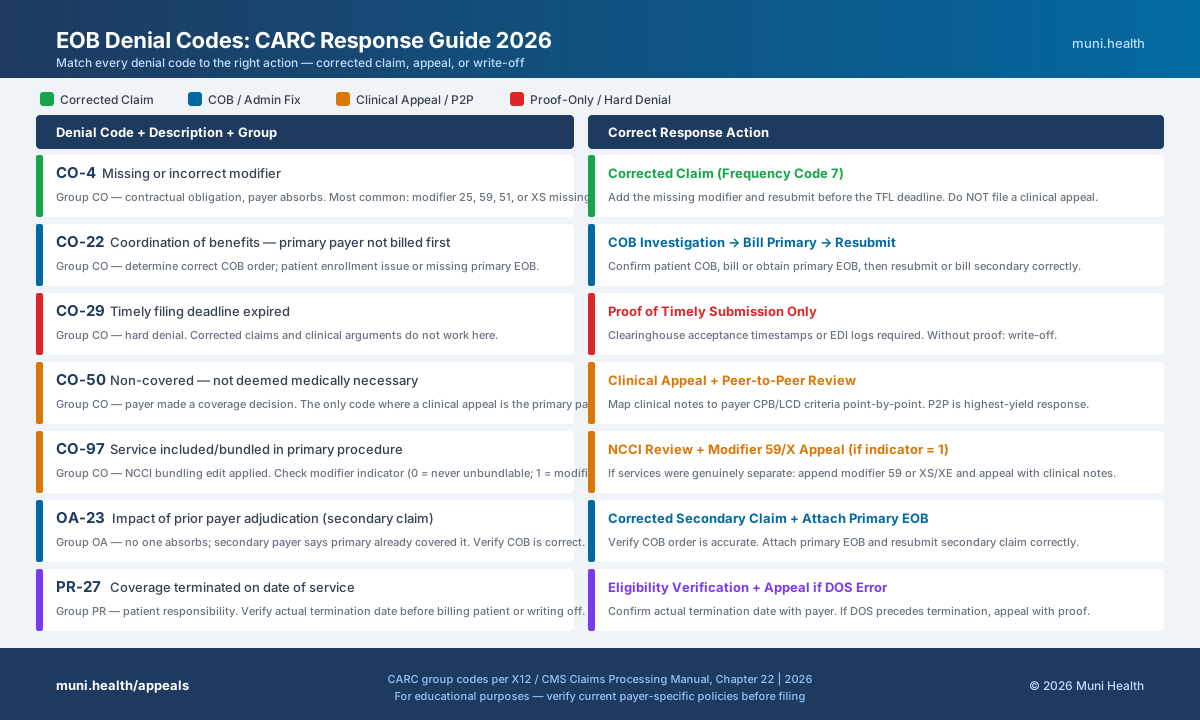
Top Denial Codes by Response Type
The most common CARC codes fall into four response categories. Getting this right before you file is the single most efficient thing a billing team can do to recover denied revenue.
Prepare this appeal packet with your team.
Draft the appeal, coordinate missing documents, and approve the reviewed packet. Keep your clearinghouse; your practice checks deadlines and submits through the payer’s accepted channel.
First 3 appeals free, then $20 per appeal. Start with your denial letter or EOB and available records. No meeting or clearinghouse connection required.
| Code | Group | Description | Correct Response | Common Mistake |
|---|---|---|---|---|
| CO-4 | CO | Procedure code inconsistent with the modifier used (or a required modifier is missing) | Corrected claim (FC 7) | Filing a clinical appeal — won't work |
| CO-16 | CO | Missing information (read the RARC) | Corrected claim with specific fix | Appealing without fixing the data error |
| CO-22 | CO | Coordination of benefits issue | COB investigation + corrected claim | Filing clinical appeal before fixing COB order |
| CO-29 | CO | Timely filing deadline expired | Proof of timely submission only | Filing clinical appeal — won't work |
| CO-50 | CO | Non-covered / not medically necessary | Clinical appeal + P2P review | Resubmitting as corrected claim |
| CO-57 | CO | Prior authorization not obtained | Retro-auth request or formal appeal | Corrected claim submission |
| CO-96 | CO | Non-covered / benefit plan exclusion | Formal appeal if misapplied; patient billing review | Assuming it's always non-recoverable |
| CO-97 | CO | Payment included in another adjudicated service | Verify payer rule; NCCI/modifier review only if applicable | Assuming CO-97 alone proves an NCCI edit |
| OA-23 | OA | Impact of prior payer adjudication | Corrected secondary claim + primary EOB | Filing appeal before verifying COB order |
| PR-27 | PR | Coverage terminated on date of service | Eligibility verification + appeal if DOS error | Billing patient before confirming termination date |
The rule of thumb: if the denial stems from an error on your claim (wrong modifier, missing field, wrong payer sequence), submit a corrected claim. If it stems from a payer decision (medical necessity, coverage exclusion), file a formal appeal. CO-29 is the exception — it's neither; it requires proof, not clinical argument. CO-45 (charge exceeds the fee schedule or contracted amount) sits outside both buckets too: it is usually an expected contractual write-off, and only a payer-side pricing error is worth disputing. The CO-45 denial code guide shows how to check the rate first.
CO-4: Procedure Code Inconsistent With the Modifier
CO-4 is a correctable claim error — not a coverage decision — and should never be sent through the formal appeal process. The official X12 description is "the procedure code is inconsistent with the modifier used." The trigger is a mismatch: a modifier can be present and still fire CO-4 if it doesn't pair correctly with that code. Payers also use it when a code requires a modifier that wasn't billed.
Common CO-4 triggers:
- Modifier 25 missing on an E&M service billed on the same date as a procedure
- Modifier 59 (or XS, XE, XP, XU) missing when two potentially bundled procedures were performed separately
- Modifier 51 missing when multiple procedures are billed in the same session
- Modifier LT/RT missing on bilateral procedures where side matters
- Modifier GP/GO/GN missing on an "always therapy" code — a rehab-specific trigger covered in depth in the physical therapy & rehab claim denials guide, including the CQ/CO pairing rule for assistant-furnished services
Fix the modifier and resubmit as frequency code 7 (replacement claim) before your timely filing deadline for corrected claims. Because the fix is a claim-data correction, CO-4 is one of the more preventable denials: claim-scrubber edits for modifier-to-code pairing catch most of them before submission.
Corrected Claim vs. Appeal
Submitting a formal appeal on a CO-4 denial does not pause your corrected claim window. If the payer's corrected claim deadline passes while your appeal processes, you permanently lose the ability to resubmit — even if the appeal is later denied. See the full guide on corrected claims vs. insurance appeals for deadline specifics by payer.
CO-22: Coordination of Benefits
CO-22 denials mean the payer believes another insurer should have paid first — the COB order on file is wrong, or the primary insurer's EOB wasn't submitted. This is an administrative problem, not a clinical one.
The resolution sequence:
- Verify the patient's actual COB order. Call the patient or check your eligibility system. Most CO-22 denials trace back to a patient who switched jobs, aged off a parent's plan, or added Medicare without updating your records.
- If another payer is primary: Bill the primary payer first. Once you have their EOB, submit to the secondary with the primary EOB attached.
- If the payer's records are wrong: Contact provider relations and request a COB correction. This often requires a letter from the patient or a copy of the other plan's termination notice.
For the specific mechanics of CO-22 and OA-23 secondary claims, see the coordination of benefits denial appeal guide.
CO-29: Timely Filing — The Only Code You Can't Fix Clinically
CO-29 is a hard denial. No amount of clinical justification, medical necessity documentation, or peer-to-peer review will overturn a CO-29 denial. The only successful response is documented proof that the claim was submitted on time.
Acceptable proof includes:
- Clearinghouse acceptance reports with timestamps showing the claim was received before the payer's filing deadline
- EDI acknowledgment files (997/999) confirming transmission
- Payer portal submission confirmation numbers with timestamps
- Certified mail receipts if the claim was submitted by mail
CO-29 Without Proof = Write-Off
If you have no documented proof of timely submission, CO-29 is a permanent write-off. Practices that rely on verbal confirmations or internal logs without timestamps typically cannot recover these denials. The standard commercial payer TFL is 90–180 days from the date of service; Medicare allows 12 months. Track every claim submission date at the clearinghouse level.
Anthem's denial letters for CO-29 frequently cite an incorrect filing clock start date (DOS rather than remittance date in some affiliate markets). If you received a CO-29 denial from an Anthem affiliate and your submission timestamp shows you filed within 90 days of the remittance date, that is an appealable error.
CO-50: Non-Covered / Not Medically Necessary
CO-50 is the one code in this group where a clinical appeal is the correct and primary response. The payer has made a coverage decision — they reviewed the documentation and concluded the service doesn't meet their medical necessity criteria.
A generic appeal letter will not overturn CO-50. Your appeal must:
- Identify the payer's specific policy. Pull the Clinical Policy Bulletin (CPB), Local Coverage Determination (LCD), or National Coverage Determination (NCD) governing the procedure.
- Map the patient's chart to each coverage criterion. Quote the policy by name and section, then cite the specific clinical findings (lab values, imaging results, prior treatment history) that demonstrate the patient meets each criterion.
- Request a peer-to-peer review within the appeal window. P2P allows the treating physician to speak directly with the payer's medical director. According to the AMA's 2025 Prior Authorization Physician Survey, 81.7% of prior authorization denials that were appealed were fully or partially overturned — a rate that underscores why filing is worth the effort even when the initial denial feels final.
Do not resubmit CO-50 as a corrected claim — it accomplishes nothing. The payer will deny it again for the same reason, and your formal appeal window keeps running. For a payer-specific policy lookup table and a full CO-50 appeal letter template, see the CO-50 denial code appeal guide.
A retroactive "not an emergency" denial on an ED claim looks similar to CO-50 but runs on a different legal standard — the payer isn't citing a clinical policy bulletin, it's disputing whether the visit qualified as an emergency at all. See the emergency medicine claim denials guide for the federal prudent layperson standard that governs that fight, plus the separate E/M level downcoding dispute (99284 to 99283) that shows up on ED claims the payer doesn't dispute were legitimate.
CO-97: Service Bundled Into the Primary Procedure
CO-97 means the payer included the benefit for one service in payment for another service or procedure already adjudicated. The code alone does not prove that the payer applied a National Correct Coding Initiative (NCCI) edit. Read the RARC and remittance detail, then confirm the payer's bundling rule and version for the date of service.
If the payer confirms that an NCCI Procedure-to-Procedure edit applies, NCCI organizes code pairs into Column 1 (comprehensive) and Column 2 (component). Each pair has a modifier indicator:
- Indicator 0: An NCCI-associated modifier cannot bypass the edit when it applies. Correct coding if needed, but use the payer's correction, reprocessing, or appeal path if the edit or claim context was misapplied.
- Indicator 1: The procedures can be separated with the correct modifier if they were genuinely distinct services.
When the modifier indicator is 1 and the services were clinically separate:
- Append modifier 59 (distinct procedural service) or the appropriate X modifier (XE for separate encounter, XS for separate structure, XP for separate practitioner, XU for unusual non-overlapping service)
- Submit a corrected claim with a brief clinical note explaining why the services were distinct
- If the payer denies again, file a formal appeal with the NCCI Policy Manual reference supporting separate payment
Confirm that the payer used NCCI, then check the CMS file covering the date of service and verify the payer's applicable version before filing. Using modifier 59 to bypass a correctly applied indicator-0 edit is a compliance risk that draws OIG scrutiny, but CCMI 0 does not eliminate correction, reprocessing, or appeal when the payer applied the wrong edit or context. For the full payer-rule and modifier-indicator decision tree, the correct X-EPSU-versus-59 choice, and a corrected-claim and appeal template, see the CO-97 denial code appeal guide.
CO-97 also shows up when an E/M service gets bundled into a same-day procedure instead of two procedures colliding. Verify the payer rule; when modifier 25 applies, the issue is chart-note support for a significant, separately identifiable E/M service rather than a modifier-59 override. See modifier 25 denials and appeals for that documentation standard. Urology practices also see diagnostic cystoscopy bundled with therapeutic cystoscopic procedures; the urology claim denials guide explains why the named 52000 pairs currently carry modifier indicator 0 and require corrected coding, not an X-modifier override.
OA-23: Impact of Prior Payer Adjudication
OA-23 appears on secondary claim remittances when the secondary payer determines that the primary payer's payment fully covers the allowed amount, leaving nothing additional owed. It is a COB calculation outcome, not a coverage denial.
Most OA-23 denials resolve by verifying the COB is in the correct order and resubmitting with the primary EOB clearly attached. The secondary payer needs the primary's allowed amount, paid amount, and patient responsibility breakdown to calculate their obligation accurately.
Appeal OA-23 only when you can demonstrate the secondary payer's crossover calculation is incorrect — for example, when the secondary plan has a coordination formula (non-duplication vs. maintenance of benefits) that produces a higher secondary payment than the payer calculated. This requires pulling the patient's secondary plan documents (Summary Plan Description) and doing the math yourself.
PR-27: Coverage Terminated on Date of Service
PR-27 means the patient's insurance was not active on the date of service — or the payer believes it wasn't. The group code PR signals patient responsibility, but you should verify the denial before billing the patient or writing it off.
Prepare this appeal packet with your team.
Draft the appeal, coordinate missing documents, and approve the reviewed packet. Keep your clearinghouse; your practice checks deadlines and submits through the payer’s accepted channel.
First 3 appeals free, then $20 per appeal. Start with your denial letter or EOB and available records. No meeting or clearinghouse connection required.
Step 1: Confirm the actual termination date. Call the payer's eligibility line and request the exact coverage end date. Payer records are sometimes wrong — retroactive terminations, employer reporting delays, and group billing errors all create erroneous PR-27 denials.
Step 2: If the date of service falls before the confirmed termination date, you have a viable appeal. Submit with proof of coverage on the DOS: the eligibility verification you ran on or before the date of service (confirmation number and timestamp from your eligibility system), or a copy of the patient's insurance card showing coverage period.
Step 3: If coverage was genuinely terminated, review the patient's financial liability under their plan documents before billing. Some states restrict retroactive termination without advance notice to providers.
How Muni Appeals Handles Denial Code Response
When staff upload a denial notice or relevant remittance evidence, Muni Appeals surfaces the denial code and likely response path for review. Staff decides whether the case requires a corrected claim, COB investigation, or clinical appeal and completes that workflow directly.
For CO-50 denials, Muni compiles the payer's applicable CPB criteria, maps the patient's documentation to those criteria, and drafts the appeal with the policy references already cited. For CO-97 denials, Muni helps staff turn the denial materials and supporting records into a review-ready draft; staff verifies the payer's applicable bundling rule and date-of-service NCCI context when relevant before choosing a correction, reprocessing, or appeal path. For CO-29 denials, Muni surfaces the clearinghouse submission timestamps needed for proof-based appeals before the window closes.
Some specialties see denial codes tied to their own utilization-management rules rather than a general coverage dispute — interventional pain management, for example, generates a disproportionate share of CO-119 (benefit maximum reached) denials tied to Medicare LCD and UM-vendor session caps; see the pain management claim denials guide for the frequency-limit specifics. Ophthalmology has a contractor-specific modifier rejection: for J6/JK claims within current Wellpoint Federal (formerly National Government Services/NGS) articles A52451 or A52370, a CPT 67028 claim without RT, LT, or 50 is returned unprocessed rather than denied. Other Medicare and commercial claims must follow the governing MAC or payer rule. See the ophthalmology claim denials guide for the product scopes and second-eye global-period coding.
Frequently Asked Questions
What is the difference between a CARC and a RARC?
A CARC (Claim Adjustment Reason Code) explains why a payment was adjusted — it is the "what." A RARC (Remittance Advice Remark Code) provides the specific detail that makes the CARC actionable — it is the "why" or "where." CO-16 without a RARC tells you something is missing; CO-16 with RARC N290 tells you the ordering provider NPI is the problem. Always read both.
Can I appeal a CO-29 denial without proof of timely filing?
No. CO-29 is a hard denial that can only be overturned with documented proof that the original claim was submitted within the payer's timely filing window. Clinical documentation, medical necessity letters, and verbal explanations are not accepted. Without a clearinghouse acceptance report or EDI timestamp, CO-29 is a write-off.
What is the difference between CO-50 and CO-96?
CO-50 is a medical necessity denial — the payer agrees the service exists in their covered benefits but says it wasn't clinically justified for this patient. CO-96 is a benefit plan exclusion — the service is simply not a covered benefit under the patient's plan. CO-50 warrants a clinical appeal with patient-specific documentation. CO-96 is only appealable if the exclusion was misapplied; otherwise, it is a coverage determination with limited recourse.
When should I use modifier 59 on a CO-97 denial?
Only after confirming that the payer applied an NCCI edit, that the date-of-service code pair has modifier indicator 1 under the applicable rule, and that the services were genuinely distinct — performed at a separate anatomical site, in a separate encounter, or by a separate practitioner. Using modifier 59 to bypass a correctly applied indicator-0 edit is incorrect billing and a compliance risk. When in doubt, review the payer rule and the NCCI Policy Manual section governing the specific code pair. See the CO-97 denial code appeal guide for the full verification and indicator-0-vs-1 decision tree and which X-EPSU modifier to use instead of 59.
What happens if I file an appeal on a denial that should have been a corrected claim?
The appeal will likely be denied for the wrong reason, and your corrected claim window keeps running. If the payer's deadline for corrected claims passes while your appeal is processing, you permanently lose the ability to resubmit the corrected version — even if the appeal is denied and you now understand the fix. See the corrected claim vs. insurance appeal guide for payer-specific corrected claim deadlines.
What does the CO group code mean for patient billing?
CO (Contractual Obligation) adjustments cannot be billed to the patient for in-network services. Your participation agreement with the payer prohibits it. If the denial reason is CO-coded, the write-off is yours — unless the denial is for a service the patient was informed in advance would not be covered (Advanced Beneficiary Notice for Medicare; similar notice for commercial plans).
How do I find the right clinical policy for a CO-50 appeal?
Search the payer's provider portal for "clinical policy bulletin" or "coverage determination" along with the CPT code you billed. Aetna and Cigna publish CPBs with numbered identifiers (e.g., Aetna CPB #0552). UHC uses Coverage Determination Guidelines (CDGs). BCBS affiliates use Medical Policies published on their provider websites. Always reference the policy by name, number, and effective date in your appeal letter. See the CO-50 denial code appeal guide for the full payer-by-payer policy name table and a criterion-by-criterion appeal letter template.
Is CO-22 always a payer error?
No. CO-22 frequently reflects a real COB issue — the patient has multiple insurance plans and the payer's records show you billed in the wrong order. The first step is always verifying the correct COB order with the patient before assuming it is a payer error. If your records show the patient only has one plan, then it is a payer records issue worth escalating to provider relations.
Ready to Stop Filing the Wrong Response to Denials?
The most expensive billing mistake isn't the denial itself — it's routing it to the wrong workflow. CO-4 going through the clinical appeal queue. CO-29 getting a medical necessity letter. CO-50 getting resubmitted as a corrected claim. Each mismatch costs time, resets timelines, and forfeits recovery opportunities.
Get started:
- Automated denial code routing to the correct response workflow
- Clinical appeal drafting with payer-specific CPB criteria mapped to patient documentation
- Clearinghouse timestamp retrieval for CO-29 proof-based submissions
- COB investigation workflow for CO-22 and OA-23 denials
This guide reflects 2026 CARC/RARC code definitions and payer policy standards. Specific payer requirements, appeal deadlines, and corrected claim windows vary by plan and state. Verify current payer-specific policies before filing. This guide does not constitute legal or billing compliance advice.