

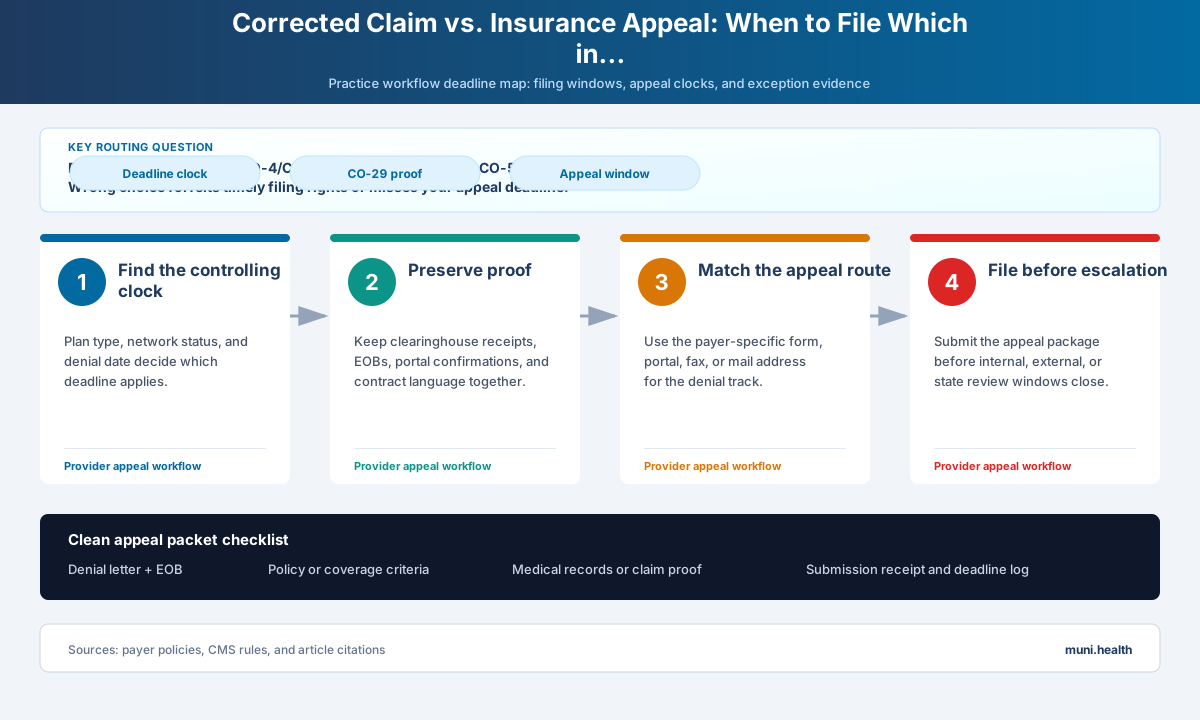
File a corrected claim (frequency code 7) when the denial is caused by a data or coding error — wrong modifier (CO-4), missing information (CO-16), or incorrect diagnosis. File a formal appeal when the denial is a coverage or medical necessity decision (CO-50, CO-197, CO-96). Choosing the wrong path can forfeit timely filing rights or miss your appeal deadline permanently.
Why This Decision Matters More Than Most Billing Teams Realize
The corrected claim vs. appeal decision is one of the most consequential choices in medical billing — and it gets made wrong constantly. Small practices lose recoverable revenue not because the denial was unfair, but because they chose the wrong response path.
Filing a formal appeal on a claim that just needed a modifier fix delays payment by weeks and doesn't stop the corrected claim window from closing. If the payer's corrected claim deadline passes while your appeal is pending, you may permanently lose the ability to resubmit — even if the appeal is denied and you now know the correct fix.
The reverse error is less common but equally damaging: submitting a corrected claim on a medical necessity denial accomplishes nothing. The payer denies it again for the same reason, and your formal appeal window keeps running.
The Timely Filing Trap
A corrected claim must be submitted within the payer's corrected claim window — typically 90 to 180 days from the original remittance date. Filing an appeal on a correctable claim does not pause that clock. If your appeal is still processing when the corrected claim deadline expires, you have permanently forfeited the right to resubmit.
Decision Matrix by Denial Code
The denial reason code (CARC) on your remittance advice is the fastest way to determine the right path. The shared rule: if the denial resulted from an error on your claim, resubmit it corrected. If the denial reflects a payer decision, appeal it.
Prepare this appeal packet with your team.
Draft the appeal, coordinate missing documents, and approve the reviewed packet. Keep your clearinghouse; your practice checks deadlines and submits through the payer’s accepted channel.
First 3 appeals free, then $20 per appeal. Start with your denial letter or EOB and available records. No meeting or clearinghouse connection required.
| Denial Code | Description | Correct Response | Notes |
|---|---|---|---|
| CO-4 | Modifier required or invalid modifier combination | Corrected claim — add correct modifier, resubmit as frequency code 7 | Most common: missing modifier 25, 59, 51, or X-modifiers. Fix the modifier and resubmit. Do not appeal. |
| CO-11 | Diagnosis code inconsistent with procedure | Corrected claim — correct the ICD-10 code, resubmit as frequency code 7 | Data error. Verify the correct diagnosis, update, and resubmit. |
| CO-16 | Claim/service lacks information needed for adjudication | Corrected claim — add the missing data, resubmit as frequency code 7 | Always read the accompanying RARC — it identifies the specific missing element (auth number, referral, taxonomy code, member ID). |
| CO-18 | Duplicate claim/service | Investigate — void true duplicate (frequency code 8); appeal if not a duplicate | If submitted twice in error, void one with code 8. If billed separately for distinct services, appeal with documentation. |
| CO-29 | Timely filing deadline exceeded | Appeal ONLY with documented proof of timely original submission | Hard denial. Requires clearinghouse timestamps, EDI rejection logs, or certified mail receipts as proof. Without proof, typically a permanent write-off. |
| CO-49 | Non-covered service — routine/preventive exam, or a diagnostic/screening procedure billed in conjunction with a routine/preventive exam | Check coding first — if the service was genuinely diagnostic, a corrected claim with the correct diagnosis pointer or modifier 25/59 may resolve it; formal appeal if the payer still won't separate it | Not an experimental-treatment code. Confirm the visit wasn't actually bundled with a preventive exam before appealing — that's a coding fix, not a coverage argument. |
| CO-50 | Non-covered service — not medically necessary | Formal appeal with medical records and clinical justification | Medical necessity decision. Requires clinical notes, physician letter, and relevant policy citation (CPB, LCD, NCD). Do not resubmit. |
| CO-197 | Precertification/authorization/notification/pre-treatment absent | Formal appeal or retroactive authorization request (payer-dependent) | Coverage/administrative decision. Some payers allow retro-auth — check before filing the appeal. (Formerly confused with CO-57, which X12 deactivated in 2007 and is not the current code for this denial.) |
| CO-96 | Non-covered charge — excluded from benefit plan | Formal appeal if exclusion was applied incorrectly; otherwise review patient liability | Appeal only if the exclusion was misapplied. Otherwise, evaluate patient responsibility per the EOC/SPD. |
| CO-97 | Payment adjusted — service included in allowance for another service | Corrected claim with modifier OR formal appeal — depends on NCCI edit | The gray zone. See section below. |
Always read the Remittance Advice Remark Code (RARC) alongside the CARC. The RARC is the specific message that makes CO-16 actionable — CO-16 alone says "something is wrong." CO-16 with RARC MA27 tells you the patient ID is the issue. See the CO-16 denial code guide for a full RARC-to-fix lookup table and a corrected-claim cover note template.
When Corrected Claims Are the Right Move
Corrected claims are appropriate when the denial traces back to an error you introduced — billing the wrong modifier, sending the wrong diagnosis, or omitting a required field. Fix the error, resubmit, and the payer will process it normally.
Common corrected claim scenarios:
- Wrong modifier (CO-4): Orthopedic procedures billed without modifier 59 when a bundled CPT was also submitted. Append the modifier and resubmit as frequency code 7.
- Incorrect diagnosis (CO-11): The procedure code doesn't support the diagnosis submitted. Identify the correct ICD-10 and resubmit.
- Missing authorization number (CO-16 + RARC): Prior auth exists but wasn't populated in Box 23 on the original CMS-1500. Add the auth number and resubmit.
- Billing taxonomy error (CO-16): Wrong taxonomy code caused the claim to route incorrectly. Correct and resubmit.
- True duplicate submission (CO-18): Same claim submitted twice by billing software. Void one instance with frequency code 8.
- COB billing order error (CO-22): Claim filed with the wrong insurer as primary. Bill the correct primary payer first; once the primary EOB is returned, submit the secondary claim with the EOB attached as a new secondary claim — not a corrected claim on the original. For priority rule disputes or ping-pong denials where both payers deny, see the coordination of benefits denial appeal guide.
CMS 837 Claim Frequency Codes
On electronic 837 claims, use the claim frequency code in Loop 2300, CLM05-3:
- Code 1 — Original claim (first submission)
- Code 7 — Replacement/corrected claim. Requires the original claim's ICN in Loop 2300 REF02 with qualifier F8.
- Code 8 — Void. Cancels a claim submitted in error.
On paper CMS-1500 forms, enter the resubmission code in Box 22 with the original reference number.
When Formal Appeals Are the Right Move
File a formal appeal when the denial is a decision, not an error. The payer reviewed the claim and determined that coverage, medical necessity, or authorization criteria were not met. No amount of resubmitting will change that outcome — only a formal appeal with supporting clinical or administrative documentation can reverse it.
Common formal appeal scenarios:
- Medical necessity denial (CO-50): Counter with the patient's clinical notes, physician statement of necessity, and citations to relevant clinical policy bulletins (CPBs), Local Coverage Determinations (LCDs), or National Coverage Determinations (NCDs).
- Prior auth denied after service (CO-197): Determine whether the payer accepts retroactive authorization requests. If not, appeal on the grounds that the service met medical necessity criteria and the authorization was unreasonably withheld.
- Plan exclusion disputes (CO-96): If you believe the exclusion was misapplied — wrong benefit interpretation, in-network vs. out-of-network confusion — appeal with the EOC or Summary Plan Description language you're contesting.
For payer-specific appeal processes and deadlines, see the insurance appeal deadlines guide and how to fight AI insurance denials. Note that "formal appeal" itself isn't a single step on every payer — some require an informal reconsideration first, which runs on a separate deadline; see Reconsideration vs. Appeal: What's the Difference.
CO-97: The Bundling Gray Zone
CO-97 sits on the boundary between a correctable coding issue and a coverage decision, which is why it generates so much confusion.
CO-97 means the payer is treating one of your billed services as already included in the payment for another — a bundling edit. Your response depends on whether the two services were genuinely distinct and separately billable.
Corrected claim path: If the procedures were performed independently and a modifier would properly break the bundling edit, append modifier 59 or the appropriate X-modifier (XE for separate encounter, XP for separate practitioner, XS for separate structure, XU for unusual non-overlapping service) and resubmit as frequency code 7. Documentation must support that the services were truly separate.
Formal appeal path: If no modifier applies but you believe the bundling edit was applied incorrectly — or your payer's policy supersedes the NCCI edit — file a formal appeal with documentation explaining why the procedures are distinct and independently reimbursable.
Check the NCCI Edit Table First
The CMS National Correct Coding Initiative (NCCI) Procedure-to-Procedure edit table defines which code pairs require a modifier to bill separately, and which cannot be unbundled at all. Look up the code pair before responding to CO-97. If the modifier indicator is 1, the corrected claim path is available. If the modifier indicator is 0, only a formal appeal can resolve it.
That's the procedure-to-procedure version of CO-97. A separate, common variant bundles an E/M service into a same-day procedure instead — that's a modifier 25 issue, and it turns on chart-note documentation rather than an unbundling modifier. See modifier 25 denials and appeals for that specific decision path.
Payer-Specific Corrected Claim Windows
Even when the corrected claim path is clearly right, the window may be closing. Most commercial payers set a corrected claim deadline measured from the original remittance date — not the original date of service.
| Payer | Corrected Claim Window | Clock Starts | Notes |
|---|---|---|---|
| UnitedHealthcare (commercial) | ~180 days from original EOP | Original remittance advice date | Submit through UHCProvider.com portal. UHC has eliminated paper and fax reconsideration intake for most commercial plan types. Include original ICN. |
| Aetna (commercial) | ~180 days from original EOB | Original EOB/ERA date | Non-par and Medicare Advantage plans may allow up to 365 days from DOS. Submit through Availity or the Aetna provider portal. Original claim number required. |
| BCBS (by affiliate) | 90–180 days depending on affiliate | Denial date or remittance date (varies) | BCBS has 36 independent affiliates — no single national standard. Anthem affiliates typically 90 days; others allow 180 days. Verify with your specific affiliate's provider manual. |
| Cigna (commercial) | ~180 days from original processing date | Original claim processing date | Submit through eviCore for delegated specialty services. Include ICN from original remittance. EviCore and Cigna use separate systems. |
| Humana (commercial) | ~180 days from original EOB | Original EOB date | Submit through Availity Claims Center. Medicare Advantage corrected claim windows follow CMS guidelines — verify separately from commercial. |
These windows are published-standard guidelines. Your signed provider agreement may specify a shorter window than the manual default. Pull your PAR contract before assuming the standard window applies to your account.
For plan-specific timely filing detail: Aetna timely filing limits · BCBS timely filing limits · UHC timely filing deadlines
Federal and quasi-federal programs draw the same corrected-claim-vs-appeal line differently again. VA Community Care Network, for example, treats a claim reconsideration as a distinct process from a corrected claim, routes each to a different address, and splits disputes across three separate tracks depending on whether a claim, a referral, or a veteran's own reimbursement is at issue — see the VA Community Care appeal guide.
How Muni Appeals Helps
The corrected claim vs. appeal decision has downstream consequences — wrong path means delayed payment, forfeited rights, or a second identical denial. Muni Appeals surfaces a likely response path, deadline risk, and documentation checklist from the uploaded denial. Staff verifies the path, calendars both windows, and compiles the final submission.
Prepare this appeal packet with your team.
Draft the appeal, coordinate missing documents, and approve the reviewed packet. Keep your clearinghouse; your practice checks deadlines and submits through the payer’s accepted channel.
First 3 appeals free, then $20 per appeal. Start with your denial letter or EOB and available records. No meeting or clearinghouse connection required.
Frequently Asked Questions
What is the difference between a corrected claim and an insurance appeal?
A corrected claim (also called a resubmission) is a new claim submission that fixes a data or coding error on the original. An insurance appeal is a formal challenge to the payer's coverage or medical necessity decision. They follow different processes, require different documentation, and run on separate deadline clocks. Confusing the two is one of the most common causes of permanent revenue loss in medical billing.
Which denial codes require a corrected claim instead of an appeal?
CO-4 (modifier issue), CO-11 (diagnosis code mismatch), and CO-16 (missing or invalid information) are the most common corrected claim scenarios. The shared characteristic: the error is in your claim data, not the payer's policy. Fix the error and resubmit using claim frequency code 7 with the original claim number. For a complete breakdown of every major CARC code — including CO-22, CO-29, CO-50, CO-97, OA-23, and PR-27 — with the correct response action for each, see the EOB denial code guide.
Can I file a corrected claim to avoid the appeal deadline?
No — and this is a costly mistake. Filing a corrected claim on a medical necessity or coverage denial (CO-50, CO-197) accomplishes nothing because the payer will deny it again for the same reason. The formal appeal window continues running while you wait for that second identical denial, and you will have lost time you needed for the appeal.
What happens if I file an appeal on a claim that needed a corrected claim?
The payer will typically deny the appeal as non-actionable and direct you to resubmit with corrected information. If the corrected claim window closes during that process, you may have permanently lost the ability to bill the claim — the so-called timely filing trap. Always match the response type to the denial reason code before acting.
What are CMS 837 claim frequency codes and when do I use them?
Claim frequency codes indicate the type of submission on electronic 837 transactions. Code 1 is an original claim. Code 7 is a replacement or corrected claim — use this when fixing errors on a previously processed claim, and always include the original ICN in Loop 2300 REF02 with qualifier F8. Code 8 voids a claim submitted in error. On paper CMS-1500 forms, these codes go in Box 22 along with the original claim reference number.
How do I handle a CO-97 bundling denial?
First, look up the code pair in the CMS NCCI Procedure-to-Procedure edit table. If the modifier indicator is 1 (modifier allowed), append modifier 59 or the appropriate X-modifier and resubmit as a corrected claim. If the modifier indicator is 0 (modifier not allowed), only a formal appeal with documentation supporting distinct and separately billable services can resolve the denial. Do not append a modifier when the NCCI edit prohibits it — the claim will be denied again and you may be flagged for incorrect billing.
Can I appeal a CO-29 timely filing denial?
Yes, but only with documented proof that the original claim was submitted within the filing window. Acceptable documentation includes EDI clearinghouse date-stamped acknowledgment reports, Availity submission confirmation numbers, or certified mail receipts. Without proof, CO-29 denials are typically final. Maintain your clearinghouse rejection logs — they are your evidence if a timely original submission was rejected for a data error before you could correct and resubmit.
What is Aetna's corrected claim resubmission window?
Aetna's published standard for commercial plans is approximately 180 days from the date of the original EOB or ERA. Non-participating provider accounts and Medicare Advantage plans may allow up to 365 days from the date of service. Your specific provider agreement may specify a shorter window. Verify with the Aetna provider portal or your PAR contract. See the Aetna timely filing limits guide for additional plan-type detail.
Ready to Stop Losing Claims to the Wrong Response Path?
Whether a denial needs a corrected claim or a formal appeal, the response has to be timely, documented, and matched to the right deadline clock. Muni Appeals organizes the denial code, likely response path, and evidence checklist; billing staff verifies the decision and maintains the submission trail.
Get Started with Muni Appeals:
- Denial code identification and corrected claim vs. appeal routing
- Parallel deadline-risk guidance for corrected-claim and formal-appeal windows, verified by staff
- Documentation compilation for medical necessity and coverage appeals
- CO-29 timely filing evidence preservation and appeal support
This guide reflects 2026 medical billing procedures based on CMS NCCI edit standards, CARC/RARC code definitions from the X12 CARC list, and published payer provider manual guidelines. Corrected claim windows and appeal policies vary by plan type, state, and individual provider agreements. Always verify with your provider manual and PAR contract before acting on a denial.