

Gather the member ID, CPT/ICD-10 codes, ordering NPI, and a one-paragraph clinical summary before dialing. On the call, confirm you've reached the prior authorization department, state the codes and clinical summary clearly, then ask for three things before hanging up: a reference number, the rep's name and ID, and the exact date a decision is due. Log all three in the patient record — that log is what wins a timely-filing or appeal dispute later.
Why the Phone Call Still Decides Whether You Get Paid
A prior authorization approval given verbally over the phone is worth exactly as much as your documentation of it. If a payer later has no record of the call, or your notes say only "approved 6/12," the claim gets denied as "no authorization on file" — even though someone at the payer said yes. The fix isn't a better memory. It's a script that forces the call to produce evidence.
Prior authorization already consumes enormous staff time. Physicians and their staff complete an average of 39 prior authorization requests per physician, per week, and spend roughly 13 hours a week on them, according to the AMA's 2024 Prior Authorization Physician Survey (n=1,000 physicians). A meaningful share of that time is phone time — hold queues, IVR menus, and reps who read from a script of their own. The only leverage your staff has on that call is what they ask for before hanging up.
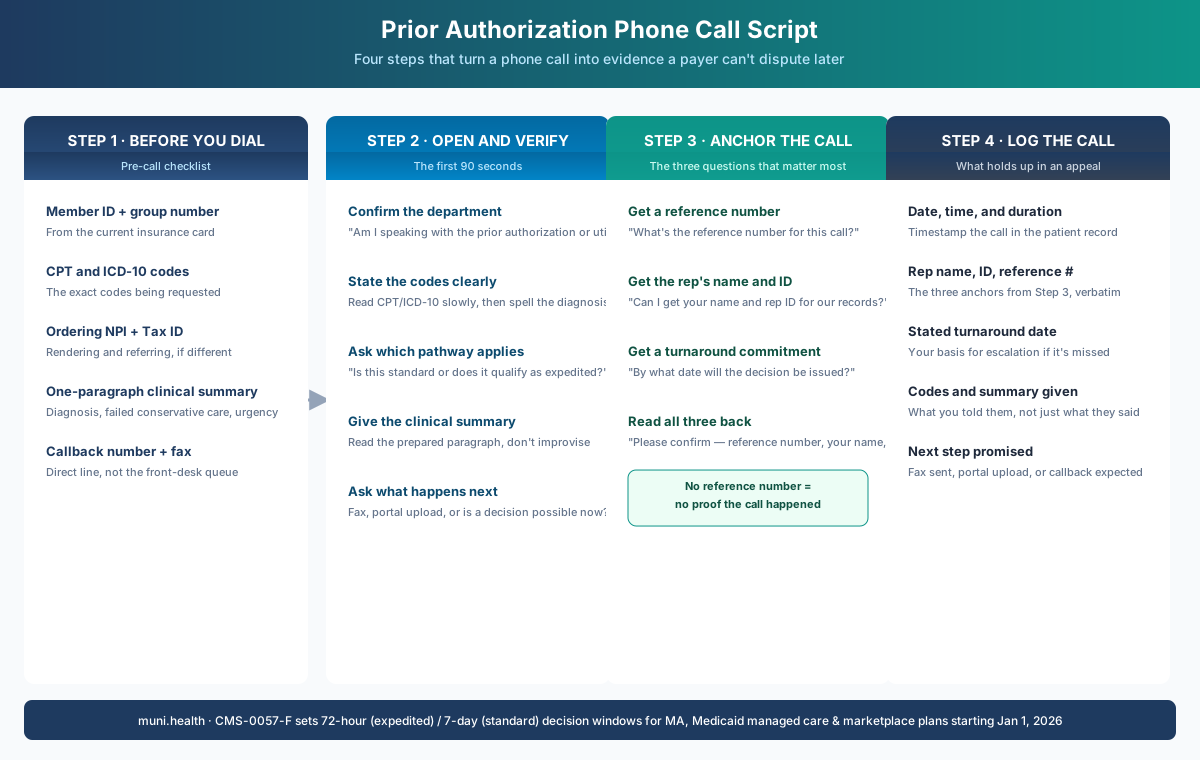
Before You Dial: The Prior Authorization Call Checklist
Every prior authorization call goes faster and produces better documentation when the caller has this ready before the phone rings:
- Member ID and group number — from the current insurance card, not a prior visit's chart note
- CPT and ICD-10 codes — the exact codes for the requested service, not just the diagnosis name
- Ordering NPI and Tax ID — plus the rendering provider's NPI if it's a different person
- A one-paragraph clinical summary — diagnosis, relevant history, why the service is medically necessary, and any conservative treatment already tried
- A direct callback number and fax — not the front-desk main line, so the payer's follow-up doesn't get lost in a shared queue
Common Mistake
Calling before the clinical summary is written costs more time than writing it costs. Reps regularly transfer calls to a nurse reviewer who asks the same clinical questions a second time — if the caller has to say "let me check with the doctor and call back," the request restarts the queue.
The Call Script: What to Say, Step by Step
Step 1: Confirm you've reached the right department
Insurance phone trees route prior authorization, claims, and member services differently depending on the payer, and getting transferred mid-call resets any hold time already spent. Open with:
"Hi, this is [name] calling from [practice name], NPI [number]. I'm calling to
submit a prior authorization request. Am I speaking with the prior
authorization or utilization management department?"
Skip the blank template. Start with a review-ready draft.
Use the template as guidance, or let Muni prepare a payer-specific draft for your team to verify, sign, and submit.
First 3 appeals free, then $20 per appeal. Start with your denial letter or EOB and available records. No meeting or clearinghouse connection required.
Step 2: State the request clearly, once
Read the codes and clinical summary from your prepared notes rather than improvising. This is the single biggest speed lever on the call — reps who have to ask "can you repeat that code" three times are more likely to route the request incorrectly.
"I'm requesting prior authorization for CPT [code] with diagnosis [ICD-10
code and description], ordered by Dr. [name], NPI [number]. Here's the
clinical summary: [one paragraph — diagnosis, relevant history, why this
service is medically necessary, and conservative treatment already tried]."
Step 3: Anchor the call to a reference number
This is the step most calls skip, and it's the one that matters most later. Before ending the call, ask for — and write down — three specific things:
"Before we finish, can I get three things: the reference number for this
call, your name and rep ID, and the date by which I should expect a
decision?"
Then read all three back to the rep and ask them to confirm:
"To confirm — the reference number is [X], I'm speaking with [rep name],
rep ID [Y], and the decision is due by [date]. Is that correct?"
Why This Step Is Non-Negotiable
Without an authorization number, payers may deny the resulting claim as "no authorization on file" even when a rep approved it verbally — the reference number and rep ID are what let you prove the call happened when the payer's own records are incomplete or the case gets reassigned.
When the Rep Won't Give You a Reference Number
Some reps push back on giving a reference number, especially if the call is still pending review rather than a final decision. Don't accept "it's in the system" as a substitute — most payers log calls with a reference or case number, so ask for it explicitly.
"I understand this may still be under review. I still need a reference or
case number for this specific call for our records, even if the final
determination is pending. Can you provide that, or can I speak with a
supervisor who can?"
If a rep repeats "no reference number is available" after that request, escalate:
"I'd like to be transferred to a supervisor, please. I need to document
that we made a good-faith submission today with the codes and clinical
information I just provided."
Document the escalation itself — the time of the transfer request and whether it was granted is part of the record if the request is later disputed as untimely.
Regulatory Backstop: What Payers Are Required to Commit To
The turnaround date you ask for in Step 3 isn't arbitrary — it should match what the payer is actually required to meet, so you know immediately if the answer you're given is out of line.
| Plan Type | Decision Window | Source |
|---|---|---|
| Medicare Advantage, Medicaid/CHIP managed care | 72 hours (expedited) / 7 calendar days (standard) | CMS Interoperability and Prior Authorization Final Rule, CMS-0057-F — effective Jan. 1, 2026 |
| Marketplace QHPs on the Federally-Facilitated Exchange (FFE) | 72 hours (urgent) / 15 days (standard) — CMS-0057-F's shorter timeframe does not apply to FFE QHP issuers | 45 CFR 147.136 |
| ERISA self-funded and most commercial group plans (pre-service claims) | 15 days, one 15-day extension allowed for circumstances beyond the plan's control | U.S. Dept. of Labor, ERISA claims procedure regulation, 29 CFR 2560.503-1 |
| Fully insured state-regulated plans | Varies by state insurance department — some states require written confirmation within days of a verbal decision | State insurance department regulations (verify by state) |
Connecticut's insurance regulations, for example, require that if a decision is communicated orally, written confirmation must follow within 3 calendar days — a reminder that a verbal "yes" is not the end of the paper trail even when the payer is following the rules correctly (Connecticut Office of the Healthcare Advocate). If your state or plan type has a different requirement, ask the rep directly which timeline applies to the call — that answer is worth writing down too.
For Medicare fee-for-service prior authorization programs specifically, see our guide to the CMS WISeR model, which sets its own decision timelines in six states starting in 2026.
Documenting the Call So It Holds Up in an Appeal
The Medical Group Management Association's prior authorization guidance is direct on this point: document who you spoke with, when, and where — then ask for the payer's own estimated decision timeline and record it alongside the submission (MGMA, Prior Authorization Issue Brief). If the payer misses the timeline it gave you, that log entry is your basis for escalation instead of starting the argument from scratch.
Stop sitting on hold with insurers.
Muni Calls handles prior authorizations, claim follow-ups, and eligibility checks — your staff gets 15+ hours back every week.
A call log entry that actually holds up later includes:
- Date, time, and duration of the call, timestamped in the patient record
- Rep name, rep ID, and reference number — the three anchors from Step 3, written exactly as given
- The codes and clinical summary you provided — what you told them, not just what they told you
- The stated decision timeline — your basis for escalation if the payer misses its own date
- What happens next — fax sent, portal upload required, or a callback promised, and by whom
Without the reference number and rep ID specifically, a verbal approval is nearly impossible to prove after the fact — write down the name of the person you spoke with and the reference number every time, because that pairing is what a payer's own audit trail gets matched against during a dispute. If the prior authorization is ultimately denied despite everything documented correctly on the call, the next steps are covered in our guides to what happens if a prior authorization is denied and the complete prior authorization denial action guide.
How Muni Calls Handles Prior Authorization Calls
For an approved prior-authorization workflow, Muni Calls can place the outbound call, follow the validated phone path and script, and return supported reference and status fields for staff review. Payer, plan, state, call type, and exception handling are confirmed during onboarding rather than implied across every payer line. Managed payer operations receive a fixed quote based on call volume, workflow complexity, and support needs; the $499 starting plan is for standardized receptionist use.
The same reference-number discipline applies to eligibility verification calls — see our eligibility verification call script and checklist for the front-desk side of this workflow — and to the follow-up call once a claim is submitted, covered in our claim status call script. If this prior authorization comes back denied, the next clinical discussion is led by a treating or ordering clinician authorized by the plan: our peer-to-peer review call script covers the scheduling request and the four-part clinical argument. For practices evaluating phone automation more broadly, see our comparison of AI phone systems for medical clinics.
Frequently Asked Questions
What should I say when I call for a prior authorization?
Confirm you've reached the prior authorization or utilization management department, then state the CPT/ICD-10 codes and a prepared clinical summary clearly and without improvising. Before hanging up, ask for a reference number, the rep's name and ID, and the exact date a decision is due, then read all three back to confirm.
What if the insurance rep won't give me a reference number?
Ask again, specifying that you need a reference or case number for your records even if the review is still pending — every payer's phone system generates one automatically. If the rep still declines, ask to be transferred to a supervisor and document the time and outcome of that escalation request.
Is a verbal prior authorization approval binding?
It can be, but only if you can prove it happened. Without a documented reference number, rep name, and call date, a payer can — and often does — deny the resulting claim as "no authorization on file," regardless of what was said on the call.
How long does a prior authorization take when submitted by phone?
It depends on the plan type. Medicare Advantage and Medicaid/CHIP managed care plans must decide within 72 hours for expedited requests and 7 calendar days for standard requests under CMS-0057-F, effective January 1, 2026 — but that shorter timeframe does not extend to marketplace exchange (FFE) plans, which remain at 72 hours urgent / 15 days standard under 45 CFR 147.136. ERISA self-funded and most commercial group plans have up to 15 days for pre-service claims, with one possible 15-day extension. Ask the rep which timeline applies to your specific plan and write down the answer.
What's the difference between a reference number and an authorization number?
A reference number (or call/case number) documents that the call took place, regardless of outcome. An authorization number is issued only once the prior authorization is approved and is what the claim ultimately needs to process without a denial. Ask for a reference number on every call; ask for the authorization number once a decision is issued.
Can I request an expedited prior authorization by phone?
Yes, if the clinical situation meets the payer's definition of urgent — typically when a standard timeline could seriously jeopardize the patient's life, health, or ability to regain maximum function. State clearly on the call that you're requesting expedited review and why, since reps generally won't offer the faster pathway unless it's requested explicitly.
What happens if the payer misses the turnaround date it gave me?
That's exactly what the reference number and stated decision date are for — call back, cite the reference number and the date you were given, and ask for an immediate status update or escalation. Missed timelines under CMS-0057-F or ERISA's claims procedure regulation are grounds to push for an expedited resolution.
Should front-desk staff or clinical staff make prior authorization calls?
Administrative staff can handle most of the call — verification, codes, and the reference-number anchor questions — using a clinical summary the physician has already approved in writing. Reserve physician time for calls where a reviewer specifically requests a peer-to-peer conversation about medical necessity.
Ready to Stop Losing Reference Numbers?
A missed reference number turns a clean prior authorization approval into a denied claim months later, and by then no one remembers the rep's name. The fix is a script your staff runs the same way every time, and a call log that captures the three details that matter before anyone hangs up.
This guide reflects 2026 prior authorization call procedures, including the CMS-0057-F decision timelines effective January 1, 2026 and the ERISA claims procedure regulation at 29 CFR 2560.503-1. Specific timelines vary by plan type, state, and payer — confirm the applicable timeline with the payer on each call. This information is for administrative and billing purposes and is not medical advice.