

When prior authorization is denied, the right sequence is: (1) request peer-to-peer review within your payer's window (7–14 days) — not the formal appeal; (2) file internal reconsideration with new documentation if P2P fails; (3) submit Level 1 formal internal appeal within 65–180 days; (4) request external independent review if Level 1 is denied; (5) pursue ALJ hearing for Medicare Advantage or Medicaid managed care. Using P2P before filing a formal appeal preserves your fastest intervention without burning the appeal clock.
Why Most Practices Miss the Fastest Fix After a PA Denial
When a prior authorization is denied, the most valuable intervention isn't the formal appeal — it's the peer-to-peer review. P2P connects your ordering physician directly to the insurer's medical director by phone: no formal appeal letter, no submission portal, no multi-week wait, and — unlike a formal appeal — a denial after P2P doesn't cost you any appeal rights. No payer publishes a peer-to-peer-specific overturn rate, so treat P2P as the fastest option worth trying first, not a guaranteed reversal.
The problem: the American Medical Association's 2024 Prior Authorization Physician Survey documents widespread underutilization of peer-to-peer review — most billing teams skip straight to the formal written appeal, which is slower, requires more documentation, and closes the P2P window at some payers once the formal process starts.
Good documentation from the original request also matters here. If the initial prior authorization was submitted or followed up by phone, a documented call — reference number, rep name, and stated decision date — gives the P2P reviewer and any later appeal a clean record of what was requested and when.
This guide covers the correct response sequence — P2P first, then internal reconsideration, then formal appeal, then external review, then ALJ — with the payer-specific windows and 2026 CMS timelines that determine whether each option is still available to you.
That sequence applies once a required prior authorization has been formally denied. If the service went through a predetermination review instead — a voluntary, non-binding estimate rather than a required authorization — the response path is different; see Predetermination vs. Prior Authorization vs. Precertification for which track you're actually on.
Why Sequence Matters
At several major payers, initiating the formal appeal process before attempting peer-to-peer review closes the P2P scheduling queue. Filing in the wrong order burns your highest-ROI intervention for a longer process with more documentation overhead.
Why Was the Prior Authorization Denied?
The denial reason determines your response, so identify it before you call. Under CMS-0057-F (effective January 1, 2026), payers subject to the rule must now state a specific clinical reason for each denial rather than a generic code — but the underlying denial almost always falls into one of a handful of categories:
Prepare this appeal without starting from scratch.
Muni drafts the letter, surfaces payer-policy citations, and builds the evidence checklist. Your staff stays responsible for review and submission.
First 3 appeals free, then $20 per appeal. Start with your denial letter or EOB and available records. No meeting or clearinghouse connection required.
- Medical necessity not established — the most common category. The reviewer concluded the documentation didn't demonstrate that the service meets the plan's clinical coverage policy. This is the strongest candidate for peer-to-peer review, because it turns on clinical judgment the ordering physician can argue directly.
- Missing or insufficient information — the request lacked a required element (chart notes, failed-therapy history, imaging, or a specific field). This is the fastest to fix: supply the missing item through reconsideration rather than a full appeal.
- Step therapy / "fail first" required — the plan wants a trial of a preferred, usually lower-cost drug or therapy before approving the requested one. You appeal by documenting a prior failure, intolerance, or clinical contraindication to the preferred option — see the ophthalmology anti-VEGF step-therapy denial guide for plan-specific examples, including what to document when a plan requires bevacizumab first.
- Non-covered benefit or exclusion — the plan document excludes the service. Confirm the exclusion language; if the service is medically indicated and no covered alternative exists, a medical-exception request may still apply.
- Out-of-network provider — covered separately below; success depends on showing no adequate in-network option exists or requesting a single-case agreement.
If the letter states only "medical necessity not established" with no specifics, your first call is to demand the medical policy number applied and the exact criteria not met. Payers subject to CMS-0057-F are now required to provide it, and it sharpens both your P2P talking points and your written appeal.
One exception: a non-affirmed Traditional Medicare prior authorization for durable medical equipment isn't appealable. You correct the documentation and resubmit the request instead. The DME denial and prior authorization guide covers that route.
The 5-Step Prior Authorization Denial Response Sequence
The five interventions below run from fastest and lowest-effort to most formal and last-resort. Steps 1 and 2 can often run in parallel; steps 3 through 5 are sequential escalation levels that each require the prior step to be exhausted first.
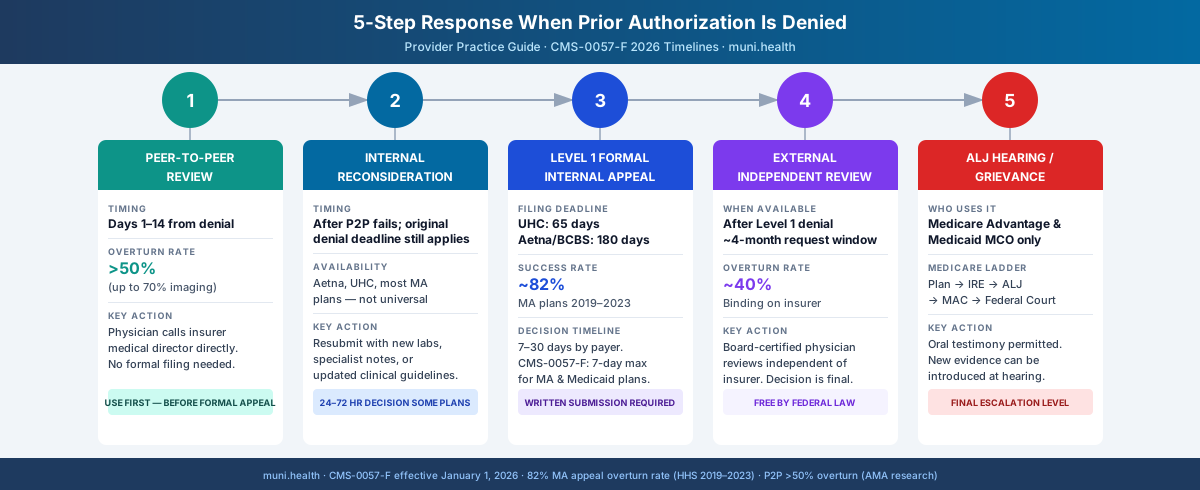
Step 1: Request Peer-to-Peer Review (Days 1–14 by Payer)
Peer-to-peer review is the fastest path to reversal after a PA denial. Your ordering physician presents the clinical rationale directly to the insurer's medical director in a 5–10 minute phone call — no formal appeal letter, no submission portal, no 30-day wait.
The ordering physician should conduct the call personally rather than delegating to office staff — most payers require it, and the call is a real-time clinical conversation with the medical director, not a documentation handoff.
How to request it:
- Call the member services or provider services number on the denial letter and ask specifically for "peer-to-peer review scheduling"
- At most payers, only the ordering or treating physician can initiate the request — billing managers alone cannot
- Have the denial reference number, patient member ID, CPT code, and a one-paragraph clinical rationale summary ready when you call
- Request the earliest available scheduling slot — most payers book within 24–72 hours
The tight window: Each payer sets its own P2P request deadline. Cigna's EviCore gives 7 calendar days; UHC gives 14 days; Aetna gives 30 days for direct denials — but Aetna also delegates PA review to EviCore and NIA for imaging, MSK, and interventional pain, where the same 7-day window applies. Miss the window and this option is permanently closed. See the payer-specific deadline table in the next section. For Aetna-specific vendor routing by service type, see the Aetna prior authorization denial appeal guide 2026.
Request P2P Before Filing a Formal Appeal
At some payers, once you submit a Level 1 formal written appeal, the case transfers to the appeals department and the P2P scheduling desk stops accepting new requests for that denial. Request peer-to-peer review first. If P2P is unsuccessful, you can still file the formal appeal — P2P does not consume appeal rights.
Step 2: Internal Reconsideration
Several major payers offer an informal reconsideration step between P2P review and Level 1 formal appeal. This is a resubmission of the original authorization request with new supporting documentation, resolved under the initial-authorization timeline rather than the longer formal appeal clock.
When it applies: Aetna, UHC, and most Medicare Advantage plans allow reconsideration when genuinely new clinical information is available that was not included in the original PA request. Some BCBS affiliates — particularly Anthem Blue Cross — also offer this step.
Use it when:
- P2P review did not result in reversal
- You have new lab results, specialist consultation notes, or recently updated clinical guidelines to add
- The denial cited missing information rather than a clinical policy judgment
What it is not: Reconsideration is not the same as a Level 1 formal appeal. It uses faster timelines — 24 to 72 hours at plans that offer it — and does not consume your formal appeal rights. If reconsideration also fails, the Level 1 formal appeal deadline is still measured from the original denial date.
Step 3: Level 1 Formal Internal Appeal
The Level 1 formal written appeal is the first mandatory step in the full appeal ladder and is required before external review becomes available. It is slower than P2P and reconsideration, but it carries a high overall success rate when built on complete documentation that directly addresses the payer's clinical coverage criteria.
What to include in the submission:
- Physician-signed letter of medical necessity citing the payer's specific coverage policy by number
- Medical records covering at least 6 months of relevant treatment history
- Documentation of failed conservative or alternative treatments with specific dates and outcomes
- Two to three peer-reviewed journal abstracts supporting clinical necessity
- Completed payer appeal form (provided with the denial letter)
Filing deadline by payer:
| Payer | Level 1 Filing Deadline | Level 1 Decision Timeline | Expedited Decision |
|---|---|---|---|
| Aetna | 180 days from denial | 30 calendar days | 72 hours |
| BCBS / Anthem (commercial) | 180 days from denial | 30 days | 72 hours |
| UnitedHealthcare | 65 days from denial | 7 calendar days | 72 hours |
| Cigna | 180 days from denial | 30 days (pre-service) | 72 hours |
| Humana (commercial) | 180 days from denial | 30 days | 72 hours |
| Humana Medicare Advantage | 60 days from denial | 30 days | 72 hours |
| Medicare Advantage (all plans) | 60 days from denial | 30 days | 72 hours |
| ACA Marketplace plans | 180 days (plan-specific) | 30 days | 72 hours |
New for 2026 under CMS-0057-F: For Medicare Advantage, Medicaid, and ACA marketplace plans, payers must now issue standard prior authorization decisions within 7 calendar days and expedited decisions within 72 hours. If the payer misses this timeline during appeal review, you can treat it as a deemed decision and move directly to external review. For insurer-specific appeal templates and submission address tables, see the complete prior authorization denial appeal guide for providers 2026.
Step 4: External Independent Review (IRO)
External review is the first escalation step outside the insurer's control. If your Level 1 formal appeal is denied, federal law requires the payer to give you access to free, independent review by board-certified physicians who have no affiliation with the insurer. The external reviewer's decision is legally binding on the payer.
Overturn rate: External review overturn rates vary widely by state, insurer, and denial type rather than sitting at one fixed nationwide figure — a JAMA-published study of New York's external review program found rates rising from 38% (2019) to nearly 53% (2025), ranging from 36% to 85% depending on the insurer. No nationwide overturn-rate figure is published.
Who can access it:
- Fully insured commercial plans under ACA: required
- Self-funded ERISA employer plans: voluntary but widely offered
- Medicare Advantage: required by CMS (called Independent Review Entity, or IRE — conducted by C2C Innovative Solutions as of May 1, 2026, previously Maximus Federal Services)
- Medicaid managed care: EQRO review required under federal Medicaid regulations
How to request: Instructions for requesting external review must be included in your Level 1 denial letter. The deadline to request is typically 4 months from the denial date. Standard decisions are issued within 60 days; expedited within 72 hours.
For a full walkthrough of the IRO request process by state and plan type, see the independent review organization appeal guide 2026.
Step 5: ALJ Hearing / Grievance (Medicare Advantage and Medicaid)
The Administrative Law Judge hearing is available primarily for Medicare Advantage and Medicaid managed care denials, where federal regulations establish a multi-level appeal ladder that extends beyond the IRO.
Medicare Advantage 5-level appeal ladder:
- Level 1: Internal appeal to the MA plan (30-day standard, 72-hour expedited)
- Level 2: IRE review by C2C Innovative Solutions (as of May 1, 2026; previously Maximus Federal Services) (60-day standard, 72-hour expedited)
- Level 3: ALJ hearing (requires the 2026 CMS minimum controversy threshold; request within 60 days of IRE decision)
- Level 4: Medicare Appeals Council review
- Level 5: Federal district court
Medicaid managed care: State fair hearing rights apply after exhausting plan-level internal appeals. Federal Medicaid regulations require a state administrative hearing opportunity for all coverage denials. The process varies by state but gives you the right to present oral testimony and introduce evidence that was not available during the plan-level appeal.
When ALJ is worth pursuing: ALJ hearings are slower and more formal than IRO review, but oral testimony and the ability to introduce new clinical evidence can recover denials that written-only appeals cannot reach. For Medicare Advantage specifically, the ALJ level has historically shown higher overturn rates for clinical necessity cases than IRE review alone.
Peer-to-Peer Review Windows by Payer: Don't Miss the Deadline
The P2P request deadline is the most frequently missed timeline in PA denial management. It is not printed prominently on denial letters — most practices discover it only after missing it. The table below shows current windows by payer:
| Payer | P2P Request Window | Who Can Request | Request Path | Key Notes |
|---|---|---|---|---|
| UnitedHealthcare | 14 days from denial date | Ordering/treating physician | uhcprovider.com → Peer-to-Peer Scheduling form | Does not pause appeal clock; formal appeal can run concurrently |
| Aetna | 30 days from denial date | Ordering/treating physician | Availity or 1-800-872-3862 provider line | Aetna often resolves commercial PA P2P same day when specialty matches |
| Cigna (commercial) | 14 days from denial date | Ordering/treating physician | CignaForHCP.com → Prior Auth Management | P2P same-day resolution common; check if EviCore-managed (shorter window) |
| Cigna via EviCore | 7 calendar days from denial | Ordering/treating physician | eviCore provider portal or 1-855-252-1117 | Imaging, MSK, cardiology, oncology. 7-day window is strict — request immediately |
| BCBS / Anthem | 30–45 days (varies by affiliate) | Ordering/treating physician | Availity or affiliate-specific portal per denial letter | HCSC affiliates (IL, TX, OK, NM, MT) use Blue Access for Providers (BAP) |
| Humana (commercial) | 14 days from denial date | Ordering/treating physician | Availity or HumanaOne provider portal | KePRO handles some MA P2P — verify plan type routing from denial letter |
| Medicare Advantage plans | During Level 1 appeal period | Ordering/treating physician or their office | Per plan — instructions in denial letter | CMS allows P2P concurrent with Level 1 appeal for MA plans |
The EviCore 7-day window is the most commonly missed. EviCore manages PA for imaging, musculoskeletal procedures, cardiology studies, and radiation oncology on behalf of Cigna and several BCBS affiliates — and its window is half that of Cigna direct. If the denial letter header shows "EviCore Healthcare" rather than "Cigna," the 7-day clock began when you received the denial. For a detailed EviCore-specific appeal walkthrough, see the Cigna EviCore appeal guide 2026.
The EviCore 7-Day Window Is Not on the Denial Letter
EviCore denial letters prominently display your formal appeal rights (typically 180 days) but do not highlight the 7-day P2P request window. Billing teams who read only the appeal deadline section miss the P2P opportunity every time. Build a same-day P2P triage step into your denial intake workflow.
What CMS-0057-F Changed in 2026
CMS Interoperability and Prior Authorization Final Rule (CMS-0057-F) took effect January 1, 2026, for Medicare Advantage organizations, Medicaid managed care plans, and ACA marketplace QHPs. These changes affect the timeline and transparency of PA decisions and appeals:
New initial PA decision timelines (enforcement strengthened):
- Standard (non-urgent) PA requests: must be decided within 7 calendar days
- Urgent/expedited PA requests: must be decided within 72 hours
The 7-day standard timeline replaces the 14-day window that most MA plans previously used. For practices that have experienced long waits on MA PA requests, the 7-day requirement creates grounds for a deemed-denial escalation if not met.
Mandatory denial specificity: Payers must now provide a specific clinical reason for every PA denial, not just a generic "medical necessity not established" code. A specific reason lets you target your appeal — and your P2P talking points — directly at the cited deficiency rather than building a general clinical case.
Public reporting requirements: Starting in 2026, covered payers must publicly report prior authorization approval rates, denial rates, average decision timelines, and appeal overturn rates. This transparency data creates a factual baseline for arguing that a payer's denial rate for your procedure type is an outlier — a useful framing at the Level 1 appeal and ALJ stages.
What CMS-0057-F does NOT change: The rule applies to MA, Medicaid, and marketplace plans — not to commercial self-funded ERISA plans. ERISA self-funded plans are regulated by the Department of Labor and follow the plan document's appeal procedures rather than CMS timelines. If you are unsure whether a plan is ERISA self-funded or fully insured, check the plan documents: if the plan sponsor is an employer, it is likely ERISA self-funded.
For the Medicare-specific PA workflow changes, including the CMS WISeR pilot affecting Original Medicare in six states, see the CMS WISeR model guide for providers 2026.
Escalation Rights by Plan Type
The appeal ladder available to a practice depends entirely on the plan type. This distinction determines which external review process applies — and whether ALJ hearings are an option.
Prepare this appeal without starting from scratch.
Muni drafts the letter, surfaces payer-policy citations, and builds the evidence checklist. Your staff stays responsible for review and submission.
First 3 appeals free, then $20 per appeal. Start with your denial letter or EOB and available records. No meeting or clearinghouse connection required.
| Plan Type | P2P Available | Level 1 Deadline | External Review | Final Escalation | Governing Law |
|---|---|---|---|---|---|
| Commercial — Fully Insured | Yes | 60–180 days (plan-specific) | IRO (state-assigned) | State insurance commissioner | ACA + state insurance law |
| Commercial — Self-Funded ERISA | Yes (voluntary at most plans) | 60–180 days (plan documents) | Voluntary external review (ERISA §503) | Federal district court (ERISA §502(a)(1)(B)) | ERISA, DOL 29 CFR Part 2560 |
| Medicare Advantage | Yes (concurrent with Level 1) | 60 days from denial | IRE — C2C Innovative Solutions (as of May 1, 2026) | ALJ → MAC → Federal court | CMS-0057-F, 42 CFR Part 422 |
| Original Medicare (WISeR — 6 states) | Yes | Unlimited resubmission | QIC / Maximus | ALJ → MAC → Federal court | CMS WISeR model waiver |
| Medicaid MCO | Yes | Plan-specific (30–90 days typical) | EQRO (per state contract) | State fair hearing (administrative) | 42 CFR Part 438 |
| ACA Marketplace (QHP) | Yes | 180 days (plan-specific) | IRO (state or federal) | State insurance commissioner | ACA Section 1251, CMS-0057-F |
The ERISA distinction is critical for billing teams at practices with a high volume of employer-sponsored patients. For self-funded ERISA plans, state external review laws generally do not apply — the appeal process is governed by the plan document and federal DOL regulations. External review is voluntary under ERISA, not mandatory, though the ACA requires self-funded non-grandfathered plans to have voluntary external review procedures in place.
To determine if a plan is ERISA self-funded: if the plan sponsor listed in the plan documents is an employer rather than an insurance company, the plan is almost certainly self-funded. HR departments at the employer can confirm. This distinction affects whether state-mandated appeal timelines or federal ERISA timelines govern your case.
Getting Treatment While Your Appeal Is Pending
A denial stops coverage, not necessarily care. The AMA's prior authorization physician survey underscores why speed matters here: the large majority of physicians report that PA delays necessary care, and roughly a quarter report a denial or delay has contributed to a serious adverse event. While the sequence above runs, you have four ways to keep treatment moving:
- Request expedited review when the delay is clinically dangerous. If waiting the standard timeline would "seriously jeopardize life, health, or the ability to regain maximum function," every level above can be expedited to a 72-hour decision. Quote that standard verbatim — paraphrased urgency is routinely downgraded to standard review at intake.
- Bridge with a covered alternative. Ask the ordering physician whether a covered option — a generic, a preferred formulary drug, or a conservative therapy — can hold the line while the appeal runs, without prejudicing the case for the originally requested service.
- Pay out-of-pocket and seek reimbursement. When treatment truly cannot wait, the patient can pay and be reimbursed if the appeal succeeds. Note the tradeoff: self-pay is billed at the uninsured rate with no negotiated discount, and specialty drugs can run into the thousands per dose. Keep every receipt and submit it with the appeal.
- Proceed and appeal after the fact in emergencies. For genuinely emergent care, treatment proceeds first and the appeal follows — emergency services carry separate protections from routine prior authorization.
The through-line: none of these replaces the appeal sequence — they buy clinical time while it runs. File the appeal and request P2P the same day the denial arrives, regardless of which bridge you choose.
How Muni Appeals Manages the 5-Step Sequence
Running the 5-step response correctly requires tracking five parallel deadlines — some as short as 7 days — across multiple payers, each using different portals and clinical coverage criteria.
Muni Appeals uses the uploaded denial to surface the likely P2P window and formal-appeal deadline risk, then compiles a Level 1 packet against the cited policy criteria. Staff must verify and calendar each window, notify and schedule the physician, submit the packet, and monitor the payer response.
Start 3 Free Prior Authorization Appeals
Frequently Asked Questions
What happens if prior authorization is denied?
When prior authorization is denied, you receive a written notice specifying the reason, your appeal rights, and the deadline to file. The most effective immediate response is to request peer-to-peer review — a direct call between the ordering physician and the insurer's medical director — before filing a formal written appeal. P2P can resolve the case within 24–72 hours without consuming formal appeal resources or triggering the longer written review process; no payer publishes a peer-to-peer-specific overturn rate, but the speed and lack of downside make it worth trying first.
How long do I have to appeal a prior authorization denial?
Deadlines vary by payer and plan type. UHC gives 65 days from denial; Aetna, BCBS, and Cigna give 180 days; Medicare Advantage plans give 60 days. These are the formal appeal filing deadlines. P2P request windows are significantly shorter — 7 days at Cigna EviCore, 14 days at UHC and Humana, 30 days at Aetna — and must be acted on before the formal appeal is filed. For a complete breakdown of deadlines across all major payers, see the insurance appeal deadlines guide 2026.
Does requesting peer-to-peer review count as a formal appeal?
No. Peer-to-peer review is a separate, informal intervention that does not consume your formal appeal rights. If P2P fails, you can still file a Level 1 formal appeal within the original deadline. The sequence risk runs in the other direction: at some payers, filing a formal appeal before requesting P2P closes the P2P scheduling queue for that denial. Use P2P first.
What is the success rate for each level of prior authorization appeal?
For Medicare Advantage specifically, KFF reports that 80.7% of insurer reconsiderations of prior-authorization denials were partially or fully favorable in 2024. This is an aggregate across Medicare Advantage insurers at the plan reconsideration stage; it does not combine P2P, independent review and later appeal levels. The report does not provide a P2P-specific rate. External independent review (IRO) overturn rates vary widely by state and insurer rather than sitting at one fixed figure; a JAMA-published study of New York's external review program found rates rising from 38% (2019) to nearly 53% (2025), ranging 36–85% by insurer.
Can I request expedited review if the PA denial involves urgent care?
Yes. If standard timelines would "seriously jeopardize life, health, or the ability to regain maximum function," you can request expedited review at any level. Under CMS-0057-F (effective January 1, 2026), expedited initial PA decisions must be issued within 72 hours for plans subject to the rule. When requesting expedited status, quote the phrase "seriously jeopardize life or health" verbatim — CMS has documented that paraphrased urgency language is routinely downgraded to standard review by payer intake teams. For the full expedited process including payer-specific submission paths, downgrade prevention, and how to challenge a downgrade, see the urgent and expedited insurance appeal guide 2026.
What if my formal appeal is denied?
After a Level 1 internal appeal denial, you have the right to external independent review by an IRO — board-certified physicians not affiliated with the insurer. The IRO's decision is binding on the payer. The request instructions are included in your Level 1 denial letter; the deadline to request is typically 4 months from the denial date. External review is free by federal law. For Medicare Advantage, the IRE review is followed by ALJ hearing rights if the IRE also denies. For a full walkthrough, see the independent review organization appeal guide 2026.
Should the billing team or the physician handle the peer-to-peer review call?
The ordering or treating physician must initiate and conduct the peer-to-peer call — most payers will not schedule with billing staff acting alone. Billing teams can handle the logistics: calling the scheduling line, selecting the time slot, and preparing a clinical brief organized around the payer's specific coverage criteria and the cited denial reason. Physicians who go into P2P calls with a one-page brief that directly addresses the denial's cited deficiency consistently outperform those who summarize clinical history ad hoc.
What is the difference between internal and external prior authorization appeals?
An internal appeal is submitted to the insurance company itself, where their medical director or appeals department reviews your case. Internal appeals must be completed before external review becomes available. External review (also called independent review) is conducted by an IRO — physicians with no affiliation to the insurer. External review is free, legally binding on the insurer, and available only after internal appeals are exhausted or the payer fails to follow proper procedures. For ERISA self-funded plans, external review is voluntary; for fully insured commercial and Medicare Advantage plans, it is mandatory.
Can I still get treatment while my prior authorization appeal is pending?
Yes. You can request expedited review (72-hour decision) when a delay would seriously jeopardize health, bridge with a covered alternative treatment, or pay out-of-pocket and seek reimbursement if the appeal succeeds — self-pay is billed at the uninsured rate, so keep every receipt. For genuinely emergent care, treatment proceeds first and the appeal follows. None of these replaces the appeal; they buy clinical time while it runs.
Do I need a lawyer to appeal a prior authorization denial?
No. The vast majority of prior authorization appeals are handled by the practice or the patient without legal representation. Success turns on medical evidence, clinical guidelines, and directly addressing the payer's own coverage criteria — not legal argument. Attorneys are typically only relevant if you pursue litigation after every appeal level, including external review, has been exhausted, which is uncommon for medical-necessity disputes.
Can I appeal a prior authorization denial for out-of-network services?
Yes, though success depends on the circumstances. The strongest cases show that no in-network provider with the required expertise is available, that the service was emergent and provider choice wasn't possible, or that a single-case agreement (the insurer covering the out-of-network provider at in-network rates) is warranted. Document whichever applies and include it in the appeal.
Ready to Stop Missing the P2P Window?
Most practices learn about the peer-to-peer review window after it has already closed. The 5-step sequence above captures the fastest intervention first — P2P scheduling from denial receipt — and preserves the formal appeal and external review options for the denials that P2P does not resolve.
Muni Appeals supports:
- P2P timing context from the uploaded denial, for staff verification and calendaring
- Level 1 formal appeal built against the payer's cited policy criteria
- Deadline-risk guidance across active cases, with verification and calendar ownership retained by staff
- All major payers: Aetna, BCBS, UHC, Cigna, Humana, Medicare Advantage, EviCore
Start 3 Free Prior Authorization Appeals
This guide reflects 2026 prior authorization and appeal procedures, including CMS Interoperability and Prior Authorization Final Rule (CMS-0057-F) requirements effective January 1, 2026. CMS-0057-F applies to Medicare Advantage organizations, Medicaid managed care plans, and ACA marketplace QHPs — not to commercial self-funded ERISA plans. Appeal deadlines and timelines vary by insurance company, plan type, and state. This information is for administrative guidance and is not medical or legal advice.