

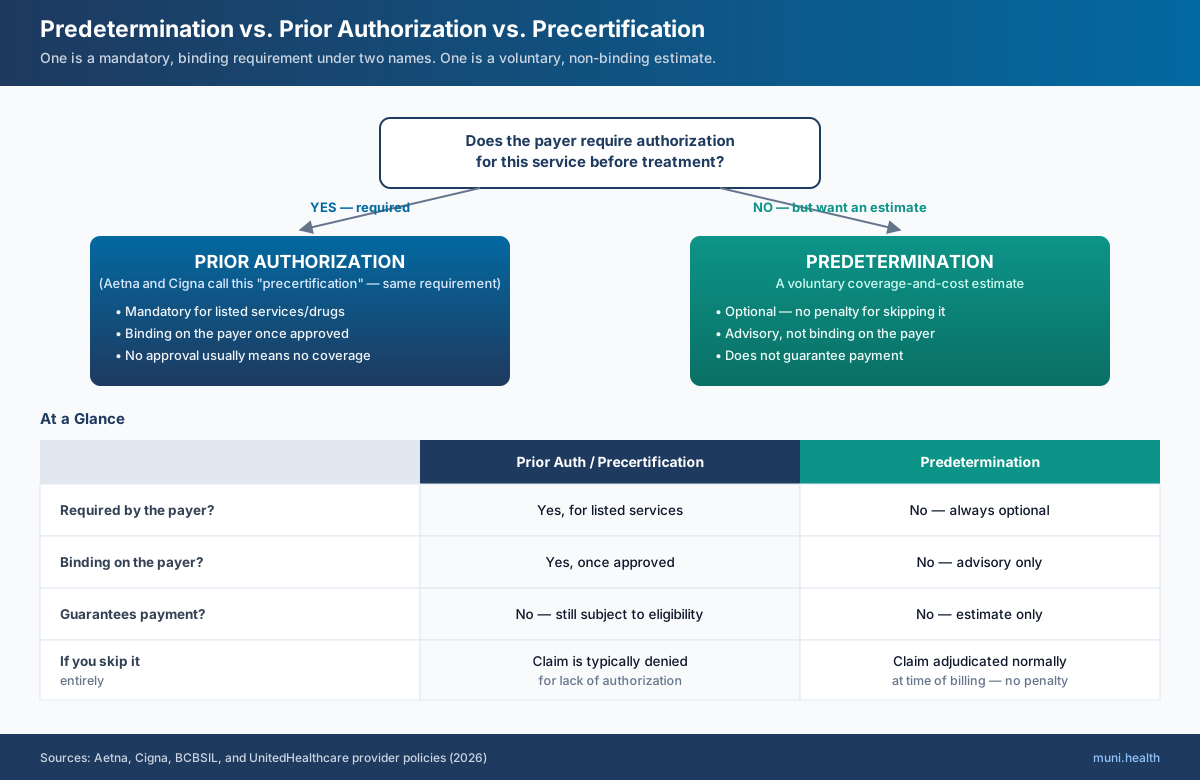
Precertification and prior authorization are the same requirement under different payer names — mandatory and binding once approved. Predetermination is different: an optional, non-binding coverage estimate. Skipping required prior authorization/precertification usually gets a claim denied outright; skipping optional predetermination just means the claim is adjudicated normally, with no penalty.
Why These Three Terms Get Confused
Billing teams lose time on this distinction constantly, and it's not because the concepts are actually complicated — it's because payers don't use consistent labels for them. Aetna and Cigna call the mandatory pre-service review "precertification." UnitedHealthcare and most other payers call the same thing "prior authorization." Both terms describe one process: a payer-required, binding review that has to happen before a specific service, drug, or admission will be covered.
Predetermination is a different animal wearing similar clothes. It's a voluntary request — usually for a service that doesn't require formal authorization — asking the payer to estimate coverage and payment before treatment. It sounds like prior authorization, it's submitted on similar forms, and it's reviewed by the same utilization management department. But it carries none of prior authorization's binding weight.
The Assumption That Costs Practices Money
Treating a predetermination approval as if it were a prior authorization approval is the most common version of this mistake. A predetermination estimate does not guarantee payment. Only a granted prior authorization or precertification binds the payer to cover the service, and even that is still subject to the patient's eligibility and benefits being active when the service is actually performed.
Precertification and Prior Authorization Are the Same Requirement, Different Names
Aetna's provider precertification page describes a mandatory utilization review that specific services, procedures, drugs, and devices must clear before the payer will cover them. Cigna's provider precertification page states the stakes just as plainly: "Not getting a precertification may lead to a denial of payment," per Cigna's Precertifications and Prior Authorizations page.
Prepare this appeal packet with your team.
Draft the appeal, coordinate missing documents, and approve the reviewed packet. Keep your clearinghouse; your practice checks deadlines and submits through the payer’s accepted channel.
First 3 appeals free, then $20 per appeal. Start with your denial letter or EOB and available records. No meeting or clearinghouse connection required.
UnitedHealthcare doesn't use the word "precertification" at all for this — its equivalent mandatory review is simply called prior authorization, administered alongside a related but distinct "advance notification" process for services that need timely payer communication without requiring full medical-necessity review. See UHC's Prior Authorization and Notification guidance for the current list-by-list breakdown.
The practical takeaway: if a payer's precertification list or prior authorization list includes the service, the practice needs the required approval before treatment — regardless of which word that specific payer uses for it. There is no substantive difference to plan around; the difference is entirely which term shows up in that payer's provider manual.
Predetermination Is a Separate, Optional Process
Predetermination (sometimes called a pretreatment estimate or, at some payers, a "recommended clinical review") exists to answer a different question: not "is this allowed," but "roughly what will this cost, and will it likely be covered."
Cigna frames its predetermination review as voluntary and explicitly not a substitute for required precertification — the review estimates which costs are likely covered, but "if no predetermination review is done ahead of time, coverage will be decided when the claim is received," with no penalty for skipping it.
Aetna's dental precertification and predetermination guidelines recommend requesting a pretreatment estimate for any course of treatment where coverage clarity matters, while stating directly that the estimate "does not guarantee payment" — benefits are only payable if the member is actually covered under the plan when services are rendered (Aetna Dental Precertification and Predetermination Guidelines).
Blue Cross Blue Shield of Illinois states the same non-binding limitation directly on its provider predetermination page: "There's no penalty if a provider doesn't elect to use the recommended clinical review process, but the service will be subject to post-service review," and separately, that "checking eligibility and/or benefit information, obtaining prior authorization or the fact that a recommended clinical review (predetermination) decision has been issued is not a guarantee of payment" (BCBSIL Predetermination guidance). BCBSIL also states the mutual-exclusivity rule directly: "If prior authorization is required for a service/drug, recommended clinical review (predetermination) isn't necessary" — the two processes don't stack on the same service.
Predetermination Doesn't Replace Prior Authorization
If a service is already on the payer's prior authorization or precertification list, requesting a predetermination on top of it is redundant — the binding review already covers what predetermination would only estimate. Predetermination is for the services that fall outside the mandatory list, where a practice or patient wants cost clarity before an elective or high-cost procedure.
Payer-by-Payer: What Each One Actually Calls It
Terminology varies enough by payer that it's worth checking before assuming a term travels across insurers.
| Payer | Mandatory Term | Optional Estimate Term | Guarantees Payment? |
|---|---|---|---|
| Aetna | Precertification | Predetermination (pretreatment estimate) | No — estimate only, per Aetna's dental precertification and predetermination guidelines |
| Cigna | Precertification / prior authorization | Predetermination of benefits | No — final payment depends on coverage active when treatment is completed |
| UnitedHealthcare | Prior authorization | Predetermination | No — subject to eligibility and benefits at time of service |
| BCBS (varies by affiliate) | Prior authorization | Predetermination / recommended clinical review | No — explicitly stated as not a payment guarantee by BCBSIL |
BCBS is the affiliate-dependent case here, the same way it is for appeal deadlines — 36 independently operated BCBS plans don't run identical predetermination processes, so confirm the specific affiliate's provider manual before assuming the Illinois pattern above applies elsewhere.
What Happens If You Skip Prior Authorization
Skipping a required prior authorization or precertification is a coverage problem, not just a paperwork problem. Cigna states directly that missing precertification "may lead to a denial of payment." Aetna goes further for services already on its precertification list: its retrospective review process — the mechanism that lets a payer evaluate coverage after the fact — is explicitly not available for elective ambulatory or inpatient services on Aetna's Participating Provider Precertification List or Behavioral Health Precertification List when precertification didn't happen before the service was provided, per Aetna's Retrospective Review policy. In other words, for the services where prior authorization is required, there often isn't a fallback after-the-fact review to fix a missed step — the claim is denied for lack of authorization, full stop.
Some payers do accept retroactive ("retro") authorization requests for a limited window after the service date, but availability, deadlines, and eligibility for retro review vary by payer and by service — it isn't a guaranteed safety net, and Aetna's own precertification-list carve-out above shows it can be explicitly unavailable for exactly the services where it would matter most.
A denied claim for missing prior authorization is a real adverse benefit determination, which means it does come with formal appeal rights. For the full path from PA denial to appeal, see What Happens If Prior Authorization Is Denied and Prior Authorization Denial: The Complete Guide.
What Happens If You Skip Predetermination
This is the low-stakes side of the comparison, and it's worth saying plainly: nothing procedurally bad happens. Because predetermination is optional everywhere it exists, skipping it doesn't trigger a denial or a compliance problem. Per Cigna's and BCBSIL's own language above, the claim simply gets adjudicated on its normal timeline when it's filed — the practice just gives up the advance visibility into likely coverage and patient cost-share that a predetermination would have provided.
The tradeoff is uncertainty, not risk. A practice that skips predetermination on an elective, high-cost service finds out what's actually covered only after the claim is filed — which can mean an unpleasant coverage surprise for the patient, but not a procedural denial the way a missed prior authorization produces.
When Predetermination Is Worth the Extra Step
Request a predetermination when a service is expensive, elective, and not already on the payer's mandatory authorization list — a borderline cosmetic-vs-medically-necessary procedure, an out-of-network exception request, or a service where documentation adequacy is genuinely uncertain. Skip it for routine, clearly-covered services where the estimate wouldn't change anything about how the claim gets billed.
Can You Appeal a Predetermination the Way You Appeal a Prior Authorization Denial?
Not in the same sense, and this is the distinction that trips up billing teams who treat the two processes as procedurally identical.
A denied prior authorization or precertification is an adverse benefit determination tied to an actual, required coverage decision — that's what triggers the formal internal appeal rights described in Insurance Appeal Deadlines 2026 and When to Appeal an Insurance Denial: A Decision Framework. It comes with a specific denial reason, a written notice, and a filing deadline.
An unfavorable predetermination response isn't that. It's an advisory estimate on a service that, by definition, didn't require payer approval in the first place — there's no claim, no expense incurred, and no binding decision to formally challenge. If a predetermination review comes back unfavorable, the practical options are to submit additional clinical documentation and request the estimate be reconsidered, proceed with treatment and let the actual claim run through normal adjudication, or treat the unfavorable predetermination as a signal to gather stronger medical necessity documentation before billing. None of those is the same procedural track as a formal prior authorization appeal, and none carries the same regulatory filing deadlines.
Decision Table: Which One Do You Actually Need
Use this before submitting either form — the fastest way to waste a UM department's turnaround time is requesting the wrong review type.
| Situation | What to Request | Why |
|---|---|---|
| Service is on the payer's prior authorization or precertification list | Prior authorization / precertification (required) | Predetermination doesn't satisfy a mandatory requirement — per BCBSIL, it "isn't necessary" when PA is already required, and skipping the required review risks denial |
| Elective or high-cost service not on any mandatory list, patient wants a cost estimate | Predetermination (optional) | Gives coverage and cost-share visibility before treatment, with no compliance requirement either way |
| Borderline medical-necessity case where documentation adequacy is uncertain | Predetermination first, even if not required | Surfaces documentation gaps before the claim is filed, when they're still fixable |
| Prior authorization was already denied | Formal internal appeal — not a predetermination | A predetermination doesn't reopen a binding denial; use the payer's actual appeal process instead |
| Need faster payer communication on a scheduled admission, no full medical-necessity review required | Advance notification (UHC-specific track) | A lighter administrative step, distinct from both prior authorization and predetermination — confirm which UHC plans require it |
How Muni Appeals Helps With the Right-Track Decision
Getting these three processes confused costs practices real time — either by requesting an unnecessary predetermination on a service that already required binding prior authorization, or by skipping a required precertification because a predetermination-style estimate felt sufficient. Muni Appeals helps billing teams confirm which review a specific payer and service actually requires, keeps prior authorization and precertification deadlines from slipping past the point where retroactive review is no longer available, and organizes the documentation trail so a borderline case is ready whether it goes through predetermination, prior authorization, or a formal appeal.
If you're still deciding whether automating this tracking makes sense for your practice's volume, see Appeal Automation Software for Small Practices for a breakdown of what to look for.
Frequently Asked Questions
Is precertification the same as prior authorization?
Yes, functionally. They describe the same mandatory, binding pre-service review — Aetna and Cigna use "precertification," UnitedHealthcare and most other payers use "prior authorization." The requirement, the stakes for skipping it, and the appeal rights if it's denied are the same regardless of which term a given payer uses.
What is a predetermination of benefits?
A predetermination is a voluntary request asking a payer to estimate coverage and likely payment for a service before it's performed. Unlike prior authorization, it's optional, it doesn't bind the payer to pay, and skipping it carries no penalty — the claim is simply adjudicated normally when filed.
Does a predetermination guarantee my claim will be paid?
No. Every payer source reviewed for this guide — Cigna, Aetna, and BCBSIL among them — states directly that a predetermination or recommended clinical review does not guarantee payment. Final payment still depends on the patient's eligibility and benefits being active when the service is actually rendered.
Can I skip predetermination and go straight to filing the claim?
Yes. Predetermination is optional everywhere it's offered. Skipping it just means the claim is decided on its normal adjudication timeline instead of getting an advance estimate — there's no compliance issue and no penalty for not requesting one.
What happens if I don't get prior authorization for a service that requires it?
The claim is typically denied for lack of authorization. Some payers accept retroactive authorization requests within a limited window, but availability isn't guaranteed — Aetna, for example, explicitly excludes elective services on its precertification list from retrospective review when precertification wasn't obtained beforehand. Treat prior authorization deadlines as hard stops, not soft ones.
Can I appeal a denied predetermination the way I'd appeal a denied prior authorization?
Not through the same process. A prior authorization denial is a formal adverse benefit determination with defined appeal rights and deadlines. An unfavorable predetermination is an advisory estimate on a service that didn't require payer approval — there's no formal appeal track for it. The options are resubmitting with stronger documentation, proceeding to treatment and letting the actual claim adjudicate, or gathering more support before billing.
Do all insurance companies offer predetermination?
Most major commercial payers offer some version of it, but availability, terminology, and process vary by payer and sometimes by plan or line of business (medical vs. dental review processes, for instance, are often handled separately). Confirm the specific payer's current provider manual rather than assuming a process from one insurer applies to another.
Is predetermination the same thing as UnitedHealthcare's advance notification?
No. UHC's own prior authorization and notification guidance treats these as separate tracks: predetermination estimates coverage for a specific service, while advance notification is a lighter administrative step that gives UHC timely notice of certain services for prospective, concurrent, or retrospective review — it doesn't function as a coverage estimate the way predetermination does.
Ready to Stop Guessing Which Review You Need?
Confusing predetermination with prior authorization wastes turnaround time on the wrong form, and confusing the reverse — assuming a predetermination estimate covers you the way a granted prior authorization would — risks a claim denial that has fewer appeal options than a straightforward prior authorization denial would.
Where to start:
- Check the payer's current prior authorization/precertification list before assuming a service is optional
- If the service is on that list, request prior authorization or precertification — not predetermination
- Reserve predetermination for elective, high-cost, or documentation-uncertain services that aren't already mandatory
- Never treat a predetermination approval as a substitute for a required prior authorization
For the deadlines that apply once a claim actually gets denied, see Insurance Appeal Deadlines 2026 and Reconsideration vs. Appeal.
This guide reflects 2026 provider policies from Aetna, Cigna, UnitedHealthcare, and Blue Cross Blue Shield of Illinois. Predetermination availability, terminology, and process vary by payer, affiliate, and plan type. Always verify current requirements against the specific payer's provider manual before submitting either a predetermination or a prior authorization request.