

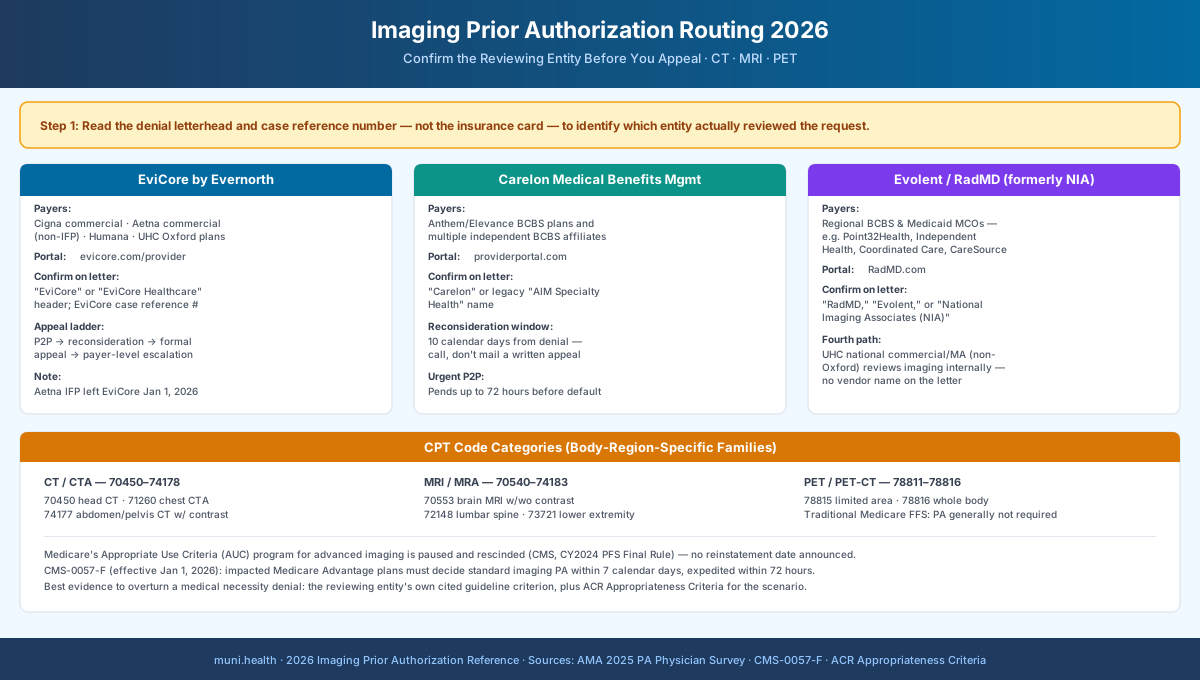
Imaging PA denials for CT, MRI, and PET route through one of three reviewing entities depending on the payer: EviCore (Cigna, Aetna commercial, Humana, UHC Oxford), Carelon Medical Benefits Management (Anthem/Elevance and many BCBS plans), or Evolent/RadMD (regional BCBS and Medicaid MCOs). A few payers, including UHC's main commercial and Medicare Advantage business, review imaging internally. Confirm the reviewing entity from the denial letterhead before appealing — Medicare Advantage plans must decide standard imaging PA requests within 7 calendar days under CMS-0057-F.
Why Imaging Prior Authorization Is Its Own Appeal Category
Advanced imaging — CT, MRI, PET, and their angiography variants — is one of the most heavily prior-authorized service categories in commercial and Medicare Advantage plans, and most payers do not review these requests themselves. They delegate the clinical review to a specialty benefit manager, which means the denial letter, the appeal address, and the clinical criteria that govern the review often belong to a company the ordering physician has never contacted directly.
According to the 2025 AMA Prior Authorization Physician Survey (n=1,000 physicians, fielded December 2025), practices complete an average of 40 prior authorizations per physician per week, nearly 1 in 3 physicians (32%) report that PA requests are often or always denied, and 74% say the number of denials has increased over the past five years. The same survey found UnitedHealthcare carries the highest reported PA burden among major national insurers — 75% of physicians rate it "high" or "extremely high" — followed by Humana (65%), Anthem/Elevance and Aetna (61% each), Cigna (59%), and BCBS (56%). Medicare Advantage was the single highest-burden line of business at 69%.
Imaging denials compound this because a routing error — sending an appeal to the payer instead of its delegated radiology benefit manager — restarts the clock without a single clinician reviewing the clinical merits.
GI practices hit the same delegated-review pattern outside of cross-sectional imaging: capsule endoscopy (CPT 91110/91113) carries its own prior authorization requirements, and Cigna cases route through EviCore's gastroenterology program rather than the imaging line. See the gastroenterology claim denials guide for capsule endoscopy PA documentation and the separate colonoscopy modifier issues that don't apply to imaging denials.
Neurology practices see this routing pattern most often on brain MRI (70551–70553) and spine MRI (72141/72146/72148), plus a documentation layer specific to the specialty: a lumbar spine MRI without a documented conservative-therapy trial or an explicit red flag is a common denial even when the routing was correct. See the neurology claim denials guide for the conservative-therapy documentation standard and the EMG/nerve conduction study coding rules that neurology practices also navigate.
Only 21% of Physicians Always Appeal a Denied PA
The AMA's 2025 survey found that just 1 in 5 physicians (21%) always appeal an adverse PA decision, and 59% of those who don't cite low confidence the appeal will succeed based on past experience. Imaging denials are frequently reversible when the appeal reaches the correct reviewing entity with the right clinical evidence — the routing step is what most often breaks the process before the clinical argument is ever evaluated.
Which Entity Reviews Your Imaging Prior Authorization
The single most important step in an imaging appeal is confirming who denied it. Read the letterhead and the phone number on the denial notice before drafting anything — appeals sent to the payer for a delegated denial are returned unfiled, and the clock on the real appeal window keeps running.
| Reviewing Entity | Payers (Imaging PA) | Portal | How to Confirm on the Denial Letter |
|---|---|---|---|
| EviCore by Evernorth | Cigna commercial, Aetna commercial (non-IFP), Humana commercial and Medicare Advantage, UHC Oxford plans | evicore.com/provider | Letterhead reads "EviCore" or "EviCore Healthcare"; case reference number is EviCore-specific |
| Carelon Medical Benefits Management (formerly AIM Specialty Health) | Anthem/Elevance BCBS plans and multiple independent BCBS affiliates (verify per plan — includes Premera, several regional Blues) | providerportal.com | Letterhead reads "Carelon" or references the legacy "AIM Specialty Health" name |
| Evolent / RadMD (formerly National Imaging Associates / NIA) | Regional BCBS and Medicaid managed-care plans (examples: Point32Health/Harvard Pilgrim/Tufts, Independent Health, Coordinated Care, CareSource, several Medicaid MCOs) | RadMD.com | Letterhead reads "RadMD," "Evolent," or "National Imaging Associates (NIA)" |
| Payer-managed internal utilization review | UnitedHealthcare national commercial and Medicare Advantage (non-Oxford plans) | uhcprovider.com | Letter is issued directly from the payer with no third-party vendor name |
Aetna's delegation to EviCore also changed for 2026: per Aetna's 2026 Participating Provider Precertification List, EviCore stopped authorizing imaging for Aetna Individual & Family Plan (IFP) members effective January 1, 2026 — those cases now route through Aetna's own review. Confirm plan type, not just payer name, before submitting. UnitedHealthcare's own radiology prior authorization page similarly confirms that Medicare Advantage and D-SNP benefit plans are exempted from CT, MRI, and MRA prior authorization under current policy, while Oxford plans route through eviCore.
Humana Removed PA for Some CT and MRI Exams in 2026
Humana eliminated prior authorization for select outpatient services — including certain CT and MRI exams — as part of a broader reduction affecting roughly a third of its outpatient PA requirements, effective January 1, 2026 (RadiologyBusiness, 2026). Confirm current requirements directly through Availity or the Humana prior authorization guide before assuming a study still requires PA — submitting to EviCore for a service that no longer needs authorization delays the claim instead of speeding it up.
If EviCore is the reviewing entity for a Cigna case specifically, the full four-level appeal ladder — P2P, formal reconsideration, formal written appeal, and Cigna National Appeals Unit escalation — is covered in detail in our Cigna EviCore appeal guide, including submission addresses and documentation checklists that apply the same way to other EviCore-managed imaging denials.
This delegated-review pattern governs specialty imaging too — a prostate mpMRI ordered before an initial biopsy routes through the same radiology benefit managers, with an added wrinkle: current AUA/SUO guideline language frames pre-biopsy mpMRI as something clinicians "may" use rather than a mandated standard, which reviewers cite to deny it as discretionary. See the urology claim denials guide for how to appeal that specific gap. Ophthalmology imaging tied to a broader radiology benefit — orbital or optic-nerve MRI ordered by an ophthalmologist, for example — can route through this same delegated process, though routine in-office imaging like OCT and fundus photography does not; see the ophthalmology claim denials guide for the more common anti-VEGF and cataract denial patterns specific to that specialty.
Imaging CPT Codes and Typical PA Routing
CT, MRI, and PET codes are organized by body region rather than a single contiguous block, so "the CT codes" or "the MRI codes" actually span several code families across the CPT radiology section. Confirming the specific code on the denial — not just the modality — matters because PA requirements and site-of-care rules can differ by body region even within the same imaging type.
| Imaging Category | Representative CPT Range | Common Examples | PA Requirement Pattern |
|---|---|---|---|
| CT / CTA | 70450–74178 (body-region-specific code families, not a continuous block) | 70450 (head CT), 71260 (chest CTA), 74177 (abdomen/pelvis CT w/ contrast) | Required by nearly all EviCore-, Carelon-, or RadMD-managed plans for contrast and advanced studies |
| MRI / MRA | 70540–74183 (body-region-specific code families) | 70553 (brain MRI w/wo contrast), 72148 (lumbar spine MRI), 73721 (lower-extremity MRI) | Required for most commercial and MA advanced imaging; UHC exempts MA/D-SNP plans from CT/MRI/MRA PA under current policy |
| PET / PET-CT | 78811–78816 | 78815 (PET/CT, limited area), 78816 (PET/CT, whole body) | Required by nearly all commercial payers; traditional Medicare fee-for-service generally does not require PA for covered PET indications |
The Imaging Appeal Ladder: P2P, Reconsideration, and Formal Appeal
Every reviewing entity uses some version of the same sequence — peer-to-peer consultation, a faster reconsideration option, then a formal written appeal — but the exact windows differ by entity and plan. Working the steps out of order, or skipping the reconsideration option to file a formal appeal too early, can forfeit the faster path without adding leverage.
| Step | What It Is | Typical Window | Notes |
|---|---|---|---|
| Peer-to-peer (P2P) consultation | Ordering physician speaks directly with the reviewing entity's medical director | Request immediately after denial; exact window is set by the determination notice | For Carelon, urgent requests pend up to 72 hours for the P2P call before the case defaults to denial |
| Reconsideration (Carelon) | Structured re-review using additional clinical information, by phone | 10 calendar days from the denial decision | Distinct from a formal appeal — call Carelon directly rather than mailing a written appeal |
| EviCore 4-level ladder | P2P → formal reconsideration → formal written appeal → payer-level escalation | Windows vary by plan and program; confirm on the determination notice | See the [Cigna EviCore appeal guide](/blog/cigna-evicore-appeal-guide-2026) for the full submission addresses and documentation checklist |
| Formal written appeal (commercial) | Full clinical merits review against the reviewing entity's published guideline | Typically 60–180 days from the denial date depending on the plan; confirm in the letter | Do not assume a payer's standard commercial deadline applies to a delegated vendor's window |
| Medicare Advantage standard PA decision | Any impacted MA plan's decision on a non-urgent imaging PA request | 7 calendar days, per [CMS-0057-F](https://www.cms.gov/newsroom/fact-sheets/cms-interoperability-prior-authorization-final-rule-cms-0057-f) | 72 hours for expedited requests; effective January 1, 2026; applies to imaging and other non-drug services |
| External / independent review | State Department of Insurance or federal IRE review after internal appeals are exhausted | 60–120 days from the final internal denial, state-specific | See our [independent review organization appeal guide](/blog/independent-review-organization-appeal-guide-2026) |
Carelon's 10-calendar-day reconsideration window and 72-hour urgent P2P pend period are documented directly in Carelon's radiology FAQ.
For urgent imaging needs where a standard appeal timeline would jeopardize the patient's condition, the expedited pathway — typically decided within 72 hours — is available at nearly every level; see our expedited appeal guide for how to document medical urgency correctly the first time.
What Evidence Actually Overturns an Imaging Medical Necessity Denial
Imaging medical necessity denials are rarely a dispute over whether the study exists as a covered service — they're a dispute over whether the submitted documentation met the reviewer's specific clinical criteria. The American College of Radiology (ACR) Appropriateness Criteria rate the appropriateness of imaging studies for specific clinical scenarios on a 1–9 scale and are the clinical reference most radiology benefit managers build their own guidelines against — EviCore and Carelon both publish guideline libraries that cite ACR criteria directly.
A complete imaging appeal package includes:
- The specific clinical question the imaging is meant to answer — not a general diagnosis, but the differential the ordering physician is trying to resolve
- Physical exam findings and symptom timeline that support the clinical question
- Prior imaging or conservative treatment already attempted, and why it was inadequate to answer the clinical question
- The reviewing entity's own guideline citation — pull the specific criterion the denial letter references before drafting, not a generic medical necessity statement
- ACR Appropriateness Criteria reference for the specific clinical scenario when available
- Correct ICD-10 coding that supports the clinical indication — a vague or symptom-only code (e.g., unspecified pain) is one of the most common triggers for a medical necessity denial that a more specific diagnosis code would have avoided
Appeal — Imaging Prior Authorization Denial
Patient: [Name] | DOS: [Date] | CPT: [Code] | Reviewing Entity: [EviCore / Carelon / RadMD / Payer]
Case/Reference Number: [Number from denial letter]

Denial reason: [medical necessity / documentation incomplete / step therapy not met]

Clinical question: [What diagnosis or condition this imaging is meant to evaluate]

Supporting findings:
Symptoms and duration: [specific, not "pain" or "workup"]
Exam findings: [objective findings supporting the clinical question]
Prior treatment/imaging: [what was tried, results, why insufficient]

Guideline reference:
[Cite the reviewing entity's specific criterion by name/number from the denial letter]
ACR Appropriateness Criteria: [specific clinical scenario topic, if applicable]

Documentation attached:
- Ordering physician's clinical notes
- Prior imaging reports (if applicable)
- Relevant specialist consultation notes
Skip the blank template. Start with a review-ready draft.
Use the template as guidance, or let Muni prepare a payer-specific draft for your team to verify, sign, and submit.
First 3 appeals free, then $20 per appeal. Start with your denial letter or EOB and available records. No meeting or clearinghouse connection required.
Don't Resubmit Without New Information
A formal reconsideration or appeal that repeats the original request without adding the specific documentation the reviewer says is missing will be denied again on the same grounds. Read the denial letter's stated criterion closely — it almost always names exactly what was absent from the original submission.
The Appropriate Use Criteria Program Is Currently Paused for Medicare
Some older guidance still references a federal requirement to consult AUC decision-support tools before ordering advanced imaging for Medicare beneficiaries. That mandate is not currently in effect. In the CY 2024 Physician Fee Schedule Final Rule, CMS paused the Medicare AUC program and rescinded its implementing regulations at 42 CFR 414.94, citing concerns that the claims processing system would generate an excessive number of inappropriately denied claims. CMS has not announced a timeline for reinstating it. Providers should not include AUC consultation codes on Medicare fee-for-service claims, and a denial citing missing AUC consultation on a traditional Medicare claim is worth escalating as a processing error rather than treating as a legitimate medical necessity finding.
This federal pause does not affect commercial or Medicare Advantage plans' own prior authorization criteria — EviCore, Carelon, and RadMD each maintain independent clinical guideline libraries regardless of the federal AUC program's status.
Medicare Advantage Imaging PA Timelines Under CMS-0057-F
Effective January 1, 2026, CMS-0057-F requires impacted payers — including Medicare Advantage organizations — to issue standard prior authorization decisions within 7 calendar days and expedited decisions within 72 hours, and to provide specific clinical reasons for every denial. This applies to imaging and other non-drug services. A CT, MRI, or PET denial that arrives with vague utilization language rather than the specific clinical criterion the request failed to meet is a documented compliance gap worth citing directly in the appeal — under the AMA's 2025 survey, Medicare Advantage carries the highest reported PA burden of any line of business at 69%, and the specific-reason requirement is one of the few concrete levers providers have to push back on boilerplate denials.
Prepare this appeal packet with your team.
Draft the appeal, coordinate missing documents, and approve the reviewed packet. Keep your clearinghouse; your practice checks deadlines and submits through the payer’s accepted channel.
First 3 appeals free, then $20 per appeal. Start with your denial letter or EOB and available records. No meeting or clearinghouse connection required.
How Muni Appeals Handles Imaging Prior Authorization Denials
Imaging appeals often fail procedurally before reaching clinical review. Muni Appeals uses the uploaded determination notice to surface the likely reviewing entity, appeal stage, and cited criterion. Staff verifies the current portal or address and controlling deadline before submitting the review-ready packet.
For imaging-specific appeals, Muni Appeals builds the clinical argument against the criterion cited in the uploaded denial and surfaces reviewer and deadline context. Staff verifies the current EviCore, Carelon, or payer guideline version and calendars each reconsideration and appeal window.
For a full walkthrough of how Muni structures the evidence hierarchy for an imaging prior authorization appeal — including the actual letter and every source cited — see the MRI prior authorization case study.
Frequently Asked Questions
Which imaging studies most commonly require prior authorization?
Advanced imaging — CT and CTA, MRI and MRA, PET, and PET-CT — requires prior authorization from nearly every commercial and Medicare Advantage plan, though the specific body-region codes and thresholds vary by payer. Traditional Medicare fee-for-service generally does not require prior authorization for covered PET indications, and some Medicare Advantage plans exempt CT/MRI/MRA from PA for D-SNP members under current policy. Always confirm PA status for the specific CPT code and plan before scheduling, since requirements change plan-year to plan-year.
How do I find out whether my imaging denial was issued by EviCore, Carelon, or the payer directly?
Read the letterhead and the case reference number on the denial notice, not the insurance card. EviCore denials identify as "EviCore" or "EviCore Healthcare." Carelon denials reference "Carelon" or the legacy "AIM Specialty Health" name. RadMD denials reference "RadMD," "Evolent," or "National Imaging Associates (NIA)." If the letter is ambiguous, call the phone number printed on it — not a general customer service line — and confirm before submitting anything.
Is the Medicare Appropriate Use Criteria (AUC) program for advanced imaging still in effect?
No. CMS paused the AUC program for advanced diagnostic imaging and rescinded its implementing regulations in the CY 2024 Physician Fee Schedule Final Rule, and no reinstatement timeline has been announced as of mid-2026. AUC consultation codes should not be included on Medicare fee-for-service claims. This pause applies only to the federal Medicare AUC program — commercial and Medicare Advantage plans' own prior authorization and clinical guideline requirements are unaffected and remain fully in force.
What evidence overturns an imaging medical necessity denial?
The strongest imaging appeals directly address the specific clinical guideline criterion the denial letter cites — not a generic medical necessity restatement. That means pulling the reviewing entity's own published guideline for the service, referencing the ACR Appropriateness Criteria score for the clinical scenario when applicable, and documenting the specific clinical question, symptoms, exam findings, and prior treatment or imaging that the original submission omitted. Appeals that only restate the original request without adding the missing documentation are denied again on the same grounds.
How quickly must Medicare Advantage plans decide an imaging prior authorization request in 2026?
Under CMS-0057-F, effective January 1, 2026, impacted Medicare Advantage plans must issue standard prior authorization decisions within 7 calendar days and expedited decisions within 72 hours, and must state the specific clinical reason for any denial. This applies to imaging and other non-drug services. A denial that arrives without a specific, criterion-level reason is worth flagging as a compliance gap in the appeal itself.
Can I request a peer-to-peer review before filing a formal imaging appeal?
Yes, in nearly all cases. A peer-to-peer (P2P) consultation connects the ordering physician directly with the reviewing entity's medical director and is typically the fastest path to reversing an imaging denial when the clinical picture is strong but the original submission was incomplete. Request it immediately — windows vary by reviewing entity and some, like Carelon's urgent P2P pathway, run on a 72-hour clock. See our peer-to-peer review guide for preparation strategy across major reviewing entities.
What happens if the imaging PA request was submitted to the wrong reviewing entity?
The request or appeal is typically returned unfiled or denied on procedural grounds without any clinical review, while the real deadline continues to run. This is one of the most common and most preventable causes of a "lost" imaging appeal. Before resubmitting, confirm the correct reviewing entity from the denial letter and verify the current delegation — vendor assignments change plan-year to plan-year and mid-year, as with Aetna's 2026 shift of IFP imaging PA away from EviCore.
Does traditional Medicare require prior authorization for imaging?
Generally no. Traditional Medicare fee-for-service does not require prior authorization for most covered imaging services, including PET scans meeting coverage criteria, and the federal AUC consultation mandate that would have added a documentation requirement remains paused. Medicare Advantage plans are different — they commonly impose their own prior authorization requirements for CT, MRI, and PET, subject to the CMS-0057-F decision timelines described above.
Ready to Appeal an Imaging Prior Authorization Denial?
Imaging denials require the appeal to reach the correct reviewer, cite the criterion at issue, and include the missing clinical documentation. Muni Appeals surfaces likely reviewer and deadline context from the uploaded notice and builds a draft against the cited criterion; staff verifies the route and deadline before filing.
Get Started:
- Automatic identification of EviCore, Carelon, RadMD, or payer-internal routing from the determination notice
- Clinical argument built against the specific reviewing entity's current guideline, referencing ACR Appropriateness Criteria where applicable
- Deadline-risk guidance across P2P, reconsideration, formal appeal, and external review for staff verification
- CMS-0057-F-aware timelines for Medicare Advantage imaging cases
This guide reflects 2026 imaging prior authorization and appeal procedures. Reviewing-entity delegation, clinical guideline versions, and appeal deadlines vary by payer, plan type, and can change mid-year — always confirm the current reviewing entity and deadline from the specific determination notice received. This information is for administrative and billing purposes and is not medical advice.