

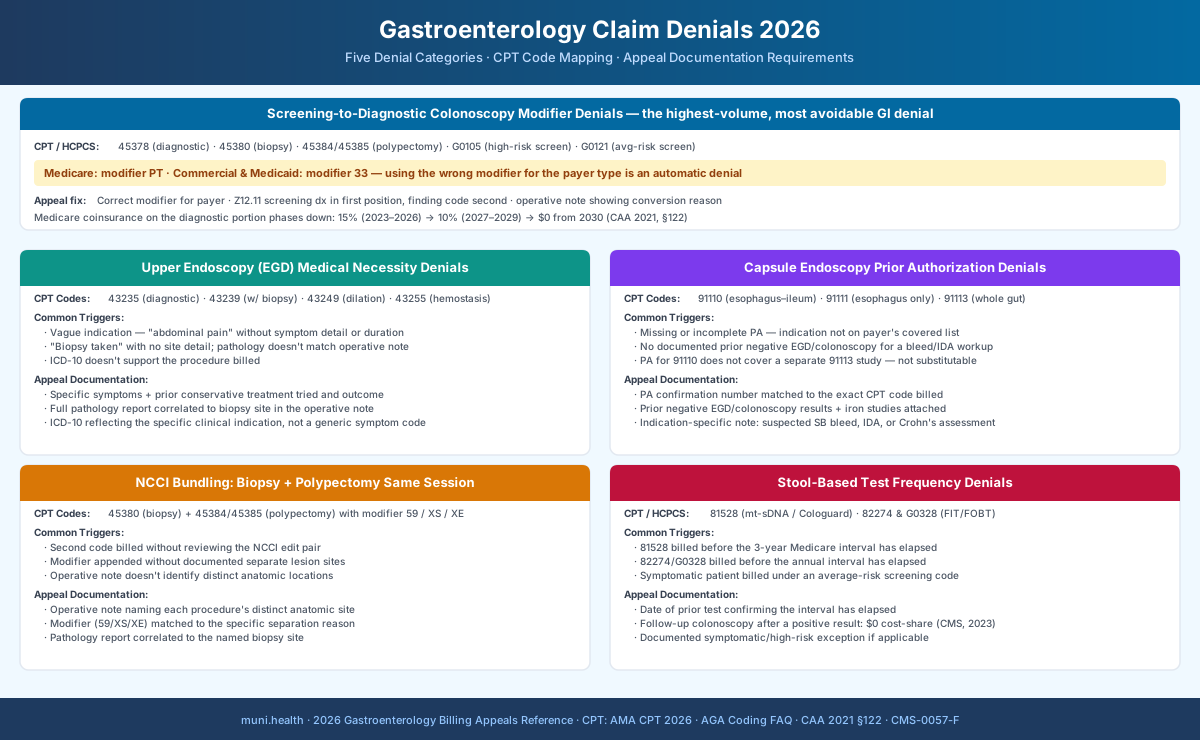
Gastroenterology claim denials cluster into five categories: screening-to-diagnostic colonoscopy modifier errors, upper endoscopy (EGD) medical necessity gaps, capsule endoscopy prior authorization, NCCI bundling disputes when a biopsy and polypectomy are billed in the same session, and stool-based test frequency edits. The single most common and most fixable error: appending the wrong modifier when a screening colonoscopy converts to diagnostic — modifier PT for Medicare, modifier 33 for commercial and Medicaid plans. Using the wrong one triggers an automatic denial.
Why Gastroenterology Claims Face Elevated Denial Rates
Gastroenterology billing combines three denial-prone elements in nearly every encounter: a screening service that can convert mid-procedure to diagnostic, prior authorization requirements that vary by payer and delegate, and NCCI bundling edits that apply whenever more than one procedure is performed at the same session. Missing any one of these turns a routine colonoscopy or EGD into a multi-week appeal.
According to the AMA's 2024 Prior Authorization Survey (n=1,004 physicians), 94% of physicians report that prior authorization requirements delay patient access to care, and 31% say their PA requests are often or always denied. GI practices carry a disproportionate share of that burden because endoscopy, capsule studies, and advanced imaging referrals all route through payer-specific review programs.
Delegated review adds a routing layer. EviCore by Evernorth administers gastroenterology precertification for Cigna, including EGD and other endoscopic procedures, per Cigna's provider precertification program. Carelon Medical Benefits Management, a subsidiary of Elevance Health, performs a similar function for Anthem/Elevance-affiliated BCBS plans on select GI and imaging categories. Submitting a PA request directly to the health plan when a delegate holds the review contract is a routing error, not a clinical one — and additional documentation alone will not fix it.
UnitedHealthcare uses advance notification, not full PA, for most GI endoscopy. Since June 1, 2023, UHC has required advance notification (not prior authorization) for diagnostic and therapeutic colonoscopy, EGD, and capsule endoscopy for commercial members in most states — screening colonoscopy is exempt from this process, though it may still need PA if performed at an outpatient hospital under site-of-service review, per UHCprovider.com's gastroenterology endoscopy advance notification page.
CMS-0057-F (effective January 1, 2026) requires Medicare Advantage plans to issue standard prior authorization decisions within 7 calendar days and expedited decisions within 72 hours, and to state the specific clinical reason for any denial. That reason is the exact gap to address in a GI appeal.
The 5 Most Common Gastroenterology Denial Types
Each GI denial type traces to a different root cause and needs different documentation. Misidentifying which one applies is the most common reason a GI appeal is submitted with the wrong evidence.
| Denial Type | Key CPT/HCPCS Codes | Primary Trigger | Appeal Documentation |
|---|---|---|---|
| Screening-to-diagnostic modifier error | 45378, 45380, 45384, 45385, G0105, G0121 | Modifier PT used on a commercial claim, or modifier 33 used on a Medicare claim | Correct modifier for payer type; screening ICD-10 (Z12.11) in first position, finding in second |
| EGD medical necessity | 43235, 43239, 43249, 43255 | Vague indication; missing biopsy rationale; ICD-10 doesn't support the procedure billed | Symptom-specific documentation, prior conservative treatment tried, pathology correlation |
| Capsule endoscopy prior authorization | 91110, 91111, 91113 | Missing or incomplete PA; indication not documented as covered (suspected small bowel bleed, IDA, Crohn's) | PA confirmation number; prior negative EGD/colonoscopy; iron studies; indication-specific note |
| NCCI bundling — biopsy + polypectomy | 45380, 45384, 45385 with modifier 59/XS | Missing modifier, or modifier applied without documented separate lesion sites | Operative note identifying distinct lesion locations for each billed code |
| Stool-based test frequency edit | 81528, 82274, G0328 | Billed before the payer's interval has elapsed (mt-sDNA: 3 years; FIT: 1 year) | Date of prior test confirming interval elapsed, or documented symptomatic/high-risk exception |
Screening-to-Diagnostic Colonoscopy Denials: Modifier 33 vs. PT
This is the single highest-volume, most avoidable denial in GI billing, and it starts with a coding rule that trips up even experienced billers: modifier PT and modifier 33 are not interchangeable, and using the wrong one for the payer type produces an automatic denial.
The rule, by payer. When a screening colonoscopy converts to diagnostic or therapeutic because a polyp is found and removed, the American Gastroenterological Association's Coding FAQ for Screening Colonoscopy specifies:
- Medicare claims: append modifier PT ("colorectal cancer screening test, converted to diagnostic test or other procedure") to the diagnostic/therapeutic code performed (CPT 45380–45392).
- Commercial and Medicaid claims: append modifier 33 ("preventive services") instead.
Using PT on a commercial claim, or 33 on a Medicare claim, is a documented cause of automatic claim rejection — the modifier itself is a payer-type flag, and payers reject the mismatch before the claim reaches clinical review.
Diagnosis code order matters. The AGA guidance also specifies that the screening diagnosis code (Z12.11 — encounter for screening for malignant neoplasm of the colon) belongs in the first position on the claim, with the finding or condition diagnosis (e.g., a polyp code) in the second position. Reversing that order can change how the payer processes cost-sharing.
Why This Denial Type Is So Common
Screening colonoscopies converting to diagnostic or therapeutic procedures mid-exam — because a polyp is found — is a routine, expected outcome of preventive colon cancer screening, not an edge case. Every GI practice's claim volume includes a meaningful share of conversions, which means the PT/33 modifier rule applies constantly, not occasionally.
The cost-sharing rule that resolves most patient-facing disputes. Early after the ACA's passage, some insurers stopped treating a colonoscopy as a "screening" once a polyp was removed, which exposed patients to unexpected cost-sharing. HHS subsequently clarified that removal of a polyp is an integral part of a screening colonoscopy, so patients with private insurance should not have to pay out-of-pocket for it — a rule confirmed by the American Cancer Society's coverage-law summary. That clarification does not extend to Medicare beneficiaries, who remain subject to coinsurance on the diagnostic/therapeutic portion — but that coinsurance is being phased out.
Medicare's coinsurance phase-down (CAA 2021, Section 122). When a Medicare screening colonoscopy converts to diagnostic through polyp removal, beneficiary coinsurance on the physician and facility fee is being reduced on a statutory schedule: 15% for 2023 through 2026, 10% for 2027 through 2029, and $0 starting January 1, 2030, per the Consolidated Appropriations Act, 2021. The reduced coinsurance applies only when modifier PT is correctly appended — billing without it can default the claim to full diagnostic cost-sharing. Anesthesia charges are not part of this phase-down and remain subject to standard 20% coinsurance regardless of the modifier used.
What a successful modifier-mismatch appeal includes:
[Practice Letterhead]
[Date]

[Payer] Appeals Department
[Address from denial letter]

RE: Appeal — Screening Colonoscopy Modifier Denial
Patient: [Name] | DOB: [Date] | Member ID: [ID]
Claim #: [Claim Number] | DOS: [Date of Service]
CPT Code(s) Billed: [45380/45384/45385, etc.]
Denial Reason: [Modifier mismatch / screening vs. diagnostic misclassification]

Dear [Payer] Claims Review Team,

This colonoscopy began as a screening procedure and converted to a
diagnostic/therapeutic procedure when [a polyp was identified and removed /
a biopsy was performed] during the exam. This is being appealed because the
claim was processed as a straightforward diagnostic procedure rather than a
screening-converted-to-diagnostic service.

PROCEDURE DETAILS:
Indication for original screening: Z12.11 (encounter for screening for
  malignant neoplasm of the colon)
Finding during procedure: [polyp location, size, number / biopsy site]
Procedure performed: [CPT code and description]
Modifier appended: [PT for Medicare / 33 for commercial — confirm correct
  modifier for this payer type is on the claim]

CLAIM CORRECTION REQUESTED:
☐ Reprocess with correct screening-conversion modifier
☐ Reprocess diagnosis code order: Z12.11 in first position, [finding
   code] in second position
☐ Waive/adjust patient cost-sharing per [payer]'s preventive-services
   policy for polyp removal during screening

SUPPORTING DOCUMENTATION:
- Operative/procedure note confirming screening intent and mid-procedure
  finding
- Pathology report (if biopsy or polypectomy performed)
- Original screening order or referral

I am available to discuss this case or provide additional documentation.

Respectfully,

[Provider Name, Credentials]
NPI: [Number]
Skip the blank template. Start with a review-ready draft.
Use the template as guidance, or let Muni prepare a payer-specific draft for your team to verify, sign, and submit.
First 3 appeals free, then $20 per appeal. Start with your denial letter or EOB and available records. No meeting or clearinghouse connection required.
Upper Endoscopy (EGD) Medical Necessity Denials
EGD denials (CPT 43235 for diagnostic EGD, 43239 with biopsy, 43249 with balloon dilation, 43255 for hemostasis) are almost always a medical necessity documentation problem rather than a coverage dispute. The payer is not disputing that the procedure occurred — it is disputing that the submitted note supports why it was necessary.
The most common gaps, confirmed across current GI billing guidance from Neolytix's 2026 Gastroenterology Billing & Coding Guide, are incomplete endoscopy reports that prevent the payer from verifying what was actually billed, and ICD-10 codes that don't clearly support the procedure performed. A note that lists "abdominal pain" without specifying symptom duration, prior treatment tried, or alarm features (weight loss, GI bleeding, dysphagia) is a common denial trigger — the same note with those specifics attached typically clears medical necessity review on first appeal.
Biopsy Documentation
"Biopsy taken" with no further detail is one of the most frequent GI documentation gaps. Payers expect the pathology report and biopsy site/count to correlate with the billed code (43239) and the diagnosis submitted — a mismatch between the operative note and the pathology report is grounds for denial even when the procedure was clearly necessary.
What strengthens an EGD medical necessity appeal:
- Specific presenting symptoms (dysphagia, odynophagia, GI bleeding, unintentional weight loss, iron deficiency anemia) rather than generic terms
- Documentation of prior conservative management (PPI trial, dietary modification) and its outcome, when applicable
- The complete pathology report when a biopsy was performed, correlated to the operative note's biopsy site count
- The correct ICD-10 code reflecting the specific clinical indication rather than a nonspecific symptom code
Capsule Endoscopy Prior Authorization Denials: CPT 91110 & 91113
Capsule endoscopy (CPT 91110 for esophagus-through-ileum studies, 91113 for whole-gut studies including colon) carries prior authorization requirements from most major commercial payers and Medicare Administrative Contractors, and missing or incomplete authorization is the leading cause of denial for these codes.
Payers typically require the PA request to document one of a defined set of covered indications: suspected small bowel bleeding, iron deficiency anemia evaluation without an identified upper or lower source, known or suspected Crohn's disease, or polyposis syndrome surveillance. A request that lists only "GI bleed workup" without confirming a prior negative EGD and colonoscopy (or the specific reason those studies were insufficient) is a common denial trigger — capsule endoscopy is typically positioned as a second-line study, not a first-line one.
| CPT Code | Study Type | Common Covered Indications | Appeal Focus if Denied |
|---|---|---|---|
| 91110 | Capsule endoscopy, esophagus through ileum | Suspected small bowel bleeding, iron deficiency anemia (source unidentified), Crohn's assessment | Confirm prior negative EGD/colonoscopy documented; iron studies attached; indication matches payer's covered list |
| 91111 | Capsule endoscopy, esophagus only | Suspected esophageal pathology when EGD is contraindicated or incomplete | Document why standard EGD was not diagnostic or not tolerated |
| 91113 | Capsule endoscopy, esophagus through colon (whole gut) | Extensive small/large bowel Crohn's evaluation | Confirm distinct indication from 91110/91113 combined billing on the same date |
Capsule endoscopy procedures are not substitutable for one another on a claim — an authorization obtained for 91110 does not cover 91113 performed at a separate encounter, and vice versa. If the practice needs to bill a second capsule study, a separate authorization request is required even when the same PA reference number is on file for the first.
NCCI Bundling Denials: Biopsy and Polypectomy in the Same Session
National Correct Coding Initiative (NCCI) edits bundle certain GI procedure pairs — most commonly a biopsy (45380) and a polypectomy (45384 or 45385) performed during the same colonoscopy. Per Neolytix's 2026 GI coding guidance, billing both codes without reviewing the applicable NCCI edit pair triggers an automatic denial of the second code.
Prepare this appeal packet with your team.
Draft the appeal, coordinate missing documents, and approve the reviewed packet. Keep your clearinghouse; your practice checks deadlines and submits through the payer’s accepted channel.
First 3 appeals free, then $20 per appeal. Start with your denial letter or EOB and available records. No meeting or clearinghouse connection required.
The bundling edit can be overridden with modifier 59 (or the more specific modifiers XS for separate structure or XE for separate encounter) only when the operative note documents that the biopsy and the polypectomy were performed at genuinely distinct anatomic sites — for example, a biopsy of one lesion and a snare polypectomy of a separate polyp elsewhere in the colon. Appending the modifier without that distinct-site documentation in the note is one of the most common reasons an unbundling appeal fails on resubmission: the modifier alone does not establish medical necessity for separate billing, the operative note does.
What an NCCI unbundling appeal needs:
- The complete operative note identifying the anatomic location of each billed procedure (e.g., "polyp, ascending colon" vs. "biopsy, sigmoid colon")
- Confirmation that the modifier (59, XS, or XE) matches the specific reason for separate billing
- The pathology report correlated to the biopsy site named in the operative note
GI Panel & Stool-Based Test Frequency Denials
Stool-based colorectal cancer screening tests carry payer-specific frequency limits, and billing before the interval has elapsed is a routine, correctable denial cause rather than a coverage dispute.
Medicare covers the multi-target stool DNA test (CPT 81528, marketed as Cologuard) once every 3 years for asymptomatic patients ages 45–75 at average risk for colorectal cancer, per Exact Sciences' Medicare coverage summary. Fecal immunochemical tests (CPT 82274, HCPCS G0328) are typically covered annually. A claim submitted before the applicable interval has elapsed since the patient's prior test — or for a symptomatic patient, since stool-based tests are indicated for average-risk screening, not diagnostic workup — will deny on a frequency edit.
The follow-up colonoscopy rule that resolves most stool-test-to-colonoscopy disputes. Effective January 1, 2023, CMS requires Medicare coverage of a follow-up screening colonoscopy after a positive non-invasive stool test (FOBT, FIT, or stool DNA) at no out-of-pocket cost to the beneficiary, per the American Cancer Society's coverage-law summary. The follow-up colonoscopy is billed as a screening service, not diagnostic — but if a polyp is found and removed during that follow-up exam, the modifier PT/33 rule and coinsurance phase-down covered above still apply.
How Muni Appeals Helps Gastroenterology Billing Teams
Most GI denials are not clinical disputes — they're a modifier applied to the wrong payer type, a PA routed to the health plan instead of its delegate, or an NCCI edit fired because the operative note didn't document separate lesion sites. Fixing the underlying error resolves the denial; resubmitting the same claim without correcting it does not.
Muni Appeals organizes uploaded GI denial materials, matches documentation to the cited payer criteria, and surfaces likely EviCore, Carelon, or direct-payer routing for staff verification. Staff confirms the current reviewer, deadline, and submission channel. For a broader view of prior authorization denials, see the complete prior authorization denial guide; for imaging delegation, see the radiology and imaging prior authorization guide.
Practices deciding between outsourcing denial management entirely and automating the appeal workflow in-house should also see the appeal automation cost comparison before committing to either approach.
Frequently Asked Questions
What modifier do I use when a screening colonoscopy converts to diagnostic?
Use modifier PT for Medicare claims and modifier 33 for commercial and Medicaid claims. These are not interchangeable — using PT on a commercial claim or 33 on a Medicare claim causes an automatic denial. Append the modifier to the diagnostic/therapeutic procedure code actually performed (CPT 45380–45392), and keep the screening diagnosis code (Z12.11) in the first position on the claim with the finding code in the second position.
Can a patient be charged cost-sharing when a polyp is removed during a screening colonoscopy?
For private insurance, generally no. HHS clarified that polyp removal is an integral part of a screening colonoscopy, so patients with ACA-compliant private plans should not owe out-of-pocket costs for it. Medicare beneficiaries are different: coinsurance still applies to the diagnostic/therapeutic portion, but it is being phased down under the Consolidated Appropriations Act, 2021 — 15% through 2026, 10% for 2027–2029, and $0 starting January 1, 2030 — provided modifier PT is correctly applied. Anesthesia charges remain subject to standard coinsurance regardless of the modifier.
Why was my capsule endoscopy claim denied even though I had prior authorization?
Confirm the authorization matches the exact CPT code billed. Capsule endoscopy codes (91110, 91111, 91113) are not interchangeable on a claim, and an authorization obtained for one code does not extend to a different capsule study performed at a separate encounter. If two capsule studies were performed, each needs its own authorization request, even under the same clinical episode.
How do I appeal an NCCI bundling denial for a biopsy and polypectomy performed together?
Confirm the operative note documents the anatomic location of each procedure separately — for example, a biopsy at one site and a polypectomy at a distinct site elsewhere in the colon. Append the correct modifier (59, XS, or XE) to the second procedure code and include the operative note excerpt identifying the separate sites in the appeal. A modifier without that documented distinction is the most common reason these appeals fail on resubmission.
Does EviCore or Carelon review all gastroenterology prior authorization requests?
No. EviCore administers GI precertification for Cigna. Carelon Medical Benefits Management, a subsidiary of Elevance Health, reviews select GI and imaging categories for Anthem/Elevance-affiliated BCBS plans. UnitedHealthcare uses its own advance notification process (not full prior authorization) for most diagnostic and therapeutic GI endoscopy. Aetna, Humana, and other BCBS affiliates vary by plan — always confirm the specific review entity from the denial letter or the plan's provider portal before submitting a PA request or reconsideration.
How often will insurance cover a stool-based colorectal cancer screening test?
Medicare covers the multi-target stool DNA test (CPT 81528) once every 3 years for asymptomatic, average-risk patients ages 45–75. Fecal immunochemical tests (CPT 82274, G0328) are typically covered annually. Billing before the applicable interval has elapsed since the patient's last test is a common, correctable denial cause — confirm the date of the prior test before resubmitting.
What's the fastest way to resolve a gastroenterology PA denial when the clinical picture is strong but documentation was incomplete?
Request a peer-to-peer review before filing a formal written appeal, when the payer or its delegate offers one. This is typically available in the days immediately following the denial and lets the ordering physician address the reviewer's specific concern directly, often faster than the formal appeal timeline. For Medicare Advantage cases requiring urgent resolution, see the expedited appeal process guide — CMS-0057-F requires a 72-hour turnaround on urgent requests.
Ready to Stop Losing Time to GI Modifier and PA Denials?
Gastroenterology denials are recoverable once the appeal matches the actual error — a modifier mismatch, a misrouted PA, or an undocumented NCCI exception. Submitting the same claim again without fixing the root cause just restarts the clock.
Muni Appeals helps GI billing teams:
- Organize appeals by denial type instead of treating every denial the same way
- Match documentation requirements to the specific payer, plan type, and PA delegate
- Provide likely EviCore, Carelon, or direct-payer routing guidance for staff to verify before filing
This guide reflects 2026 gastroenterology billing and appeal procedures. CPT code requirements, payer prior authorization rules, and NCCI edits are updated regularly. State requirements, plan-level rules, and Medicare versus commercial payer policies vary. This information is for administrative and billing purposes and is not medical advice.